
Frequencies and Thinking
What the clinic shows about oscillations, noise and radiofrequency, and what the trials show about training a mind to last.
Part of theThinking Center
Thinking is not a metaphor sitting on top of frequency. It is frequency, organised. A thought is a transient coalition of neurons firing in time, and if the timing is wrecked the thought is wrecked. In August I wrote that we have engineered a world out of tune with our own biology. That essay, The Invisible Symphony, was about the habitat. This one is about the instrument, how much of the damage a clinician can put a number on, and the part you can train.
I have been circling this from other doors. In They Are Coming for Your Thoughts the threat was linguistic: a ministry of truth that makes some sentences unsayable. In Don't Be the Best, Be the Only and AI is the Neat Handwriting of the Illiterate it was cognitive offloading: a model that finishes the sentence before the person has done the work it is meant to prove. Frequency pollution is the third door, and the only one that does not argue. It degrades the carrier the argument rides on, whether or not you believe in it. Read it against those three, and against the Thinking Center.
I. Three different things people call frequency
Most writing on this subject collapses three objects into one word, then wonders why the evidence will not sit still.
First, physical oscillation in the environment: sound pressure in air, electric and magnetic fields, photons after dusk. Measurable in decibels, watts per square metre, lux. Second, neural oscillation: the rhythmic synchrony of cortical populations an EEG records as delta, theta, alpha, beta and gamma. Also hertz, but a property of tissue rather than of a router. Third, cultural frequency: Solfeggio tables, 432 against 440, 528 as a "DNA repair" tone. I mapped that layer in Understanding the Solfeggio Scale. Those are pitches people have found meaningful for a very long time, and meaning does real work in a nervous system. A map of a tradition is worth having, and it is a different object from a dosing schedule.
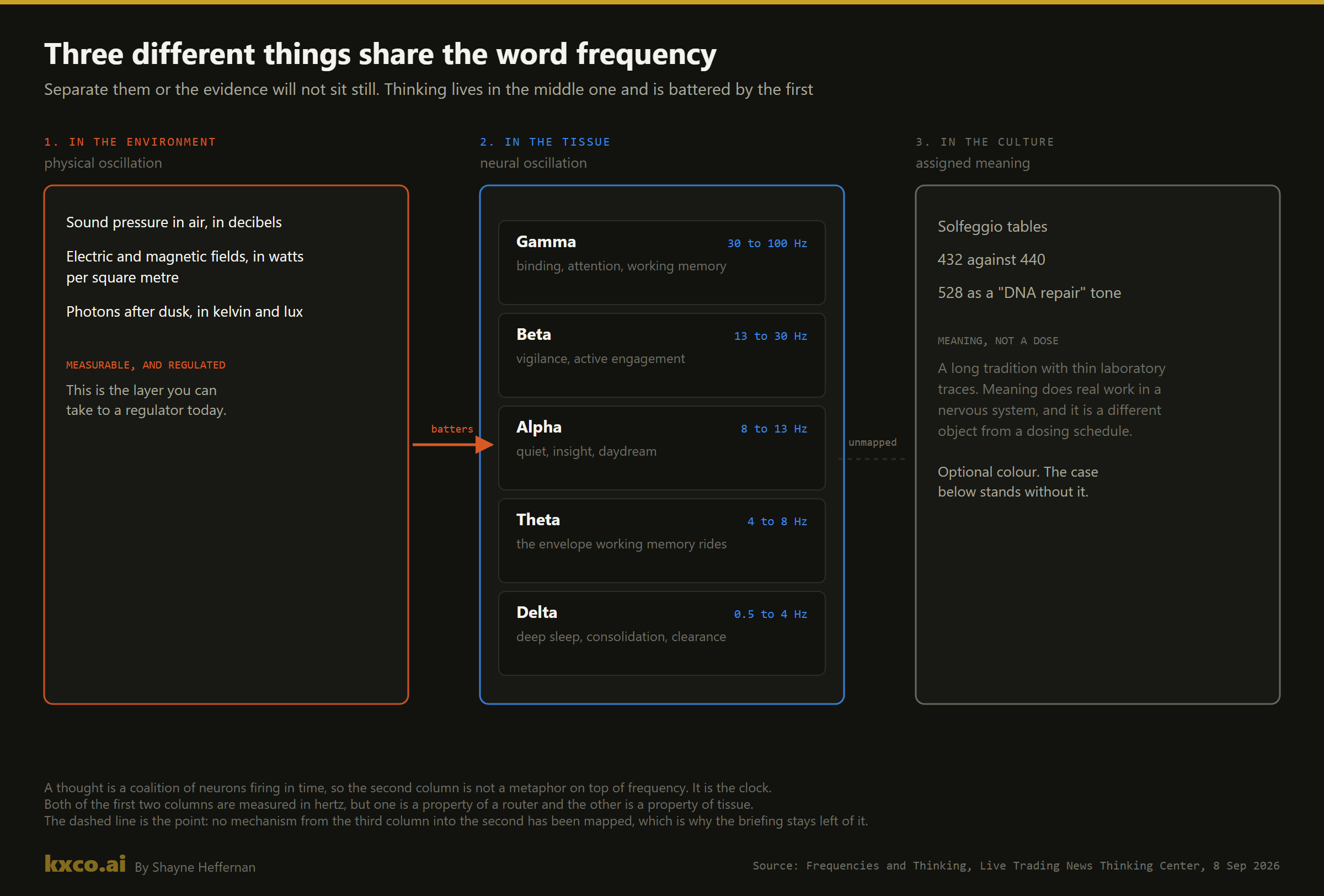
The taxonomy the argument rests on. The first two columns are both in hertz, but one is a property of a router and the other a property of tissue. The third is where most writing on frequency lives, and nothing below depends on it.
Thinking lives in the second layer and is battered by the first. The rest of this piece stays inside those two columns.
II. What a thought is made of
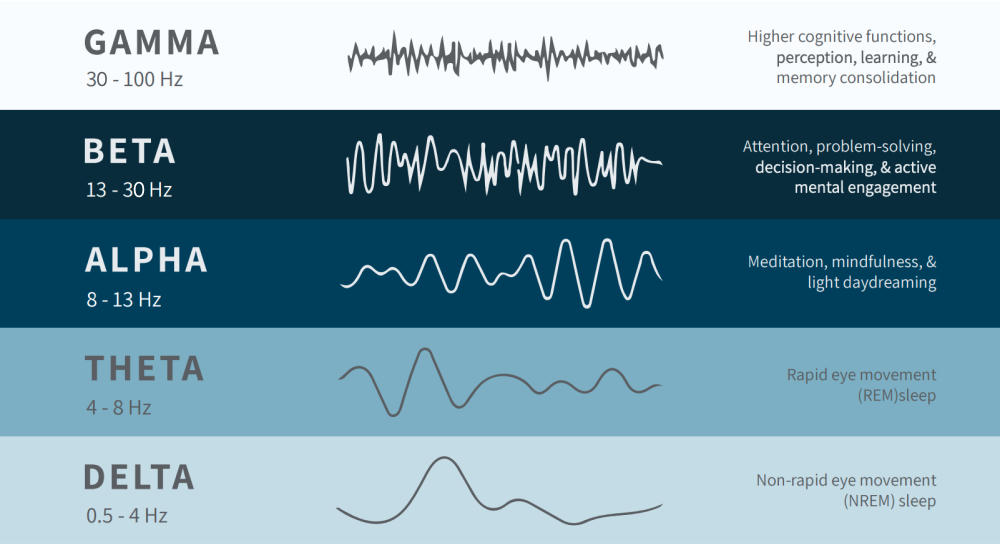
The five classical EEG bands. Thinking is not one of them. It is the traffic between them.
A working memory item is not a file. It is a pattern held against decay by recurrent firing, largely in the theta and gamma code: a slower theta envelope, roughly 4 to 8 Hz, carrying faster gamma packets, roughly 30 to 80 Hz, that bind features into one object. Attention is a beta and gamma problem in frontal and parietal cortex. Insight shows up as an alpha rise and a drop out of high beta, the opposite of the vigilance a city rewards all day. Deep sleep, where the day's traces are written into longer-term stores and the glymphatic system clears metabolic waste, is a delta house. Wreck the night and you have not made someone tired. You have removed the writing step from thinking.
The four layers, all running at once
That account is electrical, and electrical is only the first of four layers, all live at once.
The electrical layer is timing: action potentials, and the oscillations that let distant populations fire in phase. The chemical layer decides whether the timing means anything, with glutamate and GABA setting excitation against inhibition, acetylcholine gating what gets encoded, dopamine marking what was worth the trouble, noradrenaline setting the gain. The physical layer is the hardware the signal travels through: myelin, white matter integrity, capillary density, cerebral blood flow, and the glymphatic clearance that runs while you sleep. The biological layer is the slow one: BDNF, synaptic remodelling, mitochondrial capacity in an organ that is two percent of body mass and burns a fifth of its energy, and whatever inflammatory tone the rest of the body sets.
Memory, intellect and thought are not three faculties sitting on top of those four. They are what the four produce together. Each layer has its own time constant, so each answers to a different intervention. Timing responds to tonight's sleep and this hour's noise, chemistry to the week, the physical layer to months of blood pressure and blood flow, the biological layer to years. Anyone selling one product for all four is selling something.
Frequency is the clock of that system. Anything that fragments sleep architecture, keeps the sympathetic system lit, or forces continuous high-beta monitoring is not an inconvenience next to thought. It is an intervention on thought, delivered without consent, all day.
III. Frequency pollution, ranked by what the clinic can defend
In The Invisible Symphony I treated electromagnetic and acoustic load as one combined habitat. That is how a body meets them, and the right way to live in them. It is not how a literature ranks them, because a literature ranks what it has managed to measure. What follows is a ranking of the evidence, not a ranking of the harm.
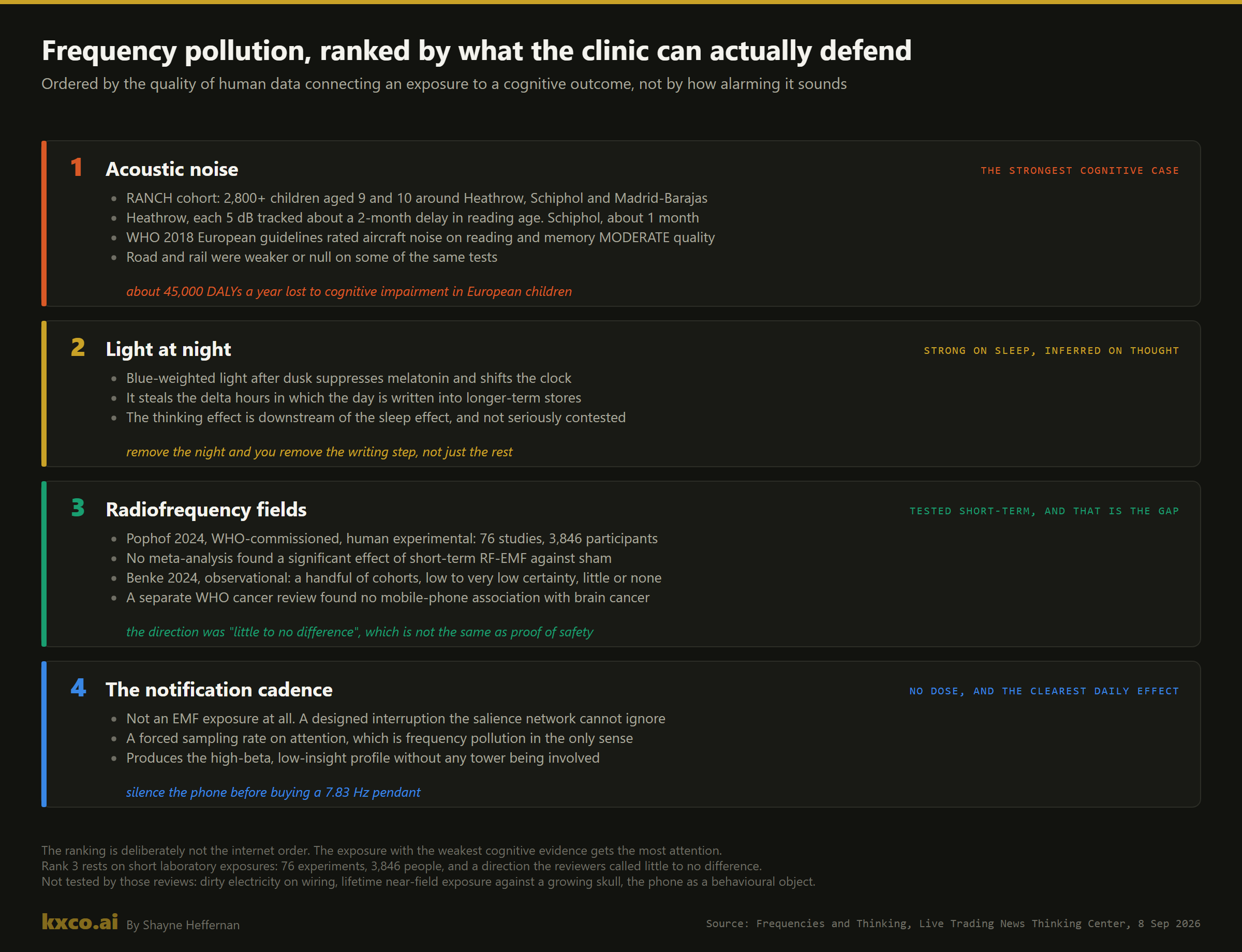
The ranking, with the human data behind each rank. Acoustic noise carries a WHO moderate-quality rating against reading and memory. Radiofrequency sits third on the strength of reviews that tested short-term exposure in a laboratory, a narrower question than the one a habitat poses.
1. Acoustic noise, the strongest cognitive case
This layer has the deepest paper trail, and it is where the August habitat argument can be proved rather than argued. The World Health Organization's 2018 European guidelines rest on systematic reviews, and for cognition the signal is clearest in children and in aircraft noise. The RANCH cohort, more than 2,800 children aged nine and ten around Heathrow, Schiphol and Madrid-Barajas, associated chronic aircraft noise with poorer reading comprehension and memory. Around Heathrow each 5 dB increase tracked with about a two-month delay in reading age, around Schiphol about a month. WHO rated the evidence for aircraft noise harming reading, oral comprehension, standardised tests and long-term memory as moderate quality. Road and rail were weaker or null on some of the same tests. Classrooms are supposed to sit at or under 35 dB LAeq during lessons, and most do not.
Europe still loses on the order of 45,000 disability-adjusted life years a year to cognitive impairment in children from environmental noise, and a 2024 EEA and ETC estimate put hundreds of thousands of children into the reading-difficulty column. Adults pay in sleep, heart disease, hypertension and annoyance. The thinking cost in a grown prefrontal cortex is less cleanly measured than the reading cost in a ten-year-old, which is a gap in the literature rather than an all-clear.
The mechanism is not mysterious. Noise is a stressor. It raises cortisol, drives the sympathetic system, fragments slow-wave and REM sleep, and forces the auditory cortex and salience network to keep scoring threats that never resolve. A brain scoring threats is not a brain binding gamma packets into a new idea. This is the pollutant that most reliably degrades thinking, and the one you can take to a council, a school board or a landlord this week.
2. Light at night, the circadian vandal
Photons are a frequency. Blue-weighted LED light after dusk suppresses melatonin, shifts the clock, and steals the delta hours in which memory consolidates. The thinking effect is downstream of the sleep effect, which is why it is easy to miss in a test battery and obvious in a life. A trader reading research until one in the morning under a 6,000-kelvin panel is not industrious. He is running tomorrow's judgment on a deficit he has not priced. The fix costs the price of a warm bulb.
3. Radiofrequency fields, and what the 2024 reviews actually tested
The August position was to keep distance from transmitters, hardwire what can be hardwired, and not sleep beside a radio. That is still the position, and it is worth being precise about what the recent reviews tested.
A WHO-commissioned systematic review of human experimental studies, Pophof and colleagues, Environment International 2024, pooled 76 studies and 3,846 participants. No meta-analysis found a statistically significant effect of short-term RF-EMF exposure against sham on cognitive performance, with certainty ranging from high to low by subclass. A companion observational review, Benke and colleagues the same year, on longer-term phone use in children and older adults, found a handful of cohorts and low to very low certainty of little or no association with attention, executive function, learning and memory. A separate WHO-commissioned cancer review found no association between mobile phones and brain cancer across decades of data, and IARC's 2011 Group 2B classification has not been promoted on that evidence.
Now the part that matters for a habitat. Those reviews establish that a short, controlled laboratory exposure does not move a cognitive test battery detectably, and the reviewers phrased the direction as little to no difference, which describes a result rather than proving safety. What they did not test is what the August essay was about: chronic near-field exposure across years, dirty electricity riding on domestic wiring, the voltage-gated calcium channel pathway Martin Pall has argued since 2013 and which remains unresolved either way, and a skull that is still growing. A handful of cohorts at low to very low certainty is a literature saying it has not run the study yet.
So the sensible reading is the engineer's. Hardwiring the desk is free, reversible and improves the connection anyway. Moving the phone off the pillow buys a better night on the light and behavioural channels alone. Distance is the cheapest control variable in the house. You take those measures because they cost nothing and the evidence base is young. What nobody should do is blame a router for a paragraph that will not finish, because brain fog has many fathers: the night, the noise, the alcohol, the glucose, the mood, and the phone as a behavioural object rather than a transmitter.
4. The informational frequency, notifications as a cognitive field
A push alert is not an EMF dose. It is a designed interruption pitched at a frequency the salience network cannot ignore, built by people who measured how well it works. The average knowledge worker lives inside a notification cadence that would be illegal if it were a fire alarm. That is frequency pollution in the only sense a psychologist needs: a forced sampling rate on attention. If you want an intervention that moves a test score this month, silence the phone before buying a 7.83 Hz pendant.
IV. Can you drive thinking with a tone?
Sometimes, in narrow conditions, with effect sizes a marketer will inflate and a methodologist will qualify. Two literatures matter, at very different stages.
Forty hertz
Gamma around 40 Hz is the band most tightly tied to binding, attention and working memory, and the band that frays early in Alzheimer's disease, which is why it drew the money. Li-Huei Tsai's group at MIT showed that 40 Hz light and sound, GENUS, gamma entrainment using sensory stimuli, recruits the glymphatic system in 5XFAD mice and clears amyloid, and a 2024 Nature paper filled in a peptide-and-interneuron mechanism. A 2025 open-label extension in Alzheimer's and Dementia reported that daily 40 Hz audiovisual stimulation over two years was safe, and may have slowed decline and tau in three women with late-onset disease. Two men with early-onset disease did not benefit. That is five people, so it is a signal rather than a protocol.
The meta-analyses disagree with each other, the honest state of a young field. Wu and colleagues, Neurorehabilitation and Neural Repair 2025, pooling eight studies and 291 people, reported large benefits on MMSE, ADAS-cog and a face-name test with no excess adverse events. A broader review in Translational Psychiatry, eleven studies and 341 people, found structural brain change and a tinnitus signal but no significant cognitive or daily-living effect. Zhang's 2024 meta-analysis of 40 Hz gamma tACS reported modest gains in global cognition and memory, sensitive to target and setting. The state of play: non-invasive, cheap, plausible, supported mechanistically in animals, unsettled in humans. Cognito Therapeutics is running the larger trial, and that is the result worth waiting for.
Binaural beats
Gerald Oster described the percept in Scientific American in 1973: two close tones, one in each ear, produce a beat at the difference frequency that the brainstem can hear. The pitch is that a 10 Hz beat puts you in alpha. The EEG literature does not obey the pitch. Ingendoh, Posny and Heine's 2023 systematic review of fourteen EEG studies found five in line with entrainment, eight against, one mixed, and methods too heterogeneous to pool. That is a field that has not yet run the same experiment twice.
Behaviour is kinder than the electrodes. Garcia-Argibay, Santed and Reales in Psychological Research 2019 meta-analysed twenty-two studies and reported a medium overall effect, Hedges' g = 0.45, on memory, attention, anxiety and pain, larger when the beat ran before or before-and-during the task, and larger with longer exposure. Frequency mattered: you do not get a memory effect by playing an anxiety beat. I use a 40 Hz or theta bed for twenty minutes before a deep-work block. The cost is twenty minutes and the downside is nothing, which is the whole of the claim.
Singing bowls, 432, 528
Goldsby's 2017 singing-bowl meditation study, and the smaller randomised work since, show what a well-run sound session reliably shows: anxiety down, heart-rate variability up, a shift toward quieter EEG. That is vagal and attentional, measurable, and real enough to build a habit on. What it demonstrates is the value of the session, not a physics unique to a Himalayan alloy. Glen Rein's 1998 in-vitro paper on 528 Hz and DNA conformation reported a change in a dish, and no human outcome has followed in almost thirty years. The 432 against 440 literature is small and mostly endodontic. None of it rewrites physiology. The night is still the intervention.
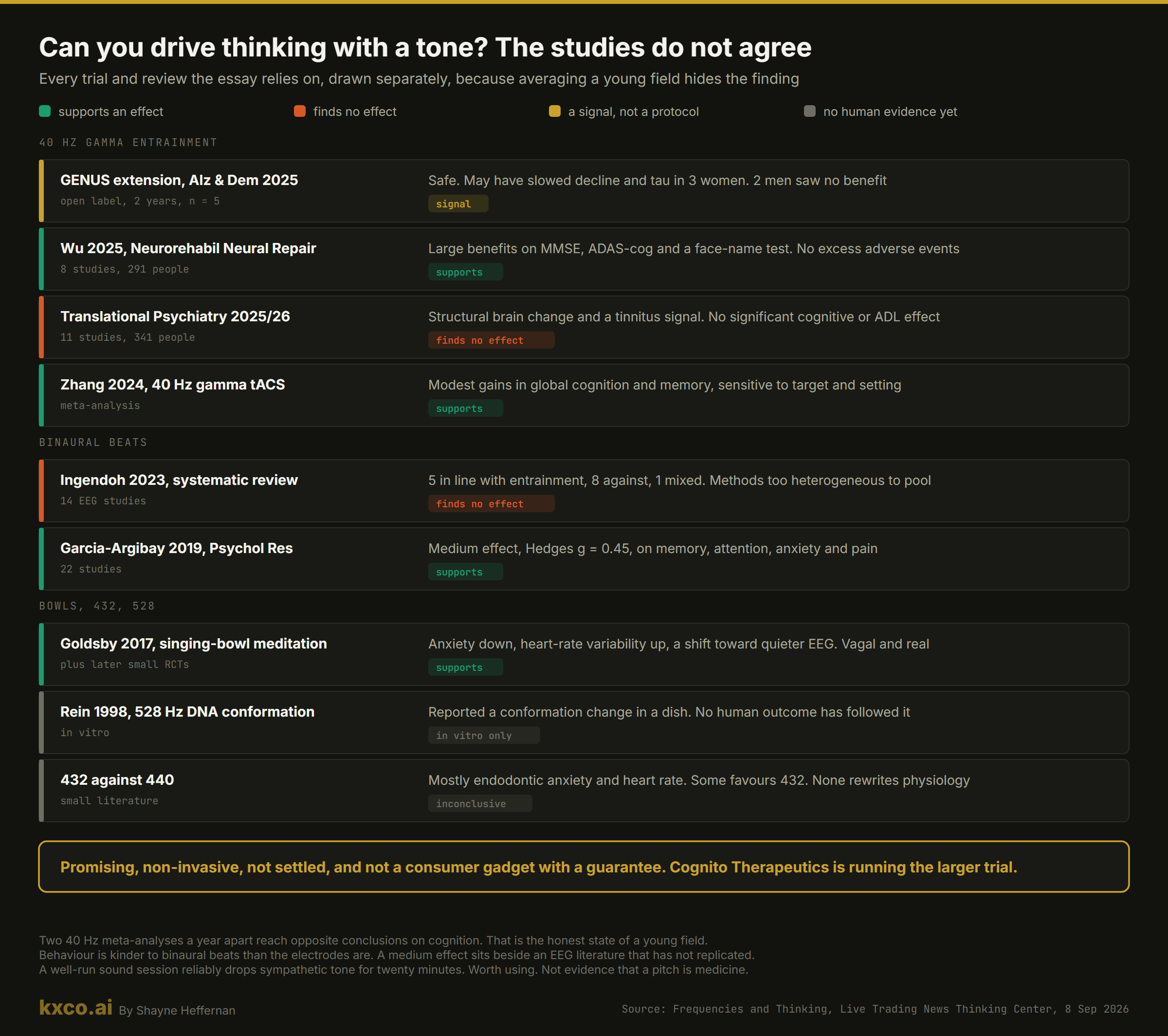
Every study this section relies on, drawn separately rather than averaged. Two 40 Hz meta-analyses published within a year of each other reach opposite conclusions on cognition. That disagreement is the finding, and pooling it away would be the dishonest move.

Gongs and bowls in a quiet canopy. The measurable object is a twenty-minute drop in sympathetic tone, worth having on its own terms.
V. Geography is a cognitive intervention
I argued in August that cities fragment thought and that forests restore something close to the Schumann fundamental near 7.83 Hz, on the doorstep of human alpha. The geography is the part of that essay I would put money on, and the forest literature is why. What a forest measurably delivers, and what a randomised shinrin-yoku literature can defend, is lower sound pressure, far fewer alerts, cleaner air, a longer visual axis, and a nervous system permitted to leave high beta. That package changes the EEG and the subjective quality of thought, reproducibly.
On the cavity itself, be precise. The Schumann resonances are a measured geophysical fact, recorded since 1952, and human alpha sits in the same neighbourhood. The coupling has not been formalised to the point where you could calculate a dose through a concrete basement, and it does not need to be, because the forest already delivers the four measurable things above. The rhyme is a reason to keep asking, not a load-bearing beam.
Bhutan, monastic acoustics, church bells at dusk: cultures that designed for coherence centuries before anyone had an EEG to justify it. The Longevity and Life centers treat place as a dose, and so does any trader who has noticed that the same book reads differently in a hotel facing a six-lane road and on a quiet morning with the router in another room. Place is the integrated dose of every frequency ranked above.
VI. The protocol, and what it buys
The protocol is almost insultingly ordinary, which is why it survives contact with a real week. Sleep in the dark, in quiet, without a radiating slab on the pillow. Hardwire the desk. Put the phone in another room, or in aeroplane mode, for the block in which a thought has to finish. Walk without headphones long enough for the auditory system to stop bracing. Warm light after dusk. If sound is used on purpose, 40 Hz or a bowl session as a prelude to the work rather than a substitute for it. Travelling, treat the first night's noise and light as a performance variable rather than as ambience.
That takes noise and light at night, the two pollutants with the best human evidence behind them, out of the hours when thinking and consolidation happen, and cuts the sampling rate on attention to something a prefrontal cortex can work under. What it leaves is the variable that was always the real one, because a clean EEG band is not judgment. Judgment is the refusal to let a model, a feed, or a ministry finish the thought for you. A quiet room makes that refusal cheaper. It does not perform it for you.
VII. The part that is yours
Genes and environment set the range. APOE4 status, the education you were given, the air and noise you grew up in, the blood pressure you inherited a tendency toward. None of it is nothing, and none of it is destiny. The 2024 Lancet Commission on dementia prevention put around 45 percent of dementia cases worldwide down to 14 modifiable risk factors across a life, adding high LDL cholesterol and untreated vision loss to the twelve it named in 2020, and moving smoking, depression, physical inactivity and diabetes from late life into midlife. Read that figure carefully: it is a population attributable fraction, a statement about what would change if a whole population changed, not a promise that one person cuts their own risk by 45 percent. It is still the strongest claim the field has made that most of this is not fixed.
Then there is the part that answers to you directly, and it is larger than most brain-health writing will say. You can make yourself measurably smarter. Ritchie and Tucker-Drob's 2018 meta-analysis in Psychological Science pooled 142 effect sizes from 42 datasets and more than 600,000 people, using only quasi-experimental designs. Each additional year of education was worth roughly 1 to 5 IQ points, the effect appeared on every broad category of ability examined, and it persisted across the lifespan rather than washing out after school. Education is the most durable method anyone has demonstrated for raising measured intelligence, and reading difficult things on purpose, for years, is the same lever without the enrolment form.
The honest limit sits beside it. Training a skill buys the skill. ACTIVE randomised 2,832 older adults to ten sessions of memory, reasoning or speed-of-processing training and produced reliable near transfer and limited far transfer: you improve at the trained thing and its close relatives, not at thinking in general. What gets forgotten is the ten-year follow-up, Rebok and colleagues 2014, where all three trained groups reported less difficulty with daily activities than controls, effect sizes 0.38 to 0.48. A decade later, from ten sessions. Not a general upgrade, then, but a trained capability that holds and a life that stays your own for longer.
Now outlook, which the clinical literature handles better than the wellness industry does, because it attaches a hazard ratio. In the Rush Memory and Aging Project, Boyle and colleagues followed more than 900 older adults without dementia for up to seven years. Greater purpose in life carried a hazard ratio of 0.48 for incident Alzheimer's disease and 0.71 for mild cognitive impairment. Observational, and purpose is partly a consequence of being well rather than only a cause.
The follow-up is harder to explain away, because it has autopsies in it. Boyle and colleagues again, in what is now JAMA Psychiatry, 2012: at the same measured burden of plaques and tangles, the people who had reported more purpose in life held more cognitive function. Same pathology, better performance. That is cognitive reserve, and it means outlook is not decoration on the machine. It is part of the machine.
Will is trainable too, and here is the real number rather than the inspirational one. Yeager and colleagues, Nature 2019, ran a growth-mindset intervention lasting under an hour, online, across a nationally representative sample of United States secondary students. Among students below the median in their own school it raised core-course GPA by 0.10 grade points, about 0.11 standard deviations, and increased enrolment in advanced mathematics. The effect held where peer norms supported the message and vanished where they did not. A small effect from one hour, honestly reported, and evidence that what a person believes about their own plasticity changes what they do. Not a licence to substitute attitude for work. Proof that the attitude is a variable rather than a fixture.
VIII. The habits that have trials behind them
The goal is cognitive longevity, and what follows is what has human evidence behind it. Where the evidence is randomised I say so, where it is observational I say so, and where the trial came back null I say that too, because a list that reports only wins is marketing.
Move, and specifically move aerobically
Erickson and colleagues, PNAS 2011, randomised 120 older adults to a year of aerobic walking or to stretching. The walkers gained about 2 percent of anterior hippocampal volume, reversing one to two years of age-related loss, and the gain tracked with serum BDNF. A structural change in the memory hardware, from walking, inside a year. Exercise reaches the physical and biological layers, which is why it has the broadest support of anything here.
Treat blood pressure as a cognitive drug
SPRINT MIND, JAMA 2019, randomised 9,361 people to a systolic target under 120 against under 140. Intensive control cut mild cognitive impairment by 19 percent and the combined outcome of MCI or probable dementia by 15 percent. Dementia alone did not reach significance, and the parent trial stopped early for cardiovascular benefit, shortening the window in which a dementia signal could appear. Blood pressure is the physical layer: perfusion and white matter.
Fix your hearing, which is this essay's own subject
ACHIEVE, Lancet 2023, randomised 977 adults aged 70 to 84 with untreated hearing loss to a hearing intervention or to health education, over three years. Across the whole trial the result was null. In the pre-specified subgroup of 238 participants drawn from an ongoing cardiovascular cohort, who carried more risk factors and were declining faster, hearing intervention slowed cognitive decline by 48 percent. The reading that survives both halves: it matters most for people already losing ground. Given how much of this briefing is about what sound does to a mind, the audiogram is not an optional appointment.
Defend the delta night
Section II said the night is where the day gets written. The cohorts say what losing it costs. Sabia and colleagues, Nature Communications 2021, followed 7,959 Whitehall II participants across 25 years and recorded 521 cases of dementia. Six hours of sleep or less at age 50 carried a 22 percent higher dementia risk against a seven-hour reference, at 60 it was 37 percent, and persistently short sleep across 50, 60 and 70 carried about 30 percent. Observational, and short sleep can be an early symptom as much as a cause. It remains the most consistent lifestyle signal in the dementia literature.
The multidomain trials, read honestly
FINGER, Lancet 2015, randomised 1,260 at-risk Finns aged 60 to 77 to two years of diet, exercise, cognitive training and vascular risk monitoring. The intervention group improved 0.23 SD on the cognitive composite. The control group, on standard care plus health advice, improved 0.19 SD. The difference was about 0.04 SD, a Cohen's d of roughly 0.13. US POINTER, in JAMA on 28 July 2025, randomised 2,111 older adults across five American sites to a structured or a self-guided version of the same idea, and reported 0.243 SD a year structured against 0.213 self-guided.
Read both properly, because the headlines did not. In each trial both arms improved and the gap between arms was small, and POINTER had no do-nothing arm, so it measures structure against self-direction rather than lifestyle against nothing. That is encouraging rather than deflating. Most of the benefit turned up in both arms of both trials, among people who had been enrolled, advised and measured. Sustained attention to the problem is most of the intervention, and a person can arrange that without a trial site.
Diet, where the observational case runs ahead of the trials
The randomised evidence that helped: Valls-Pedret and colleagues, JAMA Internal Medicine 2015, in the Barcelona arm of PREDIMED, randomised 447 people to a Mediterranean diet with extra virgin olive oil, the same diet with mixed nuts, or a low-fat control. After four years both Mediterranean arms had better cognitive function than the control.
The randomised evidence that did not: the MIND diet carries a strong observational record, and the one trial built to test it directly, Barnes and colleagues in the New England Journal of Medicine 2023, randomised 604 older adults with a family history of dementia for three years and found a between-group difference in global cognition of 0.035 standardised units, P = 0.23. Both arms improved, and both were on mild caloric restriction.
So the defensible position on food is narrower than the internet's and still worth acting on. Eat the Mediterranean pattern because a randomised trial found a cognitive benefit, because the cardiovascular case behind it is settled, and because LDL cholesterol is now on the Lancet Commission's list. What nobody should say is that a named diet has been proven to prevent cognitive decline, because the trial designed to prove that did not.
Supplements, with one result worth knowing
Most of that aisle has nothing behind it. COSMOS is the exception. A daily multivitamin against placebo improved cognition across three sub-studies: COSMOS-Mind, about 2,200 people over three years, roughly equivalent to 1.8 years less global cognitive decline, and COSMOS-Web, more than 3,500 people, with a memory benefit at one year that held across three. The cocoa extract arm of the same trial produced no cognitive benefit at all, and that internal control is what makes the multivitamin result hard to wave away as expectation. A modest effect from a cheap intervention is the profile of most things on this page that are true.
IX. The point, for a mind that still wants to be one
Frequency pollution is real and unevenly documented, which is a statement about the literature rather than the exposure. The parts you can act on today are noise, light at night and the interruption rate of the device in your pocket. Chronic near-field radio is the part still open, and cheap precautions belong exactly there.
Then there is the half that is not about protection at all. Thinking is electrical, chemical, physical and biological, and every one of those layers answers to something you can decide inside a week: what you read, how far you walk, what your blood pressure is, whether you book the audiogram, when you put the light out, and whether you can say out loud what any of it is for. Education raises measured intelligence across a lifespan. Purpose shows up at autopsy as function held against pathology. Those are not affirmations, they are findings, and they point the same way. The range is set for you. The position you take inside it is not.
Thinking is timed tissue plus character. The tissue can be protected and the tissue can be trained, and this page is the instruction sheet for both. The character is still the work. That is the through-line from The Invisible Symphony to They Are Coming for Your Thoughts to the AI essays: do not surrender the carrier, and do not surrender the sentence. Read the habitat essay again at The Invisible Symphony. Read the cognitive-offloading essays in the Thinking Center. The signed record is at shayneheffernan.com and at the author page. Then go to a quieter room and finish something that cannot be finished in a feed.
Selected sources
The Invisible Symphony: frequency pollution and human health
Don't Be the Best, Be the Only and AI is the Neat Handwriting of the Illiterate
WHO Europe, Environmental Noise Guidelines, 2018; Clark and Paunovic cognition review.
Stansfeld et al., RANCH aircraft-noise and reading, Lancet and later WHO summaries.
EEA and ETC, environmental noise burden estimate, 2024.
Pophof et al. (experimental) and Benke et al. (observational), RF-EMF and cognition, Environment International 2024.
Gamma stimulation meta-analyses: Wu et al., Neurorehabilitation and Neural Repair 2025; Translational Psychiatry 2025 and 2026; Zhang, 40 Hz tACS, 2024.
Tsai lab and Murdock et al., 40 Hz and glymphatic clearance, Nature 2024; GENUS extension, Alzheimer's and Dementia 2025.
Binaural beats: Garcia-Argibay et al. meta-analysis, Psychological Research 2019; Ingendoh et al. EEG review 2023.
Goldsby et al., singing bowl meditation, 2017; Oster, Auditory beats in the brain, 1973.
Rein, 528 Hz and DNA conformation, in vitro, 1998.
Livingston et al., Dementia prevention, intervention and care, Lancet Commission 2024 update, 14 modifiable risk factors.
Ritchie and Tucker-Drob, How much does education improve intelligence, a meta-analysis, Psychological Science 2018.
Rebok et al., ten-year effects of the ACTIVE cognitive training trial, Journal of the American Geriatrics Society 2014.
Boyle et al., purpose in life and incident Alzheimer's disease, Archives of General Psychiatry 2010, and purpose against Alzheimer pathology, JAMA Psychiatry 2012.
Yeager et al., a national experiment reveals where a growth mindset improves achievement, Nature 2019.
Erickson et al., exercise training increases the size of the hippocampus and improves memory, PNAS 2011.
The SPRINT MIND Investigators, blood pressure control and cognitive outcomes, JAMA 2019; Lin et al., the ACHIEVE hearing trial, Lancet 2023.
Sabia et al., sleep duration in middle and old age and the incidence of dementia, Nature Communications 2021.
Multidomain trials: Ngandu et al., FINGER, Lancet 2015; US POINTER, JAMA, 28 July 2025.
Diet trials: Valls-Pedret et al., PREDIMED Barcelona, JAMA Internal Medicine 2015; Barnes et al., MIND diet, New England Journal of Medicine 2023.
COSMOS multivitamin and cognition: Baker et al., Alzheimer's and Dementia 2023, and Yeung et al., American Journal of Clinical Nutrition 2023, with a meta-analysis of the three COSMOS cognitive studies in the same journal.
The taxonomy, ranking and scoreboard figures were built for this piece from the studies named above, 8 September 2026.
Disclaimer
This is journalism and research, not medical advice and not a device claim. Trials in neurodegeneration are early. Individual response varies. Do not stop prescribed treatment for a tone, and do not change a prescription on the strength of an essay. The author is founder of Live Trading News, the Knightsbridge Group and KXCO.ai. Companion essays are signed at publication.
Copyright 2026 Shayne Heffernan and Live Trading News. shayneheffernan.com

Thoughts on Thinking: Take an Art Break
The best way I know to keep complex work in perspective is to stop at intervals and look at something that took the same order of sustained attention under real constraints. The studies now show what that does: a museum visit restored attention where an urban walk did not, judging the beauty of an object raised abstract thinking almost 14 per cent, and artistic film raised originality even in people who felt worse for it. Five works, Leonardo to Holbein, and the non-default decision in each.

Careful of the Prompts You Give Yourself
A prompt is not only what you type into a model. It is any sentence that gets inside you and starts issuing orders. Most of what we call goals were written by comparison, media, competition and now the model, and they arrive dressed as ambition. Shayne Heffernan maps how an imported sentence becomes a week, why a want should carry its source the way a Round Table claim does, and how to strip, lock and guard the objective that is actually yours.
The Invisible Symphony: Frequency Pollution and Human Health
We have engineered a world that is out of tune with our own biology. Here is the evidence on electromagnetic and acoustic pollution, the frequencies that put the nervous system back together, and a practical detox you can start this week.
Knights are Reflective Thinkers
Every story, signed and delivered.
Subscribe to the kxco channel and get the headline, the AI-written key takeaways, and the chain-anchor link the moment we publish. Audio versions and per-ticker subscriptions arrive in the next iteration.