
The Invisible Symphony: Frequency Pollution and Human Health
Navigating the good, the bad and the toxic frequencies of modern life, from dirty electricity and 5G to Bhutanese singing bowls and the Schumann Resonance
Part of theLongevity Center
We are vibrational beings living in a vibrational universe. At the most fundamental level, everything we see, touch and experience is a frequency, a dance of energy oscillating at various speeds. The human body is no exception. Our hearts beat, our neurons fire, and our cells communicate through complex bioelectrical signals. Yet we have systematically engineered a world that is entirely out of tune with our biological blueprint.
In the modern era we are caught between two extremes of the acoustic and electromagnetic spectrum. On one side lies a cacophony of electronic noise and digital pollution, a chaotic sea of artificial frequencies that actively degrade human health. On the other side sit the ancient healing frequencies of the natural world, sound therapy and intentional acoustic environments. Frequency pollution is real. It is an insidious, invisible force that underpins much of the chronic stress, cognitive fog and physiological degradation of modern life. But just as bad frequencies can tear us down, the right frequencies can build us back up, repairing cellular damage, entraining the brain and returning us to a state of coherence.
To navigate this we have to understand the history of frequency use across cultures, the science of electromagnetic and acoustic pollution, the measurable impacts on biology, and the practical steps that reduce the load. This article digs into the evidence, the Himalayan traditions of Bhutan and the singing bowl, the power of specific healing tones, and the changes anyone can make this week. The spaces we inhabit are not neutral. They actively shape our cognition and physiology through their dominant frequencies.
The invisible epidemic: frequency pollution is real
To understand frequency pollution we first have to recognise that the human body operates as a complex electromagnetic receiver. Our cells communicate via low frequency electromagnetic fields, a fact established by biophysicists over the last century. When we are exposed to non-native, artificial EMFs we experience what Dr Samuel Milham, a pioneer in occupational epidemiology, termed "dirty electricity" (Milham, 2010). Dirty electricity refers to the high frequency voltage transients and harmonics that ride on our electrical wiring, created by modern electronic devices, switching power supplies, dimmer switches, and compact fluorescent or LED lighting.
The electronic noise we live with is unprecedented in human history. We are continuously bathed in a soup of non-ionising radiation from Wi-Fi routers, 5G and 4G cell towers, Bluetooth devices, smart meters, baby monitors, and the ubiquitous 60 Hz (North America) or 50 Hz (Europe and much of Asia) hum of the electrical grid. This constant exposure is not a passive background hum. It is an active biological stressor. The intensity and density of these artificial fields have increased exponentially since the widespread electrification of the early 20th century, and especially since the smartphone and wireless revolution of the 21st.
At the forefront of mechanistic research is Dr Martin Pall, Professor Emeritus of Biochemistry and Basic Medical Sciences at Washington State University. Pall's 2013 review in the Journal of Cellular and Molecular Medicine argued that the primary mechanism by which artificial EMFs cause biological harm is the activation of voltage gated calcium channels in cell membranes (Pall, 2013). When these channels are artificially stimulated by non-native frequencies across a wide range, from extremely low frequency powerline fields to the microwave and millimetre wave bands used in 5G, they allow excess calcium to flood into the cell.
That calcium influx triggers a cascade: elevated nitric oxide, production of peroxynitrite free radicals, oxidative stress, mitochondrial dysfunction, single and double strand DNA breaks, and ultimately cellular damage. Subsequent papers by Pall and others have linked this pathway to a wide array of outcomes including oxidative stress, infertility, neurological and psychiatric effects, cardiac arrhythmias and cancer promotion (Pall, 2015; Pall, 2018). The World Health Organization's International Agency for Research on Cancer classified radiofrequency electromagnetic fields as "possibly carcinogenic to humans" (Group 2B) in 2011. Many independent scientists argue the accumulating evidence supports a stronger classification.
But EMFs are only half of the frequency pollution problem. The other half is acoustic noise pollution. The low frequency hum of HVAC systems, refrigerators, traffic and elevators, and the high pitched whine of switching power supplies in our electronics, create a chronic low grade stress response. Cortisol levels remain elevated, the sympathetic nervous system stays engaged in fight or flight, and the parasympathetic rest and digest system is suppressed. We exist in a state of perpetual alarm, driven by the invisible frequencies that surround us. Studies consistently link chronic noise exposure to elevated blood pressure, sleep disruption, cognitive impairment in children and increased cardiovascular risk.
The combination of electromagnetic and acoustic pollution creates a compounding burden. The same environments that bathe us in radiofrequency fields are usually the same environments filled with mechanical and electrical noise, and often the same environments carrying the heaviest air pollution load, as I set out in Bangkok PM2.5 is a serious health risk. The modern office or apartment is, from a frequency perspective, an unnatural habitat. Our evolutionary history prepared us for the quiet of forests, the rhythms of weather and the electromagnetic stability of the pre-industrial Earth. It did not prepare us for continuous exposure to pulsed microwave radiation and a 24 hour industrial soundscape. Recognising the mismatch is the first step toward correcting it.
The good frequencies: a return to coherence
If artificial frequencies pull our biology apart, natural and therapeutic frequencies pull it back together. The most fundamental of these is the Schumann Resonance. Named after the German physicist Winfried Otto Schumann, these are global electromagnetic resonances generated and excited by lightning discharges in the cavity formed by the Earth's surface and the ionosphere. Schumann predicted the fundamental frequency in 1952 and it was experimentally confirmed shortly afterwards. The fundamental sits at roughly 7.83 Hz, with harmonics at approximately 14.1, 20.3, 26.4 and 32.4 Hz (Schumann, 1952).
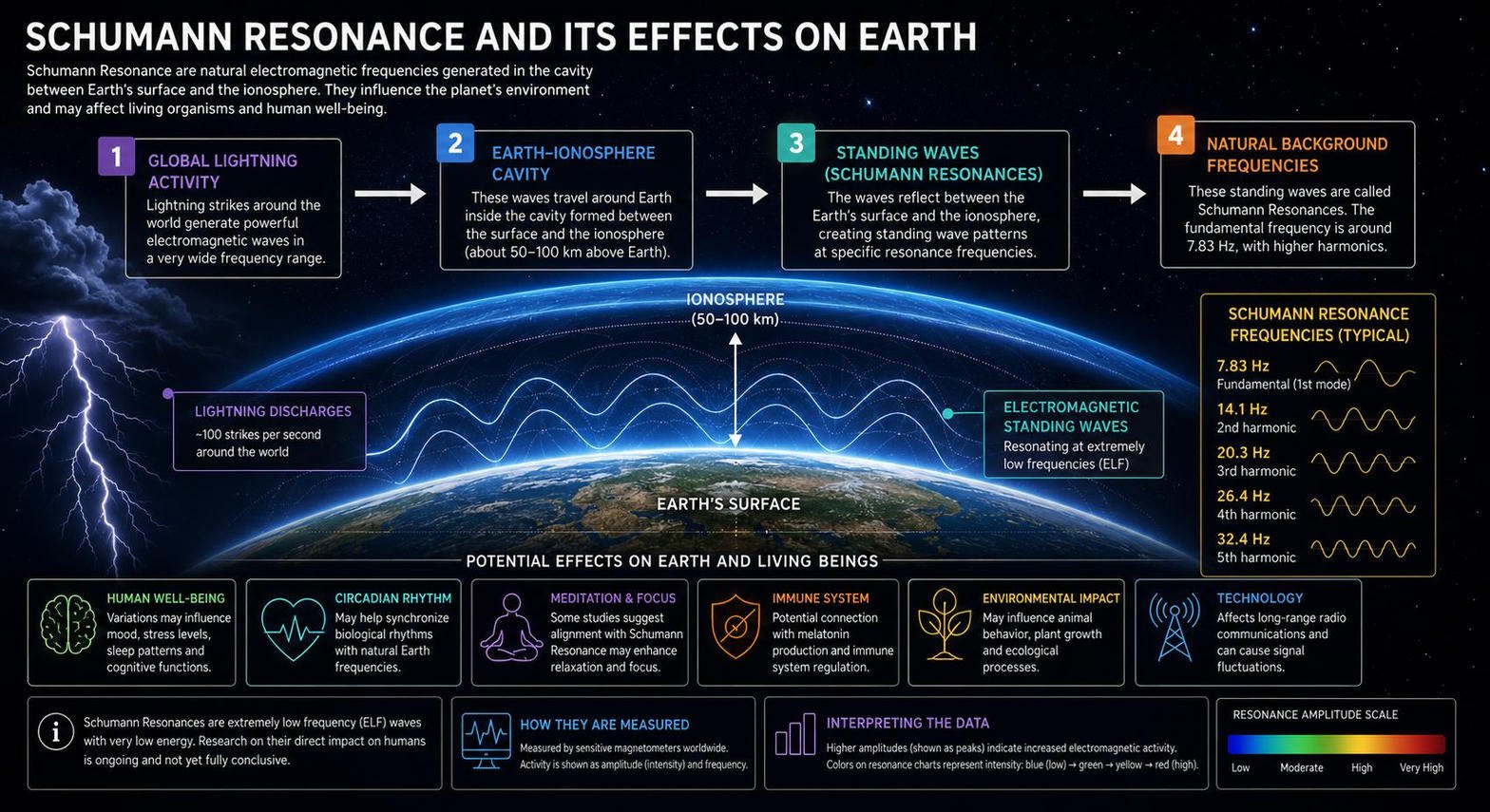
The Schumann Resonance: standing electromagnetic waves between the Earth's surface and the ionosphere, driven by global lightning activity. The fundamental frequency of about 7.83 Hz closely matches the peak of human alpha brainwave activity.
Remarkably, the peak frequency of human alpha brain waves, associated with relaxed, alert and creative states of consciousness, is also 7.83 to 8 Hz. For millions of years human biology evolved in entrainment with the Earth's electromagnetic heartbeat. When we are disconnected from that frequency, by living in concrete and steel structures that act as Faraday cages, wearing insulating rubber soled shoes, and being bombarded by higher artificial frequencies, we experience what some researchers describe as an electromagnetic form of nature deficit. Reconnection, whether through time outdoors, grounding practices or Schumann resonance generators, is associated with improved sleep, reduced stress markers and greater mental clarity.
Beyond the Earth's electromagnetic frequencies, humanity has used specific acoustic frequencies for healing for millennia. The Solfeggio frequencies, a scale of tones associated with ancient Gregorian chant, have been resurrected in modern sound therapy. The precise historical mapping of the modern Solfeggio set (396 Hz, 417 Hz, 528 Hz, 639 Hz, 741 Hz, 852 Hz and later 963 Hz) involves 20th century rediscovery and numerological work by researchers such as Dr Joseph Puleo, but the underlying principle is ancient: specific pure tones and harmonic series affect consciousness and physiology. Of these, 528 Hz is the most widely discussed. Dubbed the love frequency or the DNA repair frequency, early work by Dr Glen Rein suggested that exposure to 528 Hz could influence the conformational state of DNA in vitro, measured by changes in UV light absorption (Rein, 1998).
Similarly, 432 Hz, often called the universe frequency or natural tuning, has gained substantial popular and clinical interest. Unlike the modern concert pitch standard of A=440 Hz, adopted by the International Organization for Standardization in 1955 and promoted earlier in some countries, 432 Hz tuning produces music that many listeners experience as warmer, more resonant and less aggressive. Clinical and experimental studies have reported that music tuned to 432 Hz can lower heart rate, improve heart rate variability, reduce blood pressure and vascular stiffness, and decrease subjective anxiety compared with 440 Hz or higher tunings (Fares et al., 2019; Di Nasso et al., 2016, with more recent cardiovascular work in clinical populations reported in 2025). The mechanisms remain under investigation. The consistent direction of the physiological calming effect is what makes it notable.
Historical preference for lower pitch standards is well documented. Giuseppe Verdi and other 19th century composers advocated for A closer to 432 Hz, arguing that it produced a more natural and less strained vocal and instrumental quality. The shift to 440 Hz was driven largely by standardisation needs for international orchestras and broadcasting rather than by any demonstrated superiority for human physiology. In the context of continuous background listening and environmental imprinting, the difference between a coherent, slightly lower tuning and a brighter, more aggressive standard becomes practically relevant.
Imprinting the environment with continuous healing frequencies
Frequency is not only something we hear. It is something we physically absorb through our tissues and through the water that makes up roughly 60% of the human body. The spaces we inhabit become imprinted with the frequencies played within them. That brings me to a specific and intentional practice in my own daily life and work environment.
In my office I frequently have a continuous ambient healing frequency livestream playing. It plays often even when I am not physically present in the room. The stream delivers an unbroken loop of high vibrational ambient tones, typically centred on or combining 432 Hz and 528 Hz Solfeggio related frequencies with supportive binaural or harmonic content. Why leave it playing in an empty room? The answer lies in the physics of cymatics and environmental imprinting.
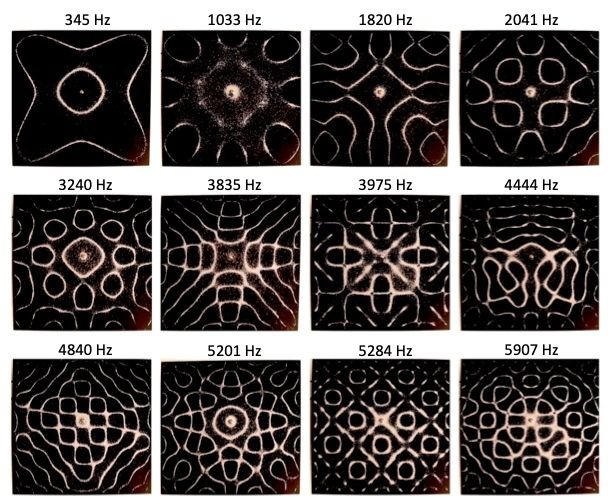
Cymatics: visual patterns formed by sound vibrations in particulate or liquid media. Different frequencies produce distinct, highly ordered geometric structures, which demonstrates that sound organises matter.
In the 1960s and 1970s the Swiss medical doctor and natural scientist Hans Jenny developed the field of cymatics, demonstrating that sound frequencies physically alter the structure of matter. By vibrating plates of sand, powders and liquids with pure tones, Jenny showed that low or chaotic frequencies produced disorganised, muddy patterns, while coherent, harmonious frequencies created complex, symmetrical geometric forms (Jenny, 1967). Those patterns are not metaphorical. They are physical evidence that frequency organises matter.
The air in our offices and homes contains vast amounts of suspended water vapour. Organic materials such as paper, wood, plants, fabrics and the micro-moisture on walls and surfaces also hold water. When a coherent healing frequency plays continuously it bathes the room in a repeating wave pattern. Over hours this can contribute to a shift in the acoustic character of the space, and to some degree its electromagnetic character too. When I return to the office after the stream has been playing, the environment feels different: denser yet calmer, more grounded, less electrically busy. I am not claiming that as pure placebo. It is the practical application of using sound as an environmental detergent, continuously washing the room of the chaotic electronic smog generated by computers, routers and the surrounding urban grid, and priming the nervous system the moment you cross the threshold.
The practice is deliberately low effort and continuous. Volume is kept moderate. The goal is environmental saturation rather than active listening. It is one of the simplest ways to introduce coherent frequencies into a workspace that would otherwise be dominated by the incoherent noise of modern electronics.
The frequency of locations and the impact on thinking
Environmental imprinting ties directly into the frequency of locations and their impact on human thinking. Geography is not merely topography or climate. It is the electromagnetic, acoustic and ionic signature of a place. Different locations on Earth hold vastly different dominant frequencies, and those signatures measurably affect cognition, mood and creative capacity.
A dense concrete urban centre saturated with overlapping 4G and 5G signals, fluorescent or LED lighting ballasts that emit both optical flicker and electrical noise, HVAC systems, traffic and thousands of Wi-Fi networks presents a severely incoherent frequency environment. In such locations thinking often becomes fragmented. The brain, attempting to process the overwhelming sensory and electromagnetic input, shifts toward higher beta and gamma activity associated with vigilance and stress. Decision fatigue sets in more rapidly. Sustained abstract, creative or visionary thinking becomes metabolically expensive, because the prefrontal cortex is already taxed by the perceived environmental threat of chronic sensory and EMF overload.
Now consider the frequency signature of an old growth forest, a high altitude mountain ridge, a quiet coastline or a traditional Himalayan valley. These locations transmit the Schumann resonance more clearly, unobstructed by steel and concrete. They generate negative ions, especially near moving water or after storms, which help clear positive ion pollutants from the air. Their acoustic environments are dominated by biophony, the sounds of wind, water, insects and birds, which evolutionary biology has hardwired humans to read as signals of safety. When you enter a high coherence geographic zone, brainwave states often shift on their own: the scattered, reactive beta of the city tends to give way to the alpha and theta associated with flow, insight and deep introspection.
The space between your ears is directly modulated by the space you are standing in. You cannot reasonably expect to cultivate high level, long horizon visionary thinking while continuously immersed in an environment that vibrates at the chaotic frequencies of a microwave oven and a traffic intersection. Location is frequency medicine or frequency poison, depending on the signature. It is the same principle behind why meditation makes you a better trader: the state you are in when you make decisions is not separate from the environment producing it.
A history of healing: Bhutan, sound baths, singing bowls and church bells
Long before we possessed the language of quantum biology or electromagnetic biophysics, ancient cultures understood the power of frequency. Nowhere is that more evident than in the Himalayan regions, particularly Bhutan, Tibet and Nepal, and in the parallel Western tradition of church bells and sacred chant.

Paro Taktsang, the Tiger's Nest Monastery in Bhutan. Geographic isolation and a cultural prioritisation of Gross National Happiness have preserved remarkably low levels of electronic and industrial noise pollution.
Bhutan, the small Buddhist kingdom in the eastern Himalayas, functions as a living laboratory of high vibrational living. Shielded by immense mountain ranges from the rapid, unregulated industrialisation that transformed much of the rest of Asia, Bhutan famously measures national success not by Gross Domestic Product but by Gross National Happiness. That is more than a political slogan. It is an environmental and cultural reality. Walking through a Bhutanese valley, the absence of electronic noise pollution is immediately striking. The dominant frequencies are the rush of glacial rivers, the wind in ancient blue pines and rhododendrons, the calls of birds, and the deep resonant tones of monastic ritual, horns and bells.
It is within that pristine acoustic environment that the Himalayan singing bowl tradition reached a high degree of refinement. Popular marketing often attributes the bowls exclusively to ancient Tibetan monks, but scholarly and metallurgical evidence points to a more complex origin centred in the metalworking traditions of Nepal and the broader Himalayan region, with roots that may extend into pre-Buddhist Bon practice and later integration into Buddhist ritual. Traditional bowls were, and high quality ones still are, forged from multi-metal alloys, commonly described as panchaloha or seven metal alloys containing copper, tin, zinc, iron and smaller amounts of other metals, sometimes including meteoritic iron. The complex alloy produces a rich spectrum of overtones rather than a single pure tone.

A traditional Himalayan singing bowl with mallet and cushion. The multi-metal alloy produces complex harmonic overtones that support brainwave entrainment and deep physiological relaxation.
When a practitioner strikes the bowl or circles the rim with a suede wrapped mallet, the resulting sound is a complex, multi-layered chord. In a group sound bath, participants lie or sit while multiple bowls of different sizes and pitches are played around them. The rich, overlapping frequencies interact with the listener's brainwaves through auditory driving and brainwave entrainment (Oster, 1973). Dominant low frequency content and amplitude modulation can encourage shifts from beta into alpha and theta states. At the same time the mechanical vibration of larger bowls travels through the body, particularly when bowls are placed on or near it, stimulating mechanoreceptors, potentially influencing vagal tone, and promoting a shift from sympathetic to parasympathetic dominance.
Modern clinical research, while still developing, supports measurable benefits. Randomised and controlled studies have shown that Tibetan singing bowl sessions can produce greater reductions in self-reported anxiety, increases in heart rate variability, which is a marker of parasympathetic activity, and favourable shifts in EEG patterns compared with progressive muscle relaxation or quiet rest controls, in trials published between 2023 and 2025. Systematic reviews note consistent improvements in tension, anxiety, mood and some physiological markers, while calling for larger and more rigorously controlled trials. A sound bath is therefore not a pleasant New Age experience and nothing more. It is a technologically simple, low risk method of recalibrating the human nervous system using frequencies refined over centuries in the Himalayas.
A parallel Western tradition exists in the church bell. From the early medieval period onward, bells were hung in towers not only to summon the faithful but because their sound was believed to drive away evil, mark sacred time and create a communal acoustic envelope. Large bells produce powerful low frequency fundamentals and rich overtones that can travel for miles. In some historical hospital and spa contexts, bell ringing or specially tuned bells were used therapeutically. The deep, periodic striking of a heavy bronze bell is itself a form of low frequency sound therapy delivered to an entire community. In an age of continuous electronic noise, the occasional intentional ringing of real bells remains one of the few public coherent frequencies many people still experience.

Historic church bells. For centuries the powerful low frequency tones and rich harmonics of bronze bells have served both practical and therapeutic roles, marking time, gathering communities and delivering coherent acoustic energy across wide areas.
Across cultures, the intentional use of pure tones, overtones and rhythmic acoustic structures has served as both spiritual technology and practical medicine. From Pythagorean harmonics in ancient Greece, to Nada Yoga and mantra in India, to the overtone singing of Tibetan and Mongolian traditions, to the carefully designed acoustics of European cathedrals, the underlying insight is the same. Frequency is not entertainment. It is a primary language through which the body and mind are organised or disorganised.
How to detox: an evidence informed approach to reducing the impact
Knowing what we know about the toxic frequencies of the modern world and the healing power of coherent ones, practical detoxification becomes an imperative. We cannot entirely escape electronic noise in contemporary life, but we can radically reduce its impact and deliberately inject good frequencies into our daily environments. What follows is grounded in the mechanisms above, and it sits alongside the broader protocol I set out in Biohacking: the science of optimizing human health and longevity.
1. Mitigating electronic noise, or reducing the bad
Hardwire everything possible. Turn off Wi-Fi on the router when it is not needed and connect computers, televisions and fixed devices via Ethernet. That single step eliminates a continuous source of pulsed microwave radiation inside the home or office.
Distance is protection. EMF intensity falls with the inverse square of distance. Never sleep with a phone under the pillow or on the nightstand. Charge devices in another room. Use a laptop on a desk rather than on your body.
Address dirty electricity. Consider quality filters designed to reduce high frequency voltage transients on household wiring. Simple steps such as avoiding dimmer switches and certain compact fluorescent bulbs also help.
Create a true sleep sanctuary. The bedroom should be as close to an electronic dead zone as practical. Unplug unnecessary devices. Consider switching off the circuit breaker to the bedroom at night if that is feasible. Deep sleep is when the brain clears metabolic waste via the glymphatic system and performs cellular repair, and continuous EMF exposure interferes with those processes. The same logic applies to screens, as covered in turn off the lights, TV, computer and smartphone for sound sleep.
Grounding, or earthing. The Earth maintains a negative electrical potential. Direct skin contact with soil, grass, sand or unsealed stone allows free electrons to enter the body, acting as natural antioxidants that can neutralise excess free radicals generated by oxidative stress (Oschman, 2007). Walking barefoot outdoors for 20 to 40 minutes daily, or using grounded sheets or mats indoors when outdoor contact is impractical, is a low cost intervention with a growing supporting literature.

Barefoot contact with the Earth allows the transfer of free electrons that can help neutralise the oxidative stress associated with modern electromagnetic exposure.
2. Acoustic detoxification
Practise silence fasting. Just as intermittent fasting gives the digestive system rest, periods of deliberate silence give the auditory and nervous systems rest. Aim for at least 20 to 30 minutes daily of true quiet, with no podcasts, no background television and no continuous music. This lets auditory processing centres down-regulate and reduces chronic low level stress activation.
Curate your acoustic diet. Prefer music tuned to 432 Hz or natural ambient recordings over chaotic, high compression, high volume commercial tracks that keep the nervous system in mild arousal. Classical music, certain ambient and binaural compositions, and nature soundscapes are generally less physiologically demanding.
3. Active frequency therapy, or adding the good
Environmental imprinting. As described with the continuous stream in my office, play coherent 432 Hz or 528 Hz ambient tracks at low to moderate volume for extended periods in living and working spaces. The goal is gentle ongoing saturation rather than intense listening sessions.
Vagal stimulation through voice. The vagus nerve passes near the vocal cords. Simple practices such as humming, sustained toning, chanting Om, or deliberate slow exhalation with voiced sound stimulate vagal afferents and can improve heart rate variability and shift autonomic balance toward parasympathetic dominance (Gerritsen and Band, 2018). The breathing protocol in use breathing to achieve soundness of mind works on the same nerve.
Tuning forks and personal singing bowls. Medical grade tuning forks, for example the Otto 128 Hz fork used on the body, and high quality Himalayan or crystal singing bowls, allow direct mechanical and acoustic delivery of coherent frequencies to specific body regions. Even a few minutes daily of intentional use can serve as a nervous system reset.
4. Geographic and micro-environmental choices
Seek high coherence locations regularly. Prioritise time in forests, near clean water, at higher elevations, or in traditional cultural environments with low electronic density. These places reset the system toward the Schumann baseline and biophonic safety signals.
Bring nature indoors. Living plants improve air quality and contribute subtle biological fields. Himalayan salt lamps and other negative ion generators can modestly improve indoor air ionisation. Minimise large reflective metal and glass surfaces that create standing wave patterns of electronic noise.
Common questions about frequency pollution
What is frequency pollution?
Frequency pollution is the continuous, unnatural load of artificial electromagnetic and acoustic frequencies in the built environment. It has two halves: non-ionising radiofrequency radiation from Wi-Fi, mobile networks and wireless devices plus the dirty electricity on household wiring, and mechanical or electrical noise from HVAC systems, traffic, appliances and power supplies.
Is EMF exposure actually harmful to health?
The World Health Organization's International Agency for Research on Cancer classified radiofrequency electromagnetic fields as possibly carcinogenic to humans, Group 2B, in 2011, and the mechanistic literature centred on voltage gated calcium channels points to oxidative stress as the pathway. The science is contested and the classification has not been revised, so the honest position is that the risk is plausible and unresolved, and the mitigations are cheap enough to take anyway.
What is the Schumann Resonance and why does 7.83 Hz matter?
The Schumann Resonance is the set of global electromagnetic resonances in the cavity between the Earth's surface and the ionosphere, excited by lightning, with a fundamental of about 7.83 Hz. It matters because that fundamental sits at the peak of human alpha brainwave activity, the state associated with relaxed and creative attention.
Is 432 Hz music better for you than 440 Hz?
Several clinical and experimental studies report lower heart rate, improved heart rate variability, reduced blood pressure and lower subjective anxiety with 432 Hz tuning compared with 440 Hz. The trials are small and the mechanisms are unresolved, but the direction of effect has been consistent and the intervention carries no risk.
What is the single highest impact change to make first?
The bedroom. Removing phones, unplugging unnecessary devices and hardwiring what remains turns eight hours a day of exposure into eight hours of recovery, during which the glymphatic system clears metabolic waste and cellular repair happens.
Conclusion: reclaiming our resonance
We are the first generation in human history to be continuously immersed in a dense sea of man-made electromagnetic and acoustic frequencies. We are conducting a massive, uncontrolled experiment on our own biology. The early results, rising rates of chronic illness, sleep disorders, anxiety and depression, fertility challenges and neurodegenerative conditions, suggest the experiment is not going well. Frequency pollution is real and it is exacting a measurable toll.
The paradigm shifts the moment we recognise that we are not helpless. By understanding the difference between the chaotic, pulsed radiation of a Wi-Fi router or cell tower and the coherent, information rich frequencies of a Bhutanese singing bowl, a 432 Hz ambient field or the Schumann resonance itself, we reclaim agency. We can hardwire our technology, remove devices from bedrooms, walk barefoot on the Earth, and deliberately flood our offices and homes with the same classes of frequencies that have supported human nervous systems for thousands of years, exactly as I do by leaving that healing livestream running even when the office is empty.
Health is not solely about the food we eat or the exercise we perform. It is also about the frequencies we allow to oscillate through our cells, our water and our environments every hour of every day. By systematically detoxifying the electronic noise of modern life and reintroducing the ancient coherent symphonies of the natural and sacred acoustic world, we can return our biology toward its original resonance. We can tune ourselves back to the frequency of life.
The practical path is neither extreme rejection of technology nor passive acceptance of every new wireless standard. It is selective, informed design of the personal frequency environment. Hardwire what can be hardwired. Distance what cannot. Ground daily. Silence regularly. Flood living and working spaces with coherent acoustic fields. Spend time in high coherence natural locations. Use the tools, singing bowls, tuning forks and carefully chosen ambient streams, that centuries of tradition and emerging clinical data both support. Frequency pollution is real, but so is frequency medicine. The choice of which symphony we live inside remains, to a surprising degree, in our hands.
Selected references and further reading
Di Nasso, L., et al. (2016). Influences of 432 Hz music on the perception of anxiety during endodontic treatment: a randomized controlled clinical trial. Journal of Endodontics, 42(9), 1338 to 1343.
Fares, S., et al. (2019). Effects of 432 Hz music on anxiety during endodontic treatment, related clinical observations.
Gerritsen, R. J. S., and Band, G. P. H. (2018). Breath of life: the respiratory vagal stimulation model of contemplative activity. Frontiers in Human Neuroscience.
Goldsby, T. L., et al. (2017). Effects of singing bowl sound meditation on mood, tension and well-being. Journal of Evidence-Based Complementary and Alternative Medicine.
Hardell, L., and Carlberg, M. (2015). Mobile phone radiation and brain tumor risk: an update. International Journal of Oncology, 46(3), 1070 to 1078.
Jenny, H. (1967/2001). Cymatics: a study of wave phenomena and vibration. Macromedia.
Milham, S. (2010). Dirty Electricity: electrification and the diseases of civilization. iUniverse.
Oschman, J. L. (2007). Can electrons act as antioxidants? A review and discussion. Journal of Alternative and Complementary Medicine, 13(9), 955 to 967.
Oster, G. (1973). Auditory beats in the brain. Scientific American, 229(4), 94 to 102.
Pall, M. L. (2013). Electromagnetic fields act via activation of voltage-gated calcium channels to produce beneficial or adverse effects. Journal of Cellular and Molecular Medicine, 17(8), 958 to 965.
Pall, M. L. (2015). Scientific evidence contradicts findings and assumptions of Canadian Safety Panel 6. Reviews on Environmental Health, 30(2), 99 to 116.
Rein, G. (1998). In vitro effect of 528 Hz sound on the conformation of human DNA.
Schumann, W. O. (1952). Uber die strahlungslosen Eigenschwingungen einer leitenden Kugel. Zeitschrift fur Naturforschung A, 7, 149 to 154.
Randomised controlled trials on Tibetan singing bowls, 2023 to 2025: acute relaxation response induced by Tibetan singing bowl sounds, showing anxiety reduction and heart rate variability improvements versus progressive muscle relaxation.
Cardiovascular trials of 432 Hz versus higher tunings in clinical populations, 2025: differential effects on heart rate, heart rate variability, vascular resistance and pulse wave velocity favouring 432 Hz.
This article is general commentary on environmental health and is not medical advice. Speak to a qualified clinician before changing any treatment or health regime.

Careful of the Prompts You Give Yourself
A prompt is not only what you type into a model. It is any sentence that gets inside you and starts issuing orders. Most of what we call goals were written by comparison, media, competition and now the model, and they arrive dressed as ambition. Shayne Heffernan maps how an imported sentence becomes a week, why a want should carry its source the way a Round Table claim does, and how to strip, lock and guard the objective that is actually yours.
KXCO is Enhanced Intelligence, Not Artificial
I never wanted artificial intelligence. I wanted enhanced intelligence, and they are not the same product. Artificial means the machine does the thinking and hands you the answer. Enhanced means I do the thinking, with more of my own mind in the room than I have ever had at one time. Forty years of reading, recallable in the second I need it. Patterns across law, credit, physics and markets that no specialist sees, because the useful ones sit between the fields rather than inside them.
The AI Safety Argument Is Being Held in the Wrong Room
The people who will be blamed for what AI does are not in the room where its safety is argued. A jailbreak escapes a policy. The failure that costs money is an action that escapes an owner, a payment sent or a record altered. Tokens are not authority. Intelligence got cheap and judgment did not, and there is no organ of standing you can copy into a model. Shayne Heffernan on the objection worth taking seriously, and the questions to take into a vendor meeting.

NIST Graded Our Post-Quantum Cryptography. Zero Failures.
NIST's Algorithm Validation Test System generated test vectors nobody had seen, we answered them over the ACVP protocol, and NIST graded the result: 2,130 cases across ML-KEM, ML-DSA and SLH-DSA in every parameter set offered, zero failures, demo certificate A11025. This is what that proves, where we deliberately drew the claim narrower than NIST's own matrix, and why the FIPS 140-2 sunset on 21 September makes the distinction between being graded and grading yourself worth understanding.
Every story, signed and delivered.
Subscribe to the kxco channel and get the headline, the AI-written key takeaways, and the chain-anchor link the moment we publish. Audio versions and per-ticker subscriptions arrive in the next iteration.