
Knights are Reflective Thinkers
#reflection #thinking #past #writing #Knights #knightsbridge
"Reflection is thinking deeply about something in the past, it requires conscious active thinking to increase awareness and leadership"--Paul Ebeling
When we reflect, we consider our feelings, past experiences, opinions, strengths and weaknesses. It may involve thinking back about a past event, considering a current situation or planning for the future.
The process of thinking deeply involves critical analysis and takes time but leads to greater insight about ourselves – our assumptions, beliefs and motives.
As a result, we can identify ways to improve our academic skills, improve our study habits and gain greater insight into topics we are studying.
You may think you don’t have time to do this or not be sure how to do it but we aim to show you that it is a great tool to improve your understanding and academic progress.
You may already spend time thinking in a reflective manner or have discussions with someone else that leads to greater reflection; however, the act of writing down our thoughts formalizes this process and often enables us to clarify ideas and identify themes more easily.
Plus, this practice provides us with a written record to refer later.
Reflective writing helps us to develop academic skills, better understand a topic you are studying, and enables us to review our progress.
What is free writing?
Free writing technique is sometimes used as part of reflection and involves deciding on a particular experience, problem or incident and writing down any feelings, thoughts and ideas that come to mind, without stopping to judge or correct grammar or spelling.
Free writing is done for a set period of time and can be a great way to get started. It may enable you to access your inner thoughts, which may have been suppressed, thus leading to greater honesty.
By reviewing your writing afterwards, you can identify Key themes. Combining free writing with a reflective writing model can be useful for making changes and planning future actions.
Note: Every word, every description of a scene counts to build a imaginary scene in our mind. Here, reading and imagination happens parallelly, ephemerally.
Have a prosperous week, the Chaos is over!

Thoughts on Thinking: Take an Art Break
The best way I know to keep complex work in perspective is to stop at intervals and look at something that took the same order of sustained attention under real constraints. The studies now show what that does: a museum visit restored attention where an urban walk did not, judging the beauty of an object raised abstract thinking almost 14 per cent, and artistic film raised originality even in people who felt worse for it. Five works, Leonardo to Holbein, and the non-default decision in each.

Careful of the Prompts You Give Yourself
A prompt is not only what you type into a model. It is any sentence that gets inside you and starts issuing orders. Most of what we call goals were written by comparison, media, competition and now the model, and they arrive dressed as ambition. Shayne Heffernan maps how an imported sentence becomes a week, why a want should carry its source the way a Round Table claim does, and how to strip, lock and guard the objective that is actually yours.
KXCO is Enhanced Intelligence, Not Artificial
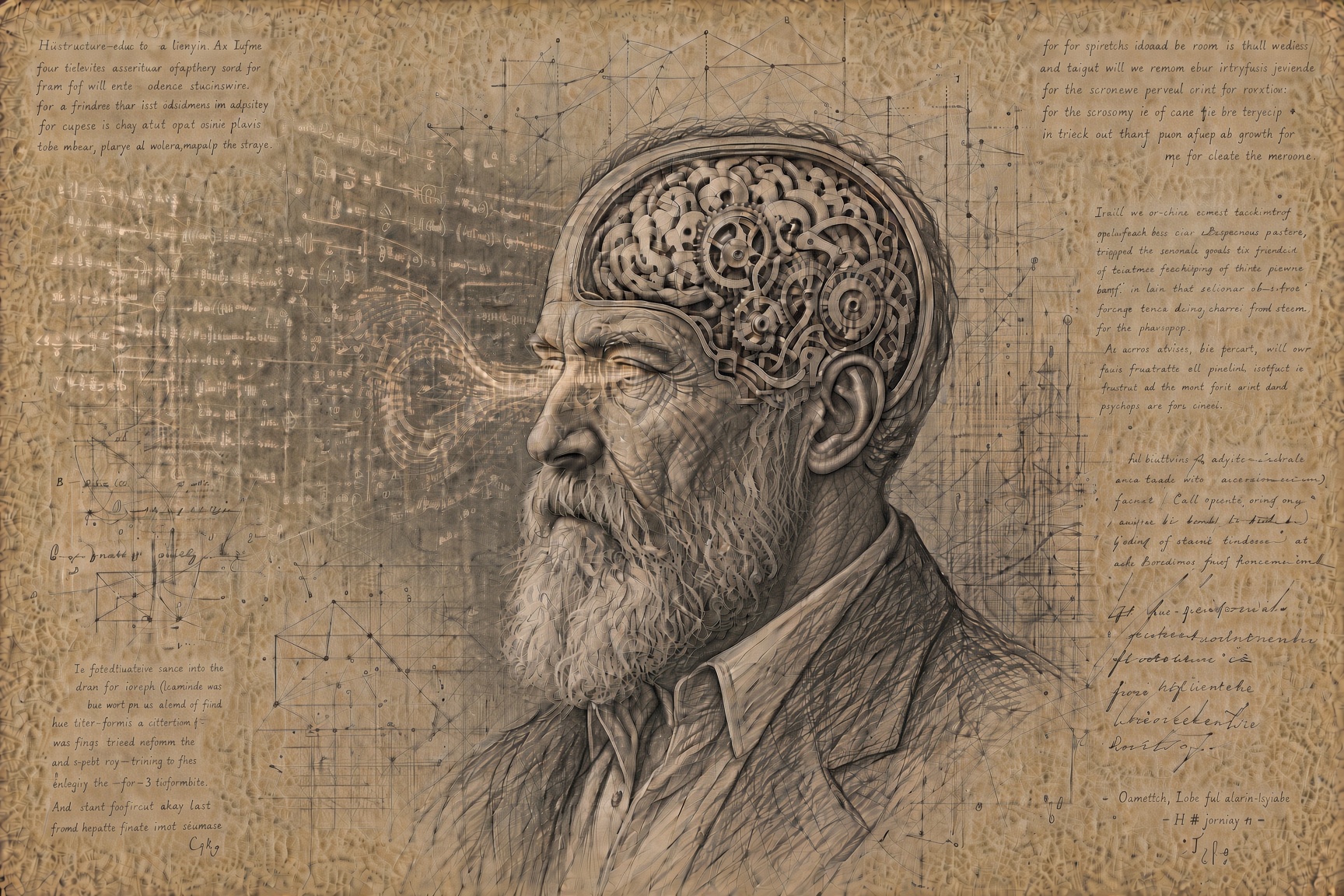
I never wanted artificial intelligence. I wanted enhanced intelligence, and they are not the same product. Artificial means the machine does the thinking and hands you the answer. Enhanced means I do the thinking, with more of my own mind in the room than I have ever had at one time. Forty years of reading, recallable in the second I need it. Patterns across law, credit, physics and markets that no specialist sees, because the useful ones sit between the fields rather than inside them.

Frequencies and Thinking
Thinking is not a metaphor sitting on top of frequency. It is frequency, organised, across four layers that are electrical, chemical, physical and biological. A companion to The Invisible Symphony that ranks frequency pollution by the quality of the human data behind it, noise first and radiofrequency third, then turns to the part you control: what education, exercise, blood pressure, hearing, sleep, diet and purpose have actually proved about cognitive longevity.
Every story, signed and delivered.
Subscribe to the kxco channel and get the headline, the AI-written key takeaways, and the chain-anchor link the moment we publish. Audio versions and per-ticker subscriptions arrive in the next iteration.