
What's Next in AI and Quantum
How the sectors are developing, who is leading the charge, breakthroughs on the horizon, and the compute and power challenge
Part of theAI Stocks Center
1. Introduction: Two Revolutions Converging
The defining technological contest of the mid-2020s is no longer a single race. It is a dual revolution. Artificial intelligence has moved from experimental large language models into the operating system of enterprise software, scientific discovery, and capital allocation. Quantum computing, long dismissed as a laboratory curiosity, is crossing the threshold from noisy intermediate-scale devices into early fault-tolerant architectures. The two fields are no longer parallel tracks. They are beginning to reinforce each other. AI is accelerating quantum error correction and circuit design. Quantum processors are generating training data and solving optimisation problems that classical systems cannot reach at scale.
This report examines the present state of both sectors as of August 2026, maps the companies and national systems that are setting the pace, identifies the technical and commercial breakthroughs that appear within reach over the next three to five years, and confronts the hard constraint that now binds the entire compute complex: electricity and the physical infrastructure required to deliver it. Particular attention is paid to Chinese companies and state-directed programs, which have closed gaps in cost-optimised models, photonic and neutral-atom hardware, and domestic chip ecosystems faster than many Western forecasts assumed.
The analysis is grounded in publicly reported results, vendor roadmaps, financing data, and independent assessments from the International Energy Agency, S&P Global, market research houses, and peer-reviewed literature. Projections are treated as directional rather than prophetic. Markets that will be created by these technologies, including drug discovery platforms, post-quantum cryptography infrastructure, materials design services, sovereign compute capacity, and high-density power solutions, are already attracting capital measured in the hundreds of billions. The investors and institutions that understand both the technical trajectories and the physical bottlenecks will hold the durable advantage.
What follows is a structured assessment of growth dynamics, leadership, near-term breakthroughs, the compute-and-power complex, and the distinctive role of Chinese participants. The goal is clarity rather than hype: to separate what has already been demonstrated from what remains a credible roadmap, and to identify the commercial markets that those demonstrations will create.
2. The AI Sector: Scale, Structure, and Momentum
By mid-2026 the artificial intelligence industry has settled into a clear industrial structure. At the frontier sit a handful of model developers whose systems set the performance benchmarks on reasoning, coding, agentic workflows, and scientific problem-solving. Below them sit the infrastructure providers, the chip designers, foundries, cloud hyperscalers, and data-centre operators that convert electricity and silicon into usable training and inference capacity. Surrounding both layers is a rapidly expanding application ecosystem that is beginning to convert model capability into recurring revenue.
Capital expenditure by the largest technology companies on AI infrastructure surpassed $400 billion in 2025 and is tracking toward approximately $700 billion to $800 billion in 2026 according to multiple banking and rating-agency estimates. Hyperscaler data-centre lease commitments already exceed $1.2 trillion. These figures are not speculative marketing. They appear in quarterly filings and guidance. NVIDIA's data-centre revenue alone has approached the $75 billion annualised run-rate, reflecting the concentration of advanced GPU demand. Memory and high-bandwidth memory supply has become a strategic bottleneck of its own, with AI-related demand growing far faster than the roughly 20 percent annual expansion of DRAM capacity. Packaging capacity for advanced chips and the availability of high-end memory have repeatedly acted as rate-limiters on the speed at which new clusters can be brought online.
On the demand side, five platforms now clear 100 million monthly active users: Meta AI, ChatGPT, Gemini, Microsoft Copilot, and ByteDance's Doubao. Claude, various Chinese assistants, and Grok sit immediately behind. Token consumption has become the new industrial metric. Chinese open-weight models, particularly those from DeepSeek, Xiaomi, and Alibaba's Qwen family, frequently dominate raw token volume on open routing platforms because of aggressive pricing. Closed-source frontier models from Anthropic and OpenAI continue to command the majority of paid enterprise spend. This divergence between volume and value is one of the clearest structural features of the 2026 market. Open models win on cost and experimentation. Closed frontier models win on reliability, safety tooling, and the willingness of enterprises to pay for production workloads.
Efficiency gains are real and rapid. Power consumption per AI task has declined at rates rarely seen in energy history. Model quantisation, mixture-of-experts architectures, speculative decoding, and specialised inference chips have all contributed. Yet absolute electricity demand continues to rise because the volume of inference and the size of training runs have grown even faster. The International Energy Agency projects global data-centre electricity consumption roughly doubling from about 485 TWh in 2025 to around 950 TWh by 2030, with the AI-focused portion growing still faster. That trajectory is already visible in interconnection queues and turbine order books. The same efficiency improvements that reduce cost per token simultaneously unlock new use cases, including longer context windows, multi-agent systems, and continuous fine-tuning, which increase aggregate demand.
Enterprise adoption has moved beyond pilots. Financial institutions, pharmaceutical companies, software developers, and government agencies are embedding frontier models into production workflows for coding assistance, document analysis, customer support, and scientific hypothesis generation. The revenue conversion that lagged capital expenditure through 2024 and early 2025 is now visible in hyperscaler cloud growth rates and in the reported run-rates of the leading model labs. The industrial logic is straightforward. Once a capability crosses a reliability threshold, the marginal cost of additional inference is low relative to the value created, and usage expands.
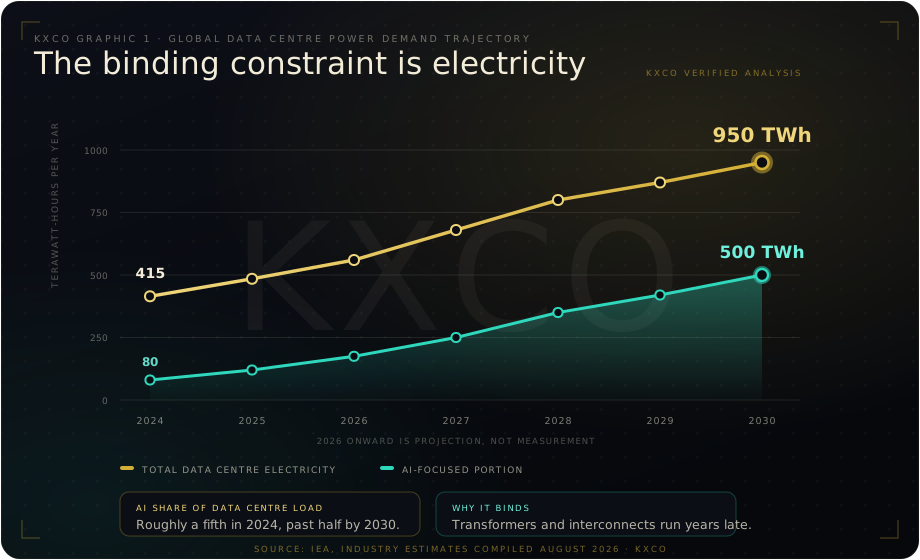
KXCO Graphic 1. Global data centre electricity demand trajectory, total against the AI-focused portion. Sources: IEA and industry estimates compiled August 2026.
3. Who Is Leading the AI Charge
United States and Allied Frontier Labs
As of August 2026 the composite leadership ranking among frontier model developers places Anthropic at the top on many public intelligence and agentic benchmarks, followed closely by OpenAI. Anthropic reported an annualised revenue run-rate exceeding $65 billion by late July and its first profitable quarter. OpenAI remains the volume leader in many consumer and developer metrics and continues to push the capability frontier with successive GPT-5.x releases. Google DeepMind's Gemini series retains strengths in long-context multimodal tasks and benefits from Alphabet's unmatched internal data and TPU infrastructure. Microsoft's Azure OpenAI service and Copilot distribution give it the deepest enterprise channels. Meta has pursued an open-weight strategy that has expanded its reach even as its closed models trail the absolute frontier. xAI's Grok series has established a distinct position emphasising real-time information and a less restrictive safety posture.
NVIDIA remains the indispensable infrastructure company. Its CUDA software moat, NVLink interconnects, and successive GPU generations, including the transition toward Vera Rubin architectures, keep it at the centre of almost every large training cluster. AMD, Broadcom, and a growing set of custom silicon efforts by the hyperscalers themselves provide secondary supply, but the performance and software ecosystem gap remains material. CoreWeave and other neo-cloud providers have carved out a profitable niche by specialising in GPU capacity for AI workloads. The concentration of advanced packaging, high-bandwidth memory, and foundry capacity, primarily at TSMC, creates a set of chokepoints that are now widely recognised by both investors and policymakers.
China's Parallel Stack
China has constructed a parallel AI ecosystem that is deliberately optimised for cost, domestic deployment, and resilience against export controls. DeepSeek's R1 release in early 2025 demonstrated that highly capable models could be trained at a fraction of the reported cost of leading U.S. systems. Subsequent DeepSeek, Moonshot AI (Kimi), Zhipu AI (GLM), and Alibaba Qwen releases have continued to close the absolute capability gap while undercutting on price. Alibaba reports that its open-weight Qwen family has accumulated more than three billion downloads. ByteDance's Doubao leads Chinese consumer monthly active users. Huawei's Ascend series and related Atlas SuperPoD systems form the domestic training backbone, with the Atlas 900 A3 SuperPoD positioned as a full-stack alternative to NVIDIA's NVL platforms. Domestic high-bandwidth memory and advanced packaging capacity remain constraints, but the algorithmic and systems-level workarounds have proven more effective than many external forecasts expected.
Chinese labs now account for roughly one-third of the world's top 10 percent most-cited AI publications and lead in patent volume focused on applied AI. The funding environment remains state-catalysed. DeepSeek, Moonshot, and Zhipu have all raised multi-billion-dollar rounds at valuations that, while still well below Anthropic or OpenAI, reflect strategic priority. The practical result is a bifurcated global market. U.S. frontier models set the ceiling on pure capability and safety research. Chinese systems set the floor on cost and the speed of domestic industrial adoption. Multinational enterprises operating in both jurisdictions are increasingly forced to maintain dual stacks. For investors this bifurcation creates both opportunity and complexity. Exposure to the absolute frontier remains concentrated in a small number of U.S. and allied names, while volume growth and cost leadership are increasingly accessible through Chinese-listed or China-exposed vehicles.
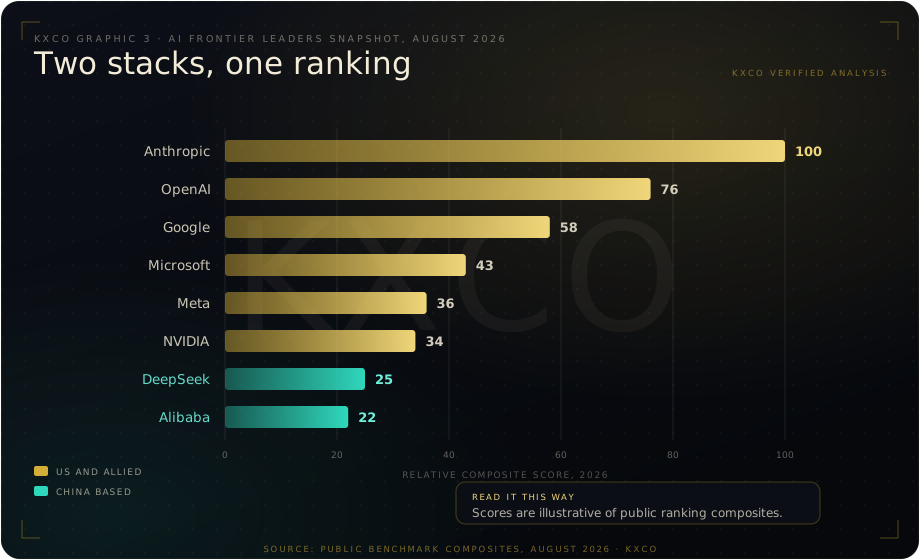
KXCO Graphic 3. Relative composite positioning of selected AI frontier and infrastructure players, August 2026. Gold marks primarily U.S. and allied names, teal marks China-based names. Scores are illustrative of public ranking composites.
4. Quantum Computing: From Laboratory to Early Utility
The quantum computing sector in 2026 is characterised by simultaneous progress on three fronts: physical qubit count and fidelity, logical qubit demonstration and error correction, and the first commercial and scientific applications that classical computers cannot efficiently replicate. Market size estimates for the broader quantum technology sector, covering computing, sensing and communications, vary by methodology, but consensus ranges place pure quantum computing revenue in the low single-digit billions in 2026 with projected compound annual growth rates of 30 to 35 percent through 2030 to 2035, potentially reaching $12 billion to $22 billion by the early-to-mid 2030s depending on the pace of fault-tolerant deployment.
Hardware modalities remain plural. Superconducting circuits from IBM, Google, Rigetti, and Chinese groups around the University of Science and Technology of China continue to lead in absolute qubit numbers and cloud accessibility. Trapped-ion systems from Quantinuum and IonQ lead on fidelity and coherent lifetime metrics. Neutral-atom platforms from QuEra, Pasqal, and a rapidly expanding Chinese cohort offer natural scalability and the ability to rearrange qubits dynamically. Photonic approaches from PsiQuantum, Xanadu, and the Chinese Jiuzhang series promise room-temperature operation and leverage semiconductor manufacturing. Annealing systems from D-Wave already deliver commercial optimisation results for selected logistics and scheduling problems. No single modality has yet demonstrated a decisive, permanent advantage. The industry is still in a period of parallel exploration.
Error correction has moved from theoretical papers into hardware demonstrations. Google's Willow processor achieved below-threshold surface-code performance. Quantinuum has demonstrated topologically ordered states and non-Abelian anyon braiding on its H2 system, work that opens a path to protected universal gates. IBM has successfully joined and cooled modular cryogenic cells, a necessary step toward multi-chip architectures that can be upgraded cell by cell. AI itself has become part of the control plane. NVIDIA's Ising models, Google's reinforcement-learning calibration techniques that improved logical stability by factors of three or more, and commercial decoders from Quantum X Labs and others are reducing logical error rates and extending coherent runtime without constant human recalibration. The classical computing overhead of real-time decoding remains a significant engineering challenge, which is why GPU-accelerated and AI-native approaches are receiving heavy investment.
Cloud access has democratised experimentation. IBM Quantum, Amazon Braket, Azure Quantum, and Google Cloud together host the majority of academic and commercial users. Job volumes on the larger platforms are measured in the millions. This accessibility is creating a generation of quantum-fluent developers and is generating the application experience that will guide the next round of hardware priorities. At the same time, the gap between what can be demonstrated in a carefully controlled experiment and what can be run reliably as a production service remains large. That is exactly the gap fault-tolerant architectures are intended to close.
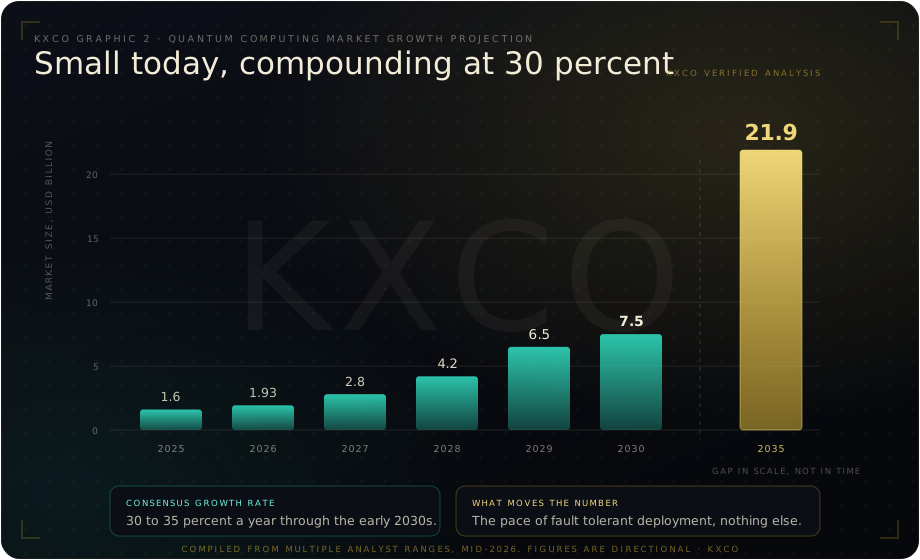
KXCO Graphic 2. Projected quantum computing market size in USD billion, compiled from multiple analyst ranges as of mid-2026. Figures are directional.
5. Quantum Hardware and Platform Leaders
Western and Global Platform Companies
IBM maintains the broadest commercial quantum platform. Its Quantum System Two and successive Heron processors, combined with the Qiskit software stack and a large installed base of enterprise and academic users, give it unmatched reach. The company's published roadmap targets a fault-tolerant system, Starling, capable of 200 logical qubits and 100 million gates by 2029, with a larger Blue Jay architecture later. Google Quantum AI continues to set research milestones on error correction and has demonstrated verifiable quantum advantage on selected chaotic dynamics benchmarks using its Willow processor. Quantinuum, the Honeywell and Cambridge Quantum combination, leads on trapped-ion fidelity and has shown generative quantum AI frameworks in collaboration with NVIDIA and pharmaceutical partners such as Pfizer. IonQ has posted the strongest pure-play commercial revenue growth among quantum hardware companies, with Q2 2026 revenue of approximately $80 million and raised full-year guidance into the $280 million to $290 million range. Microsoft is pursuing topological qubits via its Majorana program and is embedding agentic AI throughout its research and engineering workflows, targeting commercial utility by 2029.
D-Wave continues to expand its annealing customer base, including expanded work with telecommunications operators that have reported order-of-magnitude speed-ups on specific network optimisation jobs. QuEra, Atom Computing, Pasqal and others are pushing neutral-atom systems toward early logical qubit milestones and have announced cloud partnerships that will make megaquop-class systems available later in the decade. PsiQuantum remains the leading pure-play photonic effort aiming directly at utility-scale machines without a long NISQ intermediate phase, with manufacturing partnerships and site preparations underway. Cloud providers, meaning AWS Braket, Azure Quantum, and Google Cloud, serve as the primary distribution layer, lowering the barrier for enterprise experimentation and creating a feedback loop between hardware roadmaps and real application demand.
China's Quantum Push
China treats quantum technology as a strategic national priority with a full-stack approach spanning superconducting, photonic, neutral-atom, trapped-ion, and sensing platforms. Origin Quantum is the commercial flagship for superconducting systems. Its Wukong series has progressed to 180-qubit processors accessible via public cloud, with tens of millions of remote job submissions recorded from more than 160 countries. The company has entered IPO tutoring and raised significant pre-IPO capital from state-linked investors, including defence-sector entities. QuantumCTek and CIQTEK are the most mature publicly listed or near-listed players in quantum communications and sensing, providing the physical layer for China's extensive quantum key distribution networks.
Photonic systems have produced high-visibility results. The Jiuzhang series from the University of Science and Technology of China, led by Pan Jianwei and collaborators, has demonstrated large-scale Gaussian boson sampling claimed to be beyond classical simulation for the specific task, and Jiuzhang 4.0 pushed photon detection counts into the thousands. China Telecom Quantum Group's Tianyan-P2000 photonic system has been connected to the national quantum cloud platform and is offered as a quantum-advantage service. Neutral-atom activity has exploded. Multiple Shanghai and other regional startups, including the Zhongqi Wuliang and Qinghe systems and the Zhongke Kuyuan and Hanyuan series, have demonstrated room-temperature or low-power systems that fit in standard server racks, an operational advantage for data-centre co-location that superconducting systems cannot easily match. Financing for Chinese quantum enterprises rose dramatically in 2025 and 2026, with dozens of deals and cumulative private capital measured in the low billions of dollars, heavily state-catalysed.
Silicon photonic on-chip multi-qubit graph states, large defect-free atomic arrays exceeding two thousand atoms, and domestic dilution refrigerator production, including Origin's SL400 exports to Belt-and-Road markets, further illustrate the breadth of the Chinese effort. While absolute fidelity and software ecosystem depth still trail the leading Western groups in many metrics, the speed of iteration, the integration with national cloud platforms, and the willingness to deploy early systems into commercial and government workflows are distinctive. The result is a second full-stack quantum ecosystem that is already shaping global competition for talent, components, and standards.
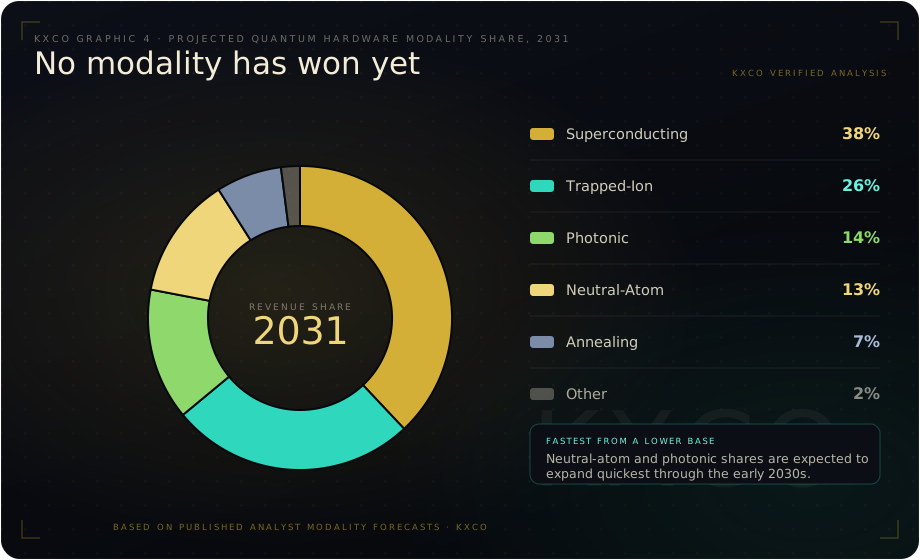
KXCO Graphic 4. Illustrative projected share of quantum computing hardware modalities by revenue circa 2031, based on published analyst modality forecasts. Neutral-atom and photonic shares are expected to expand fastest from a lower base.
6. Breakthroughs on the Horizon
Several technical milestones appear reachable between late 2026 and 2030. The most consequential is the transition from noisy intermediate-scale quantum devices to early fault-tolerant systems capable of running circuits with tens to hundreds of logical qubits and millions to hundreds of millions of reliable operations. The difference between a NISQ demonstration and a fault-tolerant calculation is not incremental. It is the difference between a result that must be heavily mitigated and post-processed and a result that can be trusted as the output of a digital computer.
Fault Tolerance and Logical Qubits
IBM's public roadmap calls for the Starling system, 200 logical qubits executing 100 million gates, by 2029. QuEra and AWS have announced Libra, a megaquop-class system of approximately one million reliable operations, targeted for cloud availability in 2028, with a subsequent gigaquop-class machine planned for 2028 to 2029 that would support on the order of one billion operations and more than a thousand logical qubits. Microsoft's Majorana 2 topological approach aims for commercial utility on a similar 2029 horizon, with the potential advantage of lower physical-to-logical qubit overhead if the underlying physics scales as hoped. Multiple groups have already demonstrated logical error rates below the physical error rates of their constituent qubits, the essential proof that error correction works. AI-driven decoders and real-time calibration are reducing the classical computing overhead that has historically limited the speed of error correction cycles. The engineering task now is to integrate these pieces into systems that can run continuously, be upgraded modularly, and be accessed through stable software interfaces.
AI and Quantum Convergence
The most productive near-term synergy is mutual acceleration. Transformer models trained on quantum data are generating chemistry circuits faster than classical optimisers. Quantinuum, NVIDIA, and Pfizer have demonstrated generative frameworks that produce high-quality ground-state preparation circuits in a single forward pass. Reinforcement learning is stabilising quantum processors over longer runtimes, with Google reporting improvements in logical error stability of 3.5 times and absolute error reductions of around 20 percent. Large language models are automating circuit design, debugging, and even experimental protocol translation into live quantum jobs. Conversely, quantum processors are beginning to supply training signals and simulation data that improve classical AI models for materials and molecular systems. OpenAI has reported that internal versions of its next-generation models have solved multiple open problems in quantum complexity theory and mathematics. If those claims are independently verified, they would mark a new mode of scientific contribution in which AI systems propose and partially prove results that human researchers then formalise.
Application Horizons
By 2028 to 2030 the first classically intractable but scientifically valuable calculations in quantum chemistry, covering embedded active-space methods for catalysts and battery materials, high-energy physics lattice models, and certain optimisation problems, are expected to become routine on early fault-tolerant machines. Financial institutions are already running hybrid quantum-classical risk and portfolio experiments. Logistics and telecommunications operators are deploying annealing and gate-model solutions for specific network problems, and D-Wave has reported production deployments that cut multi-hour classical jobs to seconds. Post-quantum cryptography migration is accelerating independently of full cryptographically relevant quantum computers. NIST standards are moving into production networks, and hybrid classical and PQC deployments are live on major content-delivery and cloud platforms, with hundreds of millions of connections recorded within minutes of activation on some networks.
The longer-term prize, fault-tolerant machines with thousands of logical qubits capable of breaking RSA-2048 or simulating complex biological systems end to end, remains on a 2030 to 2035 horizon according to most credible roadmaps. Yet the intermediate systems will already create new markets in specialised simulation-as-a-service, quantum-enhanced machine learning, and certified randomness and sensing applications. The economic value of those intermediate markets is what will fund the final push to large-scale fault tolerance.
7. The Compute and Power Markets: The Binding Constraint
Every projection of AI and quantum growth eventually collides with physics and infrastructure. Training a frontier model and serving its inference at global scale requires megawatts to gigawatts of continuous, high-quality power, advanced cooling, transformers, switchgear, and high-voltage transmission. Quantum systems add their own specialised demands, including dilution refrigerators for superconducting and certain ion traps, precision lasers and vacuum for neutral atoms and trapped ions, and ultra-stable classical control electronics, but the dominant incremental load remains classical AI compute. The power problem is therefore the central infrastructure challenge of the dual revolution.
Demand Trajectory and Bottlenecks
Global data-centre electricity consumption is on track to roughly double between 2025 and 2030. AI-optimised racks have moved from 5 to 15 kW historically to 100 to 137 kW for current NVIDIA GB200-class platforms, with next-generation designs projected at 200 to 600 kW per rack. Air cooling becomes inadequate above approximately 40 to 50 kW, forcing liquid cooling and raising capital costs per megawatt. An individual advanced server rack can draw power equivalent to dozens of households. Campus-scale facilities under planning now contemplate multi-gigawatt draws, larger than many existing power plants. The International Energy Agency and private analysts converge on the view that data centres will account for a rising share of incremental electricity demand in the United States, China, and parts of Europe and the Middle East.
The binding constraints are not primarily generation capacity in the abstract. They are interconnection queues, transformer and switchgear lead times now measured in years, skilled labour, community opposition, and the mismatch between the two-year construction cycle of a data centre and the four-to-seven-year cycle of major transmission upgrades. In Northern Virginia and other saturated markets, wait times of five to seven years are reported. Morgan Stanley and others have flagged a multi-gigawatt U.S. data-centre power shortfall risk in the 2026 to 2028 window before new solutions come online. Gas turbine order books are full, with delivery lead times stretching toward the end of the decade. Transformer shortages compound the problem. Local opposition over electricity prices, water use, noise, and land use has moved from a public-relations issue to a material development risk in several U.S. states and European jurisdictions.
Responses: Gas, Nuclear, and Onsite Solutions
The industry response is multi-pronged. Natural gas, particularly combined-cycle and, where speed is essential, simple-cycle turbines, provides the fastest dispatchable capacity in the United States and parts of Europe and Asia. Onsite generation paired with battery storage is being pursued to bypass grid queues, although AI load swings of more than 50 percent within a second create technical challenges that require overbuilding and sophisticated controls. Nuclear power has re-entered the conversation with concrete deals: Microsoft's multi-billion-dollar agreement to restart Three Mile Island Unit 1 for roughly 835 MW targeting 2028, Google's small modular reactor fleet agreement with Kairos Power for hundreds of megawatts, Amazon's large nuclear power-purchase agreements and SMR investments, and similar interest from Meta and others. SMRs are not expected to deliver material capacity before the early 2030s, but the corporate offtake commitments are accelerating their commercialisation and changing the risk profile for technology developers and their financiers.
China faces a different but equally serious power challenge. Its data-centre and AI cluster build-out is enormous, and coal remains a large share of the generation mix that supplies them. Domestic renewable and nuclear additions are proceeding rapidly, yet the carbon intensity of Chinese grid power used by data centres remains higher than in Europe or parts of North America. Huawei and other domestic suppliers are optimising for performance-per-watt under export-control constraints, which indirectly eases some pressure but does not eliminate the need for new generation and transmission. The secondary markets created by these constraints are already substantial: liquid cooling specialists, high-density power distribution, advanced thermal management, long-duration storage, and specialised EPC contractors capable of delivering multi-hundred-megawatt campuses on compressed schedules. Equity and credit markets are pricing power-equipment and utility names as AI beneficiaries alongside the more obvious semiconductor and software names.
8. China Companies: Closing Gaps on Cost and Deployment Speed
Any forward-looking assessment that omits Chinese companies is incomplete. In AI, the combination of DeepSeek, Alibaba with Qwen, Moonshot, Zhipu, ByteDance, Huawei, Baidu, Tencent, and a long tail of specialised model and application firms has produced a domestic ecosystem capable of training and serving highly capable systems with far less reliance on the highest-end Western GPUs than outside observers expected in 2023 and 2024. Export controls have slowed access to the absolute cutting edge of NVIDIA silicon, but they have also catalysed domestic alternatives and algorithmic efficiency gains that reduce the performance penalty. The result is a second, fully functional AI stack that is already being deployed across Chinese industry and is beginning to appear in export markets through open weights and cloud services.
In quantum, the picture is one of breadth rather than single-point leadership. Origin Quantum provides the most complete commercial superconducting stack and has built a global user base through its cloud. Photonic systems from the USTC orbit and China Telecom's cloud platform deliver headline quantum-advantage claims on boson sampling and are being offered as services. Neutral-atom startups are iterating toward data-centre-friendly form factors at a pace unmatched in the West. Systems that fit in standard racks and operate without dilution refrigerators remove a major operational barrier. Quantum communications infrastructure, built over a decade of sustained investment, remains a Chinese strength and provides a ready customer base for quantum-safe networking products. Financing volume in the first half of 2026 already exceeded prior full-year figures, with local governments and state-owned capital playing catalytic roles that Western pure-play quantum companies cannot easily replicate.
The strategic implication is bifurcation. Global technology standards, safety research, and the highest-capability closed models remain concentrated in the United States and its closest partners. Cost leadership, rapid domestic deployment, open-weight proliferation, and certain photonic and neutral-atom hardware approaches are increasingly Chinese strengths. Enterprises and governments outside both blocs will face choices about which stack to adopt, how to maintain interoperability, and how to manage supply-chain and regulatory risk. Capital markets already reflect this split in valuation multiples and in the geographic distribution of AI and quantum investment flows. For portfolio construction the practical consequence is that a pure U.S.-centric technology allocation underweights both the cost-driven volume growth and the hardware diversity that Chinese programs are supplying.
9. Markets That Will Develop
The technologies described above will not merely improve existing products. They will create new categories of economic activity whose scale will be measured in the tens to hundreds of billions over the coming decade.
First, simulation and design services for molecules, materials, and catalysts. Early fault-tolerant quantum computers, hybridised with AI, will allow pharmaceutical and chemical companies to explore chemical space that is currently inaccessible. The addressable market is a meaningful fraction of the existing computational chemistry and high-throughput screening spend, with upside from entirely new materials for batteries, carbon capture, and semiconductors. Companies that can deliver verified quantum-enhanced simulation as a service will command premium pricing from industries where a single successful molecule or material can be worth billions.
Second, post-quantum cryptography and quantum-safe infrastructure. Even before cryptographically relevant quantum computers arrive, the migration to NIST-standardised algorithms is underway. Certificate authorities, network equipment vendors, cloud providers, and government systems are all in scope. The market is measured in the tens of billions over the next decade and is largely non-discretionary for regulated entities. Early movers that integrate PQC into existing product lines without breaking performance or compatibility will capture share. Late movers will face forced upgrades under regulatory deadlines.
Third, sovereign and specialised compute capacity. Nations and large enterprises are treating advanced AI training clusters and early quantum systems as strategic assets analogous to energy or semiconductor fabs. This drives demand for turnkey data-centre campuses, specialised cooling and power solutions, and domestic chip and quantum hardware supply chains. The political premium attached to sovereign AI and sovereign quantum capacity is already visible in national funding programs and in the siting decisions of hyperscalers.
Fourth, AI-native scientific discovery platforms. The combination of foundation models trained on scientific literature and data with quantum or high-performance classical simulation backends will produce a new class of research tools sold on subscription or outcome-based contracts to academia and industry. These platforms will not replace human scientists. They will change the division of labour, accelerating hypothesis generation and narrowing the experimental search space.
Fifth, the power and thermal management complex itself. Every incremental gigawatt of AI load requires transformers, switchgear, liquid cooling loops, backup generation, and grid upgrades. Companies that solve the time-to-power problem, whether through modular nuclear, advanced gas, long-duration storage, or software that optimises existing grid capacity, will capture durable economics. The same constraint that threatens to slow AI deployment is simultaneously creating one of the largest infrastructure investment cycles of the decade.
10. Conclusion: Judgement in a Dual Revolution
Artificial intelligence and quantum computing are no longer speculative narratives. They are industrial build-outs constrained by physics, capital, talent, and politics. The leaders of the next five years will be those who can simultaneously push the capability frontier, control costs, secure power and cooling, navigate export controls and domestic industrial policy, and convert technical milestones into products that customers will pay for repeatedly.
In AI, the United States retains the edge in absolute frontier performance and in the capital markets that fund it. China has established a parallel, cost-competitive, and rapidly deploying stack that cannot be ignored. In quantum, the race is more open across modalities, with IBM, Google, Quantinuum, IonQ, and Microsoft setting much of the Western pace while Chinese groups advance photonic, neutral-atom, and superconducting systems with strong state support. The first genuinely useful fault-tolerant machines are now a 2028 to 2030 possibility rather than a 2035 abstraction.
The power constraint is the least forgiving. Data-centre electricity demand is doubling on a timescale shorter than traditional utility planning cycles. Gas will fill the near-term gap. Nuclear and advanced renewables plus storage will shape the 2030s. Companies and countries that treat electricity, cooling, and interconnection as first-order strategic variables will out-execute those that treat them as someone else's problem.
For investors, the opportunity set spans semiconductors, hyperscale infrastructure, specialised power equipment, quantum hardware and software pure-plays, post-quantum security, and the application layer that monetises the new computational capabilities. For policymakers, the dual revolution raises questions of energy security, technology sovereignty, and the governance of systems that will increasingly shape scientific discovery and economic competitiveness. For everyone else, the practical advice is the same as it has been through every prior technological discontinuity: stay close to the primary sources, update your map when the evidence changes, and never confuse a compelling demonstration with a completed market.
The breakthroughs are real. The markets are forming. The constraints are physical. Judgement, about which technical path will scale, which company can execute, and which bottleneck will bind first, remains the scarce resource.
Stocks mentioned in this article: $NVDA, $MSFT, $GOOGL, $META, $AMZN, $AMD, $AVGO, $TSM, $CRWV, $IBM, $IONQ, $RGTI, $QBTS, $HON, $PFE, $BABA, $BIDU, $TCEHY and $XIACY.
About the Author
Shayne Heffernan, Ph.D., is an economist and market analyst with more than forty years of experience across global capital markets, venture capital, and emerging technology. He is the founder of Live Trading News, the KnightsBridge Group, Knightsbridge Law and the KXCO.ai ecosystem spanning post-quantum cryptography, identity, attestation and enterprise ontology. His work focuses on the intersection of artificial intelligence, quantum technologies, digital assets, and the real-economy constraints that shape their deployment. More at www.shayneheffernan.com.
Disclaimer: This article is for informational purposes only and does not constitute investment advice. All projections are forward-looking and subject to substantial uncertainty. Data compiled from public sources as of August 2026.
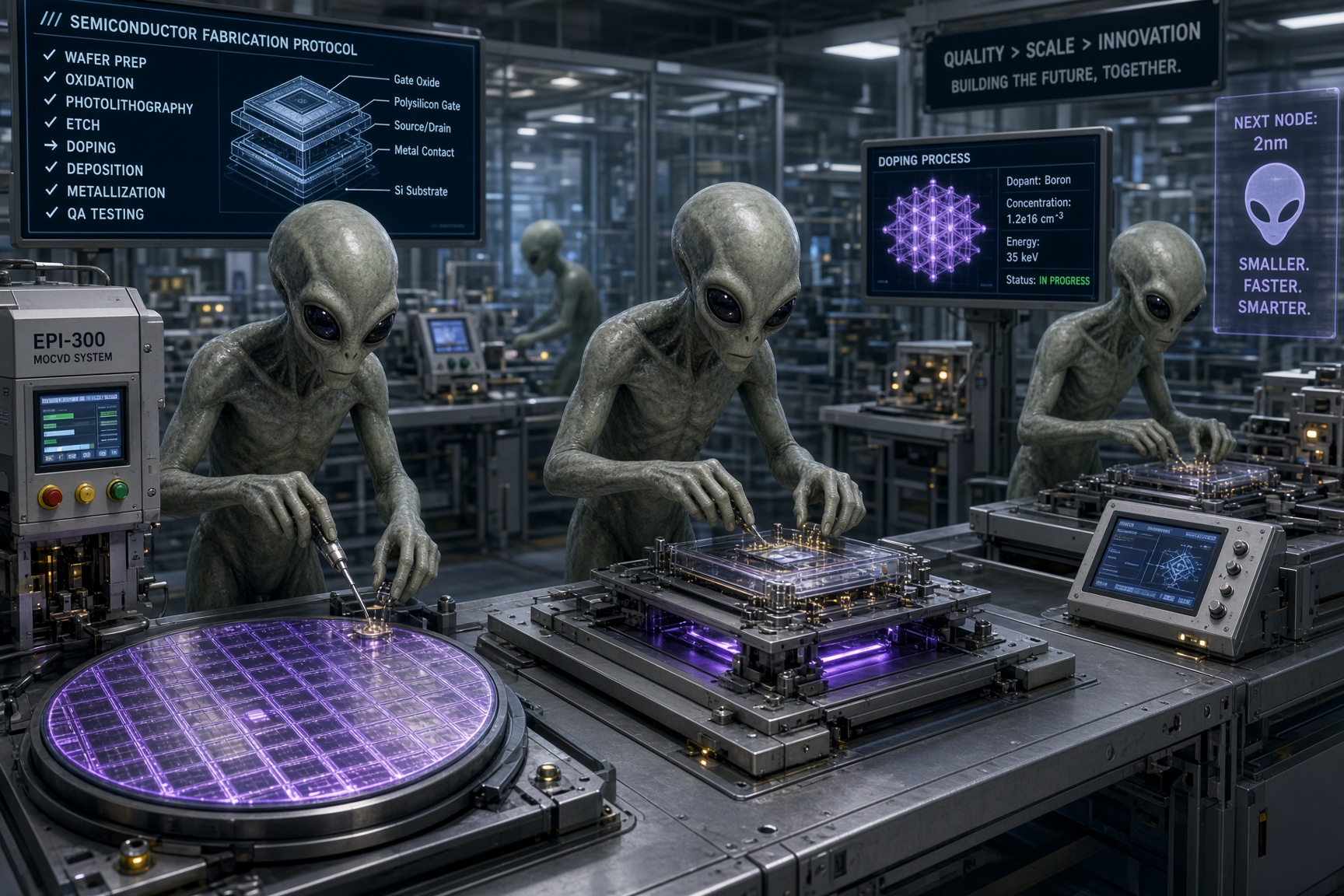
AI Is Being Powered by Tech That Looks Almost Alien
Every frontier AI model runs on chips printed by one Dutch machine. ASML's extreme-ultraviolet scanner fires a laser at up to 50,000 droplets of molten tin a second, per ASML, and bounces the light off mirrors whose deviations are tens of picometres. Veritasium called it the closest thing we have to alien technology. This piece takes the film as the brief and checks it: the machine, High-NA, and the wafer-scale chips and liquid-cooled racks downstream of it.
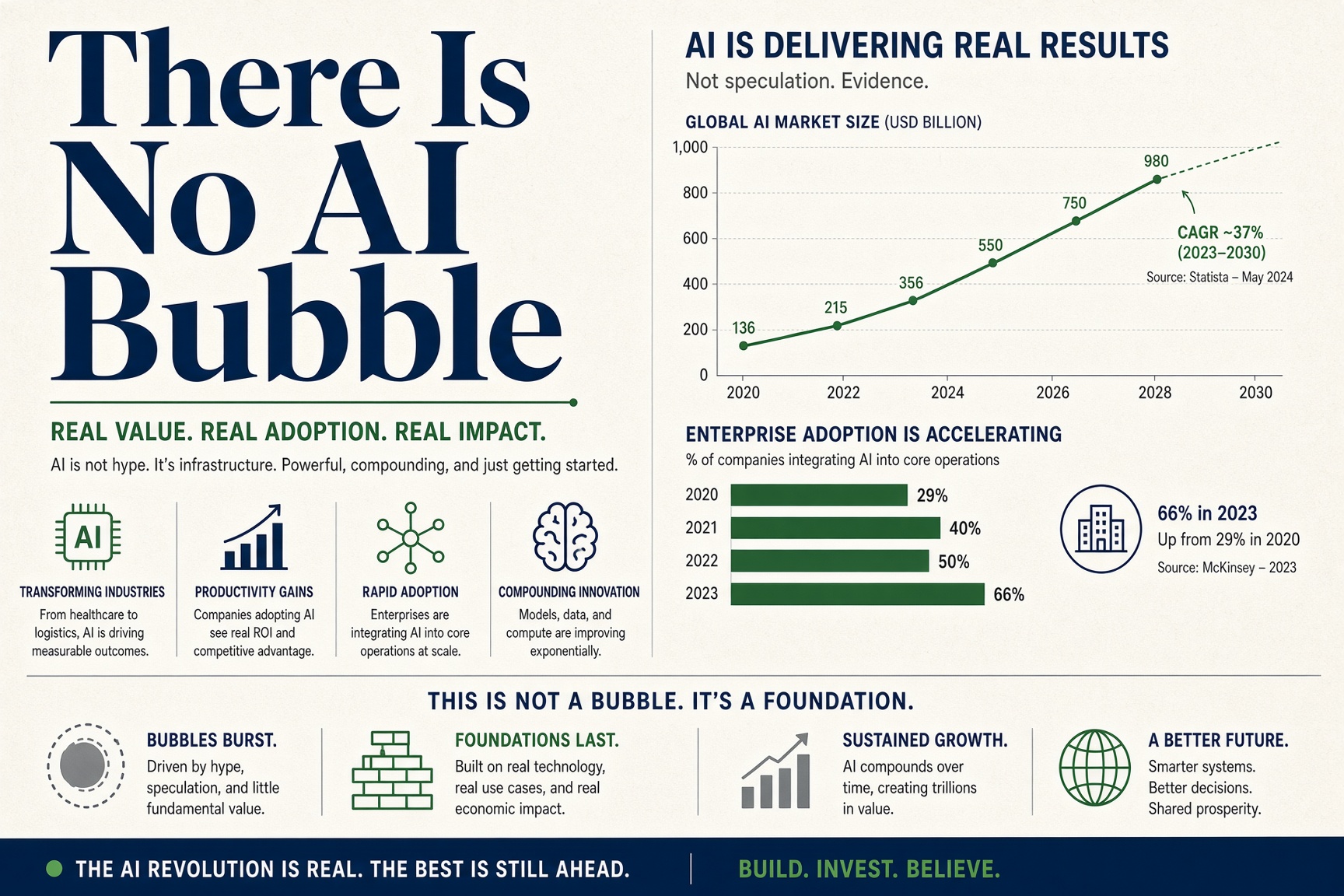
There Is No AI Bubble
There is no AI bubble. A bubble is capacity nobody uses, demand nobody signs for and a glut when the building stops. KXCO's AI sector ontology, refreshed on 7 October 2026, finds the reverse: adoption rising on six independent measures, about $2.35tn of contracted backlog at the four largest sellers of compute per their own reports, and supply rationed at every layer. It keeps the bear case in the same record, 20 circular capital claims, and answers it.

Weekly Market Outlook: Fed Minutes, Anthropic and OpenAI IPOs, Gold, Bitcoin, FX
The Fed raised rates in September and payrolls rose 29,000, per the Labor Department. This week the FOMC minutes, three Treasury auctions and a 10-year near 5.3 percent test that gap. Anthropic's IPO clock runs toward a 14 October investor day while OpenAI's chief executive says not 2026. Gold sits 26 percent below its record, bitcoin near $85,500, the dollar up three weeks running. Two knowledge graphs from KXCO's records map the IPO backers and the FDA board.
Thoughts on Thinking in an AI World
A model will write an answer about anything in seconds. What an AI world makes scarce is everything around the answer: what you believed last month and why you changed it, the link between fields nobody reads together, and a decision a named person can stand behind. Three knowledge-graph exhibits from the KXCO record show each one, from a reported Nvidia deal that became a signed 8-K to a war five links from a data centre.
Every story, signed and delivered.
Subscribe to the kxco channel and get the headline, the AI-written key takeaways, and the chain-anchor link the moment we publish. Audio versions and per-ticker subscriptions arrive in the next iteration.