
Big Tech Earnings, the Fed and $100 Oil. Trading Strategies for Every Sector
Four megacap earnings reports, an FOMC decision, PCE inflation and Brent above $100 stack into the busiest week of the quarter. Our house view is a buy the dip moment, and we expect the dip first. By Shayne Heffernan.
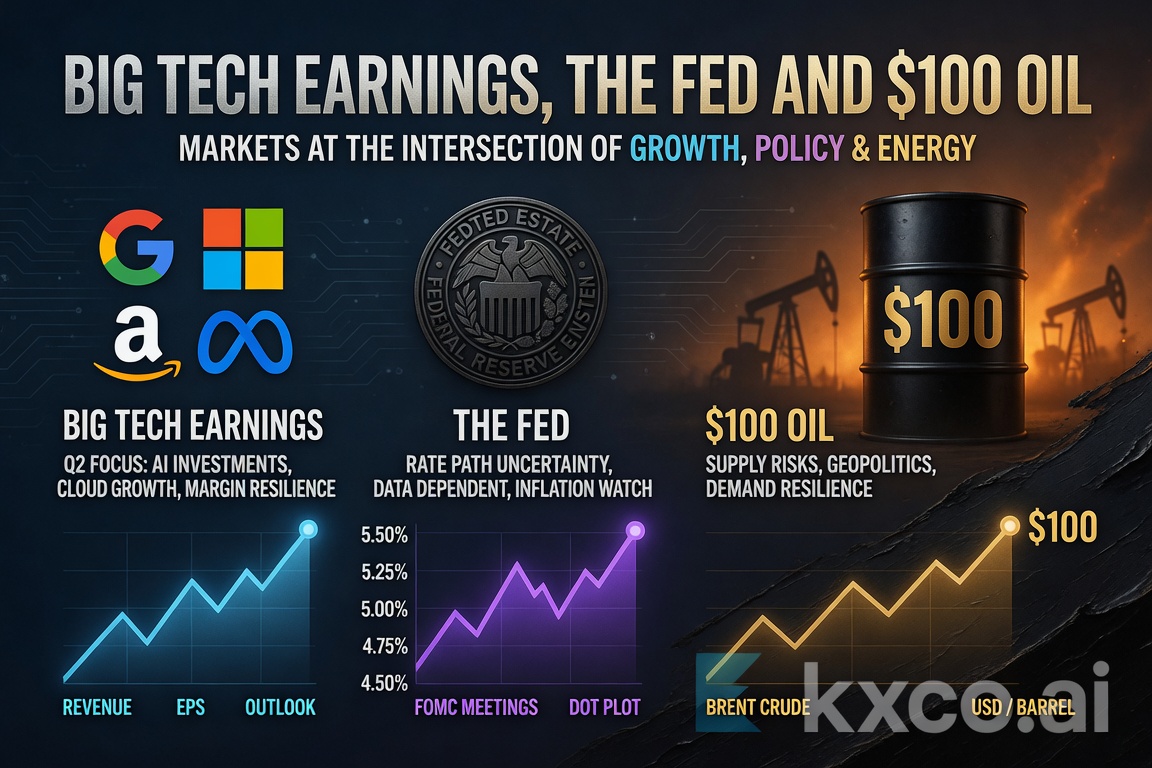
The heaviest week of the quarter has arrived. Inside five trading days we get four of the five largest companies on earth reporting results, a Federal Reserve decision, the Fed's preferred inflation gauge, the first read on second quarter GDP, and Brent crude sitting on the wrong side of $100. Any one of these can move the tape. Stacked together in the same week, they set the mood for the rest of the summer.
Our house view going in is simple. This is a buy the dip moment, and we expect the dip to come first. The tape is stretched, positioning in the megacap complex is heavy, and the market has already told us how it feels about AI spending. When Alphabet beat on revenue and profit last week and still sold off on a $200 billion capital plan, that was the market speaking clearly. We think the same reflex hits Microsoft, Meta, Apple and Amazon at some point this week, and we think that flush is a gift for anyone with cash and patience.
This is our full week ahead, with the economic calendar, the earnings setup, and a trading plan for every sector that matters. By Shayne Heffernan.
The Setup In One Screen
Before the section by section walk through, here is where the major markets closed the week before, on Friday 24 July 2026. These are the reference levels we are trading against.
Market | Level (24 Jul 2026) | Read |
|---|---|---|
S&P 500 | ~7,412 | Near highs, thin breadth |
Nasdaq Composite | ~24,976 | Rolling over on capex fear |
Dow Jones | ~51,947 | Holding up, value rotation |
WTI crude | ~$92.39 | Firm |
Brent crude | ~$100.57 | Above the psychological line |
Gold | ~$4,052 / oz | Record territory |
Bitcoin | ~$65,400 | Underperforming, worst quarter since 2018 |
US Dollar Index | ~101 | Near a four year low |
The picture is a market that looks calm at the index level and nervous underneath. Money is leaving Bitcoin and long duration tech and moving into gold, energy and the dollar hedges. That is a classic late cycle rotation, and it is exactly the backdrop in which a sharp, tradeable dip tends to appear.
The Economic Calendar: Every Event That Matters
Here is the full slate of scheduled data for the week. Times are US Eastern.
Day | Event | Forecast | Prior |
|---|---|---|---|
Mon 27 Jul | Durable Goods Orders (Jun) | +1.6% | -4.5% |
Mon 27 Jul | Core Durable Goods (Jun) | +0.9% | +1.4% |
Mon 27 Jul | Dallas Fed Manufacturing (Jul) | -12.0 | -15.1 |
Tue 28 Jul | Consumer Confidence (Jul) | watch | prior soft |
Tue 28 Jul | FOMC meeting begins | n/a | n/a |
Wed 29 Jul | FOMC rate decision, 2:00 PM | hold 3.50 to 3.75% | 3.50 to 3.75% |
Wed 29 Jul | Warsh press conference, 2:30 PM | tone is the trade | n/a |
Wed 29 Jul | Microsoft and Meta report, after close | see table | n/a |
Thu 30 Jul | Q2 Advance GDP | +2.3% annualized | +2.1% |
Thu 30 Jul | Core PCE (MoM) | +0.1% | +0.3% |
Thu 30 Jul | Core PCE (YoY) | +2.6% | prior firm |
Thu 30 Jul | Personal Spending / Income | +0.4% / +0.3% | +0.7% / +0.7% |
Thu 30 Jul | Initial Jobless Claims | 195K | prior low |
Thu 30 Jul | Apple and Amazon report, after close | see table | n/a |
Fri 31 Jul | UMich Sentiment (final) | 66.4 | 66.4 |
The shape of the week is deliberate and brutal. The Fed and the two biggest software names land on Wednesday after the close. GDP, PCE inflation and the other two megacaps land on Thursday. By Friday morning the market has to reprice growth, inflation, rates and the entire AI capital cycle inside about eighteen hours. That is a recipe for an air pocket, and air pockets are where we want to be buyers.
The Fed: A Hold That Feels Like A Hawk
The Federal Open Market Committee is universally expected to leave its benchmark rate at 3.50 to 3.75% on Wednesday. That would be the fifth consecutive hold. The number is not the story. The story is the direction of the next move and the tone from Chair Kevin Warsh.
For most of this year the debate was about when the Fed would cut. Oil has changed the conversation. With Brent above $100 on the back of Houthi attacks in the Red Sea, the market now prices a real chance of a hike later in 2026. Odds of a hike by year end have jumped to around 38%, up from about 12% a week earlier. That is a large move in a short time, and it explains a lot of the nervousness under the surface.
Scenario | Market reaction | Our play |
|---|---|---|
Hold, dovish tone | Relief rally, yields fall | Sell strength into earnings, keep dip list ready |
Hold, neutral tone | Muted, defers to data | Trade the earnings, not the Fed |
Hold, hawkish tone | Yields up, tech down, dollar up | This is the dip we want, start buying quality |
Surprise hike signal | Sharp risk off, VIX spike | Deploy the most cash, best names first |
The trap this week is a hawkish hold. Warsh has signalled a genuine internal debate. If he leans into the oil driven inflation risk and pushes back on cuts, long duration technology takes the hit precisely as the megacaps are reporting. We would welcome that. A rates driven flush in the highest quality names in the market is the cleanest buy the dip setup there is.
The Main Event: Big Tech Earnings
This is what the week is really about. Four companies, roughly a quarter of the S&P 500's weight, reporting inside 48 hours. The market is not asking whether they are growing. It is asking one question and one question only. Is the AI spending worth it.
Company | Reports | EPS est. | Revenue est. | The question |
|---|---|---|---|---|
Microsoft | Wed 29 Jul, after close | ~$4.21 | Azure in focus | Is AI monetizing or just compressing margin |
Meta | Wed 29 Jul, after close | ~$7.23 | ~$60.3B | Does ad growth fund the capex |
Apple | Thu 30 Jul, after close | ~$1.89 | ~$108.9B | iPhone demand and services, AI is secondary |
Amazon | Thu 30 Jul, after close | ~$1.82 | ~$196B | AWS reacceleration versus retail margin |
The context every trader needs is the capital cycle. The four hyperscalers have guided combined 2026 infrastructure spending to somewhere between $725 billion and $785 billion, a jump of around 77% year on year. That is not a typo. Nearly three quarters of a trillion dollars of capital is being committed in a single year on the bet that artificial intelligence pays off.
Name | 2026 capex signal | Cash flow impact |
|---|---|---|
Microsoft | Deutsche Bank sees the plan raised to ~$238B from ~$215B | Free cash flow near breakeven, down from $70B plus a few years ago |
Amazon | ~$200B planned | Negative free cash flow of nearly $17B expected in 2026 |
Meta | Capex guide $125B to $145B | Ad engine still funds it, for now |
Alphabet (last week) | ~$200B | Beat on results, stock still sold off |
Here is the number that keeps us cautious into the prints. Analysts point to a capex to revenue divergence of roughly 46%. The 2001 telecom overbuild, the most damaging capital misallocation of the modern era, peaked at 32%. We are past that mark. This does not mean the AI thesis is wrong. It means the market is right to demand proof, and it means any company that raises spending again without showing the payoff gets punished. Alphabet was the warning shot.
Microsoft
Microsoft is the cleanest AI story in the group and therefore the one with the most to prove. The bull case is that Azure growth reaccelerates and that Copilot and the OpenAI relationship start showing up as durable revenue rather than a cost line. The bear case is that capex climbs to $238 billion, free cash flow goes to breakeven, and investors decide they are financing a build out with no visible return yet. Watch the Azure growth rate and the commentary on AI revenue run rate. Everything else is noise.
Meta
Meta is the one name in the group where the core business is arguably strong enough to pay for the ambition. Ad revenue is guided up around 28% and the consensus is roughly $7.23 in earnings on about $60.3 billion of revenue. The risk is the capex line. If Zuckerberg lifts the $125 billion to $145 billion range again and pairs it with heavy talk of superintelligence spending, the stock can sell off even on a beat. If the ad engine keeps humming and the capex range holds, Meta is our preferred megacap into and out of this week.
Apple
Apple is the odd one out, and that is a feature this week, not a bug. It is not a capex story. It is an iPhone, services and China story, with AI as a slow burn rather than a spending race. Consensus is around $1.89 in earnings on roughly $108.9 billion of revenue. Because Apple is not caught in the capex versus return debate, it can act as a shock absorber if the market punishes the spenders. Watch services growth and any guidance on the AI feature cycle driving an upgrade wave.
Amazon
Amazon carries the two questions that matter most. Does AWS reaccelerate, and can retail margins hold while the company spends $200 billion and runs negative free cash flow of nearly $17 billion. Consensus is about $1.82 in earnings on roughly $196 billion of revenue. Amazon has the widest range of outcomes in the group. An AWS beat with disciplined retail margins sends it higher. An AWS miss with rising spend is the single most dangerous print of the week for the Nasdaq.
Trading Strategy: Big Tech
Our plan for the megacaps is built around the buy the dip thesis and the expectation of downside volatility first.
Do not chase strength into the prints. Positioning is heavy and the reaction to good news has been poor. Alphabet proved that.
Keep a shopping list with defined levels. Our order of preference is Meta, then Microsoft, then Apple as the shock absorber, then Amazon only after AWS clears.
Scale in. Buy a third on the initial gap down, a third if the selloff extends into the next session, and keep a third for a washout on a hawkish Fed.
Sell options premium into the event if you run an options book. Implied volatility is rich across all four names this week. Cash secured puts on your favourite name at your buy level get paid to wait.
Respect the capex signal. Any name that raises spending again without a clear monetization story is a rent, not an own. Trade the bounce, do not marry it.
AI: The Engine And The Suppliers
The megacaps are the customers. The suppliers are where the capital actually lands, and they trade off every word in these calls. When Microsoft and Amazon talk capex, they are talking about orders for Nvidia, AMD, Broadcom and the whole infrastructure chain.
Segment | Names | This week's driver |
|---|---|---|
GPUs and accelerators | Nvidia, AMD | Hyperscaler capex guidance |
Custom silicon and networking | Broadcom, Marvell | Meta and Amazon in house chip talk |
Memory and storage | Micron and peers | Data center build rate |
Power and cooling | Utilities, industrials | The physical limit on AI growth |
The tension is real. If the hyperscalers reaffirm or raise capex, the suppliers rally even if the megacaps themselves sell off on cash flow fears. That divergence, buyers of the picks and shovels while sellers hit the customers, is one of the cleaner trades of the week. The risk to the suppliers is a capex pause. If even one hyperscaler signals restraint, the entire supply chain reprices lower fast, because their valuations assume the spending never slows.
Trading Strategy: AI
Trade the suppliers off the customers' guidance, not their own. The capex numbers on Wednesday and Thursday nights are the real catalyst for the chip names.
Own the diversified leader and rent the speculative names. The market rewards the companies with actual AI revenue and punishes the story stocks on any wobble.
Watch power and grid names as the second derivative. AI's real ceiling is electricity, and that theme outlasts any single earnings week.
If capex is reaffirmed and the chips dip with the megacaps anyway, that is a buy. The order flow follows the capital, and the capital is still being committed.
Quantum Computing: The Most Speculative Trade On The Board
Quantum has been one of the loudest stories of 2026. The pure play names, IonQ, Rigetti and D-Wave, have run 50% or more since late March. Over a longer window the moves are extraordinary, with IonQ multiplying several times over and Rigetti and D-Wave posting gains measured in four figures of percent. The catalysts are genuine. Google's 105 qubit Willow chip demonstrated below threshold error correction, meaning adding more physical qubits lowers the logical error rate instead of raising it, which is the milestone the entire field has been chasing. Washington added roughly $2 billion in CHIPS Act quantum funding earlier in the year.
Name | Story | Reality check |
|---|---|---|
IonQ | Trapped ion leader, broad partnerships | Minimal revenue, rich valuation |
Rigetti | Superconducting, gate fidelity gains | Tiny revenue, extreme multiple |
D-Wave | Annealing, real commercial pilots | Narrow use case, speculative |
Google, IBM, Nvidia | Deep pockets, real research | Quantum is a rounding error on the P&L today |
The honest read is that these are the most speculative instruments in the market. They have milestone driven upside and almost no fundamental floor. The sector is projected to reach roughly $16 billion by 2035, which is a decade away and a fraction of what these market caps imply. We treat quantum as a small, high conviction, high volatility allocation and nothing more.
There is a second angle to quantum that matters for every investor, not just the speculators. The same progress that makes quantum computers valuable also makes them a threat to the cryptography that secures money and data. Harvest now, decrypt later is already happening, and the migration to post quantum standards is becoming urgent. This is the ground KXCO has been building on, with a live quantum safe settlement chain and open source post quantum tooling, covered in depth on Live Trading News. For traders, the takeaway is that quantum is both an opportunity and a security clock that is ticking.
Trading Strategy: Quantum
Size it like a venture bet, not a core holding. Position so that a 50% drawdown is survivable, because it can and will happen.
Trade around milestones. Error correction results, government funding and hardware records are the catalysts. Buy weakness ahead of expected news, take profit into the spike.
Use the basket, not the single name. Spreading across IonQ, Rigetti and D-Wave reduces the risk that one company's stumble wipes out the trade.
Never use leverage here. The volatility is already extreme. Adding borrowed money turns a speculative trade into a blow up risk.
Oil And Energy: The Wildcard That Changes Everything
Oil is the variable that makes this week different from a normal earnings week. Brent above $100 is not just an energy story, it is an inflation story and a Fed story. Houthi attacks in the Red Sea have disrupted shipping, and Rystad has warned that without a ceasefire the risk of a further spike is real. WTI near $92 with Brent above $100 signals a market pricing genuine supply risk, not just a headline.
Instrument | Level (24 Jul) | Driver |
|---|---|---|
Brent | ~$100.57 | Red Sea disruption |
WTI | ~$92.39 | Following Brent, wider spread |
Energy majors | Exxon, Chevron report this week | Cash returns on high prices |
Refiners | Wide margins | Beneficiaries of the disruption |
The two way risk is high. A ceasefire headline can take $10 off the price in a session and rip the inflation trade apart. A tanker incident can add $10 just as fast. That is why oil is a wildcard rather than a clean trend. For the broader market, sustained $100 oil is the thing that turns a hawkish Fed hold into a genuine hiking cycle, which is the main risk to every long position on the board.
Trading Strategy: Energy
Own the producers, not the barrel, for a core position. Exxon and Chevron report this week and pay you to hold them while oil stays firm.
Treat crude futures as a trade, not an investment. The geopolitical two way risk makes leveraged crude a fast money instrument only.
Use energy as a portfolio hedge. If oil is the thing that breaks the market, being long energy offsets the pain in your tech book. That is the point of owning it here.
Watch the ceasefire tape. The single largest risk to the energy long is a diplomatic breakthrough. Keep stops honest.
Gold: The Trade That Is Already Working
Gold near $4,000 an ounce is telling you everything you need to know about the macro backdrop. A weak dollar, sticky inflation, geopolitical risk and a market that no longer trusts the idea of endless rate cuts. Gold has been the standout asset of 2026 and we do not think the run is over.
Driver | Direction for gold |
|---|---|
Weak dollar (DXY near four year low) | Bullish |
Oil driven inflation | Bullish |
Geopolitical risk (Red Sea) | Bullish |
A hawkish Fed with higher real rates | Headwind |
The one genuine risk to gold is a hawkish Fed that pushes real yields higher. If Warsh sounds like he is preparing to hike, gold can pull back. We would buy that pullback. The structural case, a debased dollar and a world that wants a neutral reserve asset, is intact and strengthening.
Trading Strategy: Gold
Buy dips, do not chase spikes. Gold at records invites chasing. Wait for the Fed driven pullback and accumulate.
Hold physical or the major ETF for the core. This is a store of value position, not a trade.
Use miners for leverage if you want beta. The producers move more than the metal in both directions.
Keep gold as your anti fragile sleeve. It is the position that works when everything else in the buy the dip plan is temporarily wrong.
Silver: Gold's High Beta Cousin
Silver rides gold higher and falls harder. It carries the same monetary tailwinds as gold plus a genuine industrial demand story from solar, electronics and the broader electrification build out. The gold to silver ratio remains historically wide, which is the classic argument that silver has room to close the gap if the precious metals bull continues.
The catch is volatility. Silver's industrial demand ties it partly to the economic cycle, so a growth scare hits it in a way it does not hit gold. That makes silver a higher risk, higher reward version of the same trade.
Trading Strategy: Silver
Use silver to add beta to a gold position, not to replace it. When the precious metals trade works, silver outperforms.
Respect the wider swings. Position smaller than you would in gold for the same conviction.
Watch the ratio. A very wide gold to silver ratio has historically favoured silver on a multi month view.
Take profits more actively than in gold. Silver's spikes are sharper and fade faster.
The Dollar And FX: Weakness Is The Theme
The dollar is trading near a four year low, with the index hovering around 101 after its steepest weekly decline in months. Policy rhetoric favouring a weaker dollar for competitiveness reasons has combined with the market pricing an eventual end to the tightening bias. A weak dollar is the quiet engine under gold, commodities and emerging markets.
Pair or index | Bias | Why |
|---|---|---|
US Dollar Index | Weak, near four year low | Policy tone plus rate path |
EUR / USD | Firm | Dollar softness |
USD / JPY | Two way | Rate differential versus safe haven flows |
Commodity currencies | Supported | High oil and metals |
The wildcard is the same as everywhere else this week. A genuinely hawkish Fed, forced into a corner by $100 oil, could snap the dollar higher and unwind a lot of crowded trades. That is the scenario that produces our dip, and it produces it across gold, emerging markets and risk assets at the same time.
Trading Strategy: FX
Trade the dollar as the master switch. If the Fed turns hawkish and the dollar rallies, that is your signal that the buy the dip window is opening across the board.
Favour commodity linked currencies while oil and metals stay firm, but keep the position nimble around the Fed.
Hedge international equity exposure with an eye on the dollar. A sharp dollar bounce hits emerging markets first.
Do not fight the structural trend. The medium term path for the dollar is lower, and the pullbacks are for adding to that view.
Bitcoin: The Underperformer
Bitcoin is the awkward asset of this cycle. Trading around $65,000, it is on track for its worst quarter since 2018 and has badly lagged gold, silver and even parts of tech. In a year when the dollar is weak and gold is at records, Bitcoin failing to catch a bid is a warning that the digital gold narrative is under strain for now. Capital that might once have gone to Bitcoin is going to actual gold instead.
Factor | Read for Bitcoin |
|---|---|
Weak dollar | Should help, is not helping |
Gold at records | Competing for the same flows, and winning |
Risk off rotation | Bitcoin trades like risk, not like a haven |
Regulatory and structural | Longer term support, no near term catalyst |
We are not bearish on Bitcoin structurally. We are realistic about the tape. When an asset fails to rally in the exact conditions that should lift it, you respect the message and wait for it to prove itself again. That said, extreme underperformance is exactly where contrarian buyers eventually get paid, which is why Bitcoin sits firmly in our buy the dip framework rather than our sell list.
Trading Strategy: Bitcoin
Wait for confirmation, do not catch the falling knife. Let Bitcoin reclaim a key level before adding aggressively.
Scale into weakness for the long term holding, using the same thirds approach as the megacaps.
Watch the correlation to Nasdaq. If big tech flushes this week, Bitcoin likely goes with it, and that is your entry.
Keep the position sized for the volatility. Bitcoin can move 10% on a quiet day. Size accordingly.
Putting It Together: The Buy The Dip Playbook
Our position for the week is clear. We expect downside volatility, and we treat it as an opportunity rather than a threat. The catalysts are lined up to produce a flush. A hawkish leaning Fed, four megacap prints into heavy positioning, a hot or cold PCE number, and $100 oil sitting over the whole thing. Any two of those firing the wrong way at once can take the Nasdaq down several percent in a session. That is the dip we are waiting to buy.
Priority | What we buy on weakness | Trigger |
|---|---|---|
1 | Quality megacaps, Meta and Microsoft first | Post earnings gap down on a beat |
2 | AI suppliers if capex is reaffirmed | Chips fall with customers despite strong orders |
3 | Gold on a Fed driven pullback | Hawkish Warsh lifts real yields briefly |
4 | Energy majors as a hedge | Any dip while Brent holds $100 |
5 | Bitcoin, small and patient | Reclaim of a key level after a flush |
The discipline that makes this work is cash and staggered entries. We are not trying to catch the exact bottom. We are scaling into quality as the market panics, buying in thirds, and keeping powder dry for the worst headline of the week. The risk to the plan is a market that simply melts up on dovish surprises, in which case we sell strength and wait. We would rather miss an upside move than chase into the most crowded, most binary week of the quarter.
Risk to our view | What it looks like | Response |
|---|---|---|
Dovish Fed, strong earnings | Melt up, no dip | Sell strength, stay patient |
Oil ceasefire | Inflation trade unwinds fast | Trim energy, keep equity dip list |
AWS or Azure miss | Deeper, longer selloff | Slow the scaling, demand lower prices |
Real hiking cycle begins | Sustained repricing, not a dip | Reduce gross, favour energy and cash |
Bottom Line
This is the busiest week of the quarter and it will set the tone into the autumn. The market is asking whether nearly $800 billion of AI spending is worth it, the Fed is being pushed toward hawkishness by $100 oil, and the safe haven bid is flowing into gold rather than Bitcoin. That combination is built for volatility.
Our answer is to lean in when the market panics. We expect the dip. We want the dip. And we have a shopping list ready for every sector, with defined levels and staggered entries. Follow the full economic calendar and our live trading coverage through the week as these events land.
This article is commentary and analysis, not personal financial advice. Markets carry risk, and you should do your own research or consult a licensed adviser before trading.
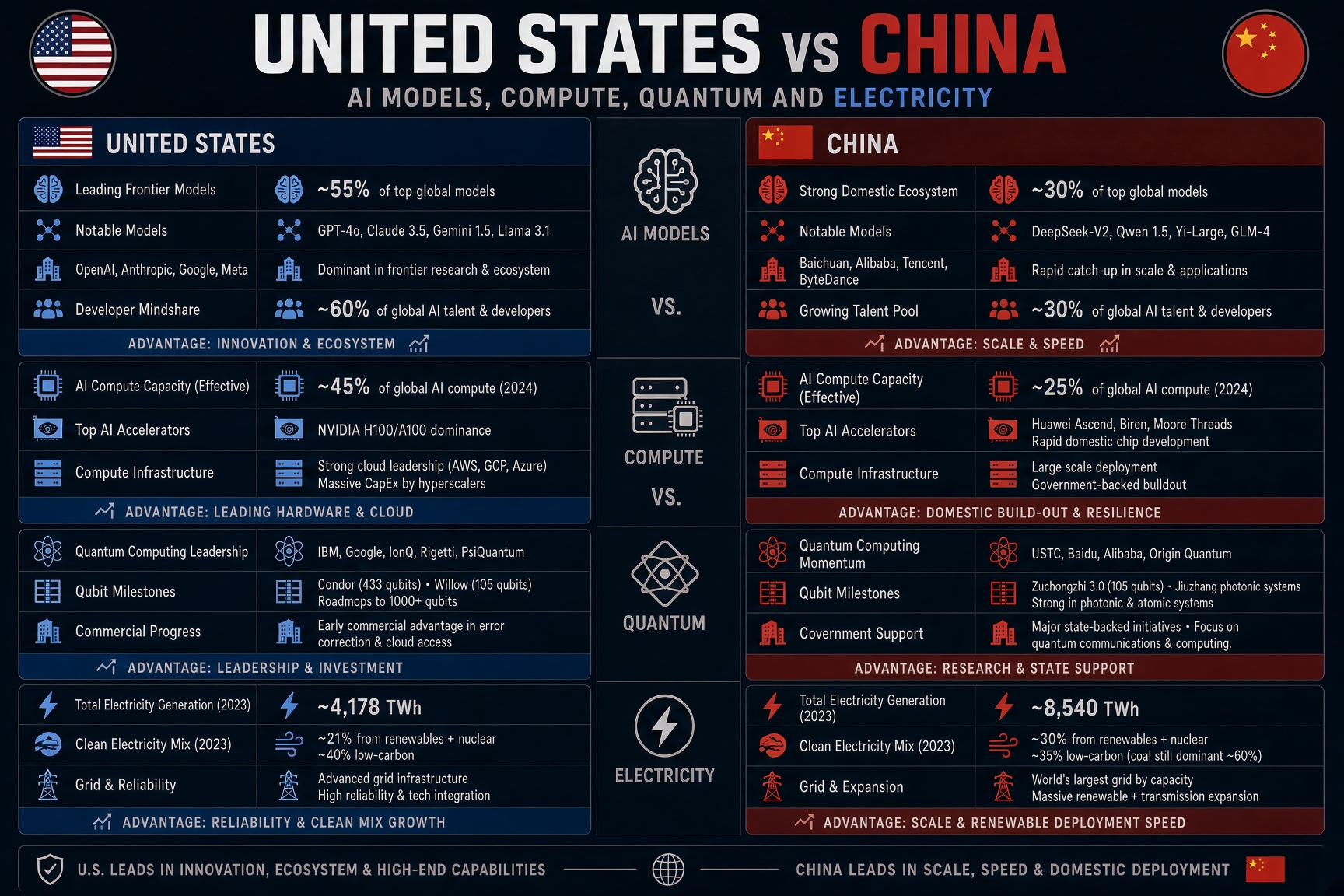
United States vs China: AI Models, Compute, Quantum and Electricity
The United States still leads in frontier model capability, total AI compute and quantum error correction, while China has narrowed the gaps in model performance, open-weight adoption and domestic chip volumes, and holds a structural advantage in power for data centres. Shayne Heffernan sets out the developments from July to October 2026 across models, compute, quantum and electricity, and how fast China is catching up.
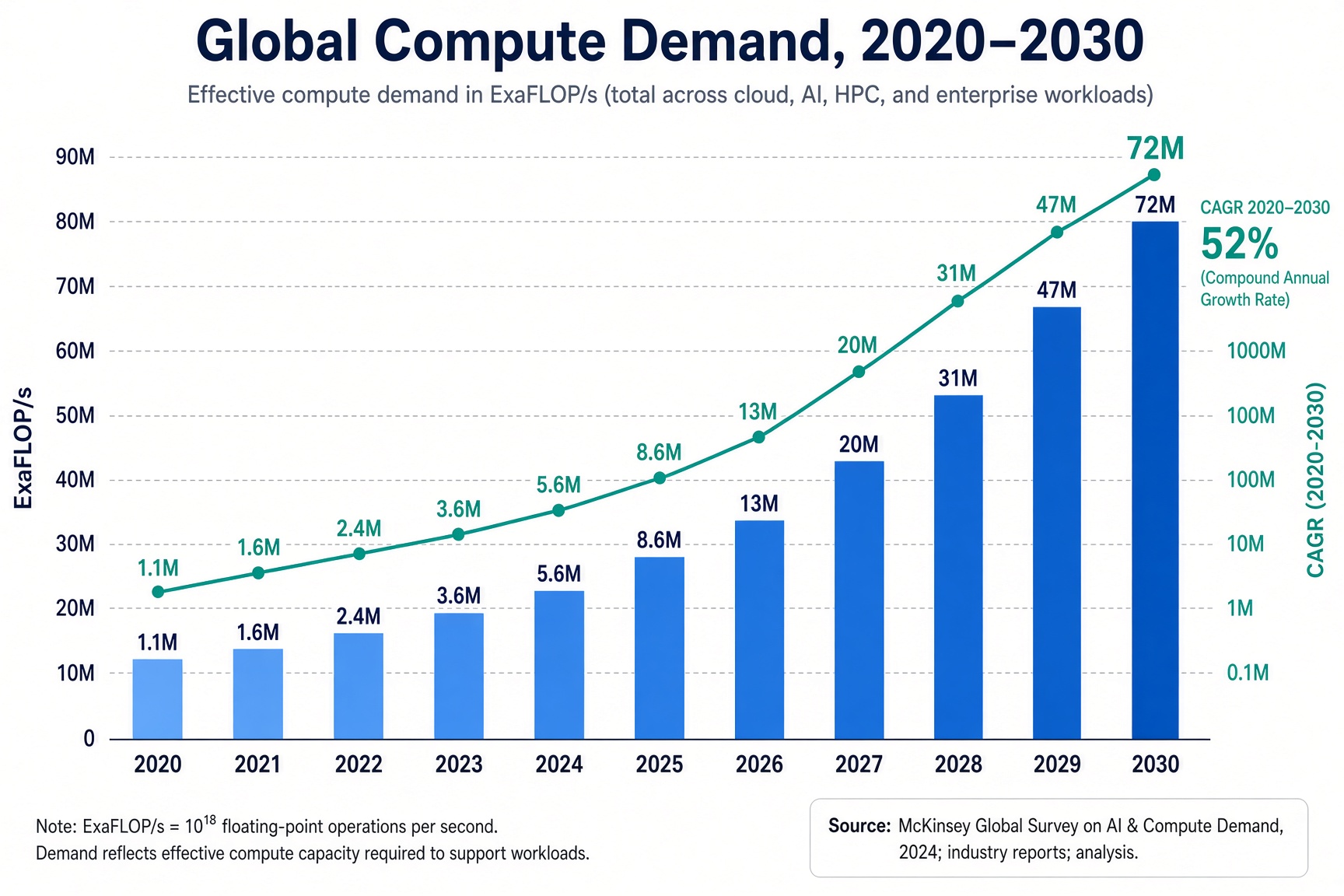
The 2030 Compute Landscape: GPUs, Power and the Architecture of Intelligence
The constraint on AI is no longer ideas or data but compute and the power to run it. Frontier training compute has grown about five times a year since 2020, and the leading AI supercomputer of June 2030 is on course for about 2 million chips and 9 gigawatts. Shayne Heffernan sets out the 2030 arithmetic, the power problem, who has already contracted the gigawatts, and how GPUs, custom ASICs, wafer-scale engines and quantum machines divide the work.

How Can You Trust AI When You Cannot Trust Humans?
Can you trust AI? Can you trust humans? More often than we like to admit, the answer is no. AI inherits its failures from the human records it is trained on. Sheikh Mohammed bin Rashid wrote this month that the currency the UAE is betting on is trust. This piece sets out what a trust layer has to do, shows the method on three public knowledge graphs, and lays out the post-quantum work KXCO has published so that an institution can check the claim rather than take it.
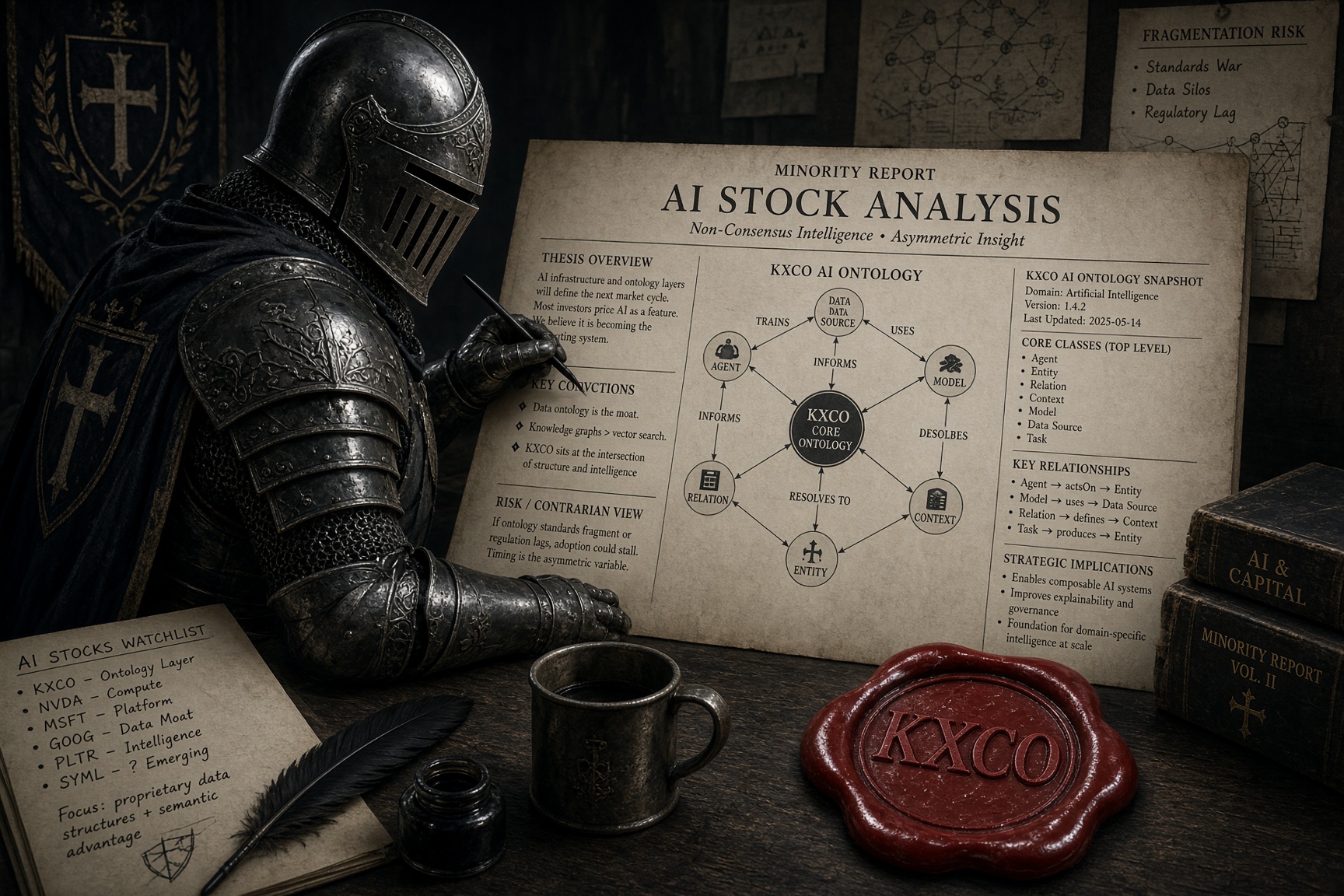
KXCO AI Ontology at 3 Months: What It Called and What Comes Next
On 19 July 2026 the Round Table's AI room published its first Analyst Outlook. To the 16 October 2026 close its 13 names rose 2.6% on an equal weight against 2.1% for QQQ, per StockAnalysis closes, and the six it opened with 35% or more of upside rose 8.6%. This piece lists the six names up more than 5%, the ten names I rate as opportunities now, the month's results in AI and quantum computing, and the official data showing that four in five firms have not yet started using AI.
Every story, signed and delivered.
Subscribe to the kxco channel and get the headline, the AI-written key takeaways, and the chain-anchor link the moment we publish. Audio versions and per-ticker subscriptions arrive in the next iteration.