
Wall Street This Week SpaceX and Beyond
The record SpaceX IPO, the data that moves the tape, the AI and quantum names getting attention — and why thinning summer volume changes how this market trades.
By Shayne Heffernan
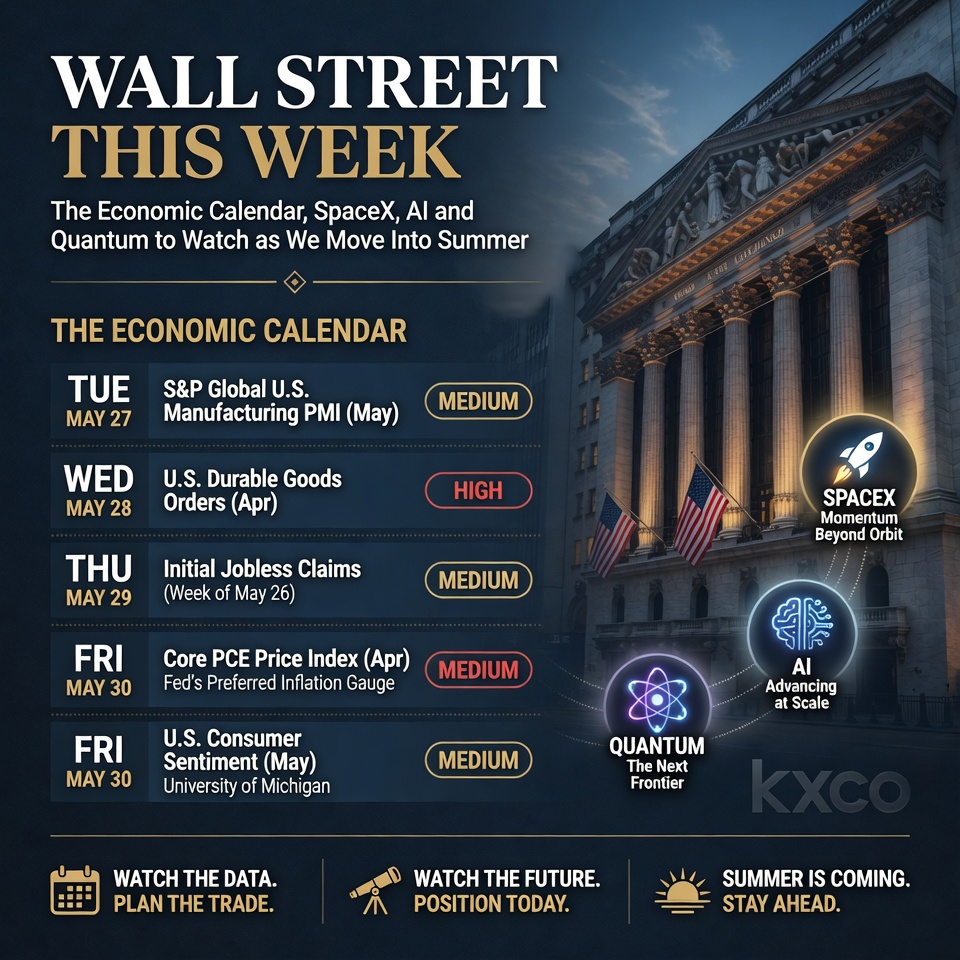
The tape is doing that thing it does every June. The urgency of spring earnings season has faded, the big macro prints are spaced further apart, and you can feel desks starting to thin out as the first wave of summer holidays begins. That does not mean nothing is happening — it means the things that are happening matter more, because there is less liquidity to absorb them. And this particular week handed us the single biggest market event of the year: SpaceX went public on Friday in the largest IPO in history. This is the week to get your watchlist tight, your levels marked, and your risk sized for a market that can move further on less volume than it did three months ago.
Below is how I am framing the week: the economic calendar that actually moves the tape, the SpaceX listing and what it means now that SPCX is a real, liquid stock, the AI headlines I am watching, the quantum names that keep grabbing attention, and what the move into summer typically does to volume and volatility. Trade your own plan — this is how I am reading it, not financial advice.
Wall Street this week: the setup
Coming into the week, the market’s personality is still defined by the same two-front battle that has run all year: the path of interest rates against the durability of the AI capital-expenditure cycle. Every rally and every flush traces back to one of those two stories. When rate-cut odds firm up, the rate-sensitive corners — small caps, real estate, long-duration growth — catch a bid. When the AI trade is in favour, a handful of mega-cap names do the heavy lifting and the index masks how narrow the participation really is. This week added a third force on top of those two: a record-breaking IPO large enough to pull capital, attention, and benchmark flows around with it.
That narrowness is the single most important feature of this market to keep in front of you. Breadth has been the quiet tell all year. On the strong days, look at how many names are actually making new highs versus how much of the index move is coming from the top five or six weights. A market that climbs on narrow breadth is not wrong — it can run for a long time — but it is fragile, and fragility plus thin summer liquidity is the combination that produces the sharp, out-of-nowhere down days that define July and August.
My posture into the week is constructive but unhurried. I want to own quality, I want to be patient on entries, and I want to respect that the easy part of the year — the post-earnings drift, the spring melt-up — is largely behind us. The back half of June is about positioning for what summer actually delivers rather than chasing what spring already gave.
The economic calendar that matters
The mid-to-late June calendar is front-loaded with the data that tells us whether the consumer is still carrying the economy and whether the disinflation story is intact. The releases to watch are the recurring monthly prints — retail sales, industrial production, housing starts and building permits, existing home sales — plus the weekly initial jobless claims, which have quietly become one of the most important high-frequency reads on the labour market. Claims are the canary: as long as they stay contained, the soft-landing narrative holds; a sustained move higher would change the whole conversation.
Housing is the sector I would not ignore. Mortgage rates have kept activity subdued, and the housing prints give you a clean read on how the rate environment is feeding through to the real economy. Weak housing alongside soft retail sales would strengthen the case for cuts; resilient housing would complicate it. Either way, the rates desk will trade off these numbers.
The Federal Reserve sits at the centre of the week’s gravity. A June policy decision, the accompanying statement, the updated Summary of Economic Projections and the famous “dot plot,” and the Chair’s press conference together carry more weight than any single data point. Markets do not just trade the decision — they trade the dots and the tone. Watch how the projections shift relative to the prior set, and watch the press conference for any change in how the Chair characterises the balance of risks. The reaction function matters more than the headline. (Confirm the exact meeting dates and release times against the official schedule before this goes out.)
One hard scheduling fact for the week: U.S. markets observe Juneteenth on June 19, so equities and bonds are closed for the holiday. Holiday-shortened weeks compress activity into fewer sessions and tend to thin liquidity around the break — exactly the kind of structural detail that gets ignored until a low-volume session produces an outsized move. Plan position sizing around it.
Rounding out the calendar are the flash purchasing managers’ indices, the University of Michigan consumer sentiment read, and, toward month-end, the Fed’s preferred inflation gauge in the PCE series. The PMIs are useful because they are timely and forward-looking; sentiment matters because the consumer has been the load-bearing wall of this expansion; and PCE is the print the Fed actually optimises against. Take them as a package, not in isolation.
SpaceX goes public: the biggest IPO in history
The headline event of the week — and frankly of the year — is that SpaceX is now a public company. The IPO priced Thursday after the close at $135 a share and the stock began trading Friday on the Nasdaq under the ticker SPCX. The numbers are staggering: roughly $75 billion raised, around three times the size of the next-largest IPO ever, at a pricing valuation near $1.75 trillion. Elon Musk, the company’s largest shareholder, rang the opening bell alongside President and COO Gwynne Shotwell. This is not a normal listing; it is the largest IPO in market history, and it instantly created one of the most valuable public companies in the world.
The first session went exactly the way a hot, scarcity-driven mega-IPO tends to go. SPCX opened around $150, pushed up into the $160s within the first hour, briefly carried the implied valuation past $2 trillion, and closed its debut day near $161 — roughly a 19% gain over the $135 offering price. That kind of pop is a statement of demand, but seasoned traders know what a first-day IPO print actually reflects: limited float, index and benchmark anticipation, and momentum-chasing, not a settled view of fair value. The opening weeks of a blockbuster listing are about supply and demand for a scarce new asset as much as they are about the business underneath it.
So what are you actually buying when you buy SPCX? A company with three distinct stories bundled together: the launch business that made the name, the Starlink satellite-internet division, and the broader satellite-and-AI ambitions on top. The crucial detail for valuation is that Starlink is the only profitable part of the business today. The launch operation is strategically dominant but lumpier and more capital-intensive, and the company as a whole has carried significant losses while it scaled. In practice, owning SPCX is a bet on Starlink’s growth trajectory plus a large slug of optionality on everything else — Starship, deep-space ambitions, and the AI angle. Price that optionality with your eyes open.
On valuation, respect the magnitude of what just happened. A $1.75 trillion pricing that traded past $2 trillion on day one is a number that already discounts extraordinary execution for years to come. I am not in the business of telling anyone a great company is a bad stock or vice versa — but a record-setting IPO that pops 19% out of the gate is exactly the kind of setup where the price can get ahead of even a phenomenal business. The company can do everything right and the stock can still need time to grow into its valuation. Those two things are not in conflict; they are the normal life cycle of a richly priced debut.
Here is what I am watching now that it trades. First, the lock-up. Like every IPO, there will be a period during which insiders and early investors cannot sell, and the expiry of that lock-up is a well-known source of future supply and downward pressure — mark the date when it is disclosed. Second, the first earnings report as a public company: that is when the market gets a clean, audited look at the revenue mix, Starlink’s growth rate, and the path on overall profitability, and it will be the first real fundamental test of the valuation. Third, expect volatility. A heavily owned, retail-beloved, Musk-led stock with a concentrated ownership structure is going to move, and the governance reality of a founder-controlled company is part of what you are signing up for.
The practical takeaway flips entirely from where it stood a week ago. SpaceX is no longer a private-market puzzle of tender offers and illiquid secondary shares — it is a liquid, listed, transparent stock you can actually trade. That is a genuinely historic change in access. But access is not a reason to chase. “Largest IPO ever, up 19% on day one, valued above two trillion dollars” is a description of euphoria, not an entry signal. My approach to any blockbuster debut is the same: let the initial frenzy settle, let the lock-up and the first earnings give you real information, and size any position for the volatility that always follows a listing this size.
AI news to watch
The AI complex is still the market’s centre of gravity, and the story has matured from “will this be big” to “who monetises it and what does it cost to run.” The first thing I am watching is the capital-expenditure cycle from the hyperscalers. The cloud giants are spending at a scale that has its own macro footprint, and the market has tied a lot of the AI trade to the assumption that this spending continues. Any sign that capex guidance is being trimmed — or, conversely, raised again — moves not just the spenders but the entire supply chain that feeds them.
That supply chain is where the cleanest read on AI demand lives. The semiconductor names at the centre of the build-out remain the bellwether; their order books, lead times, and forward commentary are the closest thing we have to a real-time gauge of AI infrastructure demand. Watch the read-through from networking, memory, and the broader data-centre hardware stack. When the chip leadership trades well on strong volume, the AI trade is healthy; when leadership stalls and the move narrows to one or two names, be careful.
The second theme is the shift from training to inference, and from raw model capability to cost and efficiency. The competitive battle is increasingly about delivering capable models cheaply enough to run them at scale. That puts a premium on custom silicon, on power efficiency, and on the unglamorous plumbing of serving models in production. The companies that win the inference-cost war capture the recurring economics; the ones that only win benchmarks do not necessarily win the business.
Third — and this is the most underappreciated angle — is power. AI infrastructure is an electricity story as much as a silicon story. Data-centre power demand has become a genuine constraint, and that has pulled utilities, grid operators, independent power producers, and even nuclear into the AI conversation. If you want a less crowded way to express an AI view, the energy-and-grid side of the trade is where a lot of the next leg of spending has to go, because you cannot run the chips without the power. There is also an obvious thread connecting this week’s headline to the AI theme: a newly public SpaceX, with Starlink and an explicit AI ambition, is now another large listed vehicle competing for capital inside the same story.
Finally, keep one eye on the policy and model-release cadence. New frontier model launches, enterprise adoption data, and the regulatory backdrop around AI all function as sentiment catalysts. None of these are things to chase on the headline — but they set the tone, and in a thin summer market, tone moves price more than it should.
Quantum companies getting attention
Quantum computing has graduated from a research curiosity into a genuine speculative theme on the tape, and the attention is not evenly distributed. There is a clear split between the large, diversified technology companies pursuing quantum as one programme among many, and the smaller, pure-play public names whose entire equity story is quantum. Both deserve a place on the watchlist, for very different reasons.
On the large-cap side, the established technology platforms continue to publish hardware roadmaps and error-correction milestones, and those announcements are the real catalysts for the sector. Progress on error correction in particular is the metric that matters, because it is the bridge between today’s noisy, experimental machines and anything commercially useful. When a credible player demonstrates a step-change in error correction or qubit quality, it re-rates sentiment across the entire group, including the small caps that did not produce the result.
The pure-play names are where the volatility lives. This is a cohort of smaller companies — spanning trapped-ion, superconducting, and annealing approaches — that have seen enormous, sentiment-driven swings. These stocks can double and halve on news flow, partnerships, government contracts, and sector-wide enthusiasm, often with limited current revenue to anchor the moves. That is the definition of a speculative theme: the optionality is real, but so is the downside, and position sizing is everything. I treat these as small, deliberate, high-variance allocations, not core holdings, and I never confuse a powerful narrative with a proven business model.
There is a second-order angle here that sits close to home for me. The same progress that makes quantum computing exciting is what makes post-quantum cryptography urgent. A sufficiently capable quantum machine threatens the public-key cryptography that secures finance, communications, and records today, which is precisely why the migration to quantum-resistant standards is already underway across serious institutions. If you are going to follow the quantum-hardware story, follow the quantum-security story alongside it — the threat and the defence are two halves of the same trade, and the defensive side has a clearer near-term commercial path.
The disciplined way to play the theme: anchor exposure with the diversified large-caps that can survive a long timeline, keep the pure-play speculation small and sized to lose, and watch error-correction milestones as the catalysts that actually matter rather than trading every press release.
Moving into summer: what to expect on volume
Now the seasonal reality. As we move out of June and into July and August, the dominant feature of the market is not direction — it is the decline in participation. Summer volume thins out, and it thins out for mundane structural reasons: portfolio managers and traders take holidays, desks run with reduced staff, and the institutional flow that provides the market’s liquidity simply gets quieter. The old “sell in May and go away” adage is a crude oversimplification, but the kernel of truth inside it is real — the summer months historically see lighter volume and, often, choppier, more directionless price action.
Lower volume is not a neutral condition. It changes the character of the market in a specific way: with fewer participants and less depth in the order book, it takes less flow to move price. The same sized order that gets absorbed quietly in a deep April market can move the tape noticeably in a thin August one. That is why summer is paradoxically known both for sleepy, low-range drift and for sudden, violent air pockets. Both come from the same source — thin liquidity. A market can grind sideways on no volume for weeks and then gap hard on a single catalyst because there is nobody on the other side to cushion it. A brand-new mega-cap like SPCX finding its feet through that thin tape only adds to the potential for outsized moves.
August deserves particular respect. It is historically one of the thinnest liquidity months of the year, and that thinness has repeatedly turned modest catalysts into outsized moves. Some of the more memorable volatility spikes of recent market history have landed in the back half of summer, precisely because a surprise hitting a low-liquidity tape gets amplified. I am not predicting a repeat — I am saying the structural conditions that make those events possible are seasonal, and they are coming.
How I adjust for it is straightforward. First, I size down. The right position in a thin market is smaller than the right position in a deep one, because slippage and gap risk are higher. Second, I respect levels more, not less — in low volume, technical levels can produce cleaner reactions because there is less noise around them, but breaks can also run further before they are faded. Third, I keep dry powder. Summer air pockets are opportunities for buyers with cash and patience; they are disasters for the fully invested and over-leveraged. And fourth, I do not over-trade a quiet tape. Forcing trades in a low-conviction, low-volume environment is how good years get given back.
There is also an opportunity in the seasonality if you flip it around. Thin markets misprice things. The summer is when neglected names, fallen out of the spotlight while everyone is at the beach, can be accumulated patiently by investors with a longer horizon. Some of the best entries of the year are made in the quiet weeks of August when nobody is paying attention. The discipline is to be the patient buyer into weakness rather than the forced seller into an air pocket.
The bottom line
This week is a transition week — from the data-dense, earnings-driven spring market into the thinner, more headline-sensitive summer one — and it arrived with a genuine landmark in the SpaceX IPO. The macro calendar still carries real weight, with the Fed at the centre and the consumer and housing data filling in the picture, and a holiday-shortened week to plan around. SpaceX is no longer a private-market story: SPCX is public on Nasdaq after the largest IPO in history, and the debate now shifts to valuation, Starlink’s profitability, the eventual lock-up, and the volatility that always follows a debut this size. The AI trade is still leadership, but the questions have shifted to monetisation, inference cost, and power. Quantum is a real and growing theme with a clear split between durable large-caps and speculative pure-plays, and a post-quantum security story riding alongside it.
Above all, respect the season. Volume is going to fall, and falling volume changes everything about how this market moves — including how a freshly listed giant like SPCX trades. Size down, stay patient, keep cash, and let the thin tape come to you rather than chasing it. The traders who treat summer with respect tend to be the ones still standing — and still liquid — when the volume comes back in September. Trade well, manage risk, and enjoy the season.
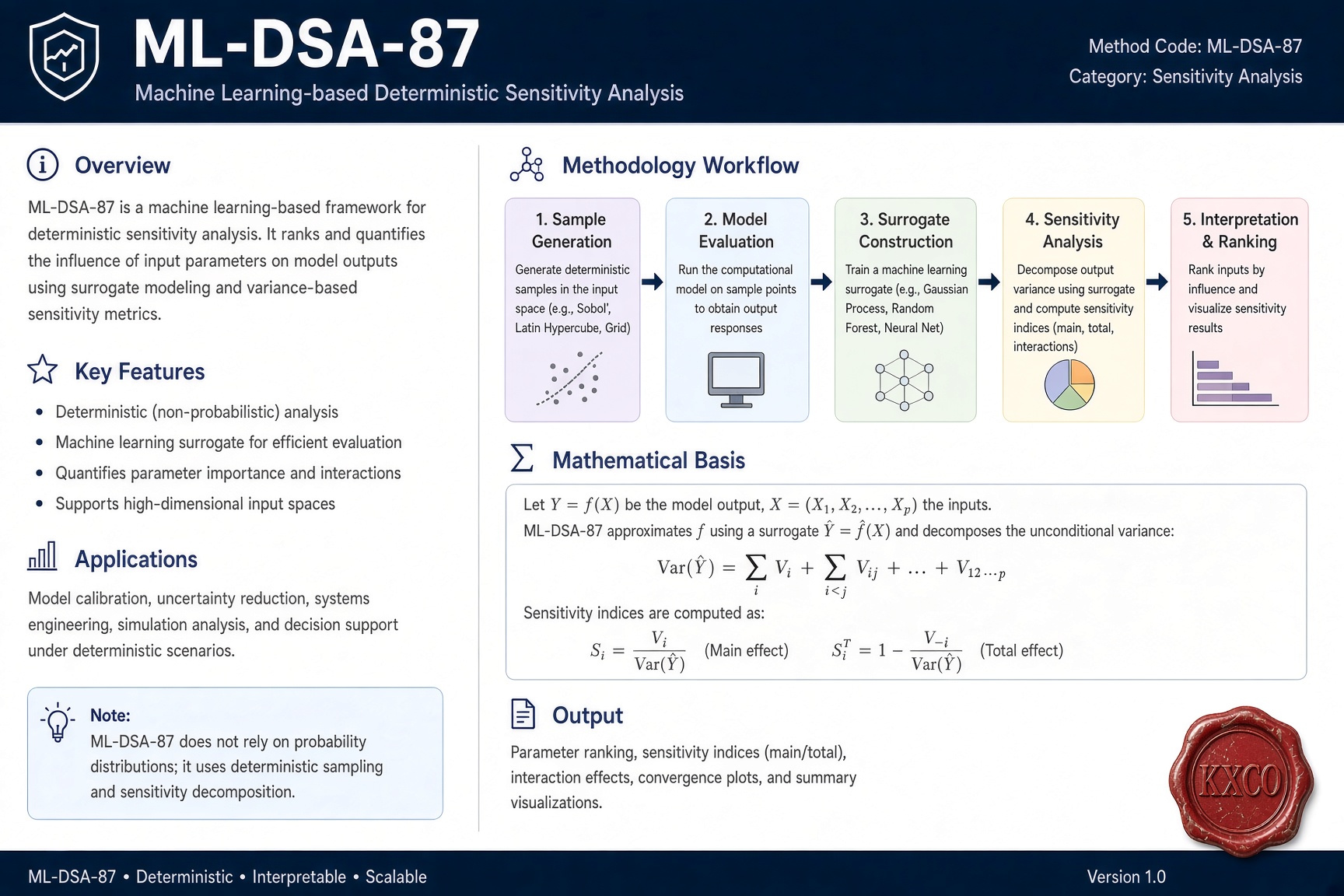
KXCO Now Verifies ML-DSA-87 in Consensus, the Signature Level Named by the NSA
On 6 October 2026 KXCO's chain began verifying ML-DSA-87 signatures as a rule of consensus, and the first ML-DSA-87 identity registered 28 seconds later. ML-DSA-87 is the category 5 level of NIST's FIPS 204, specified by the NSA for US national security systems and preferred by Australia's Information Security Manual. KXCO ships it for signing and for keys held in hardware, accepts it across its network and verifies it on chain, and anyone can check a verdict.
Weekly Market Outlook: Fed Minutes, Anthropic and OpenAI IPOs, Gold, Bitcoin, FX
The Fed raised rates in September and payrolls rose 29,000, per the Labor Department. This week the FOMC minutes, three Treasury auctions and a 10-year near 5.3 percent test that gap. Anthropic's IPO clock runs toward a 14 October investor day while OpenAI's chief executive says not 2026. Gold sits 26 percent below its record, bitcoin near $85,500, the dollar up three weeks running. Two knowledge graphs from KXCO's records map the IPO backers and the FDA board.

Post-Quantum Has a Deadline: 2030 for Keys, 2031 for Signatures
Executive Order 14412 gives federal high-value systems until 31 December 2030 for post-quantum key establishment and until 31 December 2031 for signatures. Six of the seven official calendars put a milestone in 2030. The Order reaches vendors through the contract, the purchase, the build, the data and the inventory. The runtimes already moved: a stock Node.js client negotiates X25519MLKEM768 by default. What is left is in the application.
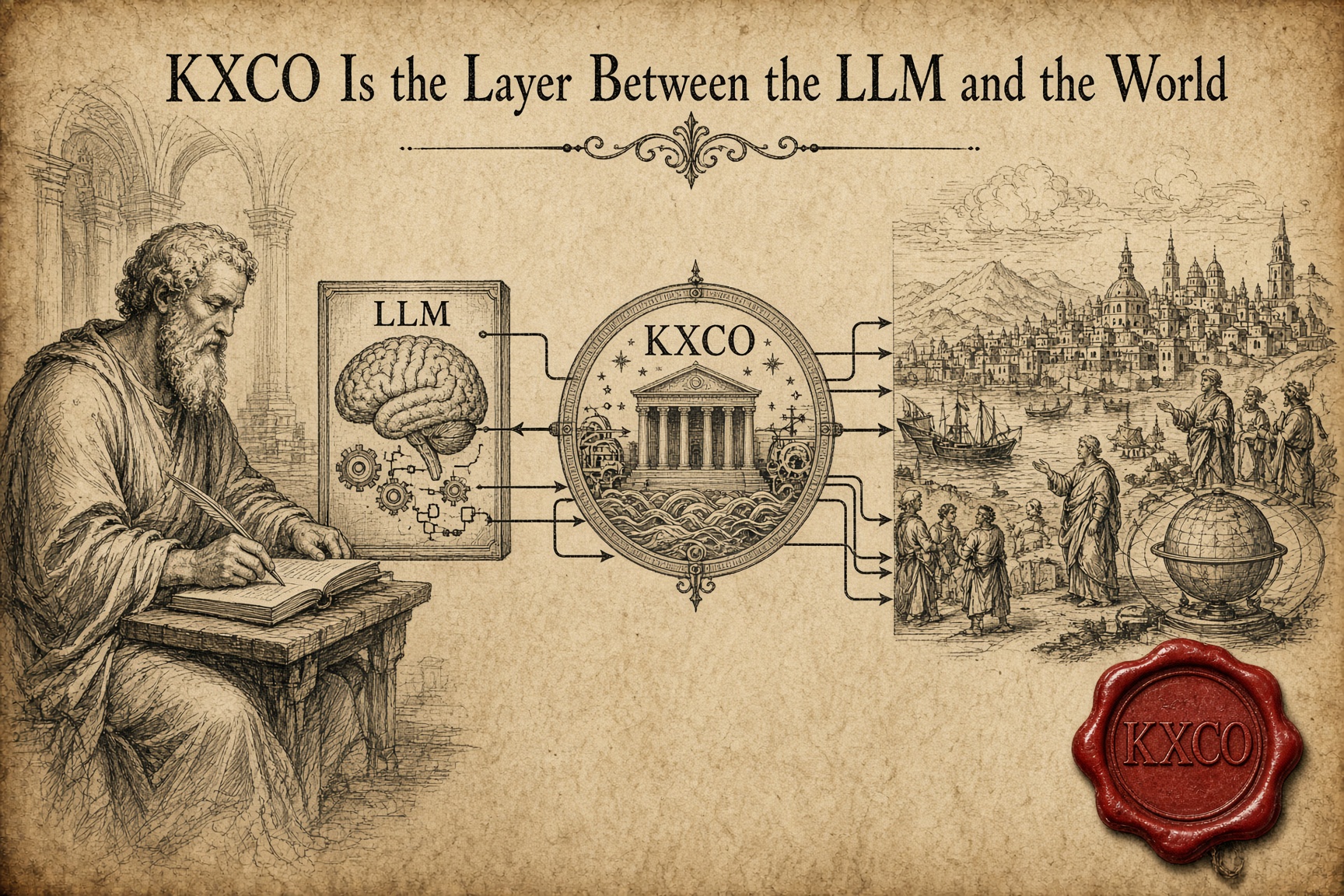
KXCO Is the Layer Between the LLM and the World
Give a hundred people the same book and very few will act on it. AI is that book: it distributes access, not understanding, and an institution cannot act on a paragraph. KXCO does not build another model or another agent. It builds the layer between the model and the world: who is speaking, what they are allowed to do, what they committed, and a post-quantum signature a stranger can check without asking us.
Every story, signed and delivered.
Subscribe to the kxco channel and get the headline, the AI-written key takeaways, and the chain-anchor link the moment we publish. Audio versions and per-ticker subscriptions arrive in the next iteration.