
Saylor Is Buying What $IBIT Holders Are Selling — At Scale
$MSTR $IBIT $BTC $TLT
Part of theBlockchain Center
Saylor is Outsmarting the Bitcoin ETFs
In the two and a half years since spot Bitcoin ETFs launched, a clear pattern has emerged that few in traditional finance want to acknowledge. While BlackRock’s iShares Bitcoin Trust (IBIT) and other ETF vehicles have delivered massive net inflows overall, they have also created repeated windows of forced or panic-driven selling. Michael Saylor, through Strategy Inc. (formerly MicroStrategy), has systematically stepped in during many of those exact windows.
Saylor is not merely accumulating Bitcoin. He is accumulating it when ETF holders are capitulating. This is not coincidence. It is strategy.
The Core Dynamic
Bitcoin ETFs are vehicles of convenience and liquidity. Investors can buy or sell exposure with the click of a button, often reacting to short-term price moves, macro headlines, or portfolio rebalancing. When Bitcoin corrects — as it did after the late-2025 highs above $126,000 and again in May–June 2026 — ETF redemptions surge. Authorized participants redeem shares, and Bitcoin leaves the funds.
Strategy, under Saylor’s direction, operates on a completely different time horizon. The company raises capital (primarily equity) and deploys it into Bitcoin with mechanical consistency. There is almost no selling. The only notable disposal in 2026 was a trivial 32 BTC in early June to cover preferred stock obligations — roughly 0.004% of holdings.
The result is a one-way absorption machine that activates most aggressively precisely when ETF flows turn negative.
Evidence in the Timing: Major IBIT Outflows vs. Strategy Buys
The following table highlights several of the most significant IBIT outflow events since late 2025 and the Strategy purchases that occurred in close proximity. Prices are approximate based on prevailing market levels at the time.
Period / Key Date | IBIT / ETF Outflow Details | Approx. BTC Equivalent (Outflow) | Strategy (MSTR) Buy Nearby | BTC Purchased by Strategy | Notes on Timing |
|---|---|---|---|---|---|
Nov–Dec 2025 | Longest outflow streak on record; >$2.7B withdrawn over ~5 weeks; multiple days >$400M–$523M | Tens of thousands | Heavy ongoing accumulation throughout late 2025 | Multiple large tranches | MSTR buying through the heaviest institutional redemption wave to date |
~Jan 30, 2026 | Record single-day IBIT outflow ~$528M | ~6,500–7,500 | January 2026 buying spree (multiple 13k–22k BTC weeks) | ~40,150 BTC in Jan alone | One of the largest monthly hauls came as IBIT saw near-record daily selling |
May 18, 2026 | ETF complex saw ~$648M outflows that week | Several thousand | 24,869 BTC purchased | 24,869 BTC | Direct overlap — major Strategy purchase during active outflow pressure |
May 27–28, 2026 | IBIT $528M single-day outflow (2nd largest ever); ~$2.43B over 9 sessions in May | ~6,500+ on peak day; broader streak much larger | Continued buying momentum from mid-May | Part of ongoing 2026 accumulation | Saylor’s team active as ETF redemptions peaked amid geopolitical and macro stress |
Early June 2026 (e.g. June 5) | >$2B ETF outflows in streak; IBIT $214M one day (~3,580 BTC) | Thousands | 1,550 BTC on June 8 (after tiny 32 BTC technical sale June 1) | 1,550+ BTC | Buying resumes immediately after heavy redemption days |
Broader May–June 2026 | Multiple billion-dollar outflow streaks | 15,000–25,000+ across period | April–June 2026 cluster: 34k (Apr 20), 13.9k (Apr 13), 24.8k (May 18), etc. | >70k BTC in ~2 months | Concentrated buying during the most sustained ETF selling pressure of 2026 |
This is not cherry-picking isolated days. It reveals a repeatable pattern: when ETF holders hit the sell button in size, Strategy has capital ready and deploys it.
2026: One Company vs. Global Mining Supply
The scale becomes even more striking when we examine 2026 numbers.
As of early May 2026, Strategy held 818,334 BTC — a 22% increase year-to-date. By June 8, holdings reached 845,256 BTC. Starting the year near 671,000 BTC, Strategy added roughly 174,000+ BTC in the first five-plus months of 2026 alone.
Now consider global Bitcoin mining output.
Since the April 2024 halving, the block subsidy is 3.125 BTC. With an average of approximately 144 blocks mined per day, the entire network produces roughly 450 new BTC per day.
From January 1 to June 8, 2026 (roughly 159 days), total new Bitcoin mined worldwide was approximately 71,500–72,000 BTC.
Strategy purchased more than 2.4 times the entire global mining output during that same period.
Let that sink in.
While thousands of miners worldwide — many operating at thin margins — collectively produced ~72,000 BTC, one publicly traded company absorbed more than double that amount through open-market and negotiated purchases. Saylor is not just competing with miners for new supply; in 2026 he has been outpacing them dramatically.
This is the definition of asymmetric accumulation. Miners must sell a portion of their production to cover electricity, operations, and debt. Strategy has no such obligation. It raises fiat capital on its own terms and converts it into Bitcoin with discipline.
Why the Timing Matters
ETF outflows are not random. They cluster during periods of price weakness, higher volatility, or negative macro sentiment. These are exactly the moments when weak hands — including institutions using ETFs for tactical exposure — exit.
Saylor’s approach inverts this. By maintaining continuous access to capital markets and a stated policy of aggressive accumulation, Strategy turns ETF weakness into opportunity. Every Bitcoin that leaves an ETF during a redemption is Bitcoin that must find a new home. Strategy has repeatedly been one of the largest and most reliable buyers in those windows.
This creates a powerful flywheel:
ETF redemptions increase available supply on the market.
Strategy deploys fresh capital into that supply.
Bitcoin per share for Strategy investors rises.
Long-term holders benefit from reduced liquid supply.
Meanwhile, ETF investors who sold during the fear often watch prices recover without them.
The Philosophical Divide
Saylor has repeatedly framed Bitcoin as digital property and the superior treasury reserve asset. His company does not trade Bitcoin. It holds it. The occasional tiny technical sale (like the 32 BTC in June 2026) is noise against a multi-year, multi-hundred-thousand-BTC accumulation campaign.
ETF holders, by contrast, treat Bitcoin exposure as a tradable security. Many have short time horizons, risk mandates, or performance pressure that forces selling during drawdowns. This behavioral gap is what Saylor is exploiting.
When institutions rotate out of Bitcoin ETFs during a correction, they are effectively offering discounted Bitcoin to longer-term, higher-conviction buyers. Strategy has the balance sheet flexibility and mandate to accept that offer repeatedly.
Broader Market Implications
This dynamic has profound effects on Bitcoin’s supply dynamics. With daily issuance now fixed at ~450 BTC and declining further in future halvings, consistent large-scale buying by even a few sophisticated actors can materially tighten available float.
In 2026 alone, Strategy’s purchases have removed more new supply from the market than all miners produced. When combined with other corporate and high-net-worth accumulation, plus lost coins and long-term HODLers, the effective liquid supply available to short-term traders and ETF flows shrinks.
ETFs still matter enormously for price discovery and liquidity. But their flows are two-sided. Saylor’s flows are almost entirely one-sided — and they intensify when the other side is weakest.
Risks and Counterarguments
Critics will point out that Strategy uses leverage and equity dilution to fund purchases. Share count has risen significantly. The stock can trade at premiums or discounts to net asset value. Bitcoin itself remains volatile.
These are valid observations. However, they miss the core thesis. Saylor is optimizing for Bitcoin per share over decades, not quarterly earnings or smooth NAV tracking. The dilution is the mechanism that allows faster accumulation than almost any other entity can achieve.
ETF holders who sold in May or June 2026 at lower prices have already realized losses relative to subsequent recovery potential. Strategy’s cost basis on its 2026 purchases sits comfortably below many of those exit points.
The Verdict on Timing
The data is clear. In multiple high-profile periods — November–December 2025, January 2026, and especially the May–June 2026 outflow clusters — Strategy was actively buying while IBIT and the broader ETF complex were experiencing significant redemptions.
Saylor is not merely riding the Bitcoin wave. He is positioned as the consistent buyer of last resort during the precise moments when ETF-driven selling pressure is highest. In doing so, he has accumulated Bitcoin at a pace that dwarfs global mining production in 2026 and transferred a meaningful portion of supply from weak hands into strong, long-term custody.
Whether this continues depends on Strategy’s ability to keep raising capital on favorable terms and Bitcoin’s long-term adoption curve. But the pattern through mid-2026 is unmistakable.
Michael Saylor is not just holding Bitcoin. He is buying it when the ETF holders are selling.
And the numbers show he is doing it at a scale that is reshaping the supply dynamics of the asset itself.

Wall Street Week Ahead: Rates, Oil, AI, Quantum, Defense, Metals and Bitcoin
The trading week opens after a Federal Reserve that chose to hike, a White House that chose not to strike Yemen, and an oil market still pricing a war now in its seventh month. The useful work this week is not a list of tickers. It is a map of what depends on what: the funds rate, the Magnificent Seven, a quantum cohort just handed a specification and a deadline, the missile primes selling into a restock, and gold, silver, crude and Bitcoin, all held against the live AI sector ontology.
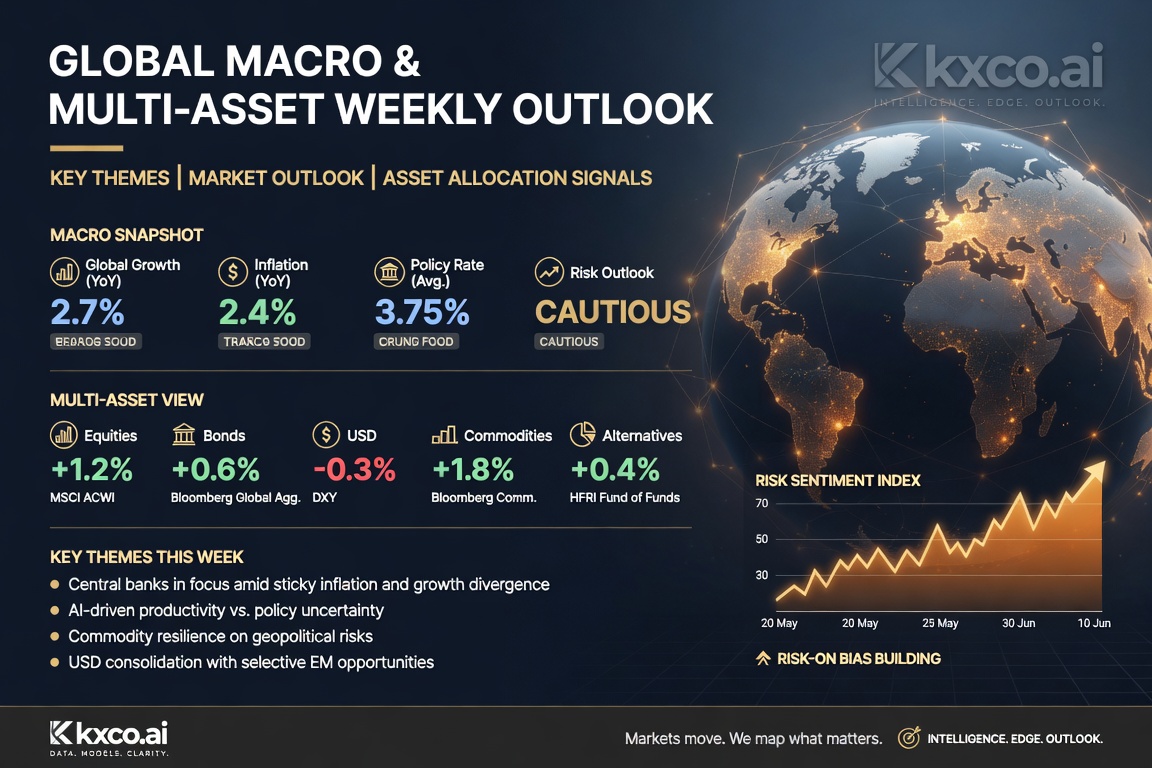
GLOBAL MACRO & MULTI-ASSET WEEKLY OUTLOOK
Markets look strong on the surface, but breadth is collapsing and more dips are coming. Patience and scale-in buying will separate the winners from the FOMO crowd.

Economic Calendar and Trading Strategies for July 7–11, 2026
A trader's guide to the week of July 7–11, 2026: the US and China economic calendar, the Fed-pivot test after a soft jobs report, and how to trade Nvidia, SpaceX, Bitcoin, the dollar, gold, silver, AI and quantum. Track every release on Live Trading News.

Is the Iran War Back?
US Central Command struck Iran on June 26, nine days after a peace memorandum, after an alleged drone attack on shipping in the Strait of Hormuz. What it means for gold, Bitcoin, the defense complex — Palantir, Lockheed, RTX — and why the return of QE matters more than the bombs.
Every story, signed and delivered.
Subscribe to the kxco channel and get the headline, the AI-written key takeaways, and the chain-anchor link the moment we publish. Audio versions and per-ticker subscriptions arrive in the next iteration.