
How to Share Confidential Documents Securely with KXCO Sign Data Rooms
View-only sharing, a built-in NDA, and a complete audit trail of who saw what — here's how data rooms work and how to use them.
Part of theKXCO Center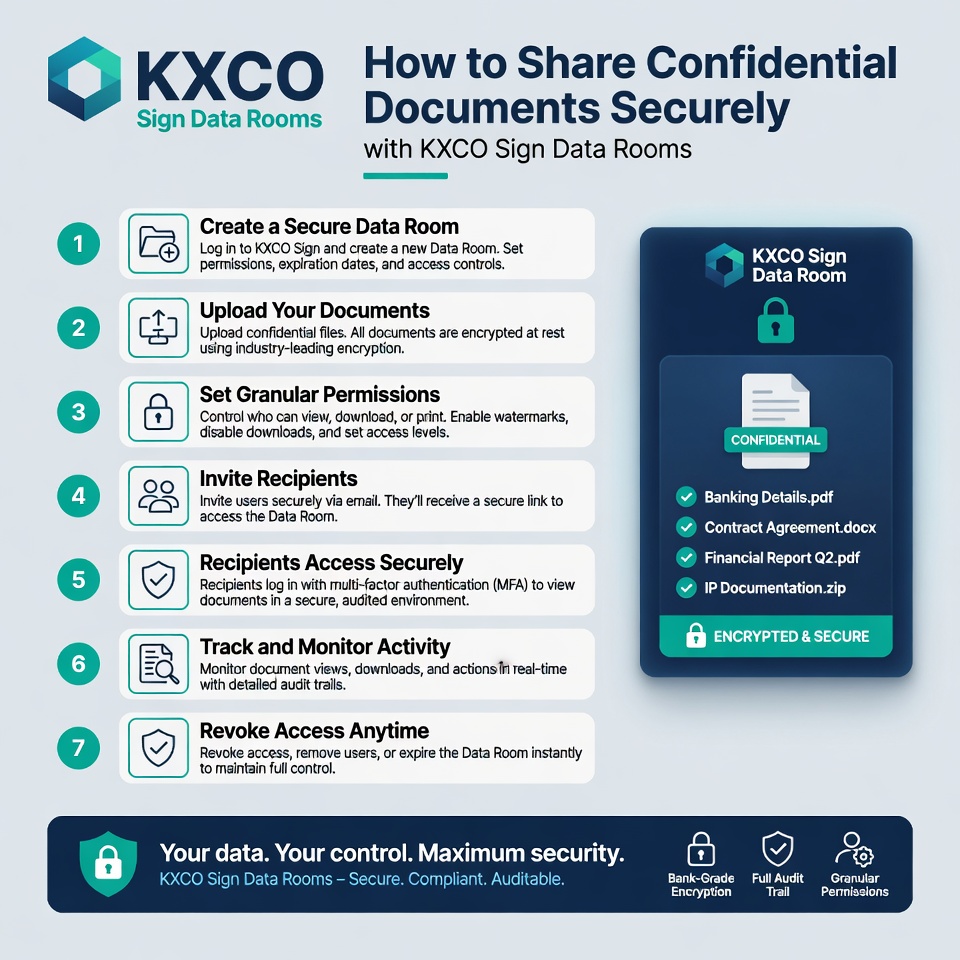
Every business eventually has to share documents it would rather not let out of its hands. A fundraise means handing your financials to investors. An acquisition means opening your books to a buyer's diligence team. A board meeting means circulating papers that must not leak. A legal matter means disclosing sensitive files to the other side. In each case you face the same uncomfortable trade-off: to make a deal happen, you have to let other people read things you cannot afford to lose control of.
The traditional answers are all bad. Emailing a PDF means the file is gone the moment it lands in someone's inbox — forwarded, downloaded, printed, screenshotted, with no record and no recall. A shared cloud-drive link is barely better. And full-blown enterprise "virtual data rooms" are powerful but priced and engineered for billion-dollar M&A, not for the steady stream of confidential sharing that ordinary businesses do every week.
KXCO Sign Data Rooms were built for exactly that gap: a simple, secure, view-only way to share confidential documents with named people, behind a built-in NDA, with a complete record of who saw what and when. This is a guide to what they do, how you use them, and where they fit.
What a data room actually is
A KXCO Sign data room is a private space where you upload documents and invite specific people — by email — to view them, but not download, copy, forward or print them. Before anyone sees a single page, they accept a non-disclosure agreement addressed to you. While they read, the platform records every view. And whenever you want, you can revoke their access instantly.
It is designed for the situations that come up constantly in real business life:
Fundraising — sharing a pitch deck, financial model and cap table with prospective investors.
Due diligence and M&A — letting a buyer's team review contracts, accounts and corporate records.
Board and investor materials — circulating sensitive papers without them ending up in a dozen downloads folders.
Legal and regulatory disclosure — providing documents to counsel or counterparties under controlled, recorded conditions.
Any confidential review — IP, customer lists, supplier terms, anything you need someone to read but not keep.
Crucially, data rooms are built into every KXCO Sign account. There is nothing extra to buy to get started, and every account's rooms are private to that account.
How to use a data room, step by step
The whole flow takes minutes. The full user guide walks through every screen; here is the shape of it.
1. Open the Data Room console. Log in at sign.kxco.ai and choose Data Room from the sidebar. You will see your existing rooms and a button to create a new one.
2. Create a room. Give it a clear name — "Series A — Diligence", say — and an optional description. You can also set an access code for an extra layer beyond the email link, useful when you want a code shared through a separate channel before anyone can enter.
3. Upload your documents. Add one or more files at once, and add more at any time. KXCO Sign converts office files to PDF and renders every page into secure images that are served only inside the locked viewer. The raw files are never placed at a public URL, so there is no link that quietly hands over the original document.
4. Invite viewers by email. Invite people one at a time, or in bulk by pasting many addresses separated by commas or line breaks. Each viewer receives their own unique secure link, and you get a copyable list of links to distribute through your own channels. No viewer needs an account.
5. Viewers accept the NDA and read. Before any document loads, each viewer accepts a built-in NDA addressed to you, then sees your documents in a locked, view-only viewer.
6. Track everything. Back in your console you see who opened the room, which pages they viewed and when — with the latest activity also surfaced on your dashboard.
The NDA gate: protection before the first page loads
This is one of the features that makes KXCO Sign Data Rooms feel built for serious use rather than casual file-sharing.
Every viewer, every time, must accept a click-to-agree non-disclosure agreement addressed to you before a single document appears. It is not a checkbox they can ignore — it is a gate. The viewer ticks to agree and types their full name, and that acceptance is recorded with their name, email address, the exact text of the NDA they agreed to, the time, and a cryptographic proof signed with a post-quantum (ML-DSA-65) key. A signed NDA certificate is then emailed to both parties.
The practical effect is significant. Instead of chasing people to sign a separate NDA before you send anything — and then hoping they actually read it — the NDA is woven into the act of opening the room. You end up with a clean, timestamped, cryptographically backed record that this specific person agreed to these specific confidentiality terms before they saw your materials. That is exactly the kind of evidence you want if a dispute ever arises.
The locked viewer: control while they read
Once a viewer is past the NDA, documents open in a deliberately constrained, view-only viewer. It is engineered to remove the easy ways a document escapes:
No download, no copy/paste, no printing, no text selection. There is no "save as" and no obvious way to pull the file out.
The view blurs the instant the tab loses focus, which deters the casual habit of lining up a screen-share or a second window to capture content.
Idle sessions time out automatically, so an open room left unattended on a screen does not stay exposed indefinitely.
Pages are rendered as images, not delivered as files, so there is no underlying document handed to the browser to begin with.
Together these turn "here is my confidential file" into "here is a window through which you may read my confidential file, for as long as I allow it."
Honest about the limits — because it matters
KXCO has a firm rule about how this feature is described, and it is worth repeating here because it is the opposite of how most "secure sharing" products are marketed.
A data room is strong deterrence plus complete traceability — not an absolute guarantee against a leak. No web platform on earth can stop a determined person from photographing their screen with a phone. Anyone who tells you their view-only viewer is leak-proof is overselling. What KXCO Sign Data Rooms genuinely give you is this: you remove the easy, frictionless ways to take a document; you put every viewer behind a recorded NDA; and you keep a precise, timestamped log of who viewed what. That combination changes behaviour and gives you real evidence — which is what control actually looks like in practice.
That honesty is the point. You can make a properly informed decision about what to share, with whom, and under what terms, because you know exactly what the tool does and does not do.
The audit trail: knowing how your materials are used
For anyone running a process — a raise, a sale, a board cycle — the activity record is quietly one of the most valuable parts. You can see who opened the room, which pages they spent time on, and when. That tells you things a plain email never could: which investors actually engaged with the deck, whether a counterparty has even looked at the contract yet, who is stalling and who is serious.
Access is also entirely under your control. Invitations and rooms expire after seven days by default, and you can revoke any invitation instantly — the moment you revoke, that person's link stops working. If a deal falls through or a relationship sours, you are not left wondering who still has a live link to your files.
A worked example: running a fundraise
Picture a typical Series A raise to see how the pieces fit. You create a room called "Series A — Diligence", upload your deck, financial model, cap table and key contracts, and set an access code that you will share with each investor by phone. You then paste in the email addresses of the dozen investors on your list, and each receives a unique link.
When an investor opens their link, they enter the code, accept an NDA addressed to your company, and only then see the materials — in a viewer that will not let them download or print. You receive a signed NDA certificate for each one. Over the following days, your activity log tells you which investors actually opened the room, who read the full model and who only skimmed the deck, and who has not engaged at all. That is real intelligence for managing the process: you know where to focus follow-up and where interest is genuine.
If a particular investor passes, you revoke their access and their link dies immediately. When the round closes, you close the room. At no point did your confidential model land, undefended, in a dozen separate inboxes — and you hold a complete, timestamped, NDA-backed record of the entire disclosure process.
How it compares to the alternatives
Set the three options side by side. Email is effortless and offers zero control: once sent, the file is theirs forever, with no NDA, no log and no recall. A traditional enterprise virtual data room offers strong control but at a cost, complexity and setup time geared to the largest transactions — overkill for a routine raise or a board cycle. KXCO Sign Data Rooms deliver the control that matters — view-only access, a built-in NDA, a full audit trail and instant revocation — with the simplicity of sending an email and no enterprise procurement process to navigate. For the great majority of confidential sharing that real businesses do, that is the right point on the curve.
Why this fits the Live Trading News audience
Readers here live in a world of confidential documents that carry real financial and legal weight: investor materials, fund documentation, deal books, KYC packs, term sheets and board papers. These are precisely the documents where uncontrolled distribution is a genuine risk and where a clean record of disclosure is genuinely useful — sometimes essential.
The usual options force a choice between convenience and control. Email is convenient and offers no control. Enterprise data rooms offer control at a cost and complexity that only makes sense for the largest transactions. KXCO Sign Data Rooms sit in the middle ground most businesses actually occupy: serious control, a built-in NDA and a full audit trail, with the simplicity of sending an email and a price point that does not require a corporate procurement process. And like the rest of the platform, the cryptography underneath is post-quantum — the same forward-looking standard KXCO applies to its signatures.
Get started
If you regularly share documents you cannot afford to lose control of, a data room is worth setting up before the next time you need one rather than during the scramble. It is built into every KXCO Sign account, so you can create a room, upload your files and invite your first viewer in a few minutes.
Create a free account at sign.kxco.ai — no credit card required — and keep the full Data Room user guide open as you go. Your next investor, buyer or board member can be reading your materials, behind an NDA and a full audit trail, before the end of the day.
KXCO Sign Data Rooms are a product of KXCO. View-only access provides strong deterrence and full access logging, not an absolute barrier against screen photography. NDA acceptances are recorded with a post-quantum (ML-DSA-65) cryptographic proof. This article is informational and is not legal advice.

KXCO Meridian Big Ticket Deals
Most deal software is built for one shape of transaction and stretched over the rest. You can tell, because it asks a property vendor for a cap table. What changes when the venue knows the difference between a standing asset, a development scheme and an equity raise.

The Truth in All Its Ugliness Must Survive
A majority vote does not determine the truth. Consensus is a mood, gossip is a sport, and a model will write the pretty version for free. Why the ugly number has to survive, why a record beats a dashboard, and what KXCO was built to keep standing when the room changes its mind.

Inside KXCO Meridian: A Complete Guide for Family Offices and Private Investors
Most private capital software covers one half of the work. Deal platforms stop at the commitment, and fund administration systems start there. Meridian covers both. A full walkthrough for family offices, investors, issuers and fund administrators, from the access request through data rooms, diligence and IC memos to the vehicle layer: cap table, capital calls, the distribution waterfall, bank reconciliation, management fees and consolidated reporting. Including the limits, stated plainly.
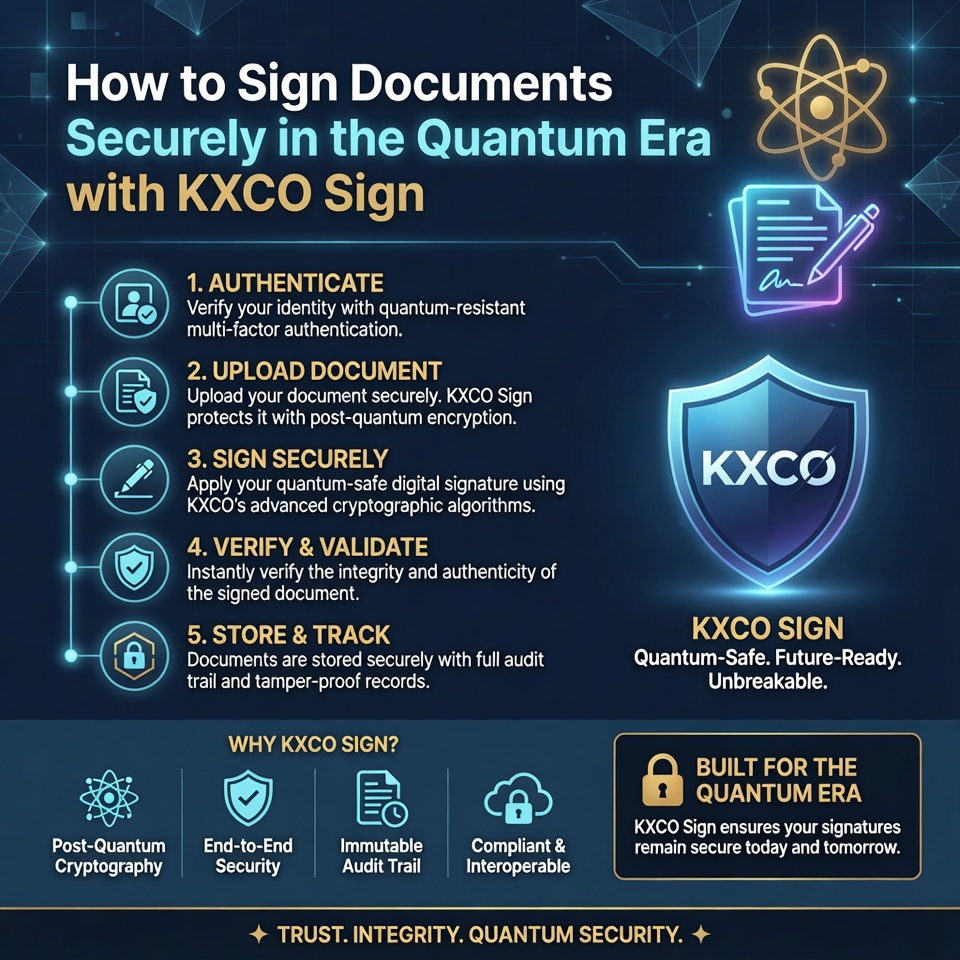
How to Sign Documents Securely in the Quantum Era with KXCO Sign
Almost every e-signature you have ever made relies on RSA and ECDSA — algorithms a quantum computer can break. KXCO Sign signs every document with post-quantum cryptography and anchors the proof on a public blockchain. Here's how to use it.
Every story, signed and delivered.
Subscribe to the kxco channel and get the headline, the AI-written key takeaways, and the chain-anchor link the moment we publish. Audio versions and per-ticker subscriptions arrive in the next iteration.