
Elon Musk, X, and the End of an Illusion: We Are the Times
Sixteen centuries ago Saint Augustine told a frightened city to stop blaming the era and start looking at itself. Elon Musk reopened the public square and proved him right. Opinion by Shayne Heffernan.
"Bad times, hard times, this is what people keep saying. But let us live well, and times shall be good. We are the times. Such as we are, such are the times."
Saint Augustine
There is a habit that shows up in every generation, and ours has it worse than most. People blame the times. The economy is broken. The institutions have failed. The culture has rotted. The future got stolen while everyone was looking the other way. You hear it at dinner tables and you read it in a thousand posts a day, this quiet conviction that the world is something that happens to us rather than something we build. It sounds like realism. It is really just surrender.
Saint Augustine heard the identical complaint in the fifth century. Rome was coming apart. The old certainties were dissolving and everyone in the city of Hippo had a theory about who was to blame. Augustine turned the question around. "Bad times, hard times, this is what people keep saying," he wrote. "But let us live well, and times shall be good. We are the times. Such as we are, such are the times."
That is not a motivational poster. It is a claim about how history actually works. The times do not float above us like weather. They are the sum of what people choose to believe and do. If the age is corrupt, it is because enough of us went along with the corruption. If it turns, it turns because someone decided to live and speak differently, and other people followed.
The Age of Performance
For most of a decade we watched a strange system take hold. It called itself justice and it worked like conformity. Places that once existed to argue over ideas started policing them instead. Companies adopted moral positions they could not explain and would not defend the moment defending them cost anything. Campuses that were supposed to protect open inquiry turned into stages for public denunciation, where the point was never the truth but the standing you earned by playing along.
The machinery worked because it was cheap. One accusation on social media could end a career, silence a critic, and frighten a large organization into acting on fear instead of facts. Outrage traveled fast. Nuance did not travel at all. Somewhere between the headline and the hashtag the actual truth, the messy and inconvenient kind, quietly died.
None of it required a conspiracy, and that is exactly why it worked so well. It ran on the willingness of people who knew better to say nothing at all. Hannah Arendt described the shape of it long ago when she wrote about how these systems survive. They do not need everyone to believe. They only need everyone to perform. The distance between what people actually thought and what they were willing to say out loud became the defining feature of the decade. People learned to read the room before they opened their mouths. Sincerity started to look reckless, and reasonable people learned to keep their heads down.
The Lion
Augustine had a second line that fits this moment even better. Truth is like a lion, he said. You do not have to defend it. Let it out and it defends itself. Truth in that sense is not a talking point you manage or a brand you protect. It is a living thing that takes care of itself the second you stop caging it.
For years the lion stayed caged. Not by one villain but by a whole layer of people who had quietly appointed themselves its keepers. Reporters curated the news. Academics curated the acceptable ideas. The platforms curated the conversation itself. Each layer claimed it was only filtering noise and adding useful context. In practice the filter became the message. The lion was not just locked up. It was sedated, fed a careful diet of approved stories, and wheeled out on schedule for an audience that had forgotten what a free animal even looked like.
Then someone opened the cage.
What Elon Musk Actually Did
When Elon Musk bought Twitter in October 2022 and turned it into X, the reaction from the established class was pure contempt. Here was a man with no newsroom, no journalism degree, and no reverence at all for the machinery of narrative control, and he had just bought the largest public square ever built. The predictions were apocalyptic. Pundits mourned. Advertisers ran for the exits. The verdict was that Elon Musk had set fire to something precious.
That verdict rested on a lie the critics could not admit even to themselves. The lie was that the thing being dismantled had been working. That the curation served the public. That the gatekeepers were guarding anything worth guarding. Underneath all of it sat the real belief, which was that ordinary people could not be trusted with unfiltered information and needed a professional class to decide for them what was safe to know.
Elon Musk understood what the critics refused to. The platform had become the story. The ranking that decided what you saw, the rules that decided what you could say, the blue badges that handed authority to favored voices, none of that was neutral plumbing. It was the architecture of a worldview that talked about justice and delivered power. Buying X was never mainly a business move. It was a demolition.
What came after was not the promised chaos. It was clarity. Stripping the legacy badges knocked down the fake hierarchy that had propped institutional voices above everyone else. The release of the internal files, which showed how the old platform had coordinated with government agencies to bury certain stories, confirmed what millions of people had suspected and could never prove. The curation had an agenda. The lion had been starved on purpose.
They called Elon Musk reckless. The real recklessness was the system he replaced, where a tiny group of unaccountable people held enormous power over what the rest of us were allowed to see and say, with no transparency and no way to appeal. X exposed the machinery, and once people had seen it, it could never be fully rebuilt. The cage was open and the lion was walking.
I will put it more plainly than Augustine ever would have.
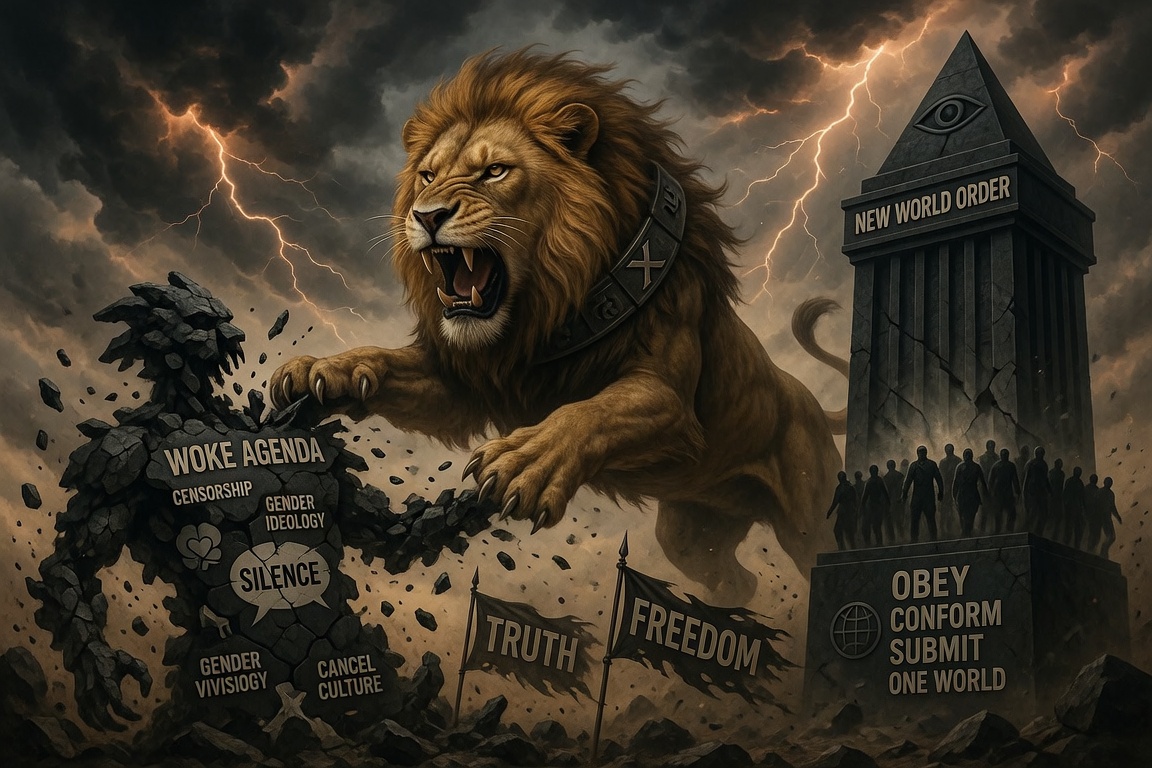
"X marks the spot, the point in time when humanity decoupled from the woke agenda and the new world order, we all owe Elon a very big thank you."
The End of an Illusion
The word "woke" started life as something serious. It came out of Black American speech as a word for staying alert to real injustice, coined by people who had lived through real suffering. What happened to it after that, the slow drift from genuine awareness into a costume for a particular kind of moral performance, is its own lesson in how a movement gets captured and sold back to the very people it claimed to serve.
What people ended up calling woke madness was never one clean ideology. It was a pattern. Posture standing in for reasoning. Group identity placed above individual dignity. Institutional power used to enforce agreement. And the automatic smearing of anyone who questioned any piece of it. It sold itself as liberation and it operated as control. It talked about inclusion and it practiced exclusion with real enthusiasm. It promised justice and it handed out something closer to revenge, with no trial and no road back.
That madness is ending now, and not because the critics finally shouted loud enough. It is ending because reality does not negotiate. You can police language. You can demand apologies. You can script the public rituals down to the last gesture. What you cannot do is make a false thing true by force of policy. Reality reasserts itself, and when the gap between the official story and what people actually live through gets wide enough, the whole structure loses its grip all at once.
You can see the end of it in a thousand small acts of nerve. The comedian who will not apologize for the joke. The writer who finally publishes what they actually think. The executive who stops issuing statements about matters that have nothing to do with the business. The student who raises a hand and asks the question everyone in the room is already thinking. None of these are heroic acts. They are ordinary people deciding that the cost of biting their tongue has finally grown higher than the cost of speaking. Augustine would know the pattern on sight. The times do not turn because somebody published a manifesto. They turn because ordinary people, one at a time, decide to live well.
The Times Are a Function of Who We Are
There is a simple bit of math hiding inside Augustine's line. If the times are the output and we are the input, then you do not fix the output by fiddling with the formula. You fix it by improving what goes in. And what goes in is human character.
Character is an unfashionable word now. It belongs to an older way of talking, one that assumed people could actually build things like courage, honesty, restraint, and good judgment, and were responsible for doing exactly that. The modern reflex is to locate every problem in a system or a structure instead. There is real truth in that. Systems matter and structures shape behavior. But people run the systems. People staff the institutions. A dishonest institution is just a crowd of dishonest people in matching lanyards. Design it as elegantly as you like. If the people inside have no integrity, it will produce rot on schedule.
This is not an argument against reform. It is an argument about where the leverage actually sits. The best designed institution staffed by weak people will still fail. A flawed institution staffed by serious people will outperform its own blueprint. Augustine understood this because he understood people. He knew that evil is not first a political problem or an economic problem. It is a problem of what a person chooses when nobody is watching and there is no reward for doing the right thing.
What Elon Musk did with X was, at the deepest level, not a technology story or a media story. It was a moral one. One person with enough money and enough nerve decided to trust the public with the truth and let the lion out of the cage. And the public, handed the chance, did not stampede. They walked up to the cage, looked hard at what had been hidden from them, and remembered something they had been told they were not clever enough to handle.
Let It Loose
We are living through the hangover of a great unmasking. The institutions that sold themselves as guardians of truth turned out to be careless custodians of it. The ideas that called themselves liberating turned out to confine. The moment that called itself progressive turned out to be the oldest human temptation wearing new clothes, which is the itch to control what other people are allowed to think and say.
The lesson is not that there should be no rules. It is that the rules should be visible, accountable, and open to challenge. Truth does not belong to a party or a platform or an ideology. It belongs to anyone willing to look for it honestly and say it plainly. That is Augustine's lesson, sixteen hundred years old and as fresh as this morning. We are the times.
So if you want better times, be a better person. Not a more strategic one. Not one who has memorized the correct vocabulary. Just better. Someone who tells the truth when it costs something. Someone who can be generous to an opponent. Someone who can hold two competing ideas in mind at once without dissolving into rage. Someone who builds instead of tearing down, who listens before speaking, who has the guts to be wrong and the grace to admit it.
The cage is open. Some of the old keepers are already scrambling to rebuild it, because the urge to control other people never really dies. But the memory of an open square does not fade so easily. For the first time in a long while it is possible to say what you think without doing the math on the social cost in real time. It is possible to read a story and reach your own verdict without a curator deciding it for you first. It is possible to meet an idea you hate and answer it with an argument instead of a campaign to erase the person who said it.
These are small freedoms and they are easy to lose. They are also the freedoms that everything else depends on. A society where people cannot speak freely is one where they cannot think freely either, and a society that cannot think freely has already stopped being free in the only way that matters. We are the times. The times are a function of who we are. So let us live well.
KXCO is Enhanced Intelligence, Not Artificial
I never wanted artificial intelligence. I wanted enhanced intelligence, and they are not the same product. Artificial means the machine does the thinking and hands you the answer. Enhanced means I do the thinking, with more of my own mind in the room than I have ever had at one time. Forty years of reading, recallable in the second I need it. Patterns across law, credit, physics and markets that no specialist sees, because the useful ones sit between the fields rather than inside them.
The AI Safety Argument Is Being Held in the Wrong Room
The people who will be blamed for what AI does are not in the room where its safety is argued. A jailbreak escapes a policy. The failure that costs money is an action that escapes an owner, a payment sent or a record altered. Tokens are not authority. Intelligence got cheap and judgment did not, and there is no organ of standing you can copy into a model. Shayne Heffernan on the objection worth taking seriously, and the questions to take into a vendor meeting.

NIST Graded Our Post-Quantum Cryptography. Zero Failures.
NIST's Algorithm Validation Test System generated test vectors nobody had seen, we answered them over the ACVP protocol, and NIST graded the result: 2,130 cases across ML-KEM, ML-DSA and SLH-DSA in every parameter set offered, zero failures, demo certificate A11025. This is what that proves, where we deliberately drew the claim narrower than NIST's own matrix, and why the FIPS 140-2 sunset on 21 September makes the distinction between being graded and grading yourself worth understanding.

The Problem Is Not the Problem
People treat the Jack Sparrow line as a joke. The attribution is a joke. The sentence is not. Forty years in markets says the same thing Epictetus said in 125 CE and Robert Merton named in 1948: the event is finite, and the story you appoint to govern it is not. This essay walks the quote back to its actual sources, draws the loop that turns a feeling into an order, and sets out the four places a rule written in advance cuts the loop. Faith is not a hedge. It is a stance.
Every story, signed and delivered.
Subscribe to the kxco channel and get the headline, the AI-written key takeaways, and the chain-anchor link the moment we publish. Audio versions and per-ticker subscriptions arrive in the next iteration.