
USD Will be Replaced in Oil Trades
The US dollar (USD) was used as the currency of choice in global oil trading. It was used to purchase oil in the international market and was accepted as a currency of payment by producers and consumers. The USD was the most commonly used currency in oil trading, as it was seen as a stable and reliable currency. The use of the USD in oil trading no longer allows for the efficient and secure transfer of funds between buyers and sellers.
As the importance of the USD evaporates Crypto based Digital Assets like those built by KXCO will take over and new Currencies like FBX will benefit from that massive growth.
KXCO Blockchain technology has the potential to revolutionize international trade by reducing the cost and complexity of transactions, streamlining processes, and providing greater levels of trust and transparency. By providing an immutable ledger of records, KXCO blockchain can help to reduce fraud and risk by allowing for the secure and efficient exchange of data and documents between trading partners. Additionally, blockchain can provide a single source of truth for trade documents, such as bills of lading, invoices, and customs forms, reducing the need for manual reconciliation and increasing accuracy. Finally, blockchain can help to reduce costs by automating processes such as payments, shipping, and inventory tracking.
The Change is Coming
Beijing will work to make energy purchases in yuan instead of US dollar signaling another step towards shifting further away from the greenback, China’s President Xi Jinping told Gulf Arab leaders as cited by Reuters.
China's leader highlighted the necessity of the move while speaking at a Chinese-Arab summit that was hosted by Saudi Arabia earlier this week. Xi had held separate talks with the heads of the Persian Gulf states at the summit that reportedly brought together 30 leaders from across the region.
The world's biggest crude importer, China in November ramped up purchases of oil by 12% year-on-year, marking the 10-month high despite the severe pandemic-related restrictions. Chinese state refiners stepped up purchases of US crude oil, while maintaining high imports of Russian oil prior to the December 5 European embargo and imposition of an oil price cap.
China’s independent refiners also moved a record amount of deeply discounted Iranian crude passed off as oil sourced from Malaysia, which is commonly used as a transfer point for oil originating from the sanction-hit Venezuela and Iran.
Saudi Arabia was China’s number one oil supplier in the first ten months of 2022, making up 18% of China’s total crude oil purchases, with imports totaling 73.54 million tons, or 1.77 million barrels per day, Chinese customs data showed.
Keen interest in the yuan and other currencies from major oil importers have arisen in the wake of unprecedented sanctions introduced by Washington and the allies against Russia, one of the world’s biggest oil producers and exporters over Moscow’s military operation in Ukraine.

AI Is Taking What You Publish and What You Type
Common Crawl holds more than 300 billion web pages, and 52 per cent of crawler requests on Cloudflare's network in June 2026 were for AI training. Models can give back what they took in: one chatbot reproduced 76.8 per cent of the first Harry Potter book near word for word. A US court ordered OpenAI to give the New York Times 20 million anonymised ChatGPT logs. This KXCO warning sets out what is exposed, what to do now, and how each KXCO client runs its own AI inside its own walls.
Industrialising Intelligence: Demand, Scarcity and the Boundary of Sovereignty
AI agents generate 80% of OpenRouter's tokens, about seven times human use, and Google's monthly tokens rose about 330 times in two years to over 3.2 quadrillion. In my view the limit on AI demand has moved from people to power: the International Energy Agency expects data-centre electricity to reach around 945 terawatt-hours by 2030. Execution is becoming a utility. Selection is not. KXCO builds the boundary that keeps the decision with a named person and lets another party check the record.
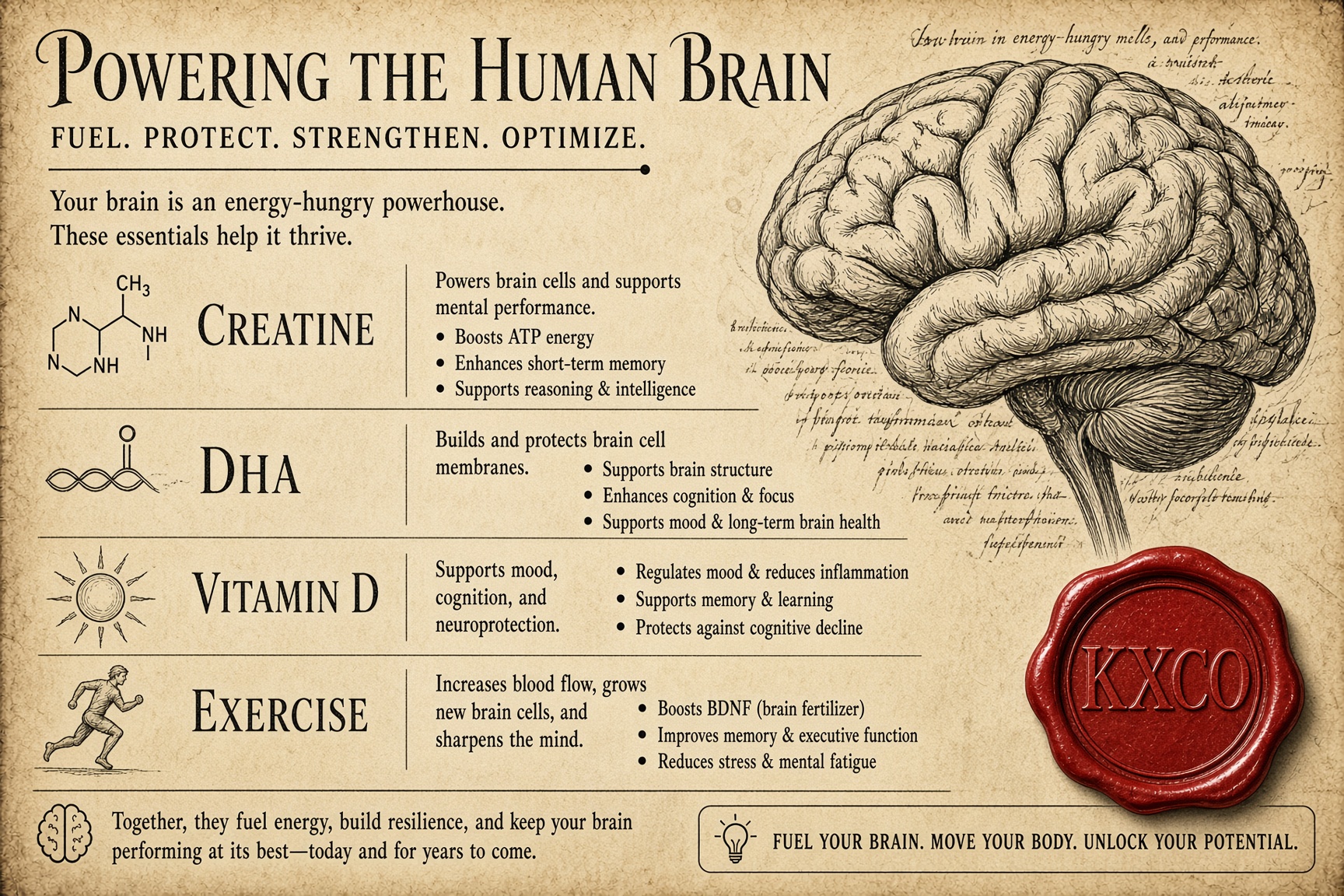
Thoughts on Thinking: Brain Essentials
Your brain runs on about 20 watts. The fastest supercomputer outruns it, but at the central published estimate the brain is about 680 times as efficient per watt as the best machine on the November 2026 Green500. It runs on four inputs most people overlook. Creatine buffers its energy, DHA builds its membranes, exercise raises its growth factors and, in older adults, enlarges the hippocampus, and low vitamin D goes with slower processing and more dementia.
KXCO's FDA Ontology Ranked INO-3107 First. Its Two Published Books Beat XBI.
KXCO's FDA ontology ranked INO-3107 first before the FDA approved it on 30 October 2026; Inovio (INO) then hit $2.71 after hours from a $0.60 close. KXCO's two published research books on the ontology stood at 109.31 and 110.28 at the close of 13 November, from 100 at the close of 14 October, against 102.58 for XBI. Nine more decisions on the board fall due before 31 December, starting with molgramostim (SVRA) and deramiocel (CAPR) on 22 November.
Every story, signed and delivered.
Subscribe to the kxco channel and get the headline, the AI-written key takeaways, and the chain-anchor link the moment we publish. Audio versions and per-ticker subscriptions arrive in the next iteration.