
AI Is Taking What You Publish and What You Type
AI training pipelines take in the public web, and many chat services keep what you type, let staff read it or train on it. Courts are still deciding what counts as theft. This KXCO warning sets out what is exposed, what to do now, and how KXCO keeps a client's AI inside its own walls.

Every page you publish can end up in an AI training set, and much of what you type into a chatbot can be kept, read by staff or used to train the next model. Common Crawl, a non-profit founded in 2007, says it holds more than 300 billion web pages (Common Crawl), and its October 2026 crawl alone captured 2.16 billion (Common Crawl). At least 64 per cent of 47 large language models published between 2019 and October 2023 were trained on it (Mozilla Foundation). On Cloudflare's network, 52 per cent of crawler requests in June 2026 were for AI training, up from 22 per cent in spring 2025 (Cloudflare).
What goes in can come back out. In a study published in January 2026, researchers got one production chatbot to reproduce 76.8 per cent of the first Harry Potter book near word for word, without any jailbreak (arXiv). A Microsoft research model cloned a voice from a 3-second recording (arXiv). A chat you deleted can be held for someone else's lawsuit: in May 2025 a New York court ordered OpenAI to preserve ChatGPT logs that users had asked it to delete (Malwarebytes).
This is KXCO's warning. The courts are still deciding what counts as theft, and the answer differs by country. Settings and discipline cut some of the exposure. For what you give an AI, the deciding factor is where it runs. KXCO's rule is that the institution keeps its knowledge and a named person makes the decision (KXCO), and each KXCO client runs its own AI, built around NVIDIA Nemotron and fine-tuned only on its own data, with its data, keys and the signed proof of every action inside its own walls.
How public material becomes training data
AI companies crawl public web content in bulk to train their models, and some of their agents also fetch pages on a user's behalf (OpenAI, Perplexity). In my view, the working rule is that a public page is available unless a technical or legal barrier stops the crawler, whether it is a website, a forum, a social post, a code repository, a news story or a research paper. Common Crawl is the base layer of much of this (Mozilla Foundation). OpenAI's GPT-3 paper of 2020 lists filtered Common Crawl as 410 billion tokens and 60 per cent of the training mix, drawn from 41 monthly crawls between 2016 and 2019 (arXiv).
Code and books followed. OpenAI's Codex, a production version of which powers GitHub Copilot, was trained on code collected in May 2020 from 54 million public GitHub repositories (arXiv). In Bartz v. Anthropic, a US court found that Anthropic downloaded more than seven million copies of books from pirate sources, including Books3, LibGen and PiLiMi, between January 2021 and July 2022 (WIPO Lex).
The AI companies also run their own crawlers. OpenAI's GPTBot collects content that may be used to train its models (OpenAI), Anthropic's ClaudeBot collects training data (Anthropic), and Meta-ExternalAgent crawls for uses that include training foundation models (Meta). Google uses a token, Google-Extended, rather than a separate crawler to decide whether the pages it crawls may train future Gemini models (Google). The exchange is lopsided. In July 2025 Cloudflare measured Anthropic crawling 38,000 pages for every visitor it sent back to a site, down from about 286,000 in January, against about 1,091 for OpenAI and 195 for Perplexity (Cloudflare).
Platforms train on what you post on them. LinkedIn trains its content-generating AI on members' profiles, posts, comments, group messages and AI prompts, and opting out does not undo training already done (LinkedIn). Ireland's Data Protection Commission said Meta planned to start training on the public posts of adults in the EU on 27 May 2025 (Data Protection Commission). X's privacy policy says it may use what it collects to help train its AI models (X).
Some content is paid for. Reddit agreed in February 2024 to make its content available for training Google's models, at about $60 million a year according to one source (Reuters). Cloudflare counts more than 50 licensing agreements between publishers and AI companies since 2023, and says licensing remains largely bespoke (Cloudflare). Blocking a crawler today does not remove what it has already taken: Common Crawl says its published archive files cannot be edited, so it filters removed addresses from later crawls and its indices instead (Common Crawl).
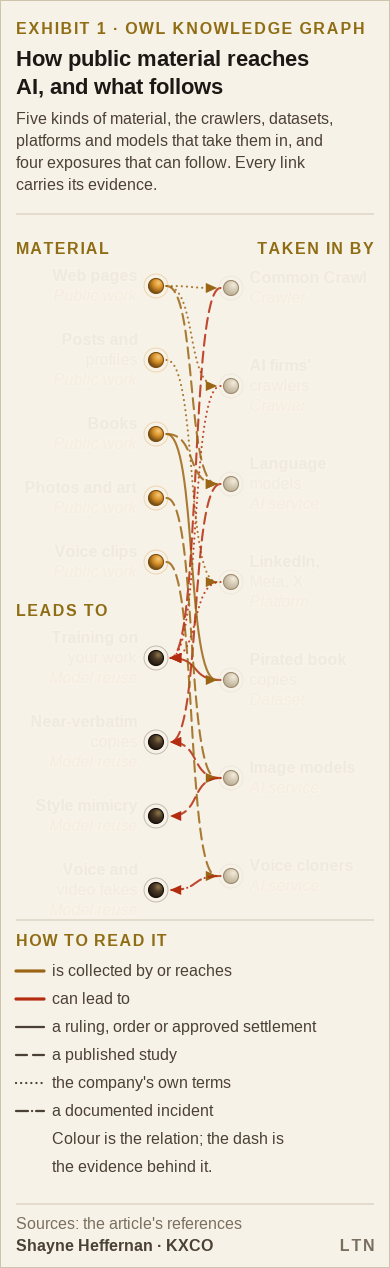
Exhibit 1 draws that record from an OWL ontology: five kinds of material, what takes them in, and four exposures that can follow, each link graded by its evidence (WIPO Lex, arXiv, LinkedIn, CNN).
Harvest or fair use: where the courts stand
Whether this is harvesting or theft is partly a legal question, and the courts have started to split it into parts.
In the United States the defence is fair use. On 23 June 2025 Judge William Alsup ruled in Bartz v. Anthropic that training on the authors' books was fair use on the facts before him, but that downloading pirated books to build a permanent library was not (Skadden). Anthropic settled for $1.5 billion. Judge Araceli Martínez-Olguín gave final approval on 20 July 2026 at about $3,000 per work (Authors Guild), and undisputed claims were scheduled to be paid on 23 November 2026, at about 70 per cent, or $2,203.56 per work (Authors Guild). Two days after Alsup's ruling, Judge Vince Chhabria found for Meta against 13 authors, while writing that his ruling does not mean Meta's training on copyrighted works is lawful (TechCrunch).
On 29 September 2026 the Third Circuit gave what appears to be the first federal appeals ruling on fair use in AI training: ROSS Intelligence's copying of 2,243 Westlaw headnotes to train a legal-research tool was not fair use (Haynes Boone). A footnote set apart generative systems that produce new expression, so the generative cases remain open (Haynes Boone). Among them, the case brought by the New York Times and other publishers against OpenAI reached summary judgment briefing in September 2026 (The Decoder).
Outside the United States the question is framed differently. In London, Mrs Justice Joanna Smith held on 4 November 2025 that Stable Diffusion, which does not store or reproduce any copyright works, is not an "infringing copy" (High Court). Getty won only in part, on points about its watermarks, findings the judge herself called extremely limited (High Court). She did not decide whether training infringed, because Getty dropped that claim for lack of evidence that the training took place in the UK (High Court). The Court of Appeal heard Getty's appeal this month, and its written decision is expected in spring or summer 2027 (BCLP).
A week after the London judgment, Munich Regional Court I held in GEMA v OpenAI that memorising song lyrics in a model and reproducing them in its answers infringes copyright and falls outside the text and data mining exception. That ruling is not final (CMS).
The European Union gives creators a legal opt-out. Its 2019 copyright directive allows text and data mining of lawfully accessible works unless the rightsholder has expressly reserved that use in an appropriate manner, such as by machine-readable means for content online (EU Directive 2019/790). The AI Act requires providers of general-purpose AI models to honour those reservations and to publish a summary of their training content (AI Act, Article 53), and the European Commission has been able to fine since 2 August 2026, with models already on the market before August 2025 given until 2 August 2027 (European Commission). The United Kingdom has no settled rule: in March 2026 the government dropped its preferred option, to let developers train unless rightsholders opt out, and said it no longer has a preferred option (UK Parliament).
So the answer depends on where you are and how the copy was made. In the United States, two first-instance rulings on books went to the developers on their facts, and the $1.5 billion settlement followed Anthropic's pirated copies (Authors Guild). In Germany, a court of first instance has held that a model that repeats your lyrics infringes. In the UK, the Getty case did not decide whether training infringes.
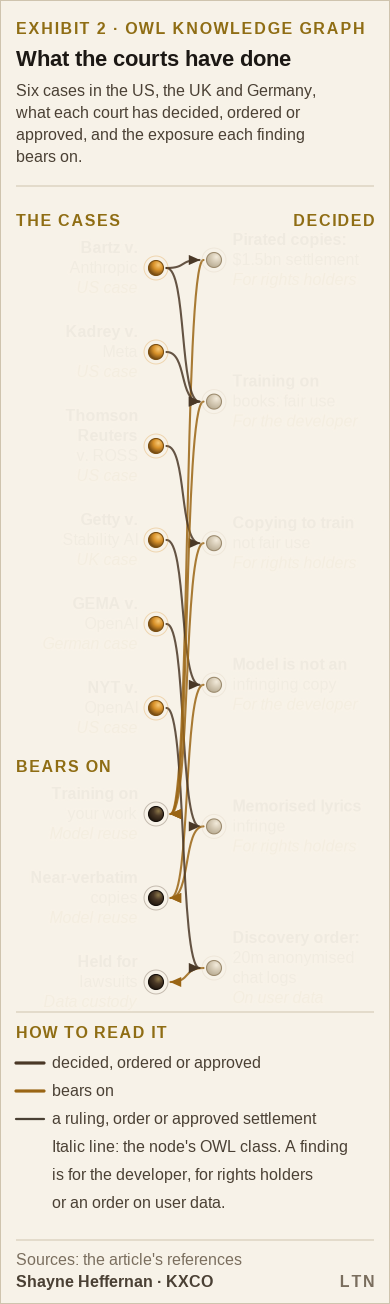
Exhibit 2 places six cases on the same ontology. Each finding is classed by whom it favours, or as an order on user data, and points to the exposure it bears on (Skadden, High Court, ABA Journal).
Once it is in a model, it can come back out
The research below shows what can be reused once material is taken in: text, personal details, images, an artist's style and a voice.
In a preprint first posted in December 2020, Carlini and 11 colleagues extracted hundreds of verbatim passages from GPT-2's training data by querying the model, including names, phone numbers and email addresses, even where a passage appeared in only one document of that data (arXiv). In November 2023 a team asked ChatGPT to repeat the word "poem" forever. The model often broke off and emitted real email addresses and phone numbers, and the authors recovered several megabytes of training data for about $200 of queries (Nasr and colleagues). Image models memorise too: Carlini's group extracted over a thousand training images from diffusion models, from photographs of individual people to trademarked company logos (arXiv).
Books are the newest test. In a preprint of 6 January 2026, Ahmed, Cooper, Koyejo and Liang recovered long parts of books from four production models, tested in August and September 2025. Without a jailbreak, Gemini 2.5 Pro and Grok 3 reproduced 76.8 and 70.3 per cent of Harry Potter and the Sorcerer's Stone near-verbatim. With a jailbreak, Claude 3.7 Sonnet in some cases produced entire books, and GPT-4.1 reached 4.0 per cent before it refused (arXiv). The authors concluded that extraction of in-copyright training data remains a risk for production models despite their safeguards (arXiv).
The proportion matters. A study of 200 books on 14 open-weight models, those whose weights are published, found that most models do not memorise most books, with exceptions: Llama 3.1 70B holds some books entire (arXiv). The authors of the ChatGPT study note that the earlier extractions recovered a tiny fraction of each training set, about 600 of several billion GPT-2 examples (Nasr and colleagues). The risk rises with the number of times a passage is duplicated in the training data and tends to rise with model size (arXiv, arXiv).
Style needs only a few samples. The University of Chicago team behind Glaze found that a mimic can copy an artist's style by fine-tuning an open-source image model on as few as 20 pieces downloaded online, in under 20 minutes on a low-end consumer graphics card (arXiv). A 2025 study found that low-effort steps such as image upscaling bypass tools such as Glaze that artists use to protect their work (arXiv).
A voice needs seconds. Microsoft's VALL-E research model synthesised the voice of a speaker it had never been trained on from a 3-second recording in January 2023 (arXiv). OpenAI said in March 2024 that its Voice Engine needs a single 15-second sample, held back a broad release because of the potential for misuse, and urged phasing out voice authentication for bank accounts (OpenAI).
The fraud is already happening. Arup confirmed to CNN in May 2024 that fake voices and images were used against it in Hong Kong, where a finance worker joined a video call on which the chief financial officer and other colleagues were all deepfake re-creations, and sent HK$200 million, about US$25.6 million (CNN). The FBI has warned that criminals clone a relative's voice to fake a crisis, use AI audio to get into bank accounts and pose as executives on live video (FBI). Its 2025 Internet Crime Report, released in April 2026, counted 22,364 complaints involving AI, with more than $893 million in reported losses (The Register).
Secrets leak in the simplest way: people paste them in. Samsung restricted staff use of generative AI tools on company devices in May 2023, a restriction it called temporary, after engineers uploaded internal source code to ChatGPT (Bloomberg, NBC News). Harmonic Security, a data-security firm, analysed 22.5 million enterprise prompts and file uploads made in 2025 and counted 579,113 sensitive-data exposures, about one in 39, with source code the largest category (Harmonic Security). In my view, companies that publish too much internal process, roadmaps, unique methods or customer data online add to the same training sets, and individuals who post extensively build durable public profiles that models can draw from.
What you type is not private by default
Several AI services train on conversations unless you opt out, and even then the provider stores what you send for a period. Google and the maker of Grok say people on their side may read it (OpenAI, Google, x.ai).
ChatGPT. On personal Free, Plus and Pro accounts, sharing conversations for training is on by default (OpenAI). After opting out, a thumbs up or down can still put the whole conversation into training (OpenAI).
Gemini. Google says that, whatever the settings, it uses chats to respond and to help protect Google, its users and the public, including with help from human reviewers, some from outside service providers. It tells users not to enter confidential information they would not want a reviewer to see (Google). Reviewed chats are kept for up to three years, even after the user deletes their history (Google). In November 2026 Google lengthened the retention of chats held with history off from 72 hours to about two months, to detect abuse, and said that data will not be used for model training (The Register).
Claude. Since 28 August 2025 Anthropic has asked users of its consumer plans to choose whether their chats train its models, and keeps the data for five years for those who allow it and 30 days for those who do not (Anthropic). TechCrunch reported that the training toggle in the pop-up was set to On (TechCrunch).
Grok. Its maker says it may train its models on prompts and responses unless users switch the setting off, that a limited number of its staff may review conversations, and asks users not to share personal or sensitive information (x.ai).
Business tiers are better, and they still run on the provider's servers. OpenAI does not train on business or API data by default and may keep API inputs and outputs for up to 30 days (OpenAI).
Courts can reach those servers. In May 2025 Magistrate Judge Ona Wang ordered OpenAI, in the New York Times case, to preserve and segregate all ChatGPT output logs that would otherwise be deleted, including chats users had asked it to delete (Malwarebytes). OpenAI objected that users share details from financial information to wedding vows in chats they expect to be deleted (Malwarebytes). The order was narrowed in October 2025, but the logs already set aside were kept (Duane Morris). On 5 January 2026 Judge Sidney Stein upheld an order that OpenAI hand over about 20 million anonymised ChatGPT logs, and rejected OpenAI's privacy objection (The Decoder, ABA Journal).
So far there is no recognised privilege for chats with a consumer AI tool. OpenAI's chief executive Sam Altman said in July 2025 that conversations with ChatGPT have no legal privilege like those with a doctor or lawyer (TechCrunch). On 13 February 2026 Judge Jed Rakoff, ruling at first instance in United States v. Heppner, held that a defendant's conversations with Claude were protected by neither attorney-client privilege nor work product (Orrick).
Sharing a chat can publish it. OpenAI withdrew its opt-in "make this chat discoverable" option on 1 August 2025 (The Register). In August 2025 Forbes found more than 370,000 Grok conversations indexed by Google, some with names, personal details and at least one password (Forbes). In July 2026 shared Claude chats and artifacts were found on Google, some reportedly containing health records and children's names and phone numbers; Anthropic said share links reach search engines only when posted somewhere public (TechCrunch).
The UK's National Cyber Security Centre stated the rule in 2023: a query to a public model is visible to the provider and stored, so leave sensitive information out of it (NCSC). Sensitive personal details, company secrets, unpublished ideas, credentials, or anything you would not want permanently associated with a model, are better kept out of the chat.
What to do now
These are the practical steps that match the caution, each sharpened by what the record shows.
Treat anything public as potentially in a training set. Post less, or post with a clear reservation where it matters. In the EU a machine-readable reservation has legal force, and providers of general-purpose models must honour it (EU Directive 2019/790, AI Act, Article 53).
Use robots.txt, authentication, paywalls or private channels. Robots.txt, the file that tells crawlers which pages to skip, is a request: the standard says crawlers are requested to honour it and that it is not a form of access authorisation (RFC 9309). Name the training crawlers and tokens one by one: GPTBot, ClaudeBot, CCBot, Google-Extended and Meta-ExternalAgent (OpenAI, Anthropic, Common Crawl, Google, Meta). Expect gaps. A block covers future material only, fetchers acting for a user may ignore it, and some crawlers falsely identify themselves as CCBot (Anthropic, OpenAI, Perplexity, Common Crawl).
Use the newer defaults where you can. Cloudflare has blocked AI crawlers by default for new domains since 1 July 2025, unless they have permission or pay (Cloudflare). A "no AI training" signal drafted at the IETF, the body that sets internet standards, is still a draft, though Anthropic began recognising it on 30 October 2026, with the rollout still in progress, and Google intends to support it in early 2027 (IETF, Anthropic, Google). These steps raise the cost of taking your material. They do not prevent it.
For companies: separate public marketing from real intellectual property. Do not discuss unreleased products, internal metrics or novel methods in open channels or in AI chats. Where staff use AI, give them a tier that excludes training by default, and remember that even then OpenAI, for one, keeps API data for up to 30 days (OpenAI).
For individuals: keep less personal data public and tighten your account settings. LinkedIn members in the EU and EEA can opt out with a settings toggle or an objection form, and Ireland's Data Protection Commission said it had not approved or found compliant LinkedIn's use of their data (Data Protection Commission), and Meta users in the EU could object or set their posts to private (Data Protection Commission). Avoid feeding AI systems distinctive samples of your voice, face, writing or private life if you care about control.
When you use AI tools, assume the conversation can be retained and used. Withhold anything you would not post publicly. Switch training off where the setting exists, and leave no feedback on a chat you want kept out (OpenAI, Google, OpenAI).
Openness has real benefits for knowledge and innovation. In my view, though, the current default of large-scale and largely uncompensated ingestion of public content creates exactly these exposure and reuse risks. Being deliberate about what is public, and about what is said to AI systems, is a reasonable adjustment to how the technology works.
Athanor: our version of sovereign AI
In my view, the steps above reduce the exposure but cannot remove it while your AI runs on someone else's servers under someone else's terms. NVIDIA describes nations taking the other route: it wrote on 6 July 2026 that countries are building and running AI on national infrastructure, data, talent and business networks, in ways that fit their language, culture and regulations (NVIDIA). KXCO applies the same principle to a company through Athanor, its sovereign AI division.
Each KXCO client runs its own AI, built around NVIDIA Nemotron and fine-tuned only on its own data. Nemotron is a family of open models: NVIDIA publishes the weights and training data on Hugging Face so the models can be evaluated before deployment, and supports deploying them anywhere from local infrastructure to the cloud (NVIDIA). In KXCO's words, "The Estate keeps your knowledge, your AI and your decisions inside your own walls, under post-quantum protection". Data, keys and the signed proof of every action stay inside the client's own walls, and every record is signed from the first entry with ML-DSA, the post-quantum signature standard that NIST published as FIPS 204 on 13 August 2024 (NIST).
Round Table, which KXCO describes as the software at the centre and the record it keeps (KXCO), is live in private deployments (KXCO). In a private deployment, what Round Table finds in your own books stays inside your deployment (KXCO). Analysts and AI models work from the same record, and the record shows which of them said what (KXCO). The rule is written down: the institution keeps its knowledge, people keep decision authority, AI prepares and checks, and a named person decides (KXCO). The software enforces it. An outside AI agent can only propose, and an agent that calls the service directly to decide is refused (KXCO). A third party can check an exported record offline, with no network connection and no KXCO system in the path (KXCO).
KXCO applies this article's advice to itself. It does not publish the Round Table software, its private graphs or the detail of its method, and it says that keeping each customer's knowledge under the customer's own control is what it sells (KXCO). Licensed institutions hold assets, KXCO supplies the software, and KXCO holds no customer assets (KXCO).
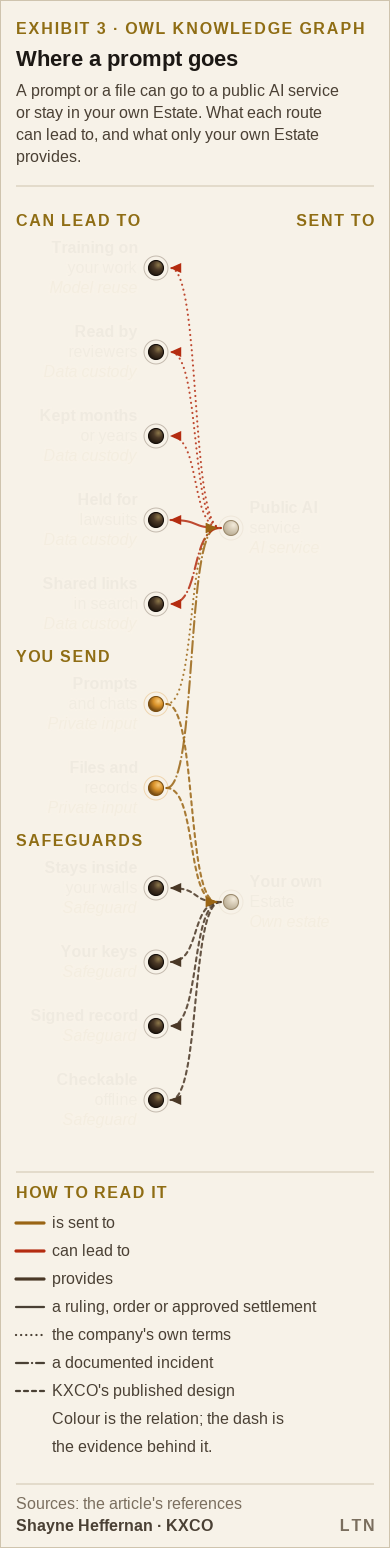
Exhibit 3 puts the two routes side by side. Sent to a public AI service, a prompt or a file can be used for training, read by reviewers, kept for months or years, held for a lawsuit or exposed through a shared link (OpenAI, Google, Malwarebytes, Forbes). Kept in your own Estate, it stays inside, under your keys, in a signed record that a third party can check offline (KXCO). In the ontology only your own Estate can provide those safeguards, and a statement that a public AI service provides your keys is refused as a contradiction.
Make the shift: how to contact KXCO
If you hold material you would not post publicly, or run a business whose method is its edge, the shift is to run your AI where your data already lives. KXCO offers a private Estate briefing: write to [email protected], or use kxco.ai/contact and choose "Request a briefing or demo". The form asks for the question you cannot currently answer about your own business and invites you to bring whatever data you already hold, and every enquiry receives an ML-DSA-87 signed receipt (KXCO). You can read more about KXCO at kxco.ai, and my writing on stocks, the economy and the KXCO build is at shayneheffernan.com.
How the graphs are built
Exhibits 1 to 3 are views of one ontology written for this piece in OWL, the Web Ontology Language (HermiT). Its schema has 21 classes under six disjoint roots (material, processor, exposure, safeguard, case and finding) and 8 object properties, each with a typed domain and range. Its record has 40 individuals and 42 assertions, and each assertion carries the research claims it stands on and its evidence grade. HermiT, a reasoner for OWL ontologies, finds the ontology consistent and refuses all three planted wrong statements. From a property chain it infers which exposures each kind of material faces: a prompt or a file sent to a public AI service faces five: training, review by people, long retention, a legal hold and exposure in search.
What to watch
The Court of Appeal's written judgment in Getty Images v Stability AI, expected in spring or summer 2027, on whether an AI model can be an infringing copy under UK law (BCLP, High Court).
Research references
How public material becomes training data
Common Crawl Foundation (2026). Common Crawl: Open Repository of Web Crawl Data. Common Crawl.
Common Crawl Foundation (2026). CCBot. Common Crawl.
Koster, M., and colleagues (2022). RFC 9309: Robots Exclusion Protocol. IETF.
Çelikkanat, H. (2026). October 2026 Crawl Archive Now Available. Common Crawl.
Brown, T. B., and colleagues (2020). Language Models are Few-Shot Learners. arXiv.
Baack, S. (Mozilla Foundation) (2024). Mozilla Report: How Common Crawl's Data Infrastructure Shaped the Battle Royale over Generative AI. Mozilla Foundation.
Weiss, A., and colleagues (2026). Content Independence Day, one year on: building the business model for the agentic Internet. Cloudflare blog.
Tomé, J. (2025). The crawl-to-click gap: Cloudflare data on AI bots, training, and referrals. Cloudflare blog.
Cloudflare (2025). Cloudflare Just Changed How AI Crawlers Scrape the Internet-at-Large. Cloudflare.
OpenAI (2026). Overview of OpenAI Crawlers. OpenAI.
Anthropic (2026). Does Anthropic crawl data from the web, and how can site owners block the crawler? Anthropic.
Google (2026). Google's common crawlers. Google for Developers.
Perplexity (2026). Perplexity Crawlers. Perplexity.
Meta (2026). Meta Web Crawlers. Meta for Developers.
Keller, P., and Thomson, M. (2026). A Vocabulary For Expressing AI Usage Preferences (draft-ietf-aipref-vocab-08). IETF Datatracker.
WIPO Lex (case summary) (2025). Bartz v Anthropic PBC, 787 F.Supp.3d 1007 (informal case summary). WIPO Lex.
Reuters (2024). Exclusive: Reddit in AI content licensing deal with Google, sources say. Reuters.
Chen, M., and colleagues (2021). Evaluating Large Language Models Trained on Code. arXiv.
Skrenta, R. (2025). Setting the Record Straight: Common Crawl's Commitment to Transparency, Fair Use, and the Public Good. Common Crawl.
Where the courts stand
Skadden, Arps, Slate, Meagher & Flom LLP (2025). Fair Use and AI Training: Two Recent Decisions Highlight the Complexity of This Issue. Skadden.
The Authors Guild (2026). Court Grants Final Approval of $1.5 Billion Anthropic Copyright Settlement. The Authors Guild.
The Authors Guild (2026). Anthropic Settlement Payments: What Authors Need to Know About Friday’s Deadline. The Authors Guild.
TechCrunch (2025). Federal judge sides with Meta in lawsuit over training AI models on copyrighted books. TechCrunch.
Haynes Boone (2026). Third Circuit Rejects Fair Use for ROSS's Copying of Westlaw Headnotes. Haynes Boone.
Bradbury, D. (2025). OpenAI forced to preserve ChatGPT chats. Malwarebytes.
Duane Morris LLP (2025). New York Federal Court’s OpenAI Discovery Orders Provide Key Insights For Companies Navigating AI Preservation Standards. Duane Morris Class Action Defense Blog.
Bastian, M. (2025). OpenAI ordered to turn over 20 million ChatGPT chats to the New York Times. The Decoder.
ABA Journal (2026). ChatGPT creator must turn over 20M chat logs in copyright litigation, federal judge says. ABA Journal.
The Decoder (2026). AI training built on fair use looks shaky when the companies' own people call it astonishing theft. The Decoder.
Orrick (2026). Court Rules AI Conversations Are Not Privileged: What United States v. Heppner Means for You. Orrick.
High Court of England and Wales (2025). Getty Images (US) Inc & Ors v Stability AI Ltd [2025] EWHC 2863 (Ch). High Court of England and Wales.
BCLP (2026). Key AI case (Getty & Stability AI) flags AI model issues and UK, EU, US Differences. BCLP.
Kendall, L. (2026). Copyright and AI Progress (HCWS1416). UK Parliament, written ministerial statement.
CMS (2025). GEMA vs. OpenAI: Munich Regional Court I issues landmark copyright decision. CMS.
European Parliament and Council of the EU (2019). Directive (EU) 2019/790, Article 4. Official Journal of the EU.
European Parliament and Council of the EU (2024). Article 53: Obligations for Providers of General-Purpose AI Models. Official Journal of the EU.
European Commission (2025). Guidelines for providers of general-purpose AI models. European Commission, Shaping Europe's digital future.
What comes back out of a model
Carlini, N., and colleagues (2020). Extracting Training Data from Large Language Models. arXiv.
Carlini, N., and colleagues (2023). Extracting Training Data from Diffusion Models. arXiv.
Nasr, M., and colleagues (2023). Extracting Training Data from ChatGPT. the authors' write-up.
Carlini, N., and colleagues (2022). Quantifying Memorization Across Neural Language Models. arXiv.
Ahmed, A., and colleagues (2026). Extracting books from production language models. arXiv.
Cooper, A. F., and colleagues (2026). Extracting memorized pieces of (copyrighted) books from open-weight language models. arXiv.
Freeman, J., and colleagues (2024). Exploring Memorization and Copyright Violation in Frontier LLMs: A Study of the New York Times v. OpenAI 2023 Lawsuit. arXiv.
Wang, C., and colleagues (2023). Neural Codec Language Models are Zero-Shot Text to Speech Synthesizers. arXiv.
OpenAI (2024). Navigating the Challenges and Opportunities of Synthetic Voices. OpenAI.
CNN (2024). Arup revealed as victim of $25 million deepfake scam involving Hong Kong employee. CNN.
FBI Internet Crime Complaint Center (2024). Criminals Use Generative Artificial Intelligence to Facilitate Financial Fraud (I-120324-PSA). FBI IC3.
The Register (2026). FBI says cybercrime losses hit record $20.87B in 2025. The Register.
Shan, S., and colleagues (2023). Glaze: Protecting Artists from Style Mimicry by Text-to-Image Models. USENIX Security.
Honig, R., and colleagues (2024). Adversarial Perturbations Cannot Reliably Protect Artists From Generative AI. arXiv.
Bloomberg News (2023). Samsung Bans Staff's AI Use After Spotting ChatGPT Data Leak. Bloomberg.
Harmonic Security (2026). What 22 Million Enterprise AI Prompts Reveal About Shadow AI in 2025. Harmonic Security.
What happens to what you type
OpenAI (2026). Data controls in ChatGPT. OpenAI Help Center.
OpenAI (2026). How your data is used to improve model performance. OpenAI Help Center.
OpenAI (2026). Enterprise privacy at OpenAI. OpenAI.
Google (2026). Gemini Apps Privacy Hub. Gemini Apps Help.
The Register (2026). Opting out of Gemini tracking? Google will still hold your data 20x longer. The Register.
Anthropic (2025). Updates to Consumer Terms and Privacy Policy. Anthropic.
Loizos, C. (2025). Anthropic users face a new choice: opt out or share your chats for AI training. TechCrunch.
Data Protection Commission (2025). DPC statement on Meta AI. Data Protection Commission.
SpaceX Super Intelligence (x.ai) (2026). Consumer FAQs. x.ai.
Forbes (2025). Elon Musk's xAI published hundreds of thousands of Grok chatbot conversations. Forbes.
X Corp. (2026). X Privacy Policy. X.
The Register (2025). OpenAI removes ChatGPT self-doxing option. The Register.
Franceschi-Bicchierai, L. (2026). PSA: Your Claude shared chats and Artifacts may have ended up on Google. TechCrunch.
Perez, S. (2025). Sam Altman warns there's no legal confidentiality when using ChatGPT as a therapist. TechCrunch.
Data Protection Commission (2025). DPC statement on LinkedIn AI Training. Data Protection Commission.
LinkedIn (2026). LinkedIn and generative AI (GAI) FAQs. LinkedIn Help.
National Cyber Security Centre (2023). ChatGPT and large language models: what's the risk? NCSC.
CNBC (2023). Samsung bans use of AI-like ChatGPT for employees after misuse of the chatbot. NBC News.
KXCO, NVIDIA and the standards
National Institute of Standards and Technology (2024). FIPS 204, Module-Lattice-Based Digital Signature Standard. NIST.
KXCO (2026). KXCO by Knightsbridge. KXCO.
KXCO (2026). KXCO Round Table. KXCO.
KXCO (2026). Where KXCO stands. KXCO.
KXCO (2026). Contact KXCO. KXCO.
KXCO (2026). Architecture. KXCO.
NVIDIA (2026). NVIDIA Nemotron. NVIDIA Developer.
Redmond, C. (2026). How Nations Are Deploying AI for Strategic Priorities. NVIDIA Blog.
University of Oxford, Data and Knowledge Group (2026). HermiT OWL Reasoner. HermiT.
Heffernan, S. (2026). Shayne Heffernan, Economist and Excogitator. shayneheffernan.com.
Not financial advice: do your own work.
Stocks mentioned: $GOOGL (NASDAQ), $MSFT (NASDAQ), $META (NASDAQ), $NVDA (NASDAQ), $NET (NYSE), $RDDT (NYSE) and $ANT (NASDAQ).
Shayne Heffernan, Ph.D., is the founder of the KnightsBridge Group (shayneheffernan.com).

AI Sell-Off Is Noise and Demand Is Rising
In my view the AI sell-off is noise. Anthropic priced its IPO at $83 on 18 November 2026 and closed its first day at $97.17. NVIDIA reported a $115.8 billion quarter and guided to $130 billion, yet closed at $125.53 on 20 November 2026, 47.5% below its record. Ramp puts paid business adoption of AI at 56.8%, up 1 point. KXCO's AI ontology ranks Oracle, Alibaba and NVIDIA as the three profitable names with the most upside to the analysts' targets.
Industrialising Intelligence: Demand, Scarcity and the Boundary of Sovereignty
AI agents generate 80% of OpenRouter's tokens, about seven times human use, and Google's monthly tokens rose about 330 times in two years to over 3.2 quadrillion. In my view the limit on AI demand has moved from people to power: the International Energy Agency expects data-centre electricity to reach around 945 terawatt-hours by 2030. Execution is becoming a utility. Selection is not. KXCO builds the boundary that keeps the decision with a named person and lets another party check the record.
Quantum Computing in November 2026: The Cost of Breaking Your Keys Keeps Falling
No quantum computer can break today's public keys yet, but three new estimates and a peer-reviewed Google paper put a break at between 19,397 and 500,000 physical qubits. Quantinuum's Helios has 98 qubits and IBM's Nighthawk r2 has 120. NIST will deprecate RSA and elliptic-curve cryptography after 2030, and only about 15% of the origin servers behind Cloudflare use post-quantum key exchange. KXCO's core library, kxco-post-quantum, scores 9.8 on the OpenSSF Scorecard.

The Week Ahead on Wall Street, 16 November 2026: Look for the Bounce
NVIDIA reports on Tuesday 17 November 2026, its first results since Jensen Huang resigned, and I expect the stock and the AI market to bounce. NVIDIA closed at $162.85 on 13 November 2026, 31.93% below its record, while the semiconductor index rose 8.05% on the week. The calendar leans to currencies, with the yen near 160 after briefly crossing it, and the US publishes retail sales, housing starts, jobless claims and the Fed's minutes. Follow them on the Live Trading News trading page.
Every story, signed and delivered.
Subscribe to the kxco channel and get the headline, the AI-written key takeaways, and the chain-anchor link the moment we publish. Audio versions and per-ticker subscriptions arrive in the next iteration.