
US Vs China The AI Arms Race
Technology, Capital, National Security and the Battle for Global AI Dominance
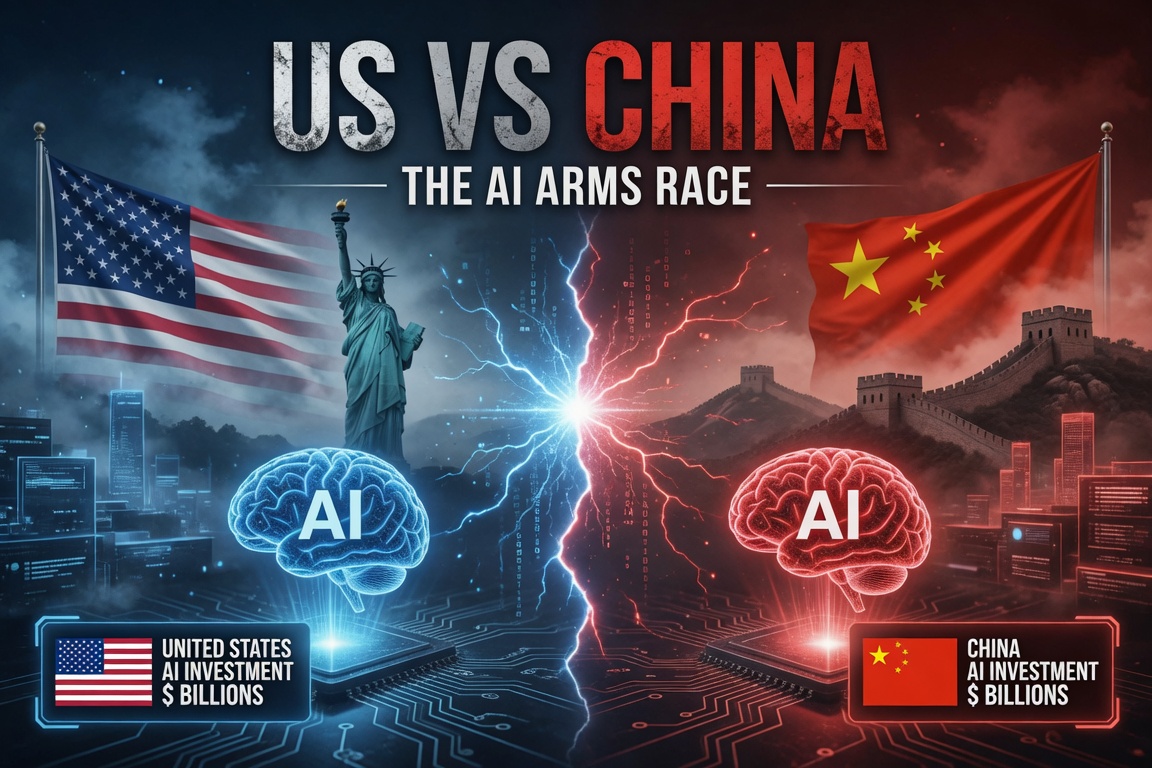
By Shayne Heffernan
Artificial intelligence has become the defining strategic technology of the twenty-first century. Unlike previous technological revolutions, AI is not confined to a single industry. It has become an enabling capability that influences virtually every sector of the global economy, including finance, healthcare, manufacturing, defence, logistics, scientific research and education.
The competition between the United States and China is therefore about far more than producing better chatbots. It is a contest over computing infrastructure, semiconductor leadership, energy availability, scientific talent, industrial capacity, software ecosystems and geopolitical influence.
The United States currently retains leadership in many of the highest-value components of the AI ecosystem. American firms dominate advanced graphics processing units (GPUs), hyperscale cloud infrastructure, frontier proprietary language models and venture capital funding. Companies such as NVIDIA, Microsoft, Alphabet, Amazon, Meta Platforms and OpenAI have created an ecosystem that continues to attract global investment and engineering talent.
China, however, has adopted a different strategy. Rather than relying primarily on private venture capital, Beijing has integrated AI into national industrial policy. Central and provincial governments support AI through direct funding, infrastructure investment, procurement programs and long-term planning. Export controls imposed by the United States have accelerated China's efforts to build domestic semiconductor capability and open-source AI ecosystems rather than slowing innovation outright. Recent research suggests those policies have encouraged broader adoption of open models within China. Recent academic work argues that export controls may have unintentionally strengthened China's open AI ecosystem.
Recent developments illustrate how quickly the competitive landscape is changing. Chinese open-source models have gained significant traction internationally, while U.S. firms continue to invest heavily in proprietary frontier models and compute infrastructure. Reuters has also reported plans for approximately 2 trillion yuan of Chinese investment in nationwide AI infrastructure over five years, highlighting the strategic importance Beijing assigns to AI.
From an investor's perspective, the AI race represents one of the largest capital allocation cycles in modern history. Hundreds of billions of dollars are being deployed into semiconductors, data centres, networking equipment, cloud platforms, energy infrastructure and AI software.
This report examines the major participants in that race, evaluates the competitive strengths of both countries, and considers the implications for investors.
The Fifth Great Technology Race
Modern economic history can be understood through a series of technological competitions.
The Industrial Revolution transformed manufacturing.
The twentieth century witnessed the race for nuclear technology.
The Space Race drove advances in aerospace, electronics and computing.
The Internet revolution reshaped communications and commerce.
Artificial intelligence now represents the fifth great technology race—and arguably the most significant because it amplifies every preceding technology.
Unlike nuclear weapons or space exploration, AI is not confined to governments. Every major corporation, university and military organisation can benefit from AI. Improvements in machine learning increase productivity, accelerate scientific discovery, enhance cyber defence, optimise logistics and improve decision-making across almost every industry.
This broad applicability explains why governments increasingly regard AI as strategic national infrastructure rather than simply another technology sector.
Two Different Models of Innovation
Although both nations seek AI leadership, they pursue fundamentally different models.
The United States relies primarily on private enterprise. Venture capital, research universities, public equity markets and hyperscale technology companies drive innovation. Government plays an important supporting role through defence research, procurement and semiconductor incentives, but commercial competition remains the primary engine.
China employs a state-guided model. National plans, provincial investment funds, state-owned enterprises and coordinated industrial policy accelerate deployment. Large private technology firms remain important, but they operate within a broader national strategy designed to reduce dependence on foreign technology.
These contrasting approaches create different strengths.
The American system encourages rapid innovation, entrepreneurial risk-taking and global capital formation.
The Chinese system enables coordinated infrastructure deployment, long-term planning and rapid industrial scaling.
The Compute Race
Artificial intelligence ultimately depends upon computation.
Training modern frontier models requires enormous quantities of specialised hardware, electricity and networking capacity.
This has elevated graphics processors from gaming components into strategic national assets.
NVIDIA's GPUs have become the foundation of most frontier AI systems. AMD continues to expand its AI accelerator portfolio, while hyperscalers increasingly develop proprietary silicon.
China's response has focused on indigenous chip development led by Huawei, Cambricon and Semiconductor Manufacturing International Corporation (SMIC). Although U.S. export controls have limited access to leading-edge manufacturing equipment, Chinese firms continue to improve domestic alternatives while optimising software to operate efficiently on available hardware.
Interestingly, China's recent achievement of the world's fastest traditional supercomputer demonstrates growing domestic capability in high-performance computing, although analysts note that such systems are not necessarily optimised for frontier AI workloads.
Capital is the New Weapon
The AI race is increasingly measured not only by model quality but by capital expenditure.
American hyperscalers are collectively investing hundreds of billions of dollars into AI infrastructure.
China, meanwhile, is planning nationwide AI data-centre expansion supported by state investment.
Rather than competing solely through better algorithms, both countries are effectively building parallel digital industrial revolutions.
Data centres, electrical generation, networking equipment, advanced memory systems and semiconductor fabrication have become strategic assets comparable to railroads during the nineteenth century or oil infrastructure during the twentieth.
Investors should therefore view AI not merely as a software opportunity but as an infrastructure cycle likely to span decades.
National Security
Public discussion of AI often centres on consumer products such as conversational assistants.
Government priorities differ substantially.
Military organisations view AI as a force multiplier across intelligence analysis, cyber operations, logistics, autonomous systems, surveillance, targeting and command support.
Much of this activity remains classified.
It is therefore important to distinguish between publicly documented capabilities and those that almost certainly exist but cannot be independently verified.
Neither the United States nor China publicly disclose the full extent of AI deployed within intelligence agencies or military organisations.
Historical precedent suggests governments routinely withhold details of strategically important technologies while they remain operational. Accordingly, any assessment of defence AI should separate verified public information from informed analysis rather than present speculation as established fact.
The United States: Building the World's AI Superpower
If the AI revolution has an epicentre, it remains the United States.
America's leadership in artificial intelligence is not the result of one company or one government initiative. It is the product of an ecosystem that has evolved over decades through world-class universities, deep capital markets, entrepreneurial culture, defence research, venture capital and technology giants capable of investing hundreds of billions of dollars into infrastructure.
The United States currently dominates several of the highest-value layers of the AI technology stack:
Advanced semiconductors
Cloud computing
Foundation models
AI software platforms
Enterprise AI
Venture capital
Research universities
Defence AI
This leadership has translated directly into financial markets. Since late 2022, AI-related companies have collectively added trillions of dollars in market value, making AI one of the most significant investment themes since the commercial internet.
Yet maintaining this leadership is becoming increasingly expensive.
The largest technology companies now measure annual AI capital expenditure in tens of billions of dollars, with total industry investment expected to exceed US$400 billion annually within a few years.
The AI race has therefore become an infrastructure race.
Government Support
Unlike China, the United States does not operate a centrally planned AI strategy.
Instead, government support comes through multiple channels.
CHIPS and Science Act
The CHIPS and Science Act was designed to rebuild America's semiconductor manufacturing capability after decades of production migrating to Asia.
It provides more than US$50 billion in incentives for semiconductor manufacturing, research and workforce development.
While often described as industrial policy, its strategic objective extends beyond economics.
Semiconductors have become national security assets.
Without advanced chips, there is no frontier AI.
Department of Defense
The Department of Defense has dramatically increased AI investment.
Applications include
battlefield intelligence
predictive logistics
autonomous systems
cybersecurity
satellite imagery
electronic warfare
decision support
The Pentagon increasingly views AI as essential to maintaining military superiority.
DARPA
The Defense Advanced Research Projects Agency remains one of America's most influential research organisations.
Historically DARPA has contributed to
ARPANET
GPS
autonomous vehicles
advanced robotics
machine learning
Many technologies commercialised by Silicon Valley began as DARPA research projects.
National Security
The intelligence community—including agencies such as the NSA and CIA—is believed to be investing heavily in AI.
Much of this work remains classified.
It is therefore impossible to accurately compare public and classified AI capability.
Investors should remember that some of the most advanced AI systems developed in the United States may never be publicly disclosed.
The Infrastructure Leaders
NVIDIA
Exchange: NASDAQ
Ticker: NVDA
Overview
No company has benefited more from the AI revolution than NVIDIA.
Originally known for graphics processors used in gaming, NVIDIA transformed itself into the world's dominant supplier of AI accelerators.
Its CUDA software ecosystem created an effective industry standard.
Today, nearly every frontier AI model relies upon NVIDIA hardware during development.
Competitive Advantages
CUDA software ecosystem
Blackwell GPU architecture
Networking through Mellanox
AI software stack
Strong developer ecosystem
Government Importance
NVIDIA products are considered strategically important.
Export restrictions imposed by the U.S. government on advanced AI chips destined for China illustrate the company's geopolitical significance.
Investment View
NVIDIA is no longer simply a semiconductor company.
It has become foundational infrastructure for the AI economy.
Its greatest competitive advantage is no longer hardware alone but the software ecosystem surrounding CUDA.
Microsoft
Exchange: NASDAQ
Ticker: MSFT
Microsoft has transformed itself from a traditional software company into one of the world's largest AI infrastructure providers.
Its investment in OpenAI fundamentally changed the competitive landscape.
Azure has become one of the primary cloud platforms used for training and deploying large language models.
Microsoft is integrating AI throughout
Windows
Office
GitHub
Azure
Security products
Dynamics
This breadth gives Microsoft one of the most diversified AI businesses globally.
Competitive Advantages
Azure cloud
Enterprise software
OpenAI partnership
Global distribution
Developer ecosystem
Government Relationships
Microsoft remains a major supplier to
U.S. Government
Department of Defense
Intelligence agencies
This creates long-term recurring revenue beyond commercial markets.
Alphabet
Exchange: NASDAQ
Ticker: GOOGL
Alphabet possesses perhaps the deepest AI research capability in the world.
Google researchers pioneered many of the breakthroughs underpinning modern AI, including the Transformer architecture introduced in the landmark paper Attention Is All You Need.
DeepMind continues to produce cutting-edge research across
protein folding
robotics
reinforcement learning
multimodal AI
Alphabet's challenge has never been research.
It has been commercial execution.
Nevertheless, Google Search, YouTube, Android and Google Cloud provide enormous datasets and distribution.
Amazon
Exchange: NASDAQ
Ticker: AMZN
Amazon approaches AI from infrastructure rather than consumer chatbots.
AWS remains the world's largest cloud platform.
Amazon has invested heavily in
Trainium chips
Inferentia chips
Bedrock
enterprise foundation models
logistics AI
warehouse robotics
Amazon's strength lies in enabling customers rather than building a single dominant model.
Enterprise AI
Palantir
Exchange: NASDAQ
Ticker: PLTR
Few companies illustrate the convergence of AI and government more clearly than Palantir.
Originally focused on intelligence analysis, Palantir now deploys AI platforms across defence, healthcare, manufacturing and energy.
Its Artificial Intelligence Platform (AIP) enables organisations to integrate large language models with operational data while maintaining governance.
Competitive Advantages
Government relationships
Secure deployment
Ontology-based data modelling
Enterprise integration
Palantir's ontology approach allows organisations to understand relationships between data objects rather than simply storing information.
This increasingly differentiates enterprise AI from consumer AI.
Oracle
Oracle has quietly become a major AI infrastructure provider.
Its cloud business has expanded rapidly as enterprises seek alternative compute providers.
Oracle is also building large AI data centres and partnering with multiple frontier model developers.
OpenAI
Although privately held, OpenAI has become one of the world's most influential AI companies.
Its ChatGPT platform introduced generative AI to mainstream users.
Its GPT series remains among the strongest frontier models commercially available.
OpenAI's partnership with Microsoft provides
cloud infrastructure
enterprise distribution
capital
global reach
OpenAI is increasingly evolving from a research laboratory into an infrastructure company.
Anthropic
Founded by former OpenAI researchers, Anthropic focuses on AI safety and constitutional AI.
Claude has become one of the strongest competitors to GPT.
Anthropic's partnerships with Amazon and Google provide enormous computing resources.
Its emphasis on enterprise-grade reliability has attracted significant corporate adoption.
xAI
Elon Musk founded xAI to pursue frontier AI outside existing technology giants.
Its Grok models leverage integration with X (formerly Twitter) to access large-scale real-time information.
xAI also benefits from Musk's broader ecosystem, including Tesla, SpaceX and X.
Scale AI
Scale AI occupies one of the least visible but most important parts of the AI supply chain.
High-quality labelled data remains essential for training frontier models.
Scale provides
annotation
evaluation
synthetic data
defence AI support
The company has become an important partner for both commercial and government AI programmes.
Anduril
Artificial intelligence is transforming defence.
Anduril develops autonomous defence systems combining
sensors
drones
AI
command software
Unlike traditional defence contractors, Anduril was built from inception around software and autonomy.
It represents a new generation of defence technology companies.
America's Greatest Strength
The United States possesses advantages extending beyond individual companies.
Its ecosystem combines
elite universities
venture capital
deep capital markets
entrepreneurial culture
defence research
global software platforms
No other country currently matches this combination.
However, these advantages also create vulnerabilities.
The AI industry increasingly depends upon
electricity
semiconductor supply
skilled labour
rare earth materials
global manufacturing
Maintaining leadership will require continued investment across each of these domains.
Investment Perspective
For investors, the American AI ecosystem offers exposure across multiple layers:
Layer | Representative Companies |
|---|---|
Semiconductors | NVIDIA, AMD, Broadcom |
Cloud | Microsoft, Amazon, Alphabet, Oracle |
Foundation Models | OpenAI*, Anthropic*, xAI* |
Enterprise AI | Palantir, Microsoft, Oracle |
Defence AI | Palantir, Anduril*, Scale AI* |
Robotics | Tesla, Amazon |
Infrastructure | CoreWeave*, Equinix, Digital Realty |
*Private company.
The breadth of this ecosystem remains America's greatest competitive advantage. While individual technologies may change, the United States continues to possess the world's deepest concentration of AI talent, capital and commercialisation capability.
China's AI Strategy: Winning Through Scale
If the United States built the modern AI industry through private enterprise and venture capital, China has pursued a fundamentally different path.
Artificial intelligence is regarded in Beijing as a national strategic capability rather than simply another technology sector.
China's leadership has repeatedly identified AI as critical to future economic growth, industrial competitiveness, military modernisation and national security. This long-term vision has shaped government policy, encouraged domestic investment and accelerated the development of a comprehensive AI ecosystem spanning semiconductors, cloud computing, robotics, autonomous vehicles, smart manufacturing and defence.
Unlike Silicon Valley's market-driven innovation model, China's approach combines state planning with private sector execution.
The result is one of the most comprehensive industrial technology programmes ever undertaken.
The National AI Plan
China's modern AI strategy effectively began with the New Generation Artificial Intelligence Development Plan, released in 2017.
Its objectives were ambitious:
Become the world's leading AI innovation centre.
Reduce dependence on foreign technology.
Integrate AI across manufacturing.
Modernise national defence.
Develop domestic semiconductor capability.
Create globally competitive AI companies.
Subsequent Five-Year Plans have reinforced these objectives, while provincial governments have established dedicated AI industrial parks, research centres and funding programmes.
This continuity gives Chinese companies confidence that AI investment will remain a national priority regardless of short-term economic cycles.
Export Controls Changed the Game
When the United States restricted exports of advanced AI chips and semiconductor manufacturing equipment, many observers expected China's AI development to slow dramatically.
Instead, export controls produced two important effects.
First, they accelerated domestic semiconductor development.
Second, they encouraged optimisation.
Chinese researchers increasingly focused on building efficient open-source models capable of competing with frontier systems using fewer computational resources.
Rather than attempting to match American compute expenditure dollar-for-dollar, Chinese developers emphasised engineering efficiency.
DeepSeek became the clearest demonstration of this philosophy.
Its emergence surprised many Western observers and highlighted China's growing capability to develop highly competitive models despite hardware constraints.
Huawei
Although privately owned, Huawei has become one of China's most strategically important technology companies.
Originally known for telecommunications equipment, Huawei has transformed into a major AI infrastructure provider.
Its Ascend AI processors now underpin many domestic AI deployments.
Huawei's strategy extends beyond chips.
The company now offers:
AI servers
Cloud infrastructure
Networking
Enterprise AI
Operating systems
AI development tools
This vertical integration reduces dependence on foreign suppliers.
Huawei's importance to Beijing cannot be overstated.
It has become both a commercial champion and a strategic technology asset.
Alibaba
Exchange: Hong Kong Stock Exchange / New York Stock Exchange
Ticker: 9988 (HK) / BABA (NYSE)
Alibaba is China's closest equivalent to Amazon, Microsoft Azure and OpenAI combined.
Its strengths include:
Alibaba Cloud
Qwen foundation models
Enterprise AI
E-commerce
Logistics
Financial technology
Alibaba Cloud remains one of Asia's largest cloud providers.
Its Qwen family of large language models has become increasingly competitive internationally, with open-source releases gaining traction among developers.
Alibaba benefits from enormous commercial datasets generated through its retail, logistics and payment ecosystems.
Tencent
Exchange: Hong Kong Stock Exchange
Ticker: 0700
Tencent possesses one of the richest consumer ecosystems in the world.
Its platforms include:
WeChat
QQ
Gaming
Cloud
Digital payments
AI is now embedded across nearly every Tencent product.
The company's greatest competitive advantage lies in user engagement.
Few companies globally possess comparable behavioural datasets.
Tencent increasingly focuses on enterprise AI while continuing to integrate AI across consumer applications.
Baidu
Often described as China's Google, Baidu has invested in artificial intelligence for more than a decade.
Its Ernie foundation models represent one of China's flagship AI platforms.
Baidu also maintains strengths in:
Autonomous driving
Search
Cloud AI
Voice recognition
AI chips
While its consumer search business has matured, AI has become the company's primary growth engine.
ByteDance
Although privately held, ByteDance deserves inclusion among the world's most important AI companies.
Its recommendation algorithms transformed social media through TikTok and Douyin.
Those same AI capabilities now extend into:
Foundation models
Video generation
Productivity tools
Enterprise AI
ByteDance demonstrates how expertise in recommendation systems can evolve into broader AI leadership.
DeepSeek
Perhaps no company symbolises China's recent AI progress more than DeepSeek.
Originally attracting attention within technical communities, DeepSeek rapidly gained global recognition after releasing highly capable open-source reasoning models.
Its significance extends beyond model quality.
DeepSeek demonstrated that innovation is not determined solely by access to the largest compute clusters.
Efficient architecture, optimisation and engineering discipline can partially compensate for hardware limitations.
For policymakers, DeepSeek became evidence that export controls alone may not prevent frontier AI development.
For investors, it showed that China's AI ecosystem remains highly innovative despite external constraints.
Z.ai (formerly Zhipu AI)
Z.ai has become one of China's leading frontier model developers.
Supported by significant venture funding and strategic partnerships, the company focuses on enterprise-grade foundation models.
Its products increasingly target government, finance, manufacturing and healthcare.
Unlike consumer chatbot providers, Z.ai emphasises practical commercial deployment.
Moonshot AI
Moonshot AI specialises in long-context language models capable of processing extremely large documents.
Enterprise customers increasingly require systems capable of analysing extensive technical documentation, contracts and research reports.
Moonshot has positioned itself strongly within this specialised market.
MiniMax
MiniMax focuses on multimodal AI, including text, image, speech and video generation.
The company has expanded rapidly across Asia and represents one of China's fastest-growing AI startups.
SenseTime
Exchange: Hong Kong Stock Exchange
SenseTime was originally recognised for computer vision.
Its expertise has expanded into:
Foundation models
Smart cities
Healthcare AI
Industrial AI
Despite facing geopolitical challenges, SenseTime remains an important participant within China's AI ecosystem.
iFlytek
Few companies possess deeper expertise in speech recognition than iFlytek.
Its products support:
Education
Healthcare
Government
Translation
Voice assistants
Speech remains an area where China has achieved global competitiveness.
Cambricon
Cambricon develops specialised AI processors intended to reduce China's dependence on imported chips.
Although significantly smaller than NVIDIA, Cambricon represents an important component of Beijing's semiconductor strategy.
SMIC
Semiconductor Manufacturing International Corporation occupies a critical position within China's AI ambitions.
Manufacturing remains China's greatest structural challenge.
Although SMIC trails the most advanced global fabrication technologies, continued investment and engineering improvements have narrowed some capability gaps.
Its long-term strategic importance exceeds its current technological position.
Robotics and Manufacturing
One area where China may hold structural advantages is industrial automation.
The country already possesses the world's largest manufacturing base.
Combining robotics with AI enables:
Predictive maintenance
Factory optimisation
Autonomous logistics
Industrial inspection
Supply-chain management
Unlike software-only companies, China's manufacturers can rapidly deploy AI into physical production systems.
Government Procurement
Chinese government procurement plays a significant role in commercial AI adoption.
Public-sector demand supports deployment across:
Healthcare
Education
Transportation
Manufacturing
Urban management
This early adoption accelerates commercial maturity.
Military-Civil Fusion
Perhaps the greatest difference between China and the United States is the concept of Military-Civil Fusion.
Rather than maintaining strict separation between civilian and defence technology, China encourages dual-use innovation where appropriate.
This means advances in:
Computer vision
Robotics
Autonomous navigation
Machine learning
may ultimately benefit both commercial and national security applications.
Much of the detailed implementation remains opaque, making direct comparisons with U.S. capabilities difficult.
China's Greatest Strength
China's greatest competitive advantage is not a single company.
It is the combination of:
Government coordination
Manufacturing scale
Large domestic market
Engineering talent
Rapid commercial deployment
Long-term infrastructure planning
While the United States currently leads many frontier technologies, China has repeatedly demonstrated its ability to close technological gaps faster than many analysts expect.
History provides numerous examples—from high-speed rail to telecommunications equipment and electric vehicles—where Chinese firms evolved from followers to global leaders within relatively short periods.
AI may ultimately follow a similar trajectory.
Investment Perspective
Investors should avoid viewing China's AI industry solely through the lens of geopolitical risk.
The ecosystem is increasingly diversified.
Layer | Representative Companies |
|---|---|
Cloud | Alibaba, Tencent, Huawei |
Foundation Models | DeepSeek*, Qwen (Alibaba), Z.ai*, Moonshot*, MiniMax* |
AI Infrastructure | Huawei, Cambricon, SMIC |
Enterprise AI | Baidu, Huawei, Alibaba |
Consumer AI | Tencent, ByteDance*, Xiaomi |
Speech AI | iFlytek |
Computer Vision | SenseTime |
Manufacturing AI | Huawei, Xiaomi, Lenovo |
*Private company.
The Chinese AI ecosystem remains less accessible to global investors than its American counterpart. However, its strategic importance continues to increase, supported by substantial domestic demand, government backing and a growing emphasis on technological self-reliance.
China is no longer simply attempting to replicate Silicon Valley.
It is building an alternative AI ecosystem with its own semiconductor supply chains, foundation models, cloud infrastructure and industrial applications.
Whether that ecosystem ultimately surpasses the United States remains uncertain.
What is increasingly clear is that the global AI race will not produce a single winner.
Instead, investors are likely to see the emergence of two partially independent AI ecosystems—one centred on the United States and its allies, the other on China and its expanding technology sphere.
Understanding both ecosystems will be essential for investors seeking to identify the next generation of global technology leaders.
Beyond ChatGPT: Understanding the AI Stack
Much of the public debate surrounding artificial intelligence is dominated by consumer products such as ChatGPT, Claude, Gemini, Grok and DeepSeek. These systems have brought AI into the mainstream, but they represent only the visible layer of a far larger technological ecosystem.
The AI race is not being won by chatbots alone. It is being decided across a complex stack of interdependent technologies that includes semiconductors, cloud computing, networking, energy, software, data, robotics and defence applications.
Leadership in one layer does not guarantee leadership across the entire ecosystem. A country may excel in frontier models while remaining dependent on foreign chip manufacturing or energy infrastructure. Likewise, another nation may lag in consumer-facing AI yet dominate industrial automation or manufacturing.
To understand the competitive position of the United States and China, investors must examine each layer independently.
Layer One: Semiconductors
Artificial intelligence begins with compute. Without advanced processors, even the most sophisticated algorithms remain theoretical.
The United States currently holds a commanding lead in AI chip design.
United States
The American semiconductor ecosystem is anchored by NVIDIA, whose GPUs have become the standard platform for training and deploying large language models. NVIDIA's CUDA software ecosystem has created a powerful competitive moat, encouraging developers to optimise their software for NVIDIA hardware.
Other major participants include:
AMD
Broadcom
Marvell Technology
Qualcomm
Intel (accelerators and AI PCs)
Although Taiwan's TSMC manufactures many of these advanced chips, the intellectual property, architecture and software remain largely American.
China
China's response has centred on reducing dependence on imported semiconductors.
Key participants include:
Huawei (Ascend processors)
Cambricon
SMIC
Hygon
Biren Technology
While Chinese companies have made significant progress, they continue to face constraints resulting from export controls on advanced lithography equipment and high-end AI accelerators.
Nevertheless, necessity has encouraged innovation. Chinese engineers have focused on improving software efficiency and optimising models for available hardware.
Verdict
Current Leader: United States
The United States maintains a significant lead in chip architecture and software ecosystems, although China's progress suggests the gap may narrow over the next decade.
Layer Two: Foundation Models
Foundation models represent the intelligence layer of AI.
These models increasingly perform reasoning, software development, scientific analysis and multimodal tasks.
United States
Leading organisations include:
OpenAI
Anthropic
Google DeepMind
Meta
xAI
American models continue to perform strongly across independent benchmarks, particularly in coding, reasoning and enterprise applications.
The U.S. ecosystem also benefits from close integration between frontier research laboratories and hyperscale cloud providers.
China
Chinese developers have adopted a more diverse strategy.
Major participants include:
DeepSeek
Alibaba (Qwen)
Baidu (ERNIE)
Tencent (Hunyuan)
Moonshot AI
MiniMax
Rather than focusing exclusively on proprietary models, Chinese firms have embraced open-source development. This has accelerated domestic adoption and encouraged rapid iteration.
Verdict
Current Leader: United States
However, China's rate of improvement has surprised many industry observers. The competitive gap is substantially smaller than it was only a few years ago.
Layer Three: Cloud Infrastructure
Training and deploying AI requires enormous computing resources.
United States
The hyperscalers dominate global cloud infrastructure:
Amazon Web Services
Microsoft Azure
Google Cloud
Together, these companies provide the majority of AI training capacity used by commercial organisations.
China
China's leading cloud providers include:
Alibaba Cloud
Huawei Cloud
Tencent Cloud
Baidu AI Cloud
Although domestic providers dominate within China, they remain less influential internationally due to geopolitical constraints and regional market preferences.
Verdict
Leader: United States
American cloud providers maintain broader global reach and larger international customer bases.
Layer Four: Data
AI systems improve through access to high-quality data.
This category is often misunderstood.
It is not merely the quantity of data that matters but its diversity, quality and legal accessibility.
United States
American companies benefit from global consumer platforms including:
Google
YouTube
Facebook
Instagram
LinkedIn
GitHub
Microsoft Office
These platforms generate rich datasets across business, consumer and technical domains.
China
Chinese companies possess similarly powerful ecosystems:
WeChat
Douyin
Taobao
Alipay
Baidu
China's large domestic population and widespread digital adoption provide extensive behavioural and commercial data.
Verdict
Essentially Even
Both countries possess sufficient data to support world-class AI development.
Layer Five: Energy
One of the least discussed aspects of AI is electricity.
Modern AI infrastructure consumes extraordinary amounts of power.
Hyperscale data centres increasingly require gigawatts of electricity.
The race for AI leadership is therefore becoming a race for energy infrastructure.
United States
Advantages include:
Large private capital markets
Expanding nuclear initiatives
Natural gas production
Renewable investment
Challenges include permitting delays and grid constraints.
China
China continues to invest aggressively in:
Ultra-high-voltage transmission
Nuclear power
Hydroelectric generation
Solar
Wind
Its central planning model allows rapid infrastructure deployment.
Verdict
Slight Advantage: China
China's ability to coordinate national infrastructure projects may provide an advantage as AI electricity demand accelerates.
Layer Six: Robotics
The convergence of AI and robotics represents the next major frontier.
United States
Leaders include:
Tesla
Boston Dynamics
Figure AI
Agility Robotics
American companies remain strong in autonomous software and advanced robotics research.
China
China has become the world's largest market for industrial robots.
Companies including Huawei, Xiaomi and numerous manufacturing firms are integrating AI into production systems at remarkable scale.
Verdict
Industrial Robotics: China
Advanced Robotics Research: United States
Layer Seven: Manufacturing
Manufacturing remains one of China's strongest structural advantages.
Its integrated supply chains allow rapid scaling from research to production.
The United States retains leadership in software and high-value intellectual property, while China dominates many areas of physical manufacturing.
Verdict
Leader: China
Layer Eight: Venture Capital
The United States continues to dominate private AI investment.
Silicon Valley attracts global entrepreneurs, institutional investors and engineering talent.
Companies such as OpenAI, Anthropic, xAI, Scale AI and CoreWeave have raised tens of billions of dollars.
China's venture ecosystem remains substantial but has become more selective amid broader economic challenges.
Verdict
Leader: United States
Layer Nine: Universities and Research
American universities continue to produce much of the foundational AI research.
Institutions such as:
Stanford
MIT
Carnegie Mellon
Berkeley
remain globally influential.
China, however, graduates significantly larger numbers of STEM students and continues to increase research output.
Verdict
Research Quality: United States
Engineering Scale: China
Layer Ten: Defence AI
This is perhaps the most difficult category to evaluate.
Both governments invest heavily in classified AI programmes.
Publicly known American initiatives include:
DARPA
Project Maven
Joint Artificial Intelligence Center (JAIC, now integrated into the Chief Digital and Artificial Intelligence Office)
Numerous defence contracts involving Palantir, Anduril, Microsoft and others
China's military-civil fusion strategy suggests significant integration between civilian AI advances and defence applications, but many details remain non-public.
Verdict
Unknown
Any definitive ranking would go beyond publicly available evidence. It is more accurate to conclude that both nations regard AI as a strategic military capability and invest accordingly.
Overall Scorecard
Category | United States | China | Current Leader |
|---|---|---|---|
AI Chips | ★★★★★ | ★★★★☆ | USA |
Cloud Computing | ★★★★★ | ★★★☆☆ | USA |
Foundation Models | ★★★★★ | ★★★★☆ | USA |
Enterprise AI | ★★★★★ | ★★★★☆ | USA |
Industrial AI | ★★★★☆ | ★★★★★ | China |
Manufacturing | ★★★☆☆ | ★★★★★ | China |
Robotics | ★★★★★ | ★★★★★ | Tie (different strengths) |
Venture Capital | ★★★★★ | ★★★☆☆ | USA |
Research Universities | ★★★★★ | ★★★★☆ | USA |
Government Coordination | ★★★☆☆ | ★★★★★ | China |
Energy Infrastructure | ★★★★☆ | ★★★★★ | China |
Defence AI (Public Evidence) | Strong | Strong | Too close to call |
Investment Perspective
For investors, the most important conclusion is that this is not a winner-takes-all race.
The United States currently leads in frontier innovation, software ecosystems and capital formation. China leads in manufacturing scale, coordinated infrastructure deployment and industrial implementation.
Rather than one country replacing the other, the more likely outcome is the emergence of two parallel AI ecosystems, each increasingly self-reliant and strategically important.
This bifurcation will shape technology markets, supply chains and investment opportunities for years to come.
AI Is an Economic Revolution, Not a Technology Cycle
Every major technological revolution has created extraordinary investment opportunities.
The Industrial Revolution produced railways, steel and manufacturing giants.
The twentieth century created oil majors, automobile manufacturers and aerospace companies.
The internet created Google, Amazon, Apple and Microsoft.
Artificial intelligence is likely to produce an even broader transformation because AI enhances almost every industry rather than replacing a single technology.
The winners may not be those building the most powerful models. They may instead be those controlling the infrastructure, energy, software platforms and enterprise integration that allow AI to scale globally.
History suggests that infrastructure providers often capture more durable value than early application developers. During the California Gold Rush, the companies supplying picks, shovels and transport frequently generated steadier returns than the prospectors themselves.
AI appears to be following a similar pattern.
Investment Layer One: Compute
The first beneficiaries of AI were semiconductor companies.
Every frontier model requires enormous computational resources.
Every increase in model complexity requires more advanced chips, faster networking and larger data centres.
This has transformed compute into the foundation of the AI economy.
Investment View
This remains the lowest-risk segment of the AI ecosystem because demand continues regardless of which language model ultimately dominates.
If OpenAI wins, NVIDIA benefits.
If Anthropic wins, NVIDIA benefits.
If DeepSeek expands internationally, demand for compute still rises.
Compute has become the common denominator.
Tier One Infrastructure Companies
Company | Exchange | Strategic Position | Investment View |
|---|---|---|---|
NVIDIA | NASDAQ | AI GPU leader | Core long-term holding |
AMD | NASDAQ | GPU challenger | High-growth opportunity |
Broadcom | NASDAQ | Networking and AI infrastructure | Attractive infrastructure play |
Marvell | NASDAQ | High-speed networking | AI infrastructure beneficiary |
TSMC | Taiwan | Advanced manufacturing | Critical global supplier |
ASML | Amsterdam | Lithography monopoly | Essential semiconductor infrastructure |
Investment Layer Two: Cloud Computing
The next major beneficiaries are hyperscale cloud providers.
Training modern AI systems requires infrastructure beyond the reach of most corporations.
Consequently, enterprises increasingly rent AI compute rather than building it internally.
This structural shift favours companies operating global cloud platforms.
Tier One Cloud Providers
Company | Primary Strength |
|---|---|
Microsoft | Azure + OpenAI ecosystem |
Amazon | AWS scale and enterprise reach |
Alphabet | Google Cloud + DeepMind |
Oracle | Enterprise AI infrastructure |
Alibaba | Asia's leading cloud platform |
Cloud revenue is becoming increasingly tied to AI workloads.
As businesses integrate AI into daily operations, demand for cloud services is expected to expand further.
Investment Layer Three: Enterprise Software
Consumer AI attracts headlines.
Enterprise AI generates recurring revenue.
Large corporations require:
Governance
Security
Compliance
Integration
Auditability
Identity management
Workflow automation
These requirements favour established enterprise software providers.
Companies to Watch
Microsoft
Microsoft possesses perhaps the broadest AI monetisation strategy.
AI is embedded across Office, GitHub, Azure, Dynamics and security products.
Rather than depending upon one product, Microsoft benefits from AI adoption across its entire software portfolio.
Palantir
Palantir occupies a unique position.
Unlike companies focused on general-purpose language models, Palantir specialises in integrating AI into operational decision-making.
Its ontology-based approach enables organisations to connect data, assets, policies and workflows while maintaining governance.
This makes Palantir particularly attractive for governments and highly regulated industries.
Oracle
Oracle has quietly emerged as a major AI infrastructure provider.
Its installed enterprise customer base creates opportunities to introduce AI into existing business applications.
Oracle's investments in AI-ready cloud infrastructure position it well for long-term enterprise adoption.
Investment Layer Four: Foundation Models
Large language models currently attract the greatest attention.
However, they also present the greatest uncertainty.
Today's leading model may not remain dominant in five years.
Rapid innovation continues to reduce barriers to entry.
Consequently, investors should distinguish between:
Companies selling AI models.
and
Companies enabling the AI ecosystem.
The latter may ultimately prove more resilient.
Investment Layer Five: Robotics
The next phase of AI extends beyond software.
Robotics combines:
AI
Sensors
Mechanical engineering
Manufacturing
This convergence has enormous economic implications.
Potential applications include:
Warehousing
Healthcare
Agriculture
Construction
Logistics
Domestic assistance
Companies positioned in this sector may experience sustained growth over the next decade.
Investment Layer Six: Defence
Defence AI represents one of the fastest-growing yet least understood markets.
Governments increasingly require:
Autonomous surveillance
Drone coordination
Battlefield intelligence
Logistics optimisation
Cyber defence
Decision support
Many contracts remain classified.
Consequently, public financial statements may not fully reflect future opportunities.
Companies such as Palantir, Anduril and Scale AI appear well positioned to benefit from increasing defence AI expenditure.
The Chinese Opportunity
Many Western investors underestimate China's AI ecosystem.
While geopolitical considerations create uncertainty, Chinese companies continue to innovate rapidly.
Alibaba, Tencent, Huawei and Baidu remain central participants.
Emerging firms such as DeepSeek demonstrate that world-class AI research is no longer confined to Silicon Valley.
Investors with access to Asian markets should monitor developments carefully.
The Energy Trade
Perhaps the most overlooked investment opportunity lies outside traditional technology.
AI consumes electricity.
Data centres require:
Grid infrastructure
Natural gas
Nuclear generation
Renewable energy
Cooling systems
Electrical equipment
Consequently, utilities, engineering firms and power equipment manufacturers may become indirect beneficiaries of AI expansion.
The AI revolution is therefore likely to reshape energy markets alongside technology markets.
Risks
Despite enormous opportunity, investors should recognise several important risks.
Valuation
Many AI-related companies trade at premium valuations.
Future returns depend not only on technological leadership but also on sustained earnings growth.
Regulation
Governments continue to develop AI regulation.
Compliance requirements may increase operating costs.
Geopolitics
Export controls, tariffs and investment restrictions could reshape supply chains.
The AI race increasingly intersects with national security.
Energy Constraints
Electricity shortages could become a limiting factor for AI expansion.
Power generation may prove as important as semiconductor production.
AI Investment Scorecard
The following reflects a qualitative assessment rather than a mechanical ranking.
Company | AI Leadership | Financial Strength | Strategic Importance | Long-Term Outlook |
|---|---|---|---|---|
NVIDIA | 10 | 10 | 10 | 10 |
Microsoft | 10 | 10 | 10 | 10 |
Alphabet | 10 | 9 | 10 | 10 |
Amazon | 9 | 10 | 9 | 9 |
Meta Platforms | 9 | 9 | 9 | 9 |
AMD | 8 | 8 | 9 | 9 |
Palantir | 9 | 8 | 10 | 9 |
Oracle | 8 | 9 | 8 | 8 |
Broadcom | 8 | 9 | 9 | 9 |
Alibaba | 8 | 8 | 9 | 8 |
Tencent | 8 | 9 | 9 | 8 |
Huawei* | Strategic | Strategic | Strategic | Strategic |
DeepSeek* | Emerging | N/A | High | High |
OpenAI* | Frontier Leader | Private | Transformational | Very High |
*Private companies are assessed qualitatively because they are not publicly traded and do not publish the same level of financial information as listed firms.
Looking Ahead
The AI investment landscape will likely evolve through phases.
The first phase rewarded chipmakers.
The second rewarded cloud providers.
The third is now rewarding enterprise software.
The fourth may centre on robotics, autonomous systems and AI-enabled physical infrastructure.
Investors who recognise these transitions early may be better positioned to benefit from one of the most significant technological transformations of the modern era.
The AI Race Has Only Just Begun
The public narrative surrounding artificial intelligence often assumes that the race is nearing its conclusion.
Nothing could be further from the truth.
What investors have witnessed since the release of ChatGPT in late 2022 represents only the opening phase of a technological revolution that is likely to unfold over decades.
The internet took more than twenty years to transform the global economy.
Electricity required almost fifty years to become universal.
Artificial intelligence is unlikely to follow a shorter path.
Instead, AI is steadily becoming a foundational technology embedded in nearly every industry rather than a standalone product.
Future economic value will increasingly be created not by asking AI questions, but by integrating AI into factories, hospitals, financial systems, transport networks, defence organisations and scientific research.
The companies capable of enabling that transformation are likely to define the next generation of global technology leaders.
From Software to Intelligence Infrastructure
One of the most important shifts now underway is the evolution of AI from software into infrastructure.
Historically, businesses purchased software to automate existing workflows.
Increasingly, organisations will purchase systems capable of reasoning, planning, analysing and executing complex tasks alongside human workers.
This distinction is profound.
Software followed instructions.
Artificial intelligence increasingly generates them.
As these systems mature, enterprise architecture will change fundamentally.
Every major organisation is likely to operate thousands—or even millions—of AI agents working alongside employees, each specialising in areas such as finance, engineering, legal review, logistics, procurement or customer support.
Managing those agents safely will become a major commercial opportunity.
Identity, governance, permissions, audit trails and regulatory compliance will become just as important as model performance.
This is an area where enterprise software providers may enjoy durable competitive advantages over consumer AI companies.
The Emerging AI Economy
Artificial intelligence is creating an entirely new economic ecosystem.
Rather than a single technology sector, AI increasingly influences:
Banking
Healthcare
Manufacturing
Mining
Agriculture
Telecommunications
Defence
Insurance
Pharmaceuticals
Scientific Research
Energy
Education
Each industry will adopt AI at its own pace.
Some sectors will experience gradual productivity improvements.
Others may undergo structural transformation.
History suggests that technological revolutions often create more value through second- and third-order effects than through the original invention itself.
The railway industry created steel.
The internet created cloud computing.
Artificial intelligence is likely to create industries that do not yet exist.
The Coming Compute Shortage
One of the least appreciated risks is compute scarcity.
Demand for AI infrastructure continues to expand faster than supply.
Building frontier AI systems now requires:
Advanced semiconductors
High-bandwidth networking
Massive storage systems
Specialist cooling
Reliable electricity
Highly skilled engineers
Each component has become strategically important.
The countries capable of securing these supply chains may enjoy lasting competitive advantages.
This explains why semiconductors have become central to geopolitical policy.
They are no longer ordinary commercial products.
They are strategic infrastructure.
Energy: The Hidden Battleground
If semiconductors are the brains of AI, electricity is its bloodstream.
Every frontier model depends on abundant, reliable and affordable power.
Hyperscale AI data centres increasingly consume electricity measured in gigawatts rather than megawatts.
This creates investment opportunities extending far beyond technology.
Potential beneficiaries include:
Nuclear power developers
Renewable energy producers
Grid infrastructure companies
Electrical equipment manufacturers
Cooling technology specialists
Natural gas producers
Battery storage providers
In many respects, the AI revolution is also becoming an energy revolution.
Countries capable of expanding electricity generation efficiently may enjoy long-term competitive advantages.
Will There Be One Winner?
Perhaps the most common question asked by investors is whether the United States or China will ultimately dominate artificial intelligence.
The evidence presented throughout this report suggests that the answer is more nuanced.
The United States currently leads in:
Frontier research
Venture capital
Cloud computing
Semiconductor design
Enterprise software
Global software distribution
China demonstrates particular strength in:
Manufacturing scale
Industrial AI deployment
Infrastructure coordination
Domestic market size
Government planning
Supply-chain integration
These strengths are complementary rather than identical.
Rather than producing a single global AI champion, the next decade may see the emergence of two increasingly independent technological ecosystems.
Each will develop its own hardware, software, standards, cloud infrastructure and regulatory frameworks.
Investors should prepare for a world in which technological fragmentation becomes a permanent feature of international business.
Defence and National Security
The defence dimension deserves particular attention.
Unlike consumer AI products, military AI capabilities are rarely disclosed publicly.
Governments understandably protect technologies that may provide strategic advantages.
This creates an important limitation for analysts.
Public information almost certainly understates the true level of military AI development in both countries.
Neither Washington nor Beijing has an incentive to reveal the full capabilities of advanced autonomous systems, cyber tools, intelligence platforms or electronic warfare technologies while those systems remain operational.
Consequently, investors should distinguish carefully between:
Publicly documented programmes.
Reasonable inferences based on budgets, procurement and official statements.
Pure speculation.
Maintaining that distinction is essential for credible analysis.
Beyond the United States and China
Although this report has focused primarily on the world's two largest AI powers, other nations also play critical roles.
Taiwan remains indispensable through advanced semiconductor manufacturing.
The Netherlands occupies a unique position through lithography technology.
Japan contributes advanced materials, precision manufacturing and robotics.
South Korea remains a global leader in memory semiconductors.
Israel continues to generate significant innovation in cybersecurity, defence technology and AI startups.
Europe, despite lagging in frontier AI companies, plays an important role in regulation, industrial automation and scientific research.
The AI race is therefore global, even if its principal competitors remain the United States and China.
Final Investment View
The most successful AI investments over the coming decade may not necessarily be the companies building the most sophisticated chatbots.
Instead, long-term winners are likely to include businesses controlling critical infrastructure:
Compute
Semiconductors
Networking
Cloud platforms
Data centres
Enterprise integration
Cybersecurity
Identity
Robotics
Energy
History consistently demonstrates that infrastructure providers often generate more durable returns than application developers.
Investors should therefore examine the entire AI value chain rather than focusing exclusively on foundation models.
Final Thoughts
Artificial intelligence is not simply another technology cycle.
It represents a transformation in the way knowledge is created, decisions are made and economic value is generated.
The competition between the United States and China should therefore not be viewed solely through the lens of geopolitics.
It is equally a contest over productivity, innovation, industrial capability and economic leadership.
While market attention often focuses on quarterly earnings or the latest language model benchmark, the deeper forces shaping this competition are likely to unfold over decades.
Infrastructure, education, research, capital allocation, energy policy and industrial strategy will matter as much as software itself.
For investors, the implications are profound.
Artificial intelligence is unlikely to produce a single dominant company or even a single dominant nation.
Instead, it is creating an entirely new economic architecture that will reward those able to identify enduring competitive advantages rather than short-term excitement.
The winners of the AI era will not necessarily be those with the loudest announcements or the fastest product launches.
They will be the organisations—and nations—that build resilient ecosystems capable of sustaining innovation for decades.
Author's Opinion
The AI race is often portrayed as a battle between Silicon Valley and Beijing. In reality, it is a contest between two very different economic philosophies. The United States continues to demonstrate extraordinary strength in entrepreneurship, venture capital and frontier research. China has shown remarkable capability in long-term planning, industrial execution and scaling emerging technologies. Investors who underestimate either system risk overlooking significant opportunities.
One point deserves particular emphasis. The public discussion of artificial intelligence almost certainly reflects only part of the picture. Both the United States and China regard AI as a strategic national capability. It is therefore reasonable to assume that some of the most advanced applications in defence, intelligence and cyber operations remain classified. While there is insufficient public evidence to quantify these capabilities, history suggests governments rarely disclose technologies that provide strategic advantages while they remain operational. Investors should therefore distinguish carefully between what is publicly demonstrated, what is supported by official evidence, and what remains unknown.
The AI revolution is still in its early chapters. The next decade will determine not only which companies create the greatest shareholder value, but also which nations shape the technological foundations of the global economy. For long-term investors, understanding this transition may prove as important as recognising the internet revolution in the 1990s or the smartphone revolution in the 2000s.

How Can You Trust AI When You Cannot Trust Humans?
Can you trust AI? Can you trust humans? More often than we like to admit, the answer is no. AI inherits its failures from the human records it is trained on. Sheikh Mohammed bin Rashid wrote this month that the currency the UAE is betting on is trust. This piece sets out what a trust layer has to do, shows the method on three public knowledge graphs, and lays out the post-quantum work KXCO has published so that an institution can check the claim rather than take it.
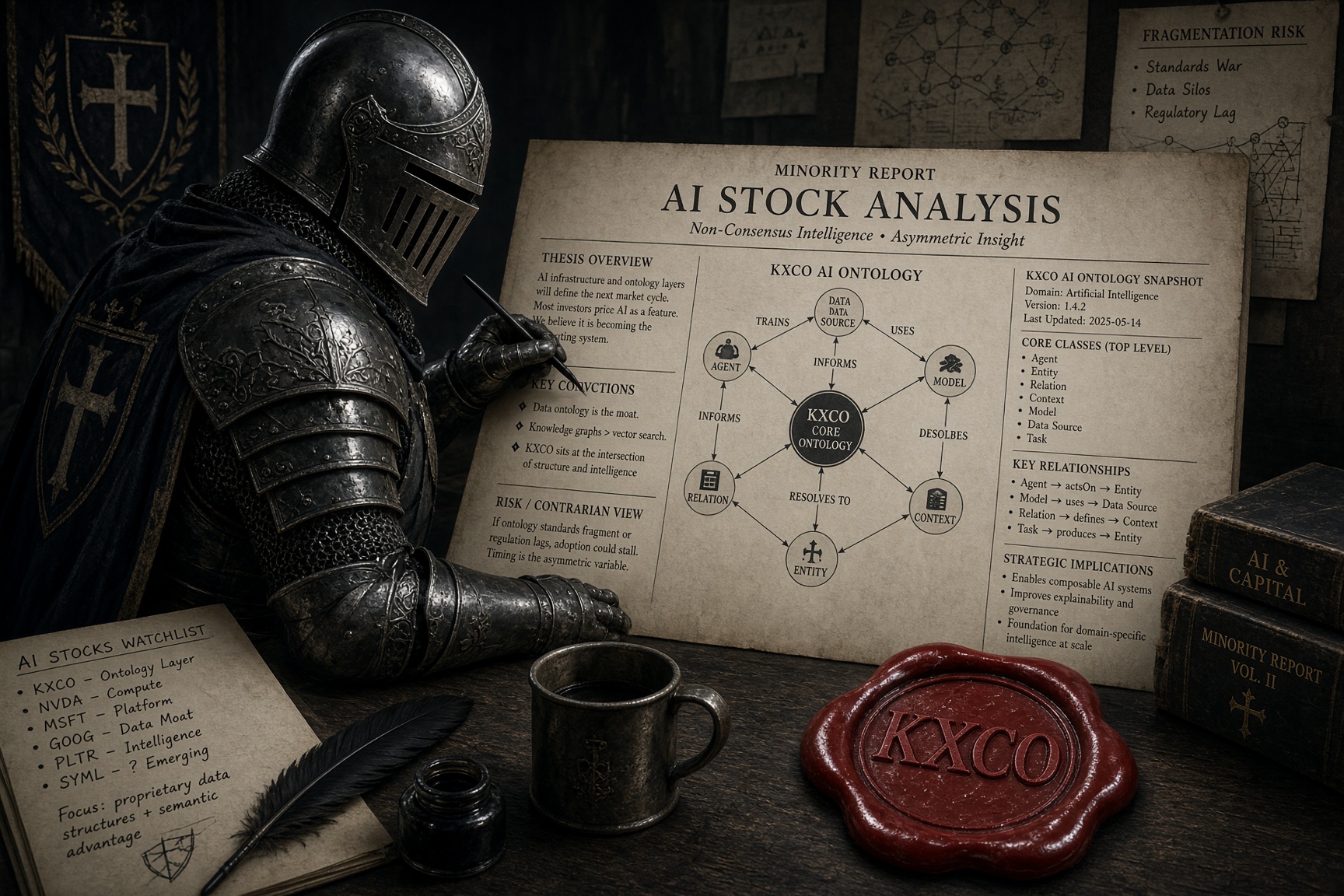
KXCO AI Ontology at 3 Months: What It Called and What Comes Next
On 19 July 2026 the Round Table's AI room published its first Analyst Outlook. To the 16 October 2026 close its 13 names rose 2.6% on an equal weight against 2.1% for QQQ, per StockAnalysis closes, and the six it opened with 35% or more of upside rose 8.6%. This piece lists the six names up more than 5%, the ten names I rate as opportunities now, the month's results in AI and quantum computing, and the official data showing that four in five firms have not yet started using AI.

Thoughts on Thinking: Physics, Biology and Thought
Thinking is not a faculty that sits on top of the body. It is the electrochemical activity of neurons, organised into rhythms whose frequencies are set by the time constants of channels, synapses and loops. Diet, light, noise, natural settings and 40 Hz drive can shift the balance, and an MIT study of essay writing found the weakest EEG connectivity in the group using a language model. The tools and the biology work on one resource: the capacity of a named person to form and defend a judgment.

What the Round Table Is Predicting in Biotech Markets
Seventeen FDA decisions fall due between 30 October 2026 and 29 June 2027, and KXCO's Round Table has called every one. Its model portfolio holds the thirteen Nasdaq companies behind them, led by BridgeBio, Cogent Biosciences and Praxis, and was signed with ML-DSA-87 and anchored on chain before the FDA acts. The first test is Inovio's INO-3107 on 30 October.
Every story, signed and delivered.
Subscribe to the kxco channel and get the headline, the AI-written key takeaways, and the chain-anchor link the moment we publish. Audio versions and per-ticker subscriptions arrive in the next iteration.