
Transitioning Dubai into a Circular Economy
Dubai Economy is strengthening its initiative launched earlier this year to bring together key industry sectors and stakeholders in an all-encompassing journey towards transitioning Dubai into a circular economy in line with the vision of the leadership and strategic plans of the government.
The move has gained fresh momentum with H.H. Sheikh Hamdan bin Mohammed bin Rashid Al Maktoum, Crown Prince of Dubai and Chairman of Dubai Executive Council, recently approving the 2021 Agenda of the Council, which has "Creating a Digital and Circular Economy" among its key objectives.
The 2021 agenda aims to promote excellence in all sectors and introduce innovative initiatives to enhance government services and further raise Dubai’s competitiveness. The circular economy plan of Dubai Economy not only seeks to contribute towards the Agenda but also positions Dubai towards sustainable progress and prosperity over the next 50 years as envisioned by the leadership.
Sami Al Qamzi, Director-General of Dubai Economy, stated, "The pandemic added new momentum to the digital transformation in the emirate and has given us enough examples of the most prudent use of existing assets and resources. Dubai Economy is pleased to have pioneered a circular economy campaign to optimise resources and minimise waste. We are now moving to the next level, engaging with key industry sectors to build on existing opportunities to expedite the circular economy transition."
Unlike the traditional linear economy, the circular economy focuses on improving resource efficiencies and reducing/eliminating waste to the highest extent by depending on re-use, sharing, repair, regeneration, re-manufacturing and recycling. The global market potential for a circular economy is over US$1 trillion (AED3.67 trillion).
As a first step, Dubai Economy launched a series of workshops (hacks) in 2019 on the circular economy transition and related challenges as well as opportunities.
The introductory hack brought together 50 key stakeholders, including sustainability enthusiasts, regulators, corporates, start-ups and NGOs, to propose solutions that would accelerate the transition, particularly across six key dimensions - market readiness, innovation, funding & capital, skills development, regulatory readiness and an adaptive mindset.
With the global outbreak of COVID-19 underlining the importance of food security and local manufacturing, Dubai Economy brought the manufacturing, real estate and food and agri-business sectors onto the centre-stage of the circular economy campaign and hack series.
Commenting on the hack series, Mohammed Shael Al Saadi, CEO, Corporate Strategic Affairs of Dubai Economy, underlined the importance of translating the vision and strategic plans of the UAE and its emirates, including the UAE Vision 2021 Abu Dhabi Economic Vision 2030, Dubai Industrial Strategy 2030 and the Future Foresight programme, into opportunities for innovations in optimal resource utilisation and energy consumption.
The first sector-focused hack on manufacturing had its emphasis on localising global supply chains and attracting investments, particularly into sustainable manufacturing and positioning Dubai as a circular economy for innovation-driven industries and halal products.
The second hack evaluated global and local trends in the real estate and construction sector as well as the advantages Dubai has in evolving into a modern, sustainable city in the backdrop of the long-term changes being set off by urbanisation and industrialisation.
Disruptive technologies and innovations in food production, processing and consumption to achieve sustainable food security, particularly in the backdrop of the growing concerns on food production outpacing demand climate change and rapid urbanization were highlighted in the third hack of the series.
Participants also pointed to Dubai’s advantages in attracting investment, technologies and talent to test-bed and develop circular economy innovations.
A focused approach towards reusing, refurbishing, and recycling are proving to help cities save millions of dollars and hence, adopting a circular economy is crucial for cities such as Dubai.

Our Consciousness Is Linked to Our Humanity, and AI Should Extend It
The only systems in which science has strong evidence of consciousness are living animals, and the only consciousness any of us knows from the inside is human. Shayne Heffernan argues that our consciousness is linked to our humanity: it grows out of a body keeping itself alive and becomes a self through a human upbringing. AI can extend that consciousness. On today's evidence it does not share it, so AI should be built as an instrument of human minds.
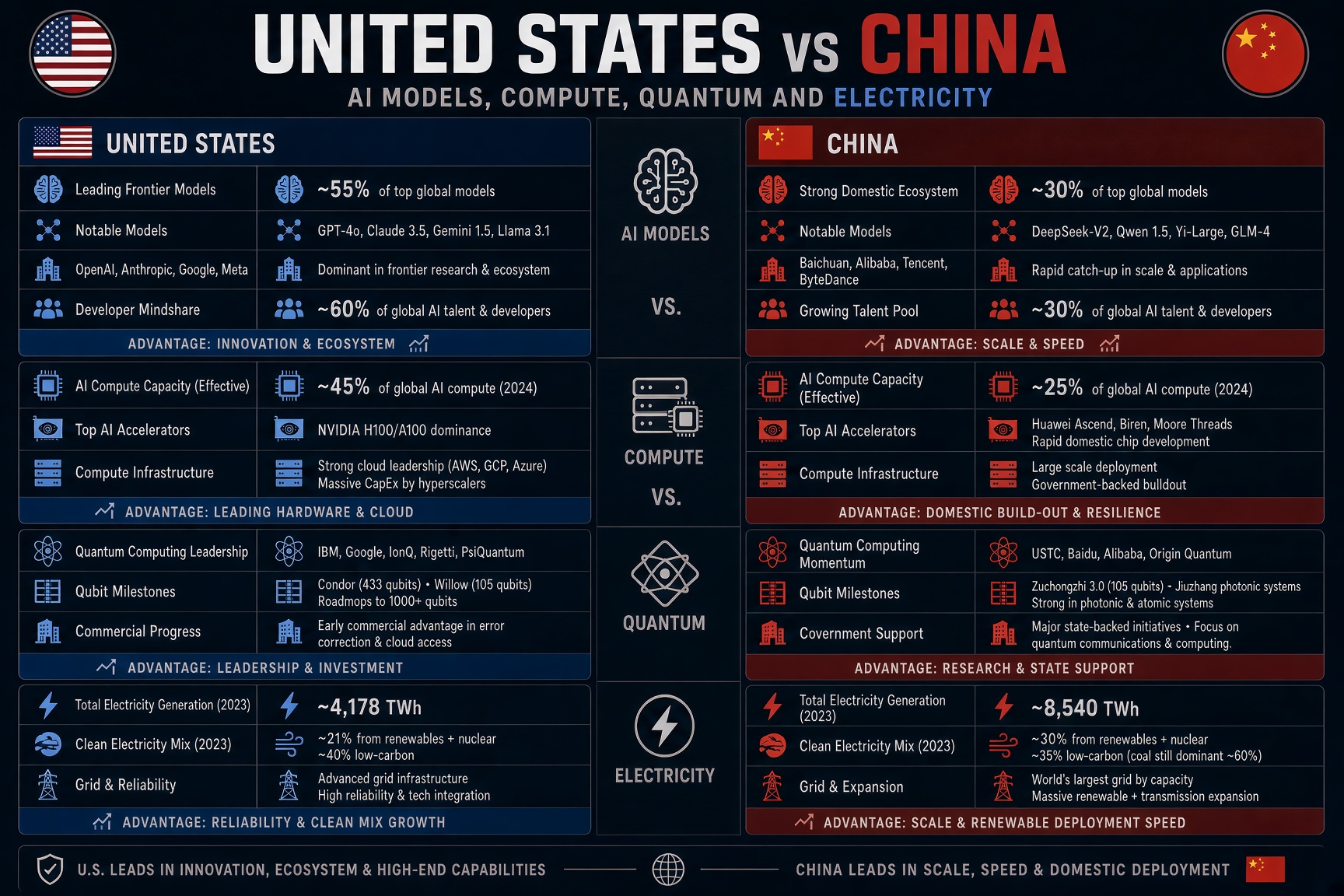
United States vs China: AI Models, Compute, Quantum and Electricity
The United States still leads in frontier model capability, total AI compute and quantum error correction, while China has narrowed the gaps in model performance, open-weight adoption and domestic chip volumes, and holds a structural advantage in power for data centres. Shayne Heffernan sets out the developments from July to October 2026 across models, compute, quantum and electricity, and how fast China is catching up.
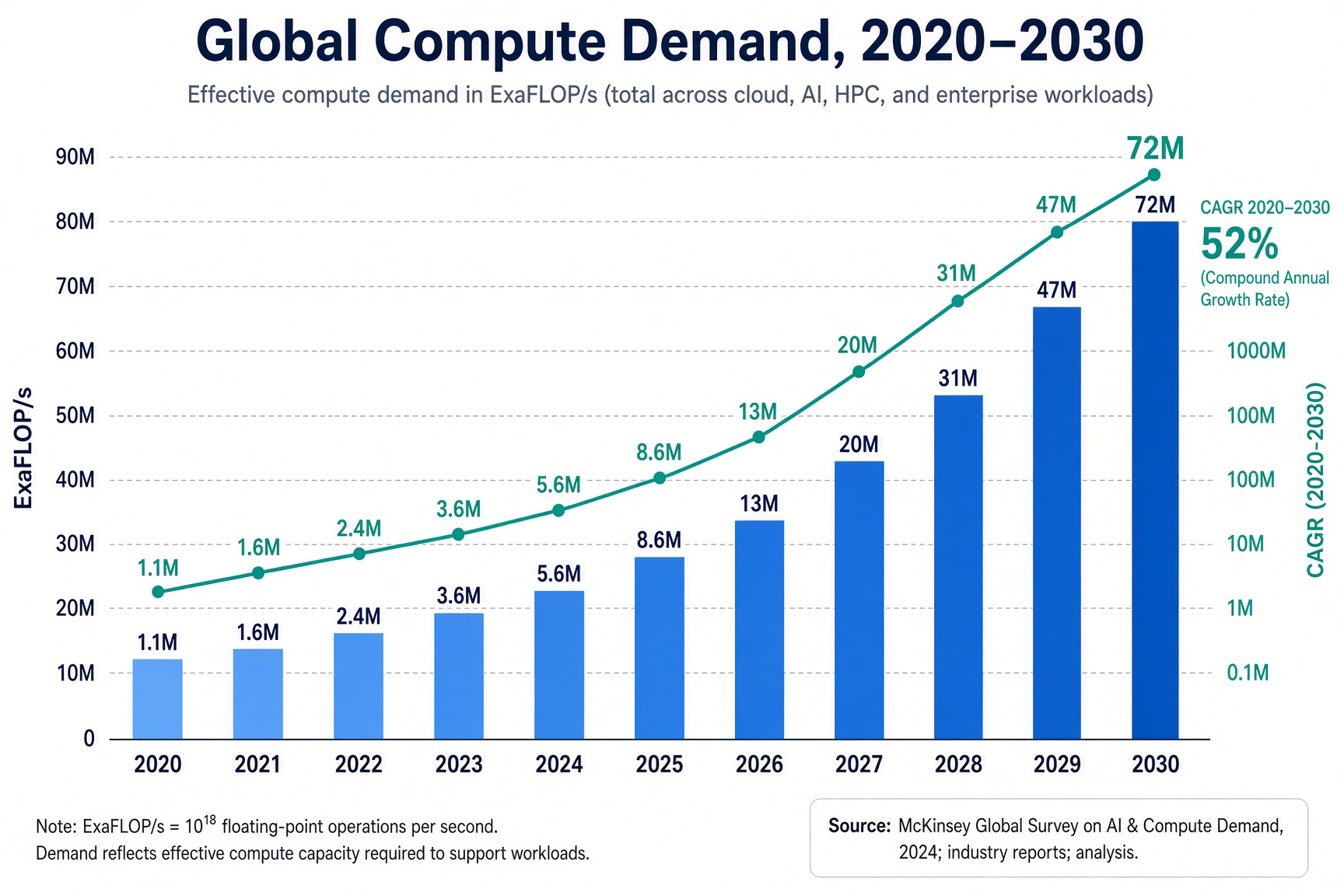
The 2030 Compute Landscape: GPUs, Power and the Architecture of Intelligence
The constraint on AI is no longer ideas or data but compute and the power to run it. Frontier training compute has grown about five times a year since 2020, and the leading AI supercomputer of June 2030 is on course for about 2 million chips and 9 gigawatts. Shayne Heffernan sets out the 2030 arithmetic, the power problem, who has already contracted the gigawatts, and how GPUs, custom ASICs, wafer-scale engines and quantum machines divide the work.
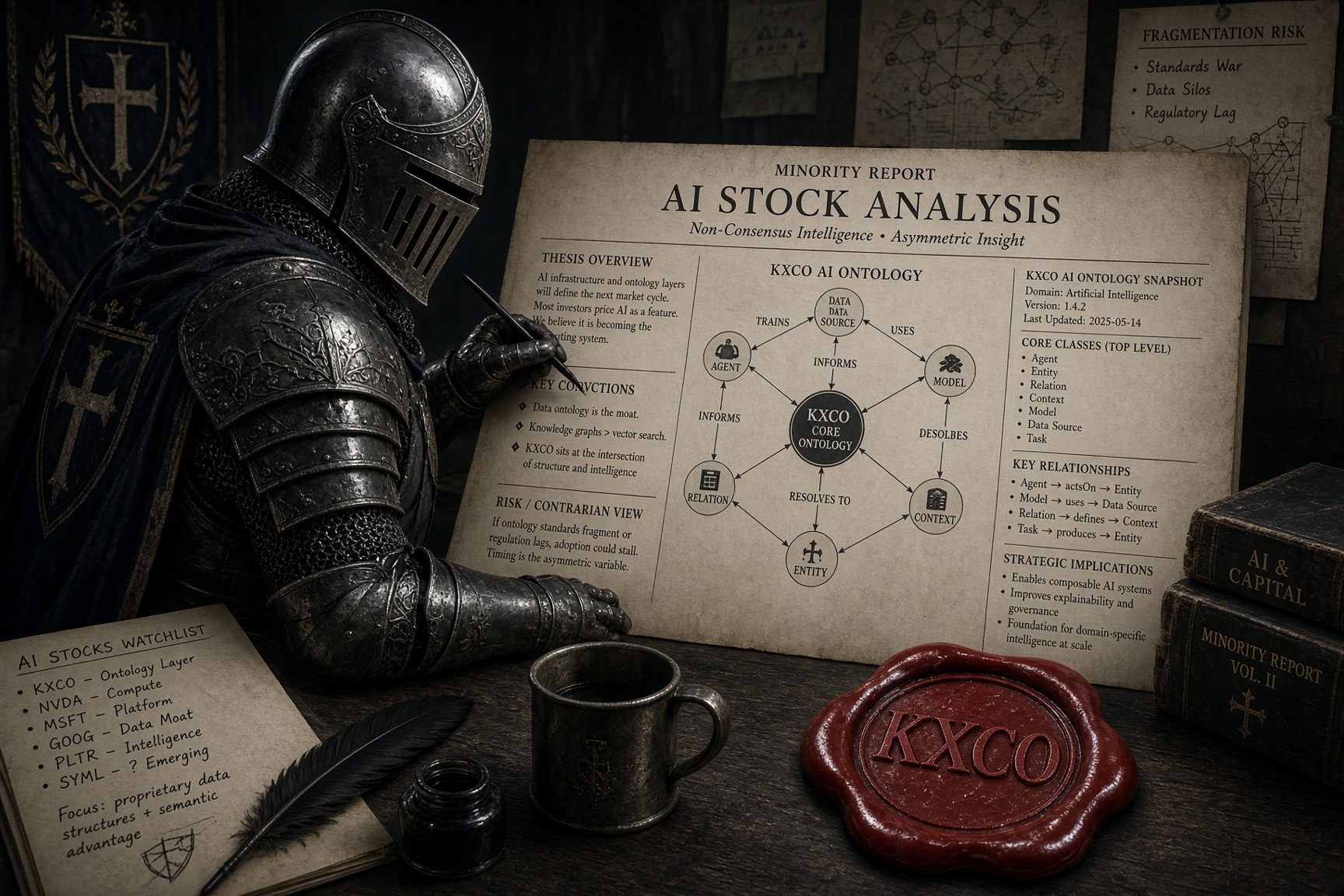
KXCO AI Ontology at 3 Months: What It Called and What Comes Next
On 19 July 2026 the Round Table's AI room published its first Analyst Outlook. To the 16 October 2026 close its 13 names rose 2.6% on an equal weight against 2.1% for QQQ, per StockAnalysis closes, and the six it opened with 35% or more of upside rose 8.6%. This piece lists the six names up more than 5%, the ten names I rate as opportunities now, the month's results in AI and quantum computing, and the official data showing that four in five firms have not yet started using AI.
Every story, signed and delivered.
Subscribe to the kxco channel and get the headline, the AI-written key takeaways, and the chain-anchor link the moment we publish. Audio versions and per-ticker subscriptions arrive in the next iteration.