
Thoughts on Thinking: You Are the Data Centre
We keep building larger halls of silicon and asking when intelligence will arrive. The intelligence asking the question is already here, and at KXCO it sits at both ends of the data.
Part of theThinking Center
The intelligence asking the question
We keep building larger halls of silicon and asking when intelligence will arrive. Meanwhile we overlook the intelligence that is asking the question.
The halls are large and getting larger. The world's data centres used about 485 terawatt-hours of electricity in 2025, and the International Energy Agency expects that to roughly double to 950 terawatt-hours by 2030, around 3 per cent of global electricity demand. The brain that commissioned them runs on about 20 watts (Balasubramanian, PNAS, 2021). It is about 2 per cent of body weight and takes about 20 per cent of the body's oxygen (Raichle and Gusnard, PNAS, 2002).
This note turns the question round. In my view, the person reading it is the most capable data centre in the room. The numbers below show the scale of that data centre, where silicon has passed it, and why the comparison matters to anyone who builds systems for people.
That last point is how we think about data at KXCO. Hardware is one part of a data system and software is another. The part we work on hardest is the interaction between a person and both of them. The data we gather is human data, generated by the actions of people: who signed, who approved, who delegated, who refused. The data we produce is delivered to a person, and delivery is a second layer of interaction with limits of its own. In that layer our focus is on understanding the human, and on understanding the human within the constraints of the technology.
This is the next note in the series. Brain Chemistry looked at the chemistry thinking runs on, and Physics, Biology and Thought went down to the membrane. This one measures the system that chemistry runs. The series sits together in the Thinking Center.
86 billion neurons, and every connection is a variable
Start with the count. The adult male human brain holds on average about 86 billion neurons (Azevedo and colleagues, Journal of Comparative Neurology, 2009).
They connect through synapses, and there are more than a hundred trillion of them. A count of the neocortex alone in five young adult men averaged 164 trillion (Tang and colleagues, Synapse, 2001), and a later estimate for the neocortex put it at about 150 trillion (Pakkenberg and colleagues, Experimental Gerontology, 2003).
Each of those connections is a dynamic, weighted link. In the rat hippocampus, Bartol and colleagues measured synapses precisely enough to infer at least 26 distinguishable synaptic strengths, about 4.7 bits of information at each synapse (eLife, 2015). A synapse holds more than a single bit, and learning acts directly on its strength (Zador, 2019). It is a setting on a dial that keeps moving.
Store a hundred trillion of those weights the way a computer would, at 32-bit precision, and the static weights alone take 400 terabytes. At the neocortex count of 164 trillion (Tang and colleagues), the same format takes 656 terabytes, so at 32-bit precision 400 terabytes is the floor. That is the frozen picture. It leaves out everything that changes the weights while the system runs.
It leaves out gene expression and the epigenetic regulation that helps set which genes a cell runs. It leaves out the ion gradients that every signal spends. The sodium-potassium pump restores them, three sodium ions out for every two potassium ions in. Experiments that block the pump in animals put the signalling it powers at 55 per cent or more of the brain's energy use (Engl and Attwell, The Journal of Physiology, 2015). It leaves out the chemistry that decides when a weight may change. Magnesium sits in the pore of the NMDA receptor at rest and leaves only when the cell is already active, which makes the receptor a coincidence detector for several forms of synaptic learning (Lüscher and Malenka, 2012). A file of weights holds none of that.
Go further down and the problem changes kind. The human body consists of about 7 × 10^27 atoms (Freitas, Nanomedicine, 1999). All-atom molecular dynamics, the method that simulates biology atom by atom, must advance in time steps of only a few femtoseconds, a femtosecond being a millionth of a billionth of a second (Hollingsworth and Dror, Neuron, 2018). In practice the step is about 2 to 2.5 femtoseconds (Jung and colleagues, 2021), so one second of biology takes about 5 × 10^14 steps.
The largest all-atom biological simulations we found hold one to two billion atoms and cover nanoseconds of simulated time. In 2019 a team modelled an entire gene locus of more than a billion atoms (Jung and colleagues, Journal of Computational Chemistry, 2019). In 2021 a scaling benchmark on the Fugaku supercomputer, built from up to 1,024 copies of a model of crowded cell interior, simulated 1.62 billion atoms at 8.3 nanoseconds of simulated time a day (Jung and colleagues, 2021). A body holds about 4 × 10^18 times as many atoms as that benchmark. An exascale supercomputer has simulated a whole virus for nanoseconds; to simulate the same virus for three hours it would need to be 10 billion times faster (Sanbonmatsu, Current Opinion in Structural Biology, 2024). A virus is a speck beside a person, and a person runs for decades.
Simulating a person molecule by molecule is a physics problem. A larger warehouse of chips does not close a gap of more than eighteen orders of magnitude.
Where silicon wins on bandwidth
On raw throughput, silicon wins, and by a long way.
The eye sends the brain about 10 million bits a second under natural viewing. That is an estimate. Koch and colleagues recorded from guinea pig retina and measured about 875,000 bits a second leaving through the optic nerve (Current Biology, 2006). Scaled to the human eye's million or so ganglion cells, that is roughly the rate of an Ethernet connection, which the University of Pennsylvania put at about 10 million bits a second.
One NVIDIA H100 SXM graphics processor moves data to and from its memory at a peak of 3.35 terabytes a second (NVIDIA). NVIDIA's newest, Rubin, is listed at 19.2 terabytes a second in its Vera Rubin NVL72 specification (NVIDIA). Counted in bits, the H100 moves about 2.7 million times what the eye delivers and Rubin about 15 million times. Against the eye's estimated output, a million to one is the floor.
The two numbers measure different things. Memory bandwidth is the peak rate at which a chip moves numbers it already holds. The eye's figure is information about a scene, and the retina has compressed it before it leaves. Zheng and Meister put the capacity of the cones in one eye at about 1.6 gigabits a second, and the optic nerve at about 100 megabits a second or less. The circuits inside the retina therefore compress the visual signal at least tenfold (Neuron, 2025). Even against that ceiling, the H100 moves about 270,000 times as many bits and Rubin about 1.5 million times. One figure describes a pipe inside a machine. The other is the output of a sensor that has done much of its selecting before the signal leaves the eye.
The rest of the brain selects again. Zheng and Meister reviewed measurements that span the better part of a century. They put the data the senses gather at about a billion bits a second, an estimate of capacity, and the information throughput of human behaviour at about 10 bits a second. From the bitstream of one eye, the brain of a typist sifts out the 10 bits a second the task needs.
Meaning is a different quantity from throughput. It needs selection: of everything arriving, which part matters. It needs context: what this signal means, given what came before it. It needs consequence: what follows if the person acts on it, and who bears the result. Each of those is a judgement, and in a working mind the person makes it.
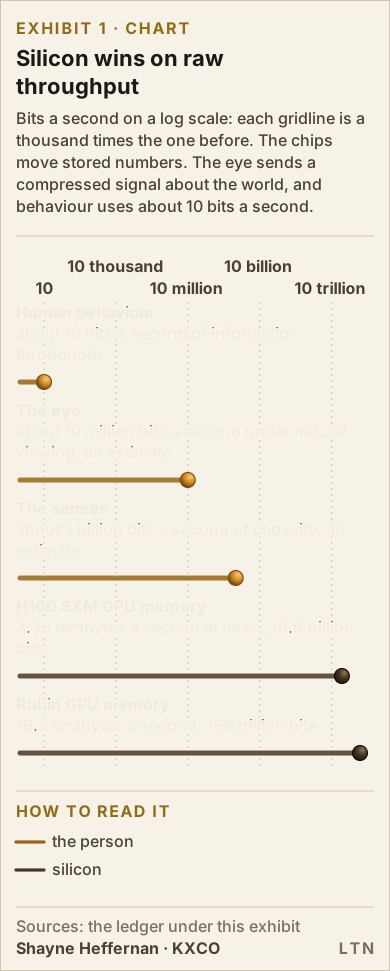
The rows of Exhibit 1, with their sources:
Human behaviour and the senses: about 10 bits a second of behaviour, and about a billion bits a second of sensory capacity, an estimate (Zheng and Meister, 2025).
The eye: about 10 million bits a second under natural viewing, scaled up from recordings of guinea pig retina (Koch and colleagues, 2006).
GPU memory: a peak of 3.35 terabytes a second for an H100 SXM (NVIDIA) and 19.2 terabytes a second for a Rubin GPU in NVIDIA's Vera Rubin NVL72 specification (NVIDIA), multiplied by eight to give bits. NVIDIA's HGX page lists the Rubin GPU at 22 terabytes a second (NVIDIA); the chart uses the lower figure.
The genome is a set of constraints
The genome is where the argument lands.
The first complete sequence of a human genome runs to 3.055 billion base pairs (Nurk and colleagues, Science, 2022). Each base is one of four letters, which is two bits of information. At the round three billion, one raw copy therefore takes 750 megabytes, and at the exact count about 764 megabytes. Most cells of the body carry two copies. The current reference annotation counts 19,442 protein-coding genes (GENCODE, release 50, 2026).
That is far too little to describe a brain synapse by synapse. Zador puts the genome's capacity at no more than about a gigabyte, and the information needed to specify every connection of the brain explicitly at about 3.7 × 10^15 bits. In his words, even if every nucleotide were devoted to the task, the genome would still be at least six orders of magnitude too small; on his own figures the gap is roughly half a million times (Nature Communications, 2019). So the genome specifies a set of rules for wiring up the brain during development. Learning then acts directly on the strengths of the synapses, and animals rely on the innate wiring and on learning together.
The genome does not store a photograph of the person. It supplies constraints that the physical world runs through.
The process starts from a prepared egg. The mother stocks it with RNAs and proteins, and those maternal products drive the first phase of development before control passes to the embryo's own genome (Schulz and Harrison, Nature Reviews Genetics, 2019). In human embryos the main switch to the embryo's own genes comes between the four-cell and eight-cell stages (Braude, Bolton and Moore, Nature, 1988), by about three days after fertilisation. Low-level transcription can be detected earlier, from the one-cell stage (Asami and colleagues, Cell Stem Cell, 2022). The egg also hands over the mother's mitochondria, the structures that convert molecules into energy in each cell, and only egg cells contribute them to the embryo (MedlinePlus Genetics). They carry their own small genome of 16,569 base pairs (Nurk and colleagues, 2022).
From there, regulation shapes what each cell becomes. The sequence of the genome is largely preserved across human cell types, while the epigenome, the chemical marks and packaging around the DNA, varies considerably and contributes to each cell's distinct programme of gene expression. Those differences arise as cells specialise during development (Roadmap Epigenomics Consortium, Nature, 2015). Physical forces shape the structure. In a gel model built from foetal brain scans, and in a matching simulation, a cortex growing faster than the tissue beneath it was forced into compression. It folded into patterns like those of a foetal brain (Tallinen and colleagues, Nature Physics, 2016). Molecules set how much the cortex grows; mechanics sets where it folds. Learning then tunes the synapses.
The information that makes a person is distributed across sequence, structure, regulation and initial conditions, and learning keeps adding to it. Exhibit 2 maps where each part draws from.
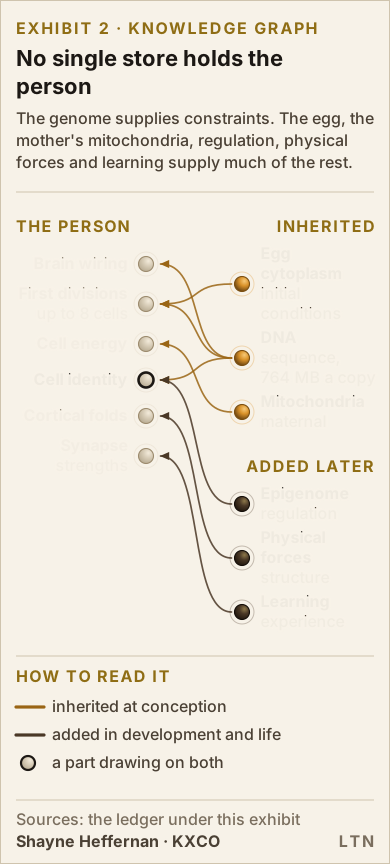
How to read Exhibit 2, link by link:
First divisions: the egg's maternal RNAs and proteins direct them until the embryo's own genome takes over, mainly between the four-cell and eight-cell stages (Schulz and Harrison, 2019; Braude and colleagues, 1988; Asami and colleagues, 2022).
Cell identity: the DNA sequence is largely the same in every cell type, and the epigenome, whose differences arise as cells specialise, shapes what each becomes (Roadmap Epigenomics Consortium, 2015).
Brain wiring: the genome constrains it with rules, since it is too small to list every connection (Zador, 2019).
Synapse strengths: learning tunes them, acting directly on synaptic weights (Zador, 2019), at about 26 distinguishable sizes in rat hippocampus (Bartol and colleagues, 2015), through receptors that change only when activity coincides (Lüscher and Malenka, 2012).
Cortical folds: physical forces fold the cortex, through compression as it outgrows the tissue below, shown in a gel model and a simulation (Tallinen and colleagues, 2016).
Cell energy: mitochondria power it, converting molecules into energy in each cell, and they come only from the egg (MedlinePlus Genetics).
The person at both ends of the data
Everything above treats the person as a processor. The same person sits at both ends of every data system a business runs, and that is where we put the work at KXCO.
At the input end, the data that matters most records something a person did. Someone signed, someone approved, someone gave an AI agent authority to act, someone refused. We frame each of those by the three questions another party will ask: who acted, what were they allowed to do, and what evidence remains (KXCO). In Herald, KXCO's identity and signature product, a valid signature shows that the holder of a given key signed the content and that it has not changed since, and authority to act is a separate check (KXCO Herald). Round Table is the KXCO software at the centre that keeps the record. When a person turns down an agent's proposal there, the decision is entered in the record under that person's name, and the proposal stays in the record with it (KXCO Round Table). The record keeps the human act, and who did it.
At the output end, the data is delivered to a person, and the constraints there are human. Across 190 studies, adults read English non-fiction silently at an average of 238 words a minute (Brysbaert, Journal of Memory and Language, 2019). Short-term memory holds about four chunks at a time when rehearsal is blocked (Cowan, Behavioral and Brain Sciences, 2001). Jakob Nielsen analysed the browsing logs of 25 users. He estimated that on an average web page people have time to read at most 28 per cent of the words, and that 20 per cent is more likely (Nielsen Norman Group, 2008). Behaviour, as above, runs at about 10 bits a second.
The strain at that end is measured too. A review of 17 studies found that clinicians overrode drug safety alerts in hospital prescribing systems in 49 to 96 per cent of cases, and noted that overriding may often be justified (van der Sijs and colleagues, JAMIA, 2006). Either way, the selecting is being done by the person, case by case, after the alert has fired. The opposite failure is over-trust. When automated decision aids are imperfect, people make errors of omission and of commission, and the bias appears in experts as well as novices (Parasuraman and Manzey, Human Factors, 2010). The rates of machine and person measure different things, but at the point of delivery the mismatch is real: whatever the machine behind the screen can move, the reader acts on about 10 bits a second.
So the engineering problem in the delivery layer is the problem meaning poses: selection, context and consequence. This is how we answer it.
For context, every claim in the Round Table record carries its source, the basis for it, a confidence level and the date it took effect. A reviewer can see which claims applied on a given date and how they changed afterwards. Analysts and AI models work from the same record, and the record shows which of them said what (KXCO Round Table). On the live map, every link shows whether it was observed or inferred (KXCO Round Table).
For consequence, AI tools prepare the material and check it against the record, and a named person makes the decision (KXCO). An outside AI agent can only propose. It cannot decide, approve or carry anything out, and the service enforces that rule (KXCO Round Table). Round Table records and explains, and decisions stay with named people. The same rule runs this newsroom: every new article on this site is signed by a human editor and recorded on Armature, KXCO's permissioned chain (Live Trading News).
For selection, what reaches a person has to fit what that person can take in, on the screen they actually hold. In October 2026, 59.9 per cent of the web page views StatCounter tracks worldwide came from mobile devices (StatCounter). KXCO's house rule is that every document it produces is set to be read on a phone, and the exhibits in this note are drawn 390 pixels wide, the width of a phone, with no text smaller than 16 pixels.
That is what understanding the human within the constraints of the technology means in practice. The person's limits are design inputs, and the decision stays with the person. Exhibit 3 maps the layer: what people do goes in on one side, and what a person can take in comes out on the other.
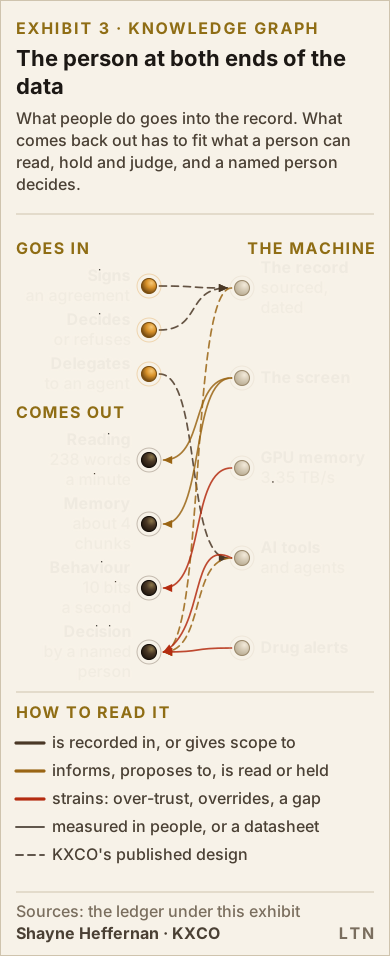
How to read Exhibit 3, link by link:
Signs, decides, delegates: an agreement is signed and the proof recorded; a refusal is entered under the person's name; authority is delegated so that an AI agent is given scope to act (KXCO Round Table; Herald).
The record and the decision: every claim carries source, basis, confidence and date, and decisions stay with named people (KXCO Round Table).
AI tools and agents: they prepare, check and propose (KXCO), and people tend to over-rely on automated aids, experts included (Parasuraman and Manzey, 2010).
The screen: read at about 238 words a minute (Brysbaert, 2019) and held in a short-term memory of about four chunks (Cowan, 2001).
Drug alerts: overridden in 49 to 96 per cent of cases across 17 studies of hospital prescribing systems (van der Sijs and colleagues, 2006).
GPU memory and behaviour: a peak of 3.35 terabytes a second against about 10 bits a second of human behaviour (NVIDIA; Zheng and Meister, 2025).
Solid lines rest on measurements in people or a manufacturer's datasheet; dashed lines are KXCO's published design, a statement of how the software works.
The position, and what the numbers support
One could call the person an inherited superintelligence. That is a philosophical position. Nobody has measured it, and I will not present it as a measurement.
The simpler claim stands on the numbers above. The integrated intelligence we keep searching for in machines already exists in the person looking.
The data centre has a customer, and the customer is you. You are also the data centre that learned to build one.
Research references
Scale
International Energy Agency (2026). Key Questions on Energy and AI: Executive summary. IEA. Data centre electricity use roughly doubles from 485 TWh in 2025 to 950 TWh in 2030, around 3 per cent of global demand.
Balasubramanian, V. (2021). Brain power. PNAS. The brain works on an energy budget of about 20 watts.
Raichle, M. E., and Gusnard, D. A. (2002). Appraising the brain's energy budget. PNAS. The brain is about 2 per cent of body weight and uses about 20 per cent of the body's oxygen.
Azevedo, F. A. C., and colleagues (2009). Equal numbers of neuronal and nonneuronal cells make the human brain an isometrically scaled-up primate brain. Journal of Comparative Neurology. The adult male human brain contains on average 86.1 billion neurons, plus or minus 8.1 billion.
Tang, Y., Nyengaard, J. R., De Groot, D. M., and Gundersen, H. J. (2001). Total regional and global number of synapses in the human brain neocortex. Synapse. The neocortex of five young male brains held on average 164 trillion synapses.
Pakkenberg, B., and colleagues (2003). Aging and the human neocortex. Experimental Gerontology. The human neocortex holds about 150 trillion synapses.
Bartol, T. M., and colleagues (2015). Nanoconnectomic upper bound on the variability of synaptic plasticity. eLife. In rat hippocampus, at least 26 distinguishable synaptic strengths, about 4.7 bits per synapse.
Engl, E., and Attwell, D. (2015). Non-signalling energy use in the brain. The Journal of Physiology. The sodium-potassium pump moves three sodium ions out for two potassium in, and takes most of the brain's signalling energy.
Lüscher, C., and Malenka, R. C. (2012). NMDA receptor-dependent long-term potentiation and long-term depression (LTP/LTD). Cold Spring Harbor Perspectives in Biology. Magnesium blocks the NMDA receptor at rest, making it a coincidence detector for synaptic plasticity.
Simulation
Freitas, R. A., Jr. (1999). Nanomedicine, Volume I: Basic Capabilities, Section 3.1 Human Body Chemical Composition. Nanomedicine. The human body consists of about 7 x 10^27 atoms.
Hollingsworth, S. A., and Dror, R. O. (2018). Molecular Dynamics Simulation for All. Neuron. Molecular dynamics time steps must be short, typically a few femtoseconds.
Jung, J., and colleagues (2021). New parallel computing algorithm of molecular dynamics for extremely huge scale biological systems. Journal of Computational Chemistry. All-atom simulations usually use a time step of 2 to 2.5 femtoseconds.
Jung, J., and colleagues (2019). Scaling molecular dynamics beyond 100,000 processor cores for large-scale biophysical simulations. Journal of Computational Chemistry. An atomic model of an entire gene locus, more than a billion atoms, was simulated.
Jung, J., and colleagues (2021). New parallel computing algorithm of molecular dynamics for extremely huge scale biological systems. Journal of Computational Chemistry. A 1.62 billion atom system was simulated at 8.30 nanoseconds a day on Fugaku.
Sanbonmatsu, K. (2024). Supercomputing in the biological sciences: Toward Zettascale and Yottascale simulations. Current Opinion in Structural Biology. An exascale computer simulated a whole virus for nanoseconds; three hours would need 10 billion times the speed.
Bandwidth and the person who receives data
Koch, K., and colleagues (2006). How Much the Eye Tells the Brain. Current Biology. Guinea pig retina sends about 875,000 bits a second through the optic nerve. Scaled to the human eye, that is roughly the rate of an Ethernet connection.
University of Pennsylvania School of Medicine (2006). Penn researchers calculate how much the eye tells the brain. EurekAlert!. The investigators calculate that the human retina can transmit about 10 million bits a second.
NVIDIA (2026). H100 GPU | NVIDIA (product page, specifications table). NVIDIA. H100 SXM GPU memory bandwidth of 3.35 terabytes a second.
NVIDIA (2026). Rack-Scale Agentic AI Supercomputer | NVIDIA Vera Rubin NVL72 (product page, specifications table). NVIDIA. Rubin GPU memory bandwidth of 19.2 terabytes a second in the Vera Rubin NVL72 specification.
NVIDIA (2026). NVIDIA HGX Platform | NVIDIA (product page, specifications tables). NVIDIA. The HGX page lists the Rubin GPU at 22 terabytes a second.
Zheng, J., and Meister, M. (2025). The unbearable slowness of being: Why do we live at 10 bits/s? Neuron. Human behaviour runs at about 10 bits a second of information throughput, while the senses gather about a billion.
Brysbaert, M. (2019). How many words do we read per minute? A review and meta-analysis of reading rate. Journal of Memory and Language. Across 190 studies, adults read English non-fiction silently at an average of 238 words a minute.
Cowan, N. (2001). The magical number 4 in short-term memory: A reconsideration of mental storage capacity. Behavioral and Brain Sciences. Short-term memory holds about four chunks when rehearsal and chunking are prevented.
Nielsen, J. (2008). How Little Do Users Read? Nielsen Norman Group. Users have time to read at most 28 per cent of the words on an average web page, and 20 per cent is more likely.
van der Sijs, H., Aarts, J., Vulto, A., and Berg, M. (2006). Overriding of drug safety alerts in computerized physician order entry. Journal of the American Medical Informatics Association. Across 17 studies, clinicians override drug safety alerts in 49 to 96 per cent of cases.
Parasuraman, R., and Manzey, D. H. (2010). Complacency and bias in human use of automation: an attentional integration. Human Factors. Automation complacency and bias appear in naive and expert participants alike.
StatCounter (2026). Desktop vs Mobile vs Tablet Market Share Worldwide. StatCounter. Mobile devices made 59.9 per cent of worldwide page views in October 2026.
KXCO
KXCO (2026). KXCO Round Table. kxco.ai. Every claim in the Round Table record carries its source, basis, confidence and the date it took effect.
KXCO (2026). KXCO Round Table. kxco.ai. An outside AI agent can only propose. It cannot decide, approve or carry anything out.
KXCO (2026). KXCO by Knightsbridge. kxco.ai. Three questions another party will ask: who acted, what were they allowed to do, what evidence remains.
KXCO (2026). KXCO by Knightsbridge. kxco.ai. AI tools prepare the material and check it against the record, and a named person makes the decision.
KXCO (2026). KXCO Herald. kxco.ai. A valid signature shows who signed and that the content has not changed. Authority is a separate check.
Live Trading News (2026). About Live Trading News. livetradingnews.com. Every new article is signed by a human editor and recorded on Armature.
The genome and development
Nurk, S., and colleagues (2022). The complete sequence of a human genome. Science. The first complete human genome sequence: 3,054,815,472 base pairs of nuclear DNA and a 16,569 base pair mitochondrial genome.
GENCODE (2026). Human Release Statistics (release 50). GENCODE. Release 50 counts 19,442 human protein-coding genes.
Zador, A. M. (2019). A critique of pure learning and what artificial neural networks can learn from animal brains. Nature Communications. The genome is at least six orders of magnitude too small to specify the brain's wiring, so it encodes wiring rules. Learning acts on synaptic weights.
Schulz, K. N., and Harrison, M. M. (2019). Mechanisms regulating zygotic genome activation. Nature Reviews Genetics. Maternal RNAs and proteins stockpiled in the egg drive development until the embryo's genome is activated.
Braude, P., Bolton, V., and Moore, S. (1988). Human gene expression first occurs between the four- and eight-cell stages of preimplantation development. Nature. In human embryos, major changes between the four and eight-cell stages depend on transcription.
Asami, M., and colleagues (2022). Human embryonic genome activation initiates at the one-cell stage. Cell Stem Cell. Human embryonic transcription begins at low level at the one-cell stage.
Roadmap Epigenomics Consortium (2015). Integrative analysis of 111 reference human epigenomes. Nature. The genome sequence is largely preserved across human cell types while the epigenome varies considerably.
MedlinePlus Genetics (2021). What are the different ways a genetic condition can be inherited? MedlinePlus. Only egg cells contribute mitochondria to the developing embryo.
Tallinen, T., and colleagues (2016). On the growth and form of cortical convolutions. Nature Physics. In a gel model and simulations, a growing cortex is compressed and folds like a foetal brain.
Shayne Heffernan, Ph.D., is the founder of the KnightsBridge Group (shayneheffernan.com).

The Week Ahead on Wall Street, 9 November 2026: AI Is Still a Buy
We still think AI is a buy. After the midterms the semiconductor index fell 11.4% while the S&P 500 lost 2.5%, in our view an overreaction that fell on the chip names. October payrolls rose 165,000, oil stays high with the Iran war unresolved, Alibaba and Tencent gained, NVIDIA trades at 15.4 times forward earnings, and both SpaceX and Tesla have special committees studying a combination. KXCO's AI ontology shows the relationships behind the NVIDIA, China and SpaceX calls.

Thoughts on Thinking: Brain Chemistry
Brain chemistry sets the level of thinking and of performance in everything else, and it bears on longevity: 14 risk factors that can be changed account for nearly half of dementia cases. The dangers come from outside, through plastic, PFAS, pesticides and metals, and from inside, through chronic stress and overwork. An organic diet cut a chlorpyrifos marker in urine by 60.7 per cent, and reciting the rosary slowed breathing to under six breaths a minute. The chemistry is a managed input.
KXCO's FDA Ontology Ranked INO-3107 First. Inovio Hit Over 300% After Hours.
KXCO's FDA ontology ranked INO-3107, from Inovio (INO), first of the FDA decisions due in the next 90 days, from 21 October 2026 to the decision. The FDA granted accelerated approval on 30 October; the news reached the market after the close. From its $0.60 close that day, Inovio traded as high as $2.71 after hours, up 351.7%, and closed 2 November at $1.89, up 215.0%. Both published research books closed ahead of XBI. On our radar: BBP-418 (BBIO), Bezuclastinib (COGT) and Relutrigine (PRAX).

KXCO's FDA Ontology Ranked INO-3107 First. The FDA Approved It.
From 21 to 30 October 2026, the first screen of KXCO's FDA ontology at kxco.ai/fda ranked Inovio's INO-3107 #1 in the next 90 days by potential return, at +112% on the first day and +103% from 22 October on its own sourced inputs. On 30 October the FDA granted it accelerated approval, on its target date. The room's watch flagged the approval that night, and the record took in the FDA's own letter 19 minutes later.
Every story, signed and delivered.
Subscribe to the kxco channel and get the headline, the AI-written key takeaways, and the chain-anchor link the moment we publish. Audio versions and per-ticker subscriptions arrive in the next iteration.