
The Compute Market Boom
$NVDA $AMD $AVGO $TSM $MU $ANTH $SPCX
Part of theStocks Center
Larry Fink, CME Futures, AI Demand, Quantum & Chipmakers — Bullish Outlook for $NVDA $AMD $AVGO $TSM $MU $ANTH $SPCX
By Shayne Heffernan, Knightsbridge
The global compute market is undergoing an explosive transformation, emerging as one of the most powerful and investable themes of this decade and beyond. What was once viewed primarily as an operational cost for technology companies has rapidly evolved into a strategic, scarce resource at the heart of the artificial intelligence revolution. Explosive demand from AI leaders, persistent supply chain constraints, groundbreaking financial innovations, and rapid technological advancements are collectively turning compute power into a fully tradable asset class with multi-trillion-dollar implications.
BlackRock CEO Larry Fink’s recent endorsement of compute as a new asset class, the impending launch of CME compute futures, massive hyperscaler deals such as Google’s $920 million monthly commitment to SpaceX, continued progress in quantum computing, and the aggressive scaling efforts by leading chipmakers all reinforce a compelling bullish outlook. This in-depth analysis from Knightsbridge explores the key drivers, market dynamics, and investment opportunities in the compute sector, with a particular focus on why $NVDA, $AMD, $AVGO, $TSM, $MU, $ANTH, and $SPCX are exceptionally well positioned for substantial long-term gains.
Larry Fink on Compute as a New Asset Class
BlackRock Chairman and CEO Larry Fink has emerged as one of the most influential voices highlighting the structural importance of compute in the AI era. Speaking at major industry forums in 2026, including the Milken Institute Global Conference, Fink emphasized that shortages in GPUs, high-bandwidth memory, power infrastructure, and data center capacity have reached critical levels. He explicitly stated that the immense scale of AI demand will require the creation of futures markets for compute, drawing direct parallels to established commodity markets for oil, natural gas, electricity, and agricultural products.
Fink’s vision is not merely theoretical. With hyperscalers and enterprises already committing hundreds of billions of dollars annually to AI infrastructure, compute is transitioning from a variable operating expense to a core strategic asset. This financialization — through futures, derivatives, and specialized investment vehicles — will enable better price discovery, risk hedging, and capital allocation. Institutional investors like BlackRock, with its vast infrastructure platforms and Global Infrastructure Partners acquisition, are uniquely positioned to capitalize on and facilitate this shift.
For investors, this represents a paradigm change. Traditionally, exposure to compute came indirectly through technology stocks or data center real estate. Going forward, direct and derivative exposure will become available, attracting a new wave of commodity-style investors and deepening overall market liquidity. This maturation process is highly bullish for the underlying ecosystem, as increased capital flows and transparency typically lead to higher valuations and accelerated innovation. Knightsbridge views compute as a foundational theme that will influence portfolios for the next 10 to 20 years.
CME Compute Futures: Institutionalizing the Market
A landmark development in the compute market’s evolution is the upcoming launch of compute futures by CME Group, the world’s premier derivatives marketplace. In partnership with Silicon Data (backed by prominent trading firm DRW), CME is preparing standardized contracts for computing capacity, expected to go live later in 2026 pending final regulatory approvals.
These futures contracts will cover key metrics such as GPU hours, cluster availability, and related infrastructure components. By providing a regulated, transparent venue for hedging, the CME initiative addresses one of the biggest pain points in the industry: extreme price volatility and uncertainty around future capacity. AI developers and cloud providers will be able to lock in costs, while speculators and investors gain new tools to express views on the supply-demand balance.
The introduction of compute futures validates Larry Fink’s asset class thesis and signals the sector’s transition from niche technology infrastructure to a mainstream financial market. Historical precedents with other commodities show that exchange-traded futures dramatically increase participation, improve efficiency, and often lead to higher spot prices as hedging demand grows. For public companies in the compute supply chain, this development enhances visibility and supports rerating of multiples as the market gains sophistication and institutional backing.
AI Leaders Driving Insatiable Compute Demand
The primary catalyst for the compute boom is the unrelenting demand from frontier AI laboratories and hyperscale cloud providers. Companies at the cutting edge of artificial intelligence require ever-increasing amounts of compute for training massive models, running inference at scale, developing autonomous agents, and powering robotics and enterprise applications.
A prime example is the recent disclosure in SpaceX filings showing Google’s commitment to pay approximately $920 million per month for access to around 110,000 NVIDIA GPUs plus supporting CPUs, memory, and infrastructure. This multi-year agreement, ramping to full rate from October 2026 through June 2029, is valued at roughly $30 billion and serves as “bridge capacity” for Google’s Gemini AI platform. Similar large-scale deals involving Anthropic and other leading labs illustrate the ferocious competition for resources.
This demand extends far beyond traditional training runs. The rise of agentic AI — systems capable of complex, multi-step reasoning and autonomous task execution — is particularly compute-intensive, shifting the balance toward inference workloads. Robotics, autonomous vehicles, scientific simulation, and sovereign AI initiatives by governments worldwide are adding additional layers of sustained demand. Analysts project global AI infrastructure spending to reach trillions of dollars over the coming decade, with inference potentially accounting for the majority of total compute consumption.
The supply-demand imbalance is structural. Even as new capacity comes online, the pace of AI capability improvement and adoption continues to outstrip additions. This environment favors companies that can secure, deliver, or innovate within the compute stack, creating a powerful tailwind for the entire sector.
Chipmakers Scaling Aggressively to Meet Demand
While demand surges, leading chipmakers and supply chain players are investing heavily to expand capacity, though meaningful shortages are expected to persist for several years.
NVIDIA ($NVDA) remains the undisputed leader in accelerated computing. Its GPUs power the vast majority of frontier AI training workloads, supported by a formidable software moat through CUDA and a full-stack offering that includes networking, storage, and systems integration. The ramp of the Blackwell platform, followed by future architectures, continues to see strong pre-orders and sell-outs. CEO Jensen Huang has repeatedly noted that shortages in chips, memory, and power represent multi-year opportunities rather than cyclical peaks. NVIDIA’s expansion into CPUs, edge computing, and enterprise AI platforms further diversifies its leadership position.
AMD ($AMD) has established itself as a credible challenger, gaining meaningful market share in both GPUs and server CPUs. Under CEO Lisa Su, the company has delivered strong execution with its MI series accelerators and high-core-count EPYC processors. AMD offers compelling performance-per-dollar advantages that appeal to cost-conscious hyperscalers and cloud providers. Expectations for 35%+ compound annual growth in data center revenue reflect successful penetration and a robust product roadmap.
Broadcom ($AVGO) plays a critical role through custom ASICs, high-speed networking, and AI accelerators. Its partnerships with major hyperscalers for bespoke silicon solutions complement the general-purpose GPU market and provide essential connectivity for large-scale AI clusters. Broadcom’s diversified business, including wireless and infrastructure software, adds stability while its AI exposure drives premium growth.
TSMC ($TSM) serves as the foundational foundry for the semiconductor industry, manufacturing advanced chips for NVIDIA, AMD, Apple, and many others. Its cutting-edge process nodes (3nm, 2nm, and beyond) are indispensable for pushing performance boundaries. TSMC’s massive capital expenditures on new fabs, particularly in the US and Europe for geopolitical resilience, position it as a key beneficiary of the compute supercycle despite cyclical foundry dynamics.
Micron ($MU) is a standout in the memory segment, particularly with high-bandwidth memory (HBM) essential for AI workloads. HBM supply is sold out well into 2027, and Micron’s technology leadership in DRAM and NAND positions it for strong pricing power and volume growth as AI servers proliferate. The company’s investments in advanced packaging and new capacity underscore its strategic importance in the stack.
Collectively, these chipmakers, along with power management, liquid cooling, and networking specialists, form an interconnected ecosystem operating at near-full capacity. The race to scale creates a virtuous cycle of innovation and investment.
Quantum Computing: The Long-Term Moonshot
While classical compute dominates current growth, quantum computing represents the next major frontier. Companies including IBM, IonQ, Rigetti Computing, Quantinuum, and others are making steady progress toward practical quantum advantage, anticipated in select applications by 2028-2029 and broader commercialization in the 2030s.
Quantum systems excel at certain optimization, simulation, and cryptographic problems that are intractable for even the largest classical supercomputers. Hybrid quantum-classical workflows will eventually augment AI models, materials discovery, drug development, and financial modeling. Although quantum remains early-stage, its potential to expand the overall addressable compute market is enormous. Public market interest continues to build, and breakthroughs will provide additional upside to the broader compute theme.
Bullish Outlook for Key Cashtags
$NVDA: Clear leader with unmatched ecosystem dominance and growth runway. $AMD: Strong challenger delivering share gains and attractive economics. $AVGO: Essential infrastructure player with custom silicon and networking expertise. $TSM: Critical enabler of advanced semiconductors with massive capacity expansion. $MU: Memory specialist benefiting from sustained HBM shortages and pricing power. $ANTH: Anthropic’s IPO will offer direct exposure to a premier AI innovator with enormous compute appetite. $SPCX: SpaceX’s compute business, validated by major deals like Google’s, adds high-growth diversification to its space infrastructure leadership.
These names span the full stack — from design and manufacturing to end-user innovation — providing diversified yet high-conviction ways to participate in the compute boom.
Broader Economic and Geopolitical Context
Resilient US and global economies, combined with contained geopolitical risks, create a favorable backdrop for continued technology investment. Pro-innovation policies and the strategic importance of AI leadership further support capital deployment. Energy constraints are real but are spurring investments in nuclear, renewables, and efficiency technologies — all ultimately bullish for long-term compute expansion.
Risks and Mitigation
Potential challenges include power availability, regulatory hurdles, execution risks on massive buildouts, and cyclical slowdowns in non-AI segments. However, the asymmetry strongly favors bulls: the productivity gains, economic value, and deflationary impact of AI far outweigh temporary bottlenecks. Diversification across the supply chain helps manage company-specific risks.
Conclusion: The Compute Supercycle Is Just Beginning
The compute market stands at the intersection of technological revolution, financial innovation, and structural scarcity. Larry Fink’s asset class framework, CME futures, insatiable AI demand, quantum potential, and the scaling efforts of leading chipmakers create a powerful setup for multi-year growth and wealth creation.
Knightsbridge remains highly bullish on the sector. Investors positioned in $NVDA, $AMD, $AVGO, $TSM, $MU, $ANTH, and $SPCX are aligned with the defining investment theme of our time. The compute supercycle is still in its early innings — those who recognize and act on this opportunity today will be best positioned for outsized returns in the years ahead.
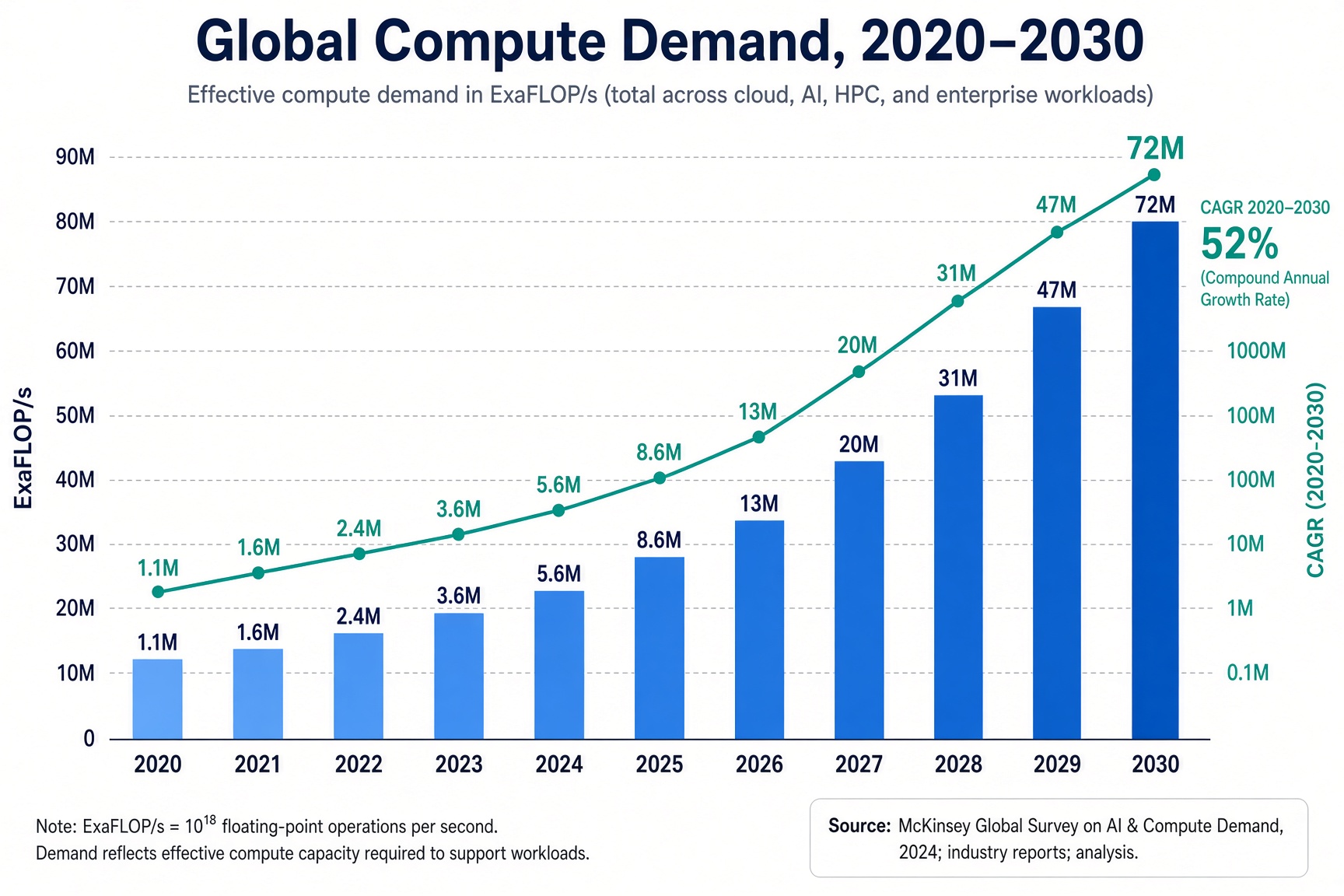
The 2030 Compute Landscape: GPUs, Power and the Architecture of Intelligence
The constraint on AI is no longer ideas or data but compute and the power to run it. Frontier training compute has grown about five times a year since 2020, and the leading AI supercomputer of June 2030 is on course for about 2 million chips and 9 gigawatts. Shayne Heffernan sets out the 2030 arithmetic, the power problem, who has already contracted the gigawatts, and how GPUs, custom ASICs, wafer-scale engines and quantum machines divide the work.

How Can You Trust AI When You Cannot Trust Humans?
Can you trust AI? Can you trust humans? More often than we like to admit, the answer is no. AI inherits its failures from the human records it is trained on. Sheikh Mohammed bin Rashid wrote this month that the currency the UAE is betting on is trust. This piece sets out what a trust layer has to do, shows the method on three public knowledge graphs, and lays out the post-quantum work KXCO has published so that an institution can check the claim rather than take it.
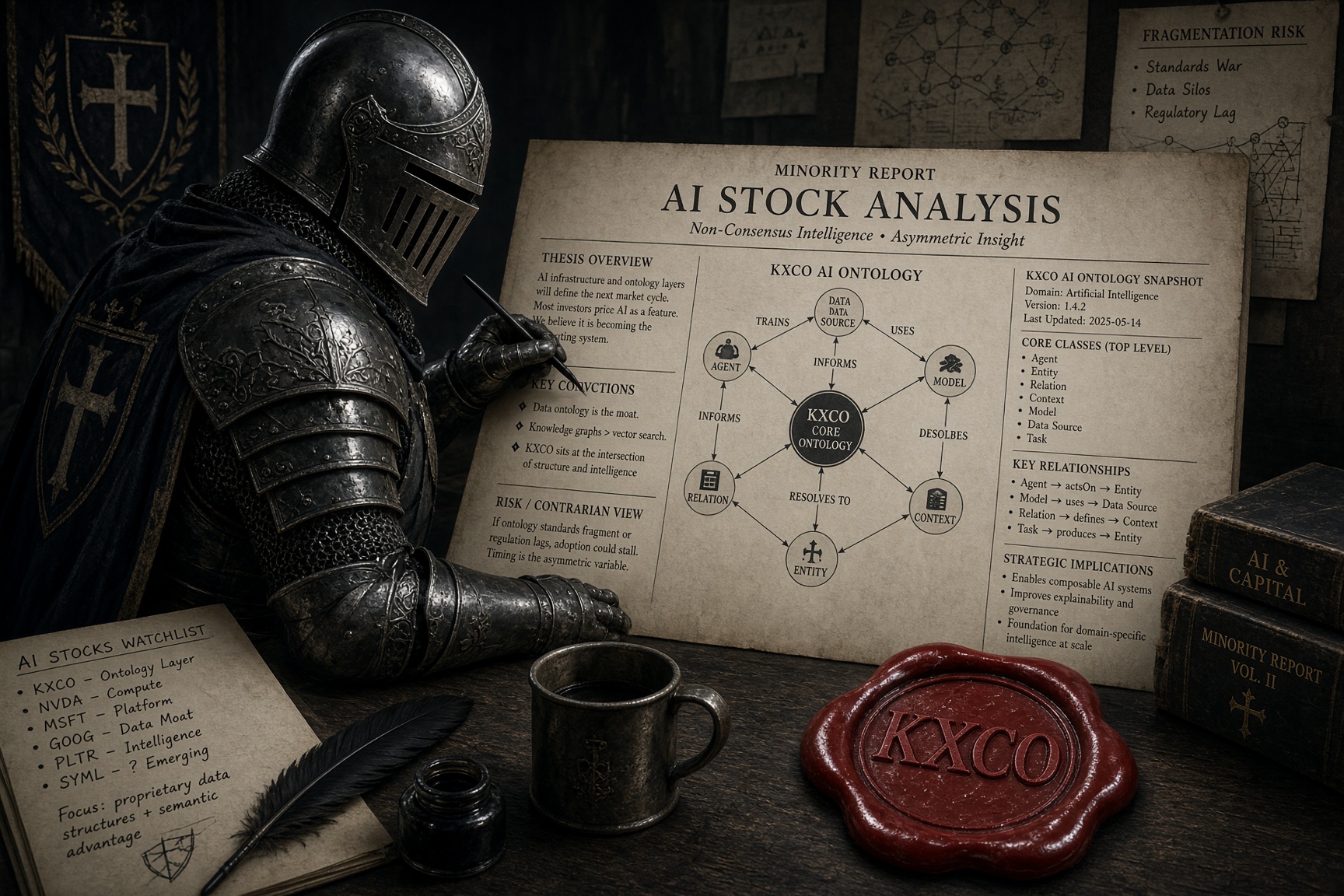
KXCO AI Ontology at 3 Months: What It Called and What Comes Next
On 19 July 2026 the Round Table's AI room published its first Analyst Outlook. To the 16 October 2026 close its 13 names rose 2.6% on an equal weight against 2.1% for QQQ, per StockAnalysis closes, and the six it opened with 35% or more of upside rose 8.6%. This piece lists the six names up more than 5%, the ten names I rate as opportunities now, the month's results in AI and quantum computing, and the official data showing that four in five firms have not yet started using AI.

SpaceX: The Road to 10 Gigawatts
SpaceX did not add an AI business. A company whose processes run on compute built its own computing plant, then built the power to run it. The 10-Q reports 1.4 gigawatts of nameplate compute at 30 June 2026, four leases worth about $41 billion a year and $100 billion of cash. The target is closer to 10 gigawatts than 5 by the end of 2027. This piece sets out the build sequence, the four layers of power in Memphis, and why Terafab is the act after 2027, not the road to it.
Every story, signed and delivered.
Subscribe to the kxco channel and get the headline, the AI-written key takeaways, and the chain-anchor link the moment we publish. Audio versions and per-ticker subscriptions arrive in the next iteration.