
The AI Trade Has Years To Run
OpenAI filed for its IPO. Anthropic is raising at $900 billion. NVIDIA cleared $81.6 billion in a quarter. xAI is burning through Starlink's cash to build out. A note on where the giants stand this week.
Three things happened this week that matter for the AI trade. OpenAI confidentially filed its IPO prospectus with the Securities and Exchange Commission today, Friday 22 May, targeting a public listing as early as Q4 2026 at a valuation between $852 billion and $1 trillion. Anthropic is reportedly closing a fresh funding round at a valuation above $900 billion, which would make it the most valuable private AI company in the world and put it ahead of OpenAI on paper. And NVIDIA delivered a quarter on Wednesday so far in excess of every credible bearish expectation that the entire AI-bubble framing should be retired for the rest of 2026.
Add Quantinuum filing for its own $20 billion quantum-computing IPO, xAI burning through $13 billion of data-centre capital in 2025 with another $7.5 billion deployed in the first quarter of 2026 alone, the OpenAI–Microsoft partnership having been materially rewritten on 27 April, and the Federal Reserve showing no sign of cutting rates with April inflation at 3.8%, and the picture for AI infrastructure heading into the second half of 2026 looks more entrenched than at any point since ChatGPT shipped in late 2022.
Here is the factual landscape, name by name.
NVIDIA — Still the King, By a Wider Margin
NVIDIA reported first-quarter fiscal 2027 results on Wednesday after the close. Revenue came in at $81.6 billion against a consensus of roughly $78 billion. That is 85 percent year-on-year growth and 20 percent sequential. Data-centre revenue alone was $75.2 billion, up 92 percent year-on-year, driven by the Blackwell 300 ramp. Gross margin held at 74.9 percent. Free cash flow set a record at $49 billion in a single quarter. The board added $80 billion to the share-repurchase authorisation and raised the dividend by a factor of 25. The Q2 guide is $91 billion against an $85 billion consensus.
The full-year fiscal 2026 numbers, which reported in February, are the most important context. Revenue was $215.9 billion, up 65 percent year-on-year. Data-centre revenue was $193.7 billion, up 68 percent. Data-centre networking alone was up 142 percent. The fiscal year ended 25 January 2026. On the new quarterly run-rate, NVIDIA's annualised data-centre business has now crossed $300 billion.
Here is the single most underappreciated number in this print. NVIDIA's quarterly AI-related revenue now exceeds the full-year AI revenue of every major cloud provider and model developer combined. That is the math, not hyperbole. AMD's projected 2026 AI GPU revenue sits in the $10 to 15 billion range. NVIDIA does that in roughly two weeks. Blackwell systems are sold out into 2027. I have tracked this build-out from the start. The latest print does nothing to change the conclusion I wrote earlier in the cycle on Live Trading News — NVIDIA Still King of AI.
One element of the print materially extended the longer-term thesis: the sovereign customer category. NVIDIA management said the company is now in active design conversations with eleven national customers. The Middle East, Southeast Asia and Europe are all building out domestic AI infrastructure under government sponsorship. That demand line did not exist eighteen months ago. It is large now and growing. Sovereign procurement has structurally different dynamics from hyperscaler procurement — longer cycles, less price sensitivity, more strategic stickiness, materially better unit economics for NVIDIA.
One supply-side fact that confirms how tight things are: Microsoft disclosed in its most recent quarter that it carries an $80 billion backlog of Azure orders that cannot be fulfilled due to power constraints. The bottleneck is not chips. The bottleneck is electricity. That tells you everything about where this cycle sits.
Anthropic vs OpenAI — The Hierarchy Has Already Shifted
The most important news of the week is not the NVIDIA print. It is the rapidly shifting balance of power at the model-developer layer. The conventional wisdom that OpenAI is the dominant frontier laboratory is no longer accurate. Anthropic has moved ahead on three measures that matter: enterprise adoption, revenue trajectory and private-market valuation.
Anthropic closed a $30 billion Series G in February at a $380 billion post-money valuation. GIC and Coatue led the round. D. E. Shaw Ventures, Dragoneer, Founders Fund, ICONIQ and Abu Dhabi's MGX participated. The growth profile underneath the round is genuinely without precedent. The company's adoption among US businesses moved from 0.03 percent in June 2023, to 7.94 percent by April 2025, to 34.44 percent by April 2026 — a near-thirty-fivefold increase in twelve months. Annualised revenue moved from $14 billion run-rate in early 2026 to $30 billion by late April. Anthropic has been growing its top line roughly tenfold each year for three consecutive years.
This week the company is reported to be closing a fresh round in excess of $30 billion at a valuation above $900 billion, which would make Anthropic the most valuable private AI company in the world.
The most telling data point of the entire year landed in April. For the first time since the modern AI race began, more American businesses are paying for Anthropic's Claude than for OpenAI's ChatGPT. Claude sits at 34.4 percent of US business AI adoption. ChatGPT sits at 32.3 percent, having fallen by 2.9 percentage points in a single month while Claude rose by 3.8. The May 2026 Ramp AI Index reported the crossover.
Drill into the segment where the money is actually being made and the gap widens. Claude holds 42 to 54 percent of enterprise coding spend, depending on measurement methodology. OpenAI sits at 21 percent. The engine behind Anthropic's rise is one product: Claude Code, the company's terminal-native coding tool. A recent analysis estimated that 4 percent of all public GitHub commits worldwide were authored by Claude Code, double the share from one month prior. That is the cleanest single signal of where enterprise developers are choosing to put their money in 2026, and it is decidedly not at OpenAI.
OpenAI is not standing still. The company filed its IPO prospectus confidentially with the SEC today, Friday 22 May. Goldman Sachs and Morgan Stanley are leading the offering. The targeted public-listing window is Q4 2026, possibly as early as September. The target valuation runs from the $852 billion of OpenAI's March funding round to as high as $1 trillion. The IPO will be the second-largest AI listing of 2026 after SpaceX, and the first to give public-market investors direct exposure to a frontier-model laboratory.
The financial profile is challenging. OpenAI burned $8 billion in 2025 and 2026 operating losses are tracking to roughly $14 billion. Anthropic, by contrast, is producing $30 billion in annualised revenue against materially lower compute losses. The bull case for OpenAI is that scaling investment now translates into category dominance later. The bear case is that scaling losses, plus a competitor (Anthropic) winning more US business buyers, plus a Microsoft relationship that has been materially weakened (more on that below), translates into a permanently impaired competitive position. The road show will test which view the public market actually holds.
Alphabet — Still the Most Underpriced AI Exposure in Public Markets
Alphabet remains the company most underpriced relative to the AI footprint it actually controls. Its 2026 capital-expenditure budget sits in the $175 to $185 billion range. Gemini is competitive with Claude and GPT-5 across most public benchmarks. DeepMind is the only research group of comparable scale to Anthropic and OpenAI doing genuine frontier-capability work. The Tensor Processing Unit programme gives Google the only credible in-house alternative to NVIDIA at scale, with the seventh-generation TPU now in production deployment. The Willow quantum chip's verifiable-quantum-advantage demonstration last year adds an optionality layer none of the other AI giants meaningfully has. And Alphabet owns a roughly $40 billion stake in SpaceX that is set to mark up to materially over $100 billion when SPCX prices on 11 June.
The market discount on Alphabet exists because of the perception that Google's search advertising moat is leaking as AI-assisted answer engines erode click economics. That risk is real. But every alternative the bears point at — ChatGPT, Claude, Perplexity — runs, at the compute layer, on infrastructure that is in significant part Alphabet's, with substantial portions of inference happening on Google Cloud or being trained on TPUs. If Google loses the consumer interface war, it sells the winners compute capacity through GCP. Either way, the cash flows. The stock is a buy on any meaningful pullback.
Microsoft — The OpenAI Relationship Just Got Rewritten
Microsoft has been the second-largest beneficiary of the AI cycle after NVIDIA. Azure AI has been the highest-growth contributor to Microsoft's revenue mix for nine consecutive quarters. Microsoft's fiscal 2026 capital expenditure is tracking toward approximately $120 billion or more, with the most recent quarter alone running at $37.5 billion. The supply-constrained $80 billion Azure backlog noted earlier sits inside this business.
But the OpenAI relationship was materially restructured in stages over the last seven months and the structure most allocators still carry in their head is no longer the structure that exists. The relevant facts:
In October 2025, OpenAI completed its corporate reorganisation from a non-profit-capped-profit hybrid into a Public Benefit Corporation called OpenAI Group PBC. The restructuring crystallised Microsoft's economic interest at exactly 26.79 percent on a fully diluted, as-converted basis — commonly rounded to "approximately 27 percent." Before the restructure, Microsoft's ownership lived inside a capped-profit LLC with uncertain upside constraints tied to artificial-general-intelligence clauses. The PBC conversion removed the cap and gave Microsoft a clean 27 percent equity position. At OpenAI's current $852 billion valuation, that stake is worth approximately $230 billion. (The widely-quoted "49 percent" figure that still circulates in older coverage refers to the previous capped-profit structure and is no longer accurate.)
Then on 27 April 2026, the two companies announced a far-reaching partnership revamp. The headline terms: Microsoft's revenue share from OpenAI is now capped at $38 billion. Microsoft's license to OpenAI intellectual property is no longer exclusive. OpenAI is now permitted to serve all of its products to customers across any cloud provider — including Amazon Web Services and Google Cloud, the two companies Microsoft has spent the last three years framing OpenAI access as Azure's competitive differentiator against. Microsoft continues receiving a revenue share from OpenAI through 2030 regardless of OpenAI's technology progress. Microsoft stops paying a revenue share to OpenAI.
The net effect on Microsoft is a mixed read. On the upside, Microsoft retains a 27 percent equity stake that will be marked up materially when OpenAI's IPO prices, and the $38 billion revenue cap is itself enormous against the original investment. On the downside, the exclusivity that anchored Azure's AI positioning is gone. AWS and Google Cloud can now sell OpenAI products to enterprise customers directly. Microsoft's competitive moat at the model-distribution layer has been narrowed by the partnership terms it agreed to.
The Stargate joint venture with OpenAI, SoftBank and Oracle continues to scale — a $500 billion commitment across four years for AI-specific data centres announced January 2025. Stargate is independent of the April 2026 partnership revamp and remains the largest single AI-infrastructure project ever announced. Microsoft is still a structural long. The 27 percent OpenAI stake plus Azure AI plus Stargate is a hugely valuable combination. But the company's competitive position is no longer as clean as it was.
Meta — The Open-Source Wildcard
Meta has been the most aggressive open-weight model player. Llama 4 has been released into open weights with a permissive licence. Mark Zuckerberg's stated strategy is to commoditise the model layer and let Meta's distribution — Facebook, Instagram, WhatsApp and the Quest hardware family — capture the consumer use cases. The six-gigawatt partnership with AMD is the largest single AI-compute deal AMD has ever signed and gives Meta a credible non-NVIDIA supply line. Meta's 2026 capital expenditure is guided in the range of $115 to $135 billion.
Capital intensity at Meta has now reached 54 percent of revenue — among the highest in any large public company outside of energy and capital-intensive utilities. The market has so far accepted this as the cost of competing in AI. If Meta's open-source strategy works, the company captures the consumer AI use cases at industry-leading distribution scale. If it does not, the capex was deadweight. The stock has held up because the second-order Reels recommendations engine, content moderation systems and ad-targeting models have demonstrably improved on the underlying compute investment. Real ROI is visible. The bigger thesis remains unproven but the runway is long. Meta is a structural long.
Amazon — Largest Capex, Playing Both Sides
Amazon's 2026 capital expenditure is tracking approximately $200 billion — the single largest hyperscaler commitment, and substantially higher than the Meta or Microsoft figures. AWS remains the largest cloud provider globally. The strategy combines in-house silicon (Trainium and Inferentia, designed to reduce NVIDIA dependence over time) with external model relationships. Amazon has committed approximately $8 billion to Anthropic across multiple investment rounds. At Anthropic's new $900 billion valuation, that stake is worth materially more than the original commitment — somewhere in the order of $30 to $50 billion on a marked-to-market basis depending on the specific terms of each tranche.
Amazon plays both sides of the model layer better than any of the other hyperscalers. It runs Anthropic Claude as a first-party offering through AWS Bedrock. It is now also able to run OpenAI models on AWS following the April 2026 partnership revamp at OpenAI. It runs Meta's Llama as an open-weight option. And it sells Trainium-based capacity for customers who want non-NVIDIA inference economics. Whichever model layer wins, Amazon collects the compute revenue underneath. The $200 billion 2026 capex commitment is the single largest expression of confidence in this cycle by any operator. Amazon is a long.
xAI — The Self-Funded Hyperscaler
xAI is the AI subsidiary inside SpaceX, which filed its own IPO prospectus on 20 May. Combined SpaceX-xAI 2025 revenue was $18.7 billion against a net loss of $4.9 billion. xAI's standalone profile is striking: $3.2 billion of revenue against $6.4 billion of losses, with approximately $13 billion of data-centre capital deployed in 2025 alone and another $7.5 billion in the first quarter of 2026.
Elon Musk's argument is that the combined SpaceX-xAI entity — Starlink's $4.5 billion of operating profit funding xAI's training infrastructure, plus Tesla AI integration via the Terafab manufacturing project announced in March — is the only AI-infrastructure business that does not need outside capital to scale at this rate. The SPCX listing on 12 June will be the public-market test of that thesis. My read: the deal prices, the deal trades up, the structure works. The wider implication is that vertically integrated, founder-controlled, cash-self-funded AI compute is now a viable corporate architecture, and the public market is about to put a price on it for the first time. The deal is going to reset comparable valuations for an entire cohort of currently private AI infrastructure businesses.
Apple — Quietly Catching Up, Or Permanently Behind?
Apple has been the most criticised of the AI giants for being late. Apple Intelligence shipped to iPhone, iPad and Mac users through 2025 and 2026 with a feature set that early reviewers found underwhelming. The Siri overhaul has been delayed. The internal model effort is reported to be behind Google's, Anthropic's and OpenAI's. The Apple-OpenAI integration deal that powers ChatGPT-in-Siri remains in place but is no longer a structural moat for either side following the April partnership revamp at OpenAI.
The bull case for Apple is that the company has historically arrived late to multiple platform transitions — graphical user interfaces, mobile computing, wearables, streaming services — and then captured disproportionate value through superior integration, hardware-software co-design and brand. The bear case is that on-device AI inference at the scale Apple needs requires either Apple Silicon advances that have not yet arrived or partnerships that compromise the privacy positioning that is one of Apple's distinctive brand assets. The next eighteen months will resolve which view holds. The stock has underperformed the broader AI cohort meaningfully in 2026, which is appropriate given the current operating evidence.
The Capex Picture — Approximately $700 Billion in 2026
The combined 2026 capital expenditure of the four largest hyperscalers — Microsoft, Alphabet, Amazon and Meta — now tracks approximately $650 to $700 billion, with broader counts that include Oracle's Stargate spending reaching up to $750 billion across the top five. That is up from approximately $410 billion in 2025. Alphabet at $175 to $185 billion, Amazon at approximately $200 billion, Meta at $115 to $135 billion, Microsoft at $120 billion or more. NVIDIA's CFO confirmed on this week's call that the company has $500 billion of Blackwell and Rubin revenue visibility booked through end of 2026. The numbers reconcile.
Approximately 75 percent of aggregate hyperscaler capex in 2026 will fund AI-related infrastructure specifically — roughly $450 to $525 billion in pure AI spending, before any other industry participants (sovereigns, AI-native cloud operators, enterprise on-premises buyers) are counted. Capital intensity has reached extraordinary levels: 86 percent of revenue for Oracle, 54 percent for Meta, 47 percent for Microsoft, 46 percent for Alphabet, 25 percent for Amazon. These are not bubble valuations chasing nothing. These are pre-committed revenue dollars chasing measurable demand.
There is no scenario in which the AI infrastructure cycle is topping while $700 billion of capex is being deployed in one calendar year and another $500 billion of forward NVIDIA revenue is already on the order book. The cycle will eventually slow. It is not slowing yet.
For investors looking for exposure beyond the obvious mega-cap names: the picks-and-shovels trade works as a derivative of the hyperscaler capex commitment. TSMC. ASML. Applied Materials. Lam Research. Broadcom. Eaton, Vertiv and Schneider on the power-infrastructure side — power is now the binding constraint, not chips, as the Azure backlog confirms. The compute futures market that CME is preparing to launch will eventually give institutional investors a way to hedge the underlying input cost directly. And for any institution that needs to integrate AI capability into their own operations rather than buying the cloud-API version, kxco.ai is the platform we run for institutional partners — AI compliance intelligence, post-quantum security and AI-to-AI commerce infrastructure on a single fabric, deployable today.
The Bottom Line
The AI trade is not over. On the capex and revenue numbers in front of us, it is accelerating. The giants are putting more capital into AI infrastructure in 2026 than they did across the previous five years combined. The competitive shape at the model layer has materially shifted in the past three months. Anthropic ahead of OpenAI in US business adoption, in enterprise coding spend, in private-market valuation, and growing tenfold annually for three consecutive years, is the cleanest single leading indicator that the model layer is not winner-take-all and that the public assumption that OpenAI "owns" the category is, as of April 2026, factually no longer correct.
Google is undervalued for its full AI exposure. Microsoft has had its competitive position narrowed by the April partnership revamp but retains a 27 percent OpenAI stake worth approximately $230 billion and an $80 billion Azure AI backlog it physically cannot fulfil. Meta's open-source strategy is the largest single experiment in commoditising the model layer that any of the giants has run. Amazon plays both sides better than anyone and just committed $200 billion in 2026 capex. xAI is the new architecture, self-funded inside SpaceX, going public on 12 June. Apple is behind. And NVIDIA sits underneath all of it, still printing.
Position for the second half of 2026 and the year beyond. Quarterly numbers will be volatile. The structural trajectory is not. Coverage continues on Live Trading News through the week.

Don't Be the Best, Be the Only: Winning in an AI World
AI is repricing competence downward. What it cannot reproduce is a life. The case for remaining non-fungible, why friction still produces the best ideas, and what it means to build AI systems that keep the human intellect in them.
Grading the AI Trade in Public: 30 Days of the KXCO Ontology
KXCO scored its public AI-sector ontology against 30 days of record. 13 of 15 findings held, the dual-IPO call broke and was rewritten in public, and the 24 July buy screen returned +14.2% against +7.1% for the full table. The scorecard is anchored on-chain.

Investing in Semiconductors
Global chip revenues hit US$796 billion in 2025 and the trillion-dollar mark is in sight, but the value sits at a handful of chokepoints: NVIDIA, TSMC, ASML, the HBM leaders, and the rare-earth supply lines beneath them all. A structural guide for investors.
Digital Erasure, and Why KXCO Matters
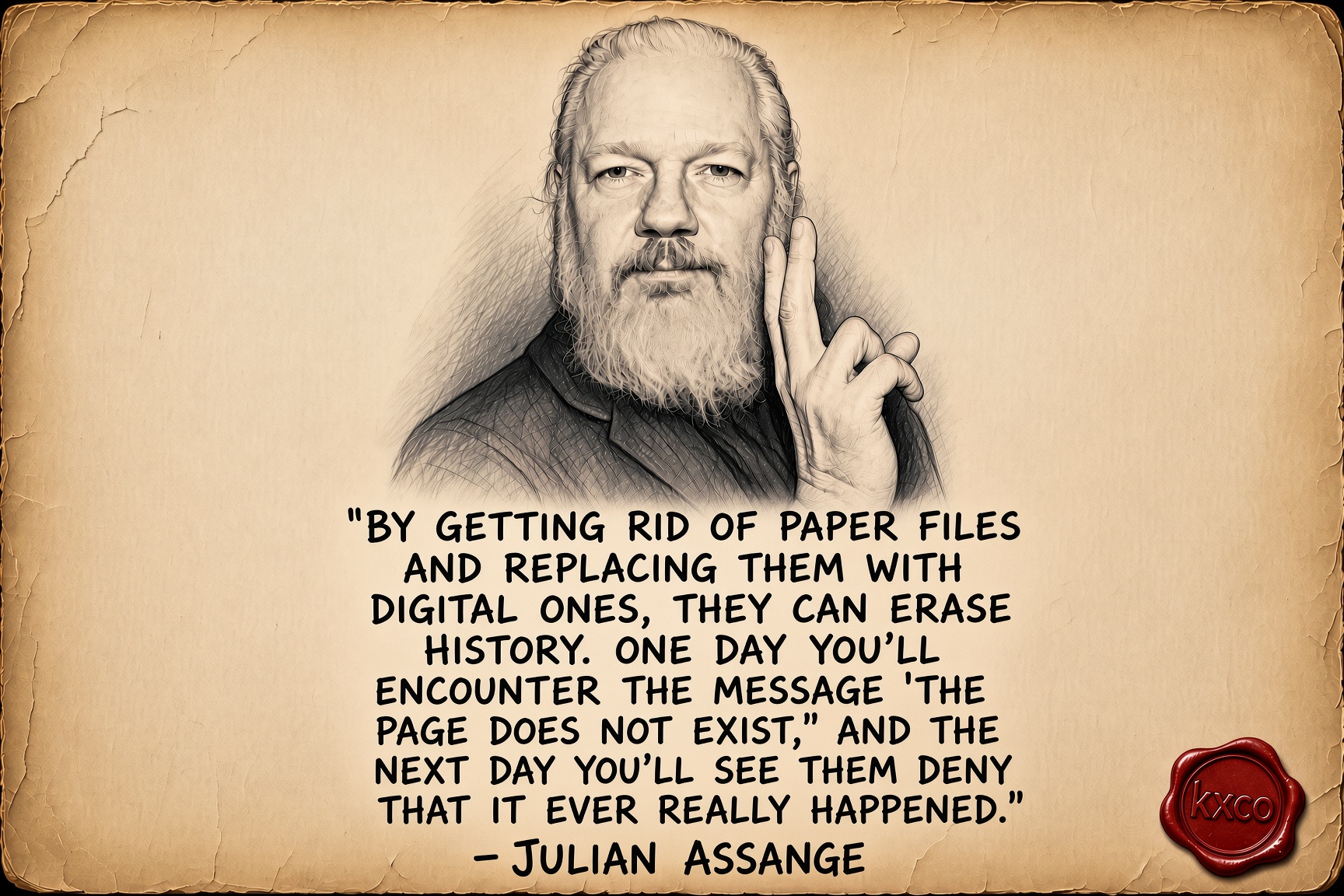
Pew found 38 percent of 2013's web pages gone a decade later, and quantum computing will eventually let attackers forge the signatures that prove records authentic. Why durable history now depends on post-quantum cryptography, on-chain anchoring and verification that needs nobody's permission.
Every story, signed and delivered.
Subscribe to the kxco channel and get the headline, the AI-written key takeaways, and the chain-anchor link the moment we publish. Audio versions and per-ticker subscriptions arrive in the next iteration.