
SpaceX and the Space Economy
$SPCX $RKLB $ASTS $LUNR $RDW $PL $BKSY $SPCE $BA $LMT $NOC $LHX
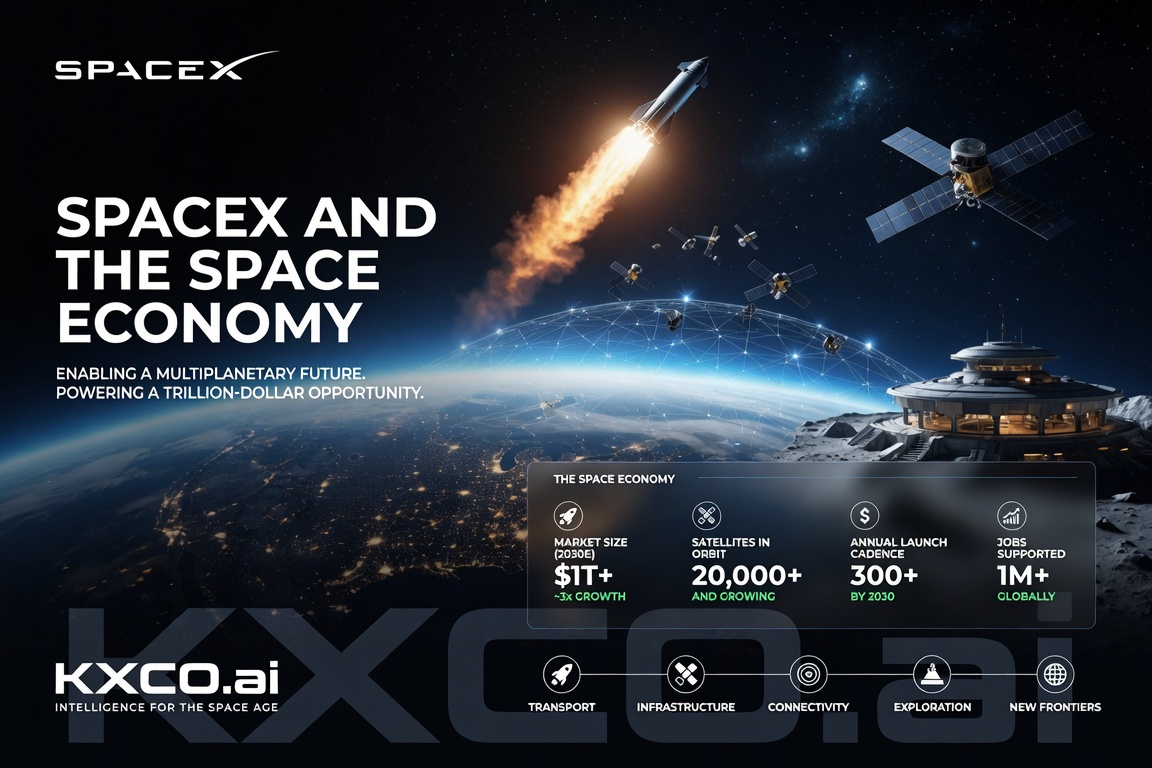
The New Space Race: Why SpaceX and the Space Economy Could Become the Next Great Gold Rush
The global space industry is entering a period of expansion that many analysts compare to the early days of the internet, railroads, or commercial aviation. For decades, access to space was dominated by governments and national agencies. Today, a new generation of private companies is transforming launch economics, satellite communications, Earth observation, lunar exploration, orbital manufacturing, and space infrastructure.
At the center of this transformation is SpaceX. The company has become synonymous with innovation in launch technology and has fundamentally altered the economics of reaching orbit. Yet the broader story extends far beyond a single company. A rapidly growing ecosystem of launch providers, satellite operators, communications networks, defense contractors, infrastructure builders, and lunar specialists is creating what may become one of the largest economic opportunities of the twenty-first century.
Investors are increasingly asking whether the space sector represents the next major wealth-creation cycle. The evidence suggests that the answer may be yes. Falling launch costs, rising government spending, defense requirements, satellite demand, artificial intelligence, and the search for new resources are combining to create powerful tailwinds for the industry.
SpaceX: The Company That Changed the Economics of Space
SpaceX deserves its position at the center of any discussion of the modern space economy. Through reusable rockets, vertical integration, rapid engineering cycles, and relentless execution, the company changed assumptions that had existed for decades. Falcon 9 dramatically reduced launch costs while increasing launch frequency. Falcon Heavy expanded payload capabilities. Starlink created a global broadband platform in orbit. Starship aims to become the most powerful launch system ever developed.
The significance of SpaceX extends beyond launches. By reducing the cost of access to space, the company created opportunities for hundreds of other businesses. Satellite constellations, Earth observation networks, communications systems, and lunar missions became more economically viable because launch became cheaper and more predictable.
SpaceX also altered competitive expectations. Governments, defense agencies, and commercial customers now expect faster innovation and lower costs. The entire industry has been forced to respond.
Blue Origin and the Long-Term Infrastructure Vision
Blue Origin, founded by Jeff Bezos, has pursued a different strategy. While SpaceX became known for speed and iteration, Blue Origin focused on long-term infrastructure. The company’s vision emphasizes millions of people living and working in space over time.
New Shepard helped create the commercial suborbital tourism market. New Glenn is designed to compete in orbital launch services. Blue Moon positions the company to participate in lunar logistics and infrastructure. Although Blue Origin has moved more slowly than some competitors, its financial resources and long-term commitment make it one of the most important companies in the sector.
Rocket Lab and the Rise of Public Space Companies
Rocket Lab has emerged as one of the most successful publicly traded space companies. Electron established a strong position in the small satellite launch market. The company then expanded into spacecraft manufacturing, satellite systems, components, and defense services.
The development of Neutron represents a major milestone. If successful, Rocket Lab could move into larger launch categories and compete for a broader range of missions. Investors increasingly view Rocket Lab not simply as a launch company but as a diversified space infrastructure business.
The Satellite Revolution
Launch vehicles attract headlines, but satellites generate much of the economic value in space. Communications, navigation, weather forecasting, Earth observation, defense intelligence, and data analytics all rely on orbital assets.
AST SpaceMobile is building direct-to-device connectivity that could allow ordinary smartphones to connect directly to satellites. Planet Labs operates one of the largest Earth observation fleets. BlackSky focuses on real-time intelligence and geospatial analytics. These businesses demonstrate how data is becoming one of the most valuable products generated from space infrastructure.
Defense, Sovereignty and National Security
Space has become a critical national security domain. Modern militaries depend on satellites for communications, navigation, missile warning, intelligence gathering, and operational coordination. Governments around the world are increasing spending on resilient space architectures.
Traditional aerospace leaders including Boeing, Lockheed Martin, Northrop Grumman, RTX, and L3Harris continue to play major roles. At the same time, commercial innovators are winning contracts as governments seek faster innovation cycles and lower costs.
The Lunar Economy
The Moon is re-emerging as a strategic destination. NASA’s Artemis program, Chinese lunar ambitions, and commercial initiatives have renewed interest in lunar infrastructure. Intuitive Machines, Firefly Aerospace, and other firms are helping build the foundations of a future lunar economy.
Potential opportunities include communications networks, navigation systems, energy generation, scientific facilities, construction materials, resource extraction, and logistics services. While still early, the Moon may become the first major off-world industrial zone.
Space Manufacturing and Orbital Infrastructure
Microgravity enables manufacturing processes that are difficult or impossible on Earth. Companies such as Redwire are developing technologies for orbital manufacturing, advanced materials, biological research, and deployable structures.
As launch costs continue to decline, manufacturing in orbit could become commercially attractive for pharmaceuticals, semiconductors, specialty materials, and advanced research. This represents one of the least appreciated opportunities in the broader space economy.
Why Space Is Valuable
Many people incorrectly assume the value of space comes primarily from exploration. In reality, space is valuable because it enables economic activity on Earth. Satellites support telecommunications, logistics, agriculture, finance, weather forecasting, defense, disaster management, and transportation.
Nearly every major industry now depends on services delivered from orbit. As costs decline and capabilities improve, this dependence is likely to increase substantially.
The Next Great Gold Rush
History shows that infrastructure providers often create more value than the end users they serve. During the California Gold Rush, railroads, suppliers, and financial institutions frequently generated more durable wealth than individual miners. The same pattern may emerge in space.
The winners may not be the companies that extract resources first. Instead, the largest fortunes could be created by firms providing launch services, communications networks, logistics systems, software, robotics, navigation, identity systems, power generation, and manufacturing infrastructure.
Artificial intelligence is likely to accelerate this trend. AI-driven satellite analysis, autonomous spacecraft operations, orbital traffic management, and robotic exploration will create entirely new markets. The convergence of AI and space may become one of the defining investment themes of the next decade.
What's Next
The modern space economy is transitioning from experimentation to commercialization. SpaceX demonstrated what is possible. Blue Origin is building long-term infrastructure. Rocket Lab is proving public companies can compete successfully. AST SpaceMobile, Planet Labs, Redwire, Intuitive Machines, BlackSky, Firefly Aerospace, Relativity Space, Sierra Space, and others are expanding the ecosystem.
The result is a rapidly developing industrial frontier. Communications, defense, manufacturing, data, energy, transportation, and resource development are all being reshaped by advances in space technology.
The next great gold rush may not take place on Earth. It may occur in orbit, on the Moon, and eventually throughout the solar system. Investors who understand that transformation early may participate in one of the most significant economic opportunities of the century.
Major Public Space and Aerospace Companies
Company | Ticker | Exchange | Focus |
Rocket Lab | RKLB | NASDAQ | Launch & Space Systems |
AST SpaceMobile | ASTS | NASDAQ | Satellite Communications |
Intuitive Machines | LUNR | NASDAQ | Lunar Infrastructure |
Redwire | RDW | NYSE | Space Manufacturing |
Planet Labs | PL | NYSE | Earth Observation |
BlackSky | BKSY | NYSE | Geospatial Intelligence |
Virgin Galactic | SPCE | NYSE | Space Tourism |
Boeing | BA | NYSE | Aerospace & Space |
Lockheed Martin | LMT | NYSE | Defense & Space |
Northrop Grumman | NOC | NYSE | Defense & Space |
L3Harris | LHX | NYSE | Space Communications |
The competitive landscape continues to evolve as launch costs fall, governments increase spending, and commercial demand expands. SpaceX remains the benchmark, but competitors are developing specialized advantages in communications, lunar services, data analytics, defense integration, and orbital infrastructure. Investors should focus on execution, recurring revenue, strategic partnerships, technological differentiation, and access to government contracts. Over time, the space economy is likely to resemble a complete industrial ecosystem rather than a single market segment.

Weekly Market Outlook: Fed Minutes, Anthropic and OpenAI IPOs, Gold, Bitcoin, FX
The Fed raised rates in September and payrolls rose 29,000, per the Labor Department. This week the FOMC minutes, three Treasury auctions and a 10-year near 5.3 percent test that gap. Anthropic's IPO clock runs toward a 14 October investor day while OpenAI's chief executive says not 2026. Gold sits 26 percent below its record, bitcoin near $85,500, the dollar up three weeks running. Two knowledge graphs from KXCO's records map the IPO backers and the FDA board.

Hegseth's AutoWarCom: Who Builds It, What the Money Buys, and the Record It Needs
Pete Hegseth's Autonomous Warfare Command is a four-star proposal that needs Congress by 1 October 2027. Until then Project Agincourt holds the work, and the money moves through Drone Dominance, the Army's counter-drone contracts and DIU. The software layer, Palantir's Maven, Anduril's Lattice and Shield AI's Hivemind, is the one the KXCO AI Sector ontology had mapped before the speech. After Minab, its hardest problem is the record, not the model.

Wall Street Week Ahead: Rates, Oil, AI, Quantum, Defense, Metals and Bitcoin
The trading week opens after a Federal Reserve that chose to hike, a White House that chose not to strike Yemen, and an oil market still pricing a war now in its seventh month. The useful work this week is not a list of tickers. It is a map of what depends on what: the funds rate, the Magnificent Seven, a quantum cohort just handed a specification and a deadline, the missile primes selling into a restock, and gold, silver, crude and Bitcoin, all held against the live AI sector ontology.

What the KXCO Ontology Exposed While the Market Stood Still
On 25 August the KXCO AI Sector Ontology stamped a fresh set of rows. Sixteen days later the Nasdaq had gone nowhere and ten of those names were up: Intel 14.68%, Meta 13.04%, SpaceX 7.42%, Oracle 5.65%. This is what a record of 393 entities and 869 sourced claims surfaces that a screen cannot: who is genuinely irreplaceable rather than merely large, which obligations sit off every balance sheet in the sector, and where the strongest bull case on the page runs into a variable no graph contains.
Every story, signed and delivered.
Subscribe to the kxco channel and get the headline, the AI-written key takeaways, and the chain-anchor link the moment we publish. Audio versions and per-ticker subscriptions arrive in the next iteration.