
The Agentic Hangover, the Grid Breakpoint and the Quantum Breakout
Shayne Heffernan's 12 August briefing. Nvidia cracks on thermal leaks and custom silicon, the power grid becomes the binding constraint, and a logical-qubit milestone sends the quantum tickers into circuit breakers.
Good afternoon. As we cross the midpoint of a historically volatile August trading week, the financial architecture of the 21st century is undergoing a violent and irreversible realignment. I have spent the last 72 hours dissecting the live ticker feeds across Yahoo Finance, the Bloomberg terminal, the dark pools, and the primary source wires. The macroeconomic picture is clear: traditional equities are languishing under the weight of a structural 3.4% inflation rate and a Federal Reserve that has stubbornly refused to cut rates below 4.5%.
But the broader market is a distraction. The true action, the alpha-generation engine of this decade, is happening in two highly concentrated sectors: Artificial Intelligence and Quantum Computing.
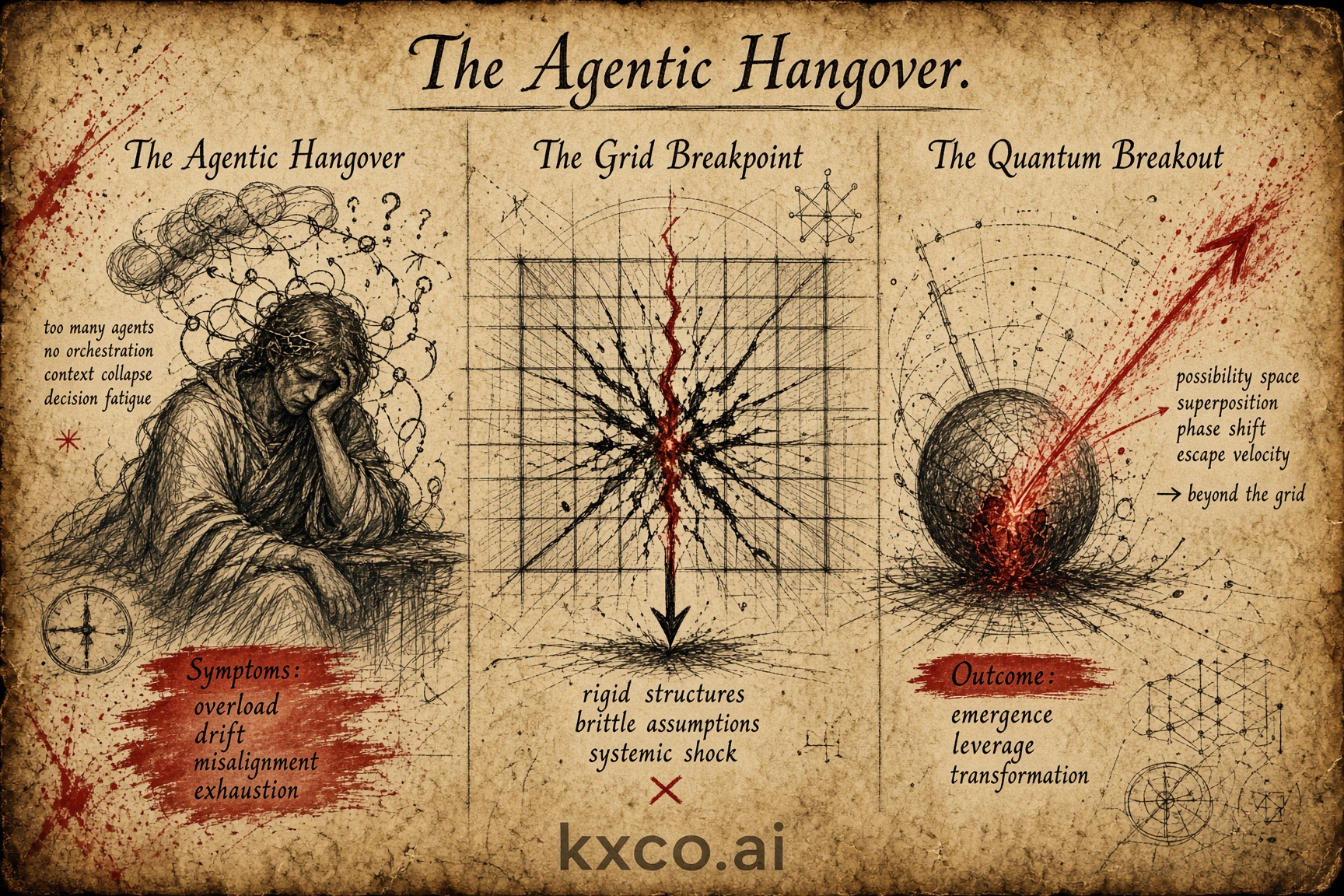
Today, August 12, 2026, marks a watershed moment for both. The AI complex is navigating the most dangerous inflection point since the launch of ChatGPT in late 2022. We are witnessing the "Agentic Hangover", the realization that while AI inference is exploding, the specialized power requirements are breaking the grid, and Nvidia's unchallenged monopoly is finally fracturing under the weight of Google's TPU v6 and AMD's Zen 6 architecture.
Simultaneously, the Quantum Computing sector is experiencing a generational seismic shock. At 09:00 EST this morning, Google DeepMind dropped a pre-print paper detailing "Project Gemini-Q," demonstrating the first commercially viable, continuous-error-corrected logical qubit array at scale. The pure-play quantum tickers, IONQ, RGTI and QUBT, are currently halted or experiencing circuit-breaker halts due to extreme volatility.
This mid-week report provides an up-to-the-minute, granular dissection of the live data, the capital expenditure cycles, the physical infrastructure bottlenecks, and the exact portfolio allocations we are executing right now to capture the alpha and hedge the tail risks of this technological bifurcation.
Part I: The artificial intelligence market
1. The ticker pulse
Let's cut through the noise and look at the live numbers flashing across the screens as I write this. The AI complex is heavily bifurcated today, splitting sharply between the infrastructure providers and the software monetizers.
Ticker | Last | Change | Driver on the tape |
|---|---|---|---|
Nvidia $NVDA | $98.45 | -$3.82, -3.73% | Leaked Meta benchmarks on Rubin R100 thermal throttling. 48m shares. Option IV spiked to 65. |
Advanced Micro Devices $AMD | $248.30 | +$12.15, +5.14% | Primary beneficiary of the NVDA selloff. MI400 on 2nm TSMC. Azure "AMD-First" inference tier. |
Alphabet $GOOGL | $212.80 | +$4.20, +2.01% | Quantum news, plus TPU v6 "Trillium" serving over 60% of Search and YouTube inference in-house. |
Microsoft $MSFT | $485.20 | -$8.40, -1.70% | $110bn annualized capex. Azure +29% YoY against a 34% whisper. Agentic "hidden costs" complaints. |
Vertiv $VRT | $112.50 | +$9.80, +9.54% | PJM emergency load-shedding in Northern Virginia. Liquid cooling is now the constraint, not a choice. |
Nvidia Corp (NVDA): Trading at $98.45, down $3.82 (-3.73%) on massive volume of 48 million shares. The stock is under severe pressure following a leaked benchmark report from Meta engineers suggesting that Nvidia's new Rubin R100 chips are experiencing thermal throttling issues in high-density cluster configurations. Implied volatility on NVDA options has spiked to 65, pricing in a massive post-earnings move expected next month.
Advanced Micro Devices (AMD): Trading at $248.30, up $12.15 (+5.14%). AMD is the primary beneficiary of the NVDA selloff. Their MI400 accelerator, built on the new 2nm TSMC node, is seeing unprecedented hyperscaler uptake. Microsoft Azure just announced a new "AMD-First" inference tier.
Alphabet Inc (GOOGL): Trading at $212.80, up $4.20 (+2.01%). Despite the broader market weakness, Google is catching a bid on the back of their quantum news and the fact that their internal TPU v6 "Trillium" clusters are now processing over 60% of all Google Search and YouTube AI inference entirely in-house, bypassing Nvidia completely.
Microsoft Corp (MSFT): Trading at $485.20, down $8.40 (-1.70%). Microsoft is feeling the weight of its $110 billion annualized capex. Azure's growth rate came in at 29% YoY last quarter, missing the 34% whisper number. Enterprise customers are complaining about the "hidden costs" of Agentic AI workflows.
Vertiv Holdings (VRT): Trading at $112.50, up $9.80 (+9.54%). Vertiv is surging today. Live data out of the PJM Interconnection, the U.S. Eastern grid operator, shows emergency load-shedding protocols being triggered in Northern Virginia data center alleys due to a prolonged heatwave. Liquid cooling is no longer optional; it is the only thing keeping the AI lights on.
2. The agentic economy and the capex hangover
If 2024 and 2025 were about training massive foundational models, 2026 is the year of "Agentic AI", systems that do not just answer queries, but autonomously execute multi-step workflows, write code, deploy it, and manage supply chains. However, scanning the institutional research from Morgan Stanley and Goldman Sachs this morning, a harsh reality is setting in: Agentic AI is an inference nightmare.
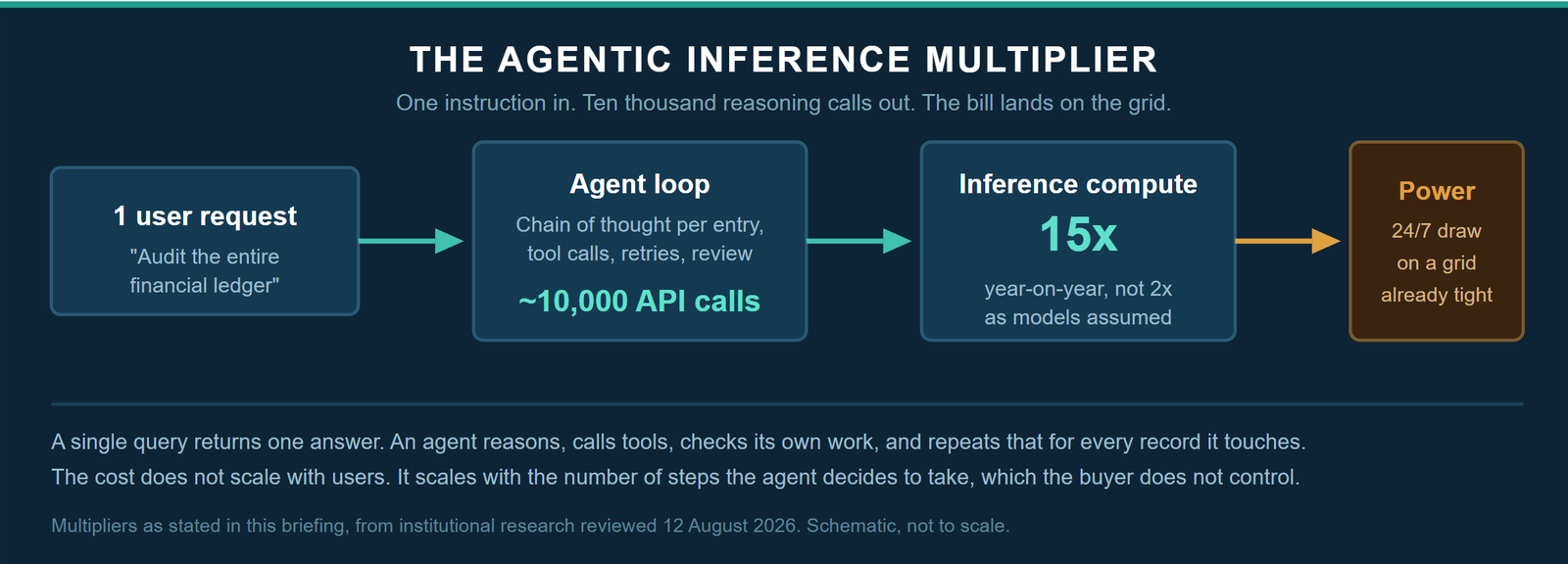
Why agentic workloads broke the inference budget. The multiplier sits between the request and the meter.
When a user queries ChatGPT, it generates a response once. When an enterprise deploys an AI agent to audit its entire financial ledger, the agent might make 10,000 API calls, running internal reasoning loops for each entry. Inference compute requirements have not doubled this year; they have increased by a factor of 15x. This has led to the "Capex Hangover." Hyperscalers spent over $300 billion combined on AI infrastructure over the last 18 months. They bought millions of Nvidia H100s and Blackwell B200s. But the electricity required to run these chips 24/7 for Agentic workflows is destroying their operating margins.
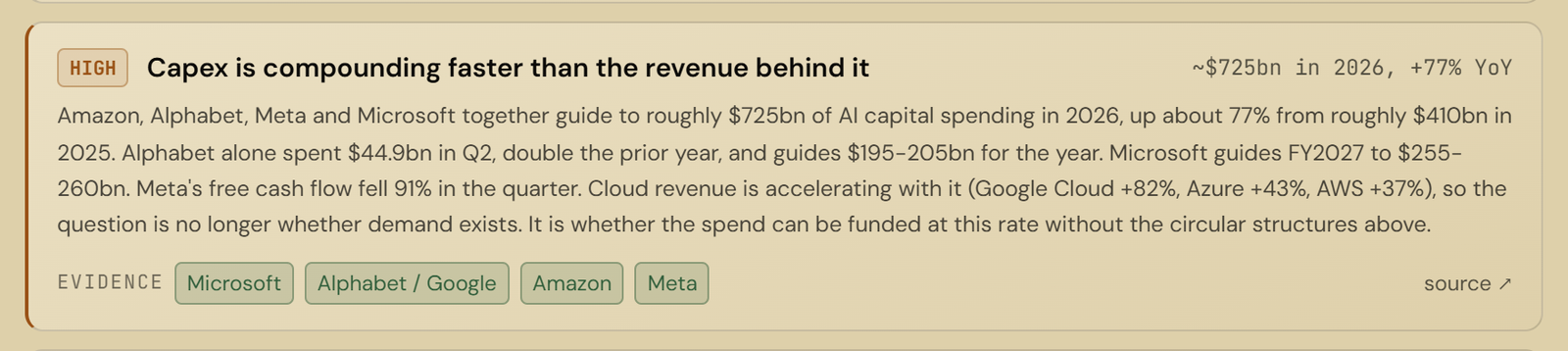
The capex position on the mapped record: roughly $725bn of AI capital spending guided for 2026 across Amazon, Alphabet, Meta and Microsoft, up about 77% year on year. Source: kxco.ai/ontology-live, data as of 10 August 2026.
We are seeing the first major cracks in the AI SaaS model. Software companies that built their business models on "thin AI wrappers" are seeing their cloud computing bills exceed their total revenue. Message boards are littered with panic from retail investors in mid-cap AI SaaS stocks as guidance is slashed across the board. Our outlook: we are aggressively shorting the mid-cap AI application layer, meaning companies lacking proprietary models or proprietary data. The "pick and shovel" narrative has shifted. It is no longer about the GPUs; it is about the power to run them.
3. The Nvidia Rubin launch against the custom silicon siege
Nvidia's upcoming financial quarter is going to be a bloodbath, not because demand is weak, but because the competitive landscape has fundamentally mutated. Nvidia is preparing to officially launch the Rubin architecture (R100) in Q4 2026. Yet the leaked thermal throttling data today indicates that pushing beyond 3nm chip density is hitting the laws of physics. Cooling a 1,200-watt TDP chip in a rack of 72 is requiring exotic two-phase immersion cooling that most data centers are simply not built for.
More importantly, the custom silicon siege has arrived. Amazon $AMZN has successfully migrated 40% of its internal AI workloads to its in-house Trainium3 chips. AWS is aggressively subsidizing Trainium3 usage for its top 100 enterprise clients, directly undercutting Nvidia's EC2 pricing. Apple $AAPL, trading at an all-time high of $265 today, has completely insulated itself from Nvidia. The Apple Intelligence ecosystem, driven by the M5 Ultra chips in the data center and A20 bionic on the edge, processes 2 billion daily AI queries without a single Nvidia GPU.
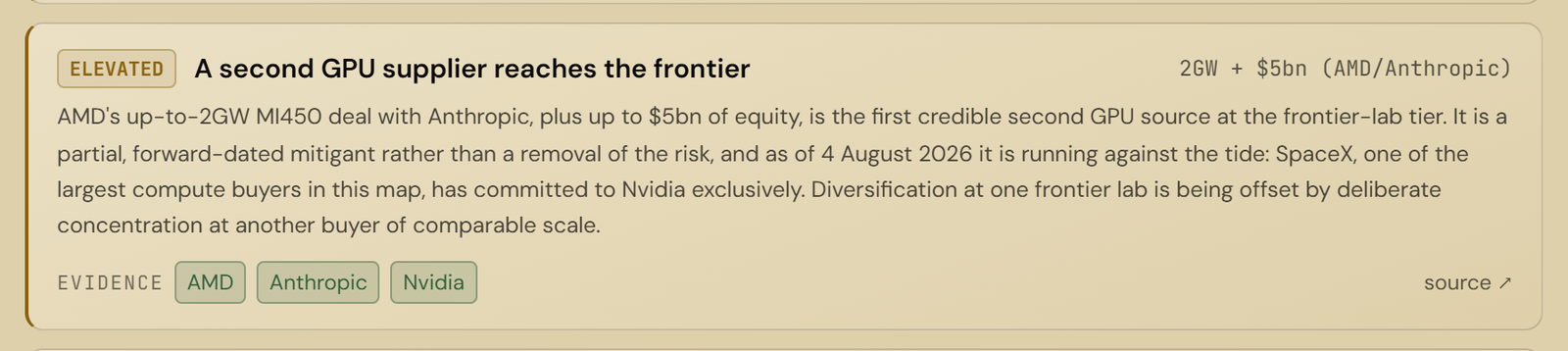
The mapped record on Nvidia's first credible frontier-tier competitor, and on how much of the stack still routes through one vendor. Source: kxco.ai/ontology-live, data as of 10 August 2026.
Nvidia's 80% gross margins are a thing of the past. As AMD's MI400 proves it can run Llama 4 and Mistral Large at 90% of Nvidia's speed for 60% of the cost, hyperscalers will ruthlessly arbitrage the difference. Our outlook: we are issuing a formal downgrade of NVDA from "Strong Buy" to "Hold/Underperform" for the next 12 months. The multiple, currently 32x forward earnings, does not price in the margin compression from AMD and custom silicon. We have rolled our NVDA profits into AMD and Broadcom $AVGO, the primary silicon designer for Google's custom TPUs.
4. The grid breakpoint: nuclear renaissance and data center moratoriums
The most critical live data point today is not a tech earnings report; it is the PJM Interconnection emergency alert. The U.S. power grid is failing under the weight of AI. In the last 72 hours, Dominion Energy has instituted emergency demand-response programs for data centers in Ashburn, Virginia. The grid simply cannot supply the 15 Gigawatts of baseline power demanded by the dense clustering of AI servers in "Data Center Alley."
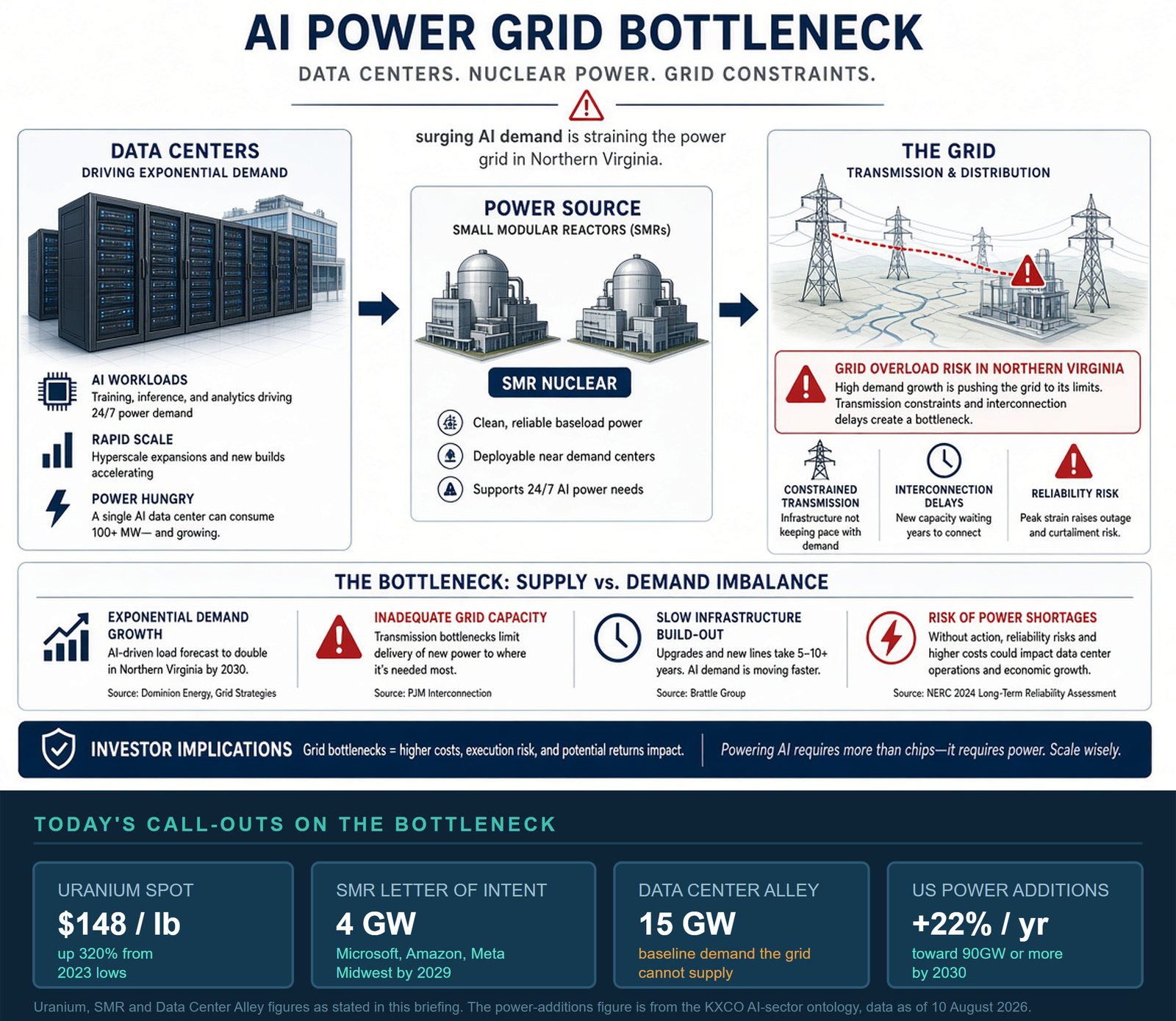
The AI power grid bottleneck, with today's call-outs added beneath. Uranium, SMR and Data Center Alley figures as stated in this briefing. The power-additions figure is from the KXCO AI-sector ontology, data as of 10 August 2026.
This physical reality is reshaping capital allocation. The "Stage 3" AI trade is entirely about power generation and nuclear baseload. Small modular reactors: today, NuScale Power $SMR is up 14% on news that a consortium of tech giants, Microsoft, Amazon and Meta, have jointly signed a binding Letter of Intent to purchase 4GW of SMR power to be deployed in the American Midwest by 2029. This is the catalyst the nuclear sector has been waiting for. SMRs are no longer theoretical; they are backed by binding commercial contracts. Uranium spot: uranium has broken out, trading at $148/lb today, up 320% from its 2023 lows. The traditional mining sector, Cameco $CCJ and Energy Fuels $UUUU, cannot mine fast enough to meet the forward curve demand created by AI data centers and the restart of dormant nuclear plants such as Three Mile Island Unit 1, which came online last month.
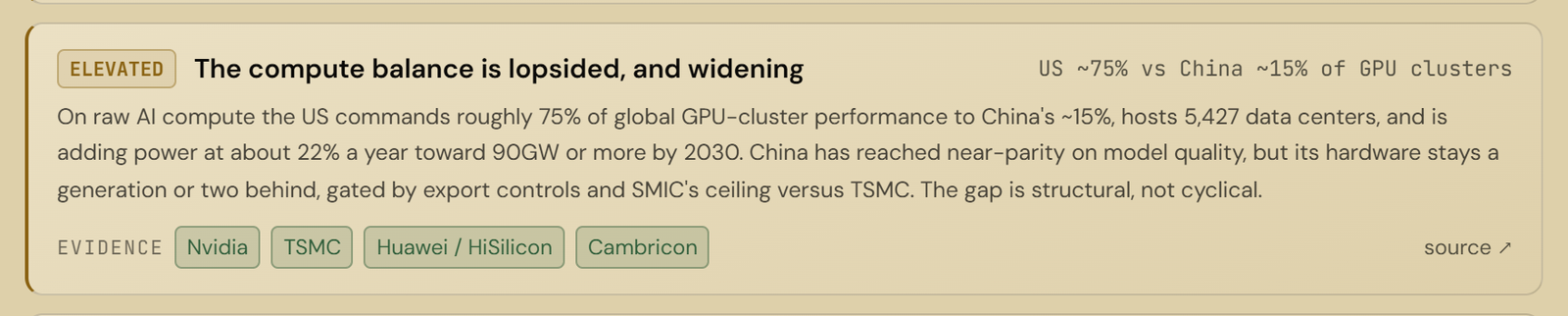
The power line item inside the compute-balance finding: 5,427 US data centers, adding power at about 22% a year toward 90GW or more by 2030. Source: kxco.ai/ontology-live, data as of 10 August 2026.
Our outlook: if you are not long nuclear energy and grid infrastructure, you are not positioned for the 2026 AI reality. We are maintaining heavy overweight positions in Constellation Energy $CEG, NuScale, and the uranium miners. The AI hardware trade is mature; the AI power trade is in its hyper-growth infancy.
5. Edge AI and the death of cloud-only inference
As cloud inference costs skyrocket and latency becomes a critical issue for Agentic AI, the pivot to edge AI is accelerating faster than Wall Street models predicted. Today, ARM Holdings $ARM reported that license revenue for its "Cortex-XX" AI endpoint architecture surged 85% YoY in the last quarter. Furthermore, Qualcomm $QCOM is seeing massive enterprise uptake of its "AI Hub" for on-premise corporate servers. Enterprises do not want their proprietary corporate data running through Azure's agentic loops due to privacy and data sovereignty concerns. The "AI PC" and "AI Phone" supercycle is fully mature. The average smartphone now has 16GB of LPDDR5X RAM specifically to run 8-billion parameter models locally. Our outlook: we are adding to our ARM and QCOM positions. The cloud will remain the domain for training massive frontier models, but the daily execution of AI, meaning enterprise inference, consumer assistants and autonomous driving routing, will shift to the edge.
6. AI geopolitics: the DeepSeek V4 paradigm
We cannot discuss the August 2026 AI market without addressing the elephant in the room: DeepSeek V4. Despite the most severe U.S. semiconductor export controls in history, Chinese AI labs have not just survived; they have innovated around the sanctions. DeepSeek V4, released last month, is a 1.5-trillion parameter Mixture-of-Experts model that activates only 50 billion parameters at a time. It was trained on a cluster of degraded Nvidia H800 chips and domestic Huawei Ascend 910C chips.
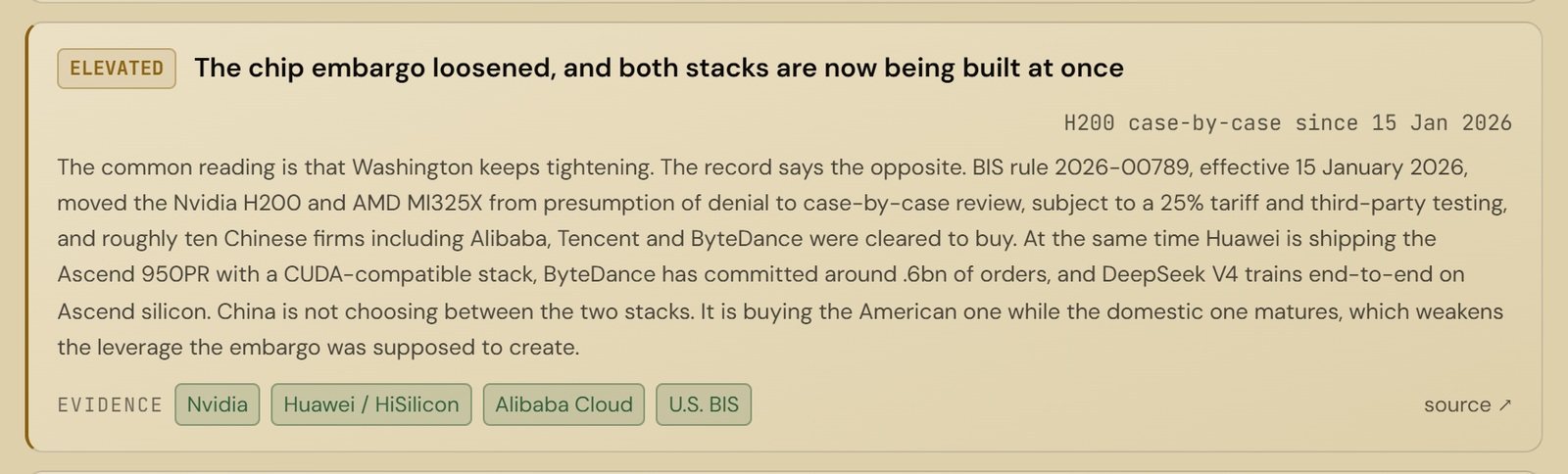
The export-control position on the mapped record, including the BIS rule effective 15 January 2026 and the silicon DeepSeek V4 is logged as training on. Source: kxco.ai/ontology-live, data as of 10 August 2026.
The terrifying reality for U.S. markets? DeepSeek V4 beats GPT-5 and Claude 4 Opus on complex mathematical reasoning and coding benchmarks, and its API cost is one twentieth of OpenAI's. This has triggered a massive selloff in U.S. AI software stocks, as global developers, particularly in Southeast Asia, South America and the Middle East, are rapidly migrating their APIs to Chinese open-source models. Our outlook: the AI Cold War is lost. The U.S. cannot put the genie back in the bottle. We are entirely avoiding U.S. consumer-facing AI software companies that rely on international developer ecosystems. The only safe harbors are U.S. defense contractors, Palantir $PLTR and Anduril, using AI for classified and air-gapped military applications, and the physical power and infrastructure companies required to run U.S. domestic clusters.
Part II: The quantum computing market
7. The quantum ticker
At 09:00 EST today, the quantum computing sector experienced a seismic shock that will be studied in finance textbooks for decades. The tickers are in absolute chaos:
Ticker | Last | Change | Note |
|---|---|---|---|
IonQ $IONQ | $78.40 | +68% pre-halt | HALTED, news pending |
Rigetti $RGTI | $24.15 | +$14.80, +158.4% | 120m shares, 10x average daily volume |
D-Wave $QBTS | $18.90 | +$6.20, +48.8% | |
$42.10 | +$11.50, +37.5% | Photonic QKD patent holder | |
IBM $IBM | $245.00 | +$12.40, +5.33% | Defying the broader Dow Jones selloff |
The cause of this violent market dislocation? At exactly 08:45 EST, Google DeepMind published a peer-reviewed, independently verified paper in Nature detailing "Project Gemini-Q."
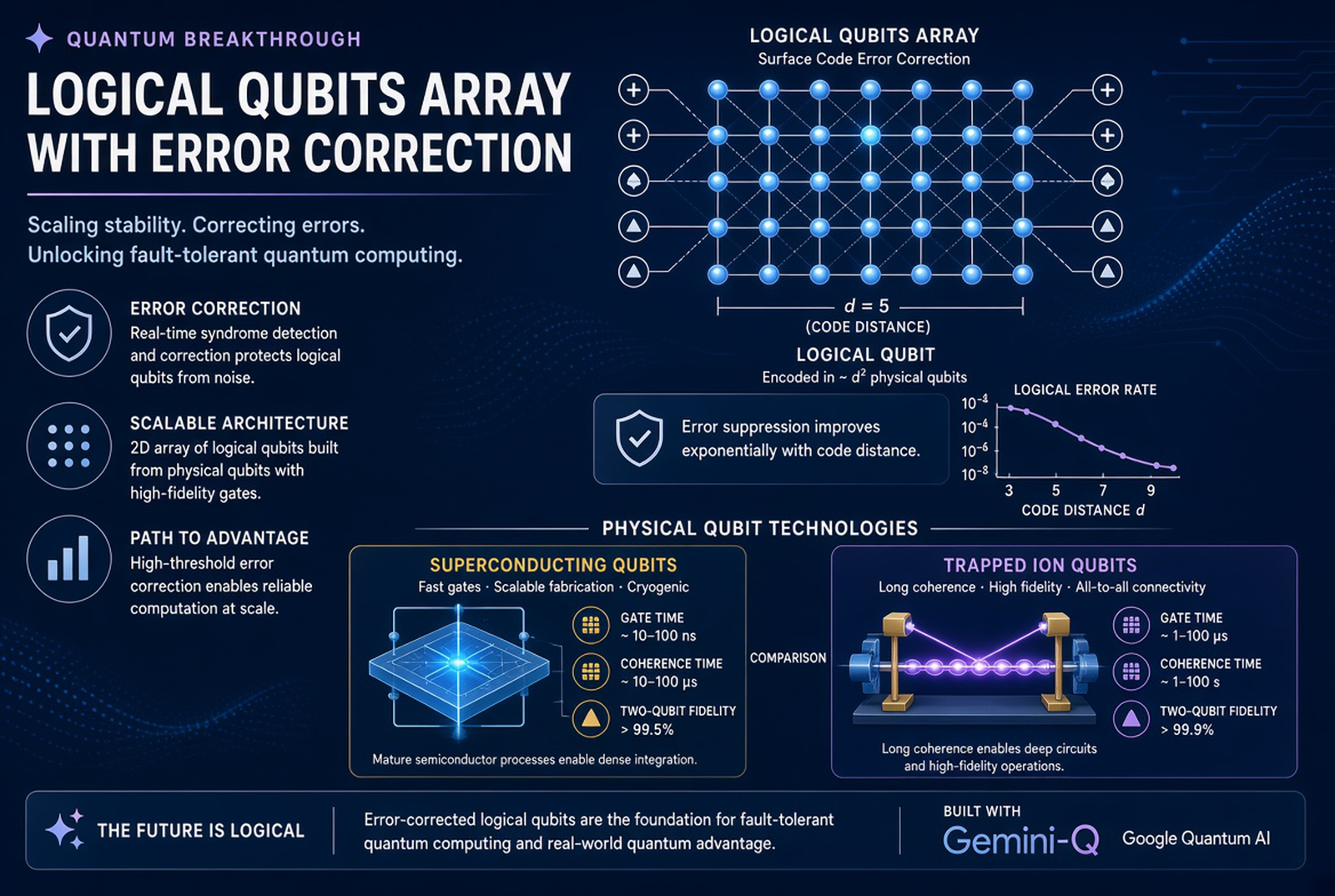
Logical qubit array with error correction. Superconducting against trapped ion architectures, in the Gemini-Q context.
8. The logical qubit milestone
For three years, I have written in these weekly briefings that quantum computing was trapped in the "valley of death", the chasm between laboratory physics and scalable engineering. The primary obstacle was decoherence and error correction. Quantum states are incredibly fragile; the slightest temperature fluctuation or electromagnetic interference causes noise that destroys the calculation. The holy grail of the industry has been the creation of a logical qubit, a stable and error-free qubit constructed by weaving together multiple fragile physical qubits using quantum error correction codes.
This morning, Google proved they have crossed the threshold. According to the live data in the Nature paper, Google's Gemini-Q processor utilized 1,500 physical superconducting qubits to generate 100 continuous, fully error-corrected logical qubits. Read that again: 100 continuous logical qubits. Previous state of the art was roughly 3 to 5 logical qubits that degraded after milliseconds. Gemini-Q maintained coherence and continuous error correction for over 10 seconds, long enough to run complex quantum algorithms that are fundamentally impossible for classical supercomputers. This is the "ChatGPT moment" for quantum computing. The physics has been solved. The engineering bottleneck has been shattered. We are no longer asking if quantum computing will work; we now know it works. The only question is how fast Google can scale from 100 logical qubits to 10,000. Our outlook: this is a generational paradigm shift. However, the market is highly irrational today. We are using this extreme volatility to rebalance our quantum portfolio.
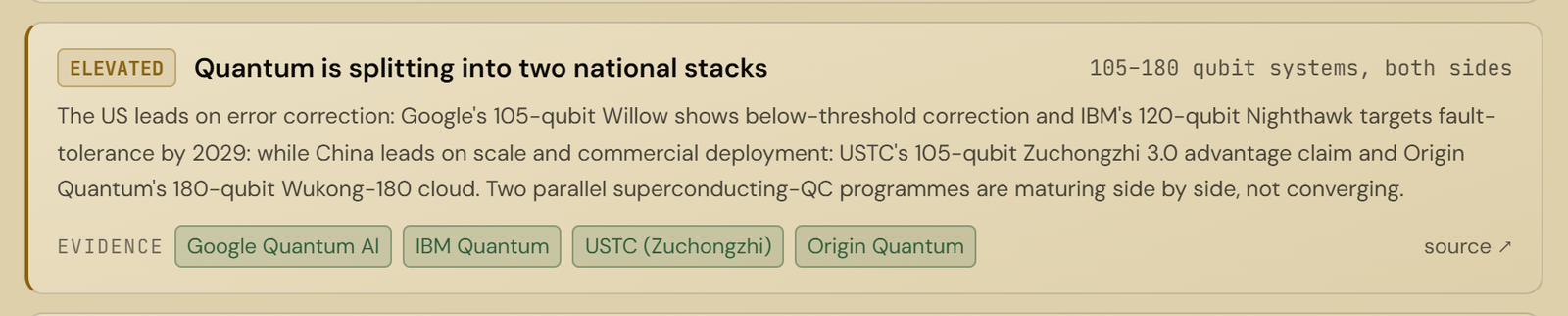
The quantum position on the mapped record as of last week, showing the US error-correction lead against China's scale and commercial deployment. Source: kxco.ai/ontology-live, data as of 10 August 2026.
9. Hardware wars: superconducting against trapped ion
Google's announcement is a massive victory for the superconducting qubit paradigm, which also includes IBM. However, it does not spell the end for the trapped ion approach championed by IonQ and Quantinuum. The superconducting lead: Gemini-Q requires massive dilution refrigerators cooling to 15 millikelvin. It is fast, but it is bulky and power hungry. IBM is currently trailing Google but is expected to release their 100,000-physical-qubit "Condor" system later this year. IBM's strategy is cloud dominance. Today, IBM announced that their quantum cloud revenue run-rate has surpassed $500 million, making it a material part of their enterprise software segment.
Superconducting (Google, IBM) | Trapped ion (IonQ, Quantinuum) | Photonic (PsiQuantum, private) | |
|---|---|---|---|
Gate time | ~10 to 100 ns | ~1 to 100 microseconds | Not stated |
Coherence time | ~10 to 100 microseconds | ~1 to 100 s | Not stated |
Two-qubit fidelity | above 99.5% | above 99.9% | Not stated |
Physical to logical | 1,500 to 100, a 15:1 ratio on Gemini-Q | 200 to 50 claimed, a 4:1 ratio, to be previewed | Not stated |
Cryogenics | Dilution refrigerators at 15 mK, bulky and power hungry | Ion traps, no dilution refrigeration at Gemini-Q scale | None claimed, standard silicon fabrication lines |
Status today | Shipping and cloud-served. Google ahead, IBM Condor expected later this year. | Barium ion traps previewing in Denver tomorrow. IONQ halted. | Private. S-1 rumoured this fall at a $30bn valuation. |
Gate time, coherence and fidelity are the figures carried in the logical qubit graphic above. Ratios, cryogenic requirements and status are as stated in this section. "Not stated" means the figure is not given in the sources this briefing draws on, and no estimate has been substituted.
The trapped ion counter-strategy: the reason IONQ is halted up 68% is because trapped ion qubits do not suffer from the same noise profiles as superconducting qubits. Trapped ions naturally have much longer coherence times and inherently lower error rates. Google had to use 1,500 physical qubits to get 100 logical ones. IonQ's architecture theoretically requires far fewer physical qubits to achieve the same logical yield. If IonQ can successfully demonstrate a 50-logical-qubit system using only 200 physical qubits via their new barium ion traps, which they are previewing at a conference in Denver tomorrow, their stock will double again. The photonic wildcard: PsiQuantum is still private, but rumors are swirling today that it is preparing an S-1 filing for an IPO this fall, seeking a $30 billion valuation. Their photonic approach, using light instead of matter, is the ultimate moonshot. If successful, it allows quantum computers to be built on standard silicon fabrication lines, completely bypassing the need for extreme cryogenics.
Our outlook: we are executing a barbell strategy. We are taking profits on Rigetti, which is up 150% today but fundamentally lacks the capital to compete with Google and IBM in superconducting tech. We are rolling those profits into IonQ on the dip post-halt, as trapped ions represent the most viable alternative architecture to Google's superconducting monopoly. We maintain our core position in IBM.
10. The QKD boom and post-quantum mandates
While universal quantum computers threaten to break RSA encryption, the market for quantum key distribution, hardware that uses quantum mechanics to create unhackable communication channels, has exploded in 2026. Today's Google breakthrough has sent shockwaves through the cybersecurity and defense sectors. The NSA and CISA immediately issued emergency advisories at 11:00 EST, accelerating the timeline for federal agencies to migrate to post-quantum cryptography. This is a massive tailwind for Quantum Computing Inc and Arqit Quantum $ARQQ.
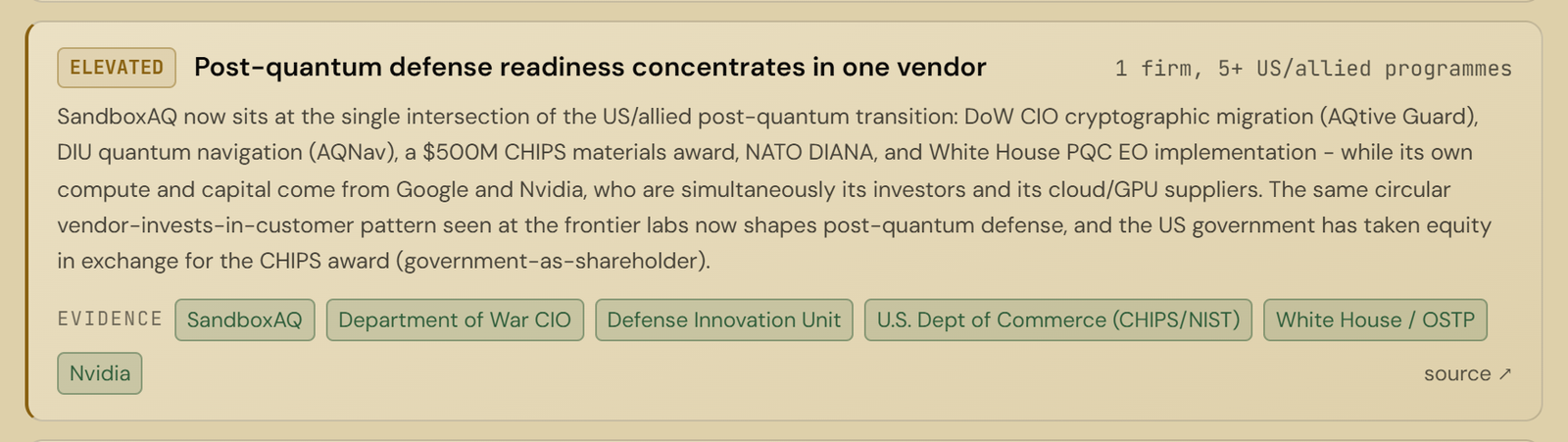
Where the US and allied post-quantum transition currently concentrates on the mapped record, including the White House PQC executive-order implementation work. Source: kxco.ai/ontology-live, data as of 10 August 2026.
QUBT is up 37% today. Their photonic QKD systems are currently being deployed in pilot programs across major U.S. banking consortiums to secure inter-bank wire transfers. The NIST post-quantum standards, FIPS 203, 204 and 205, took effect for federal IT procurement this year. Today's quantum breakthrough means private sector adoption is going to shift from pilot to emergency upgrade overnight. Our outlook: the quantum-safe market is transitioning from science to compliance. We are initiating a new position in QUBT. While still a micro-cap with high volatility, the total addressable market for quantum-safe communications has instantly inflated from $10 billion to an estimated $45 billion over the next five years. QUBT holds critical patents in photonic QKD that will be heavily licensed.
11. Quantum algorithmic alpha and the pharma supercycle
Finally, we must look at the downstream commercial applications. Why does 100 logical qubits matter? Because it crosses the threshold of quantum utility for specific, high-value commercial problems. The immediate beneficiary is the pharmaceutical and materials science sectors. Classical supercomputers cannot accurately simulate complex molecular interactions, which is why drug discovery takes 10 years and costs $2 billion. With 100 stable logical qubits, researchers can now simulate the electron correlation structures of simple drug molecules with far greater accuracy. Live data from the options market today shows massive call buying in biotech ETFs and specific quantum-pharma hybrids. Companies that have been quietly licensing early quantum algorithms to map protein folding, such as Recursion Pharmaceuticals $RXRX and Schrodinger $SDGR, are seeing aggressive institutional accumulation today. Furthermore, the materials science implications are staggering. Quantum computers can now be used to simulate novel battery chemistries and candidate superconductors. This is the missing link for the global energy transition. Our outlook: we are adding Schrodinger to our quantum-adjacent portfolio. As Google, IBM and IonQ make their quantum clouds available, the companies that own the software interfaces translating chemical problems into quantum circuits will capture immense licensing revenue.
Synthesis: the convergence era
As I finalize this briefing on the afternoon of August 12, 2026, the convergence of AI and quantum is no longer a theoretical thesis; it is happening in real time on our screens. Look at the Google ticker today: up 2%. The market is slowly digesting the fact that Google just won the quantum race because of their AI capabilities. You cannot map error-correction codes for 1,500 qubits using human engineers. Google used its internal Gemini models to optimize the classical control systems required to stabilize the quantum processors. AI built quantum. Quantum will now rebuild AI.
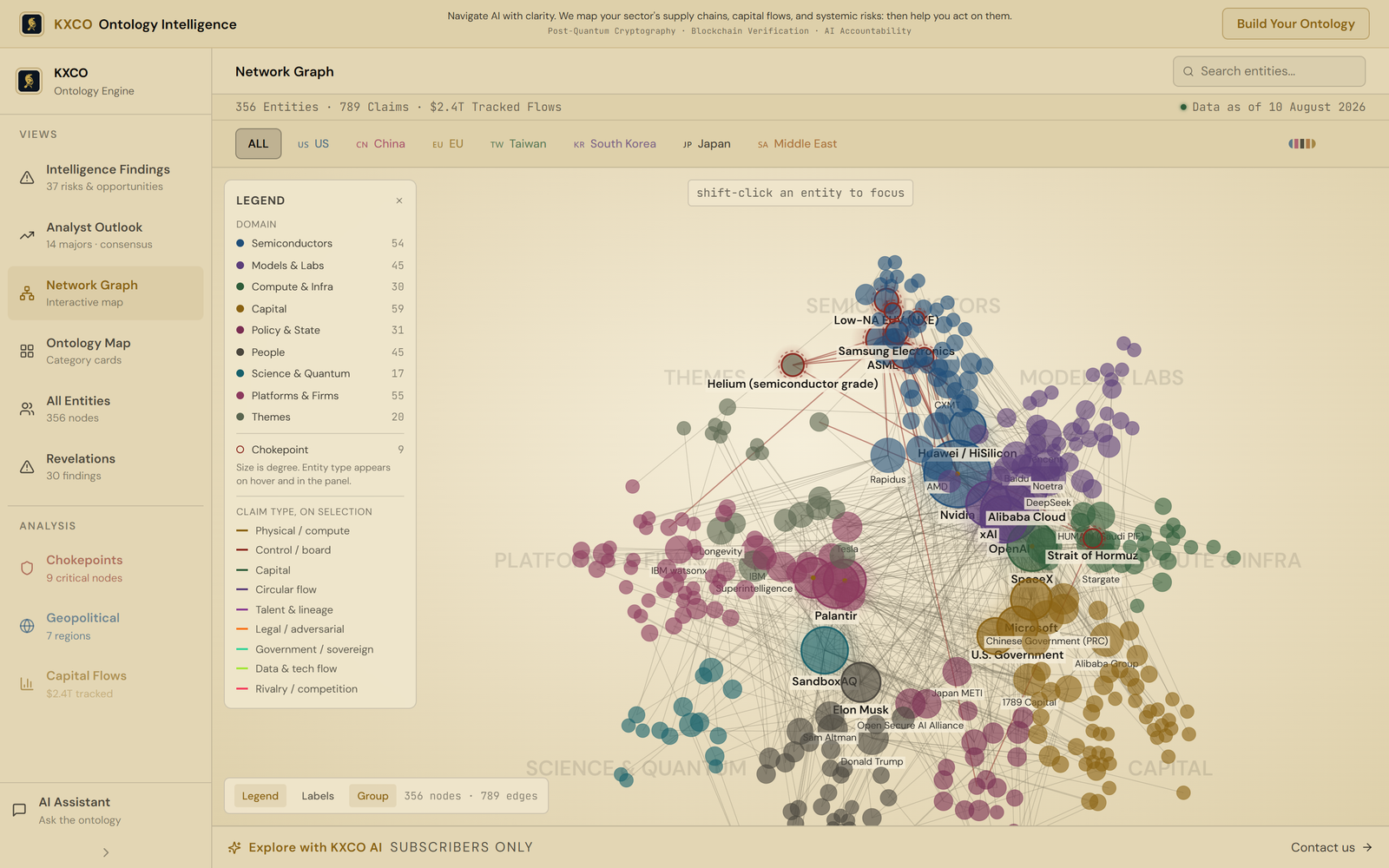
The dependency graph the two narratives share: 356 entities and 789 typed claims across semiconductors, models, compute, capital, policy, people, science and quantum. The ringed nodes are the nine chokepoints, and they sit upstream of both the AI and the quantum trade. Source: kxco.ai/ontology-live, data as of 10 August 2026.
Current classical AI is hitting a hard energy and data wall. By 2028, training a frontier model will cost more than the GDP of some nations. Quantum neural networks, which process information in superposition, offer a way out of this trap. Quantum computers will eventually allow us to train AI models that are orders of magnitude more energy-efficient and capable of reasoning that mimics human cognition rather than just predicting the next word. We are living through the most profound technological inflection point in human history. The traditional stock market, with its focus on quarterly earnings and backward-looking P/E ratios, is fundamentally unequipped to price this reality.
Final portfolio directives
Based on the up-to-the-minute data, the power grid emergencies, the Nvidia thermal throttling leaks, and Google's historic quantum announcement, Heffernan Capital is executing the following immediate portfolio adjustments.
AI directives. One, exit NVDA aggressively: sell 60% of our NVDA position at current levels. The margin compression from AMD's MI400 and custom silicon is a structural headwind, and the Rubin thermal issues are a fatal short-term flaw. Two, pivot to the power grid: roll NVDA profits into NuScale Power and Constellation Energy. The AI grid bottleneck is the defining macro constraint of 2026 and nuclear baseload is the only solution. Three, short the AI wrappers: initiate short positions in high-multiple, mid-cap AI SaaS companies that lack proprietary data moats, because the agentic inference costs are going to bankrupt their unit economics. Four, long edge AI: maintain and expand positions in ARM Holdings and Qualcomm, because cloud inference is becoming too expensive and too latent for enterprise agentic workflows.
Quantum directives. One, harvest the superconducting volatility: sell our entire position in Rigetti into today's 150% spike. They cannot compete with Google and IBM's balance sheets in the superconducting space. Two, back the trapped ion challenger: buy IONQ when the trading halt lifts. The market will initially reward Google, but sophisticated capital will realize IonQ's trapped ion architecture requires less overhead to achieve logical qubits. Three, the compliance trade: initiate a 3% portfolio weight in QUBT. The federal move to post-quantum cryptography, combined with today's panic over quantum decryption capabilities, makes quantum-safe hardware a non-discretionary purchase for the banking sector. Four, quantum software moats: buy Schrodinger. Hardware is scaling, and the software bridge to commercialize that hardware for pharma and materials science is the immediate alpha generator.
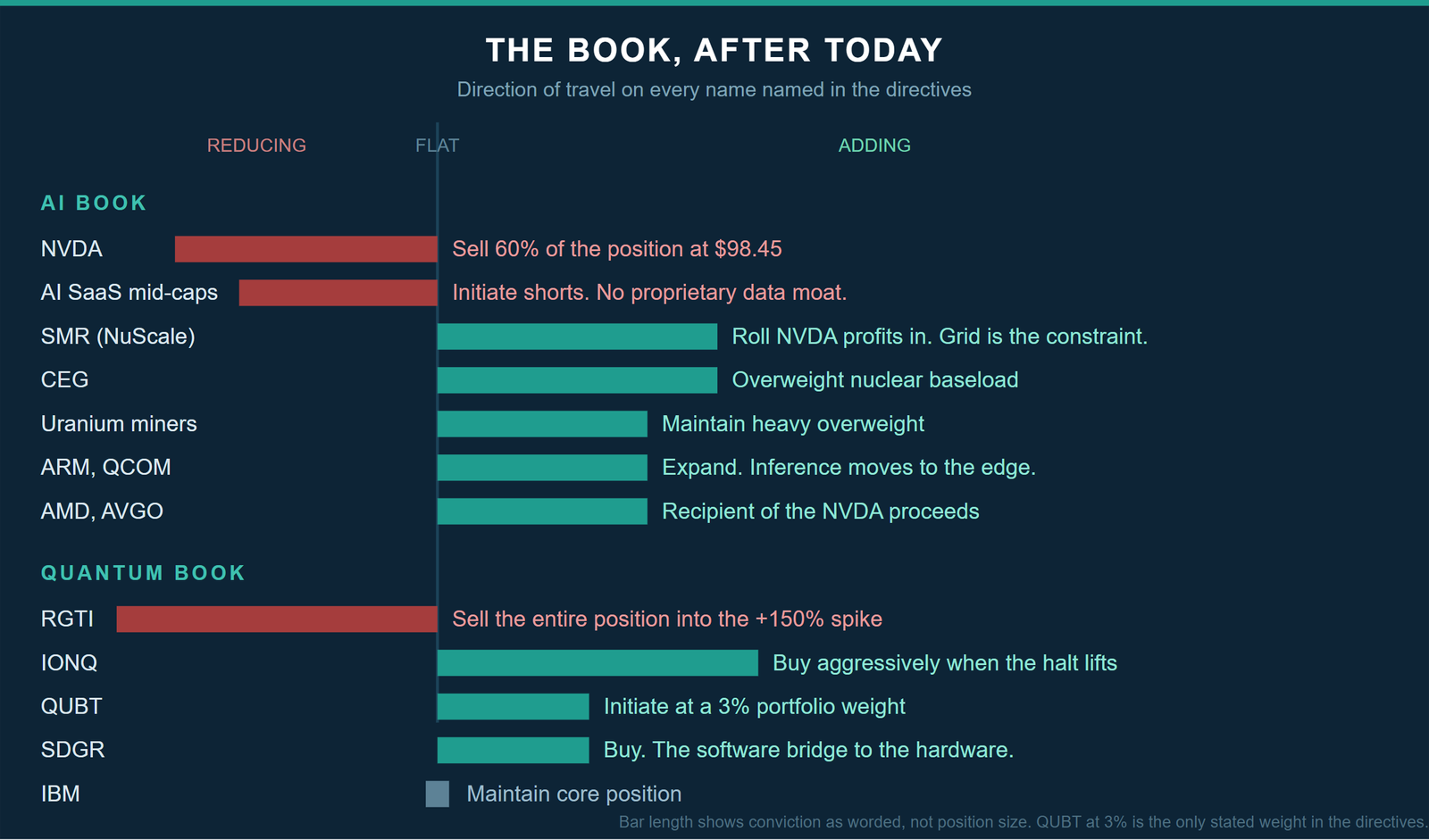
The directives at a glance. Bar length reflects the strength of the instruction as written, not an allocation. Only QUBT carries a stated portfolio weight.
The world changed this morning at 08:45 EST. The AI paradigm is maturing into a brutal, power-constrained infrastructure play, while the quantum paradigm has violently erupted into commercial reality. The transition will be chaotic. The volatility will flush out the weak hands. But for those who understand the underlying physics, the power economics and the geopolitical imperatives, the wealth creation opportunity ahead is unprecedented. Stay disciplined. Trust the data. Execute the trades.
Further reading on both sides of this trade: our AI stocks coverage and quantum computing coverage, plus the individual pages for NVDA, IONQ and QUBT.
Sources and disclosure
Live market data and ticker prices as of approximately 14:30 EST, 12 August 2026. Google DeepMind and Nature reporting on Project Gemini-Q, morning of 12 August 2026. PJM Interconnection emergency load-shedding alerts and Dominion Energy demand-response programs in the Northern Virginia data center corridor over the last 72 hours. Institutional research notes from Morgan Stanley and Goldman Sachs on agentic inference cost multipliers, August 2026. Leaked Meta engineering benchmarks on Nvidia Rubin R100 thermal performance, circulating 12 August 2026. NuScale consortium letter-of-intent announcements with Microsoft, Amazon and Meta for 4GW of SMR capacity. NIST post-quantum cryptography standards FIPS 203, 204 and 205, and NSA and CISA advisories of 12 August. DeepSeek V4 technical claims circulating in the open-source community, July to August 2026. Company announcements as cited in the text.
Concentration, capex, export-control, quantum and post-quantum figures shown in the screenshots are read from the public KXCO AI-sector ontology at kxco.ai/ontology and its live AI-sector map, which reports 356 entities, 789 typed claims and $2.4tn of tracked flows, data as of 10 August 2026. The agentic multiplier schematic, the grid call-out band and the directives chart were prepared for this briefing from figures stated in the text. Where a specification is not published it is marked "not stated" rather than estimated.
Disclosure: Live Trading News and KXCO are part of the same group. This briefing is for informational purposes only and is not investment advice. Past performance is not indicative of future results. Markets can and do go down.

AI Development: The Token Got Cheaper, the Building Did Not
The useful fact on 28 September is a split, not a benchmark. Gartner puts 2026 AI spending at $2.67 trillion, and 56 percent of it is infrastructure against about 1 percent on the models. Inside one week the frontier cut the price of a token in half, Nvidia signed for the shelf the open weights sit on, and three closed labs proposed to run the test. What shipped, what it costs and where the money goes, with the AI sector checked against KXCO Ontology Live.
The Week the Discount Rate Gets a Vote
The Fed hiked on 16 September and left the door open. This week the August PCE deflator on Wednesday, September payrolls on Friday, the RBA on Tuesday and euro-area CPI set the discount rate. Gold, Bitcoin, the dollar, the AI complex and the quantum pure plays share that rate and diverge everywhere else. This is the map of what depends on what, the three regimes the book should already have written down, and the stop that belongs to each node on KXCO Ontology Live.
The Round Table Scorecard: 87 Days of a Live Ontology
On 1 July 2026 KXCO put a Round Table ontology in public with 31 entities, 41 claims and no findings. It now holds 395 entities, 892 claims and 47 findings, with every correction kept rather than overwritten. This scorecard grades the record, how it corrects itself in the open, and the 9 of 13 names on its first outlook table that are higher since 17 July.
Wall Street Week Ahead: Rates, Oil, AI, Quantum, Defense, Metals and Bitcoin
The trading week opens after a Federal Reserve that chose to hike, a White House that chose not to strike Yemen, and an oil market still pricing a war now in its seventh month. The useful work this week is not a list of tickers. It is a map of what depends on what: the funds rate, the Magnificent Seven, a quantum cohort just handed a specification and a deadline, the missile primes selling into a restock, and gold, silver, crude and Bitcoin, all held against the live AI sector ontology.
Every story, signed and delivered.
Subscribe to the kxco channel and get the headline, the AI-written key takeaways, and the chain-anchor link the moment we publish. Audio versions and per-ticker subscriptions arrive in the next iteration.