
Lot of American Men are Not Working at Conventional Jobs, Here is Why!
#American #men #jobs #cash #savings #investing #trading #stocks #cryptocurrencies
"Lots of men are working but not at conventional jobs since 12 March 2020" -- Paul Ebeling
Consider now men are living off savings, or from money made in the market or maybe even selling NFTs.
Who knows, but quite a lot for sure.
Americans on average do have some money in the bank. Savings as a percentage of disposable income, according to the Federal Reserve of Kansas City, hit a record high of 33% in the Spring of Y 2020 and is still at 14%, or nearly 2X as high as it was prior to the VirusCasedemic.
And according to a recent survey by Northwestern Mutual, average personal savings are up over 10% compared to last yr, from $65,900 last yr to $73,100.
Average retirement savings increased 13%, from $87,500 last yr to $98,800 today.
Next let’s look at investing
1st stocks, it is not irrelevant to this narrative that the S&P 500 has climbed from 2,480 on 23 March 2020 to 4,441 today, or almost 80%. That is a huge gainer.
Much of the action has been retail investors and the meme stock boom, as millions of American males locked own at home with nothing to do all day for the past 18 months passed the time trading stocks.
Credit Suisse (NYSE:CS) estimates that since the beginning of Y 2020, “retail trading as a share of overall market activity has nearly doubled from between 15% and 18% to over 30%."
The Big Q: How many men were doing this and supporting themselves?
The Big A: Not sure, but the new trading platform Robinhood (HOOD) the broker dealer of choice for many of these new investors reported that it had 22.5-M funded user accounts last month, up from 7.2-M in March of 2020, 15-M new accounts is a big number.
Now come crypto: the fact is that the price of bitcoin is up from $4,861 on 12 March 2000 to $47,763 today, or + 10X.
Back to Robinhood last month that “revenue from cryptocurrency trading fees totaled $233-M, a nearly 50X rise from $5-M a yr earlier.” Those are just fees off the trades.
Bottom line: people have made money here.
A study by the Federal Reserve of St. Louis estimates that the average size of the “informal economy” aka cash in developed countries is 13% of GDP.
To give you a schooled estimate GDP in the US this yr is about $22-T. So 13% of that is $2.86-T. Even if half that money is paid out to women, that still leaves, say, $1-T being made by men in this country off the books.
More people than ever working for cash these days. Lots of people want to get paid in cash and so they are.
Have a healthy prosperous weekend, Keep the Faith!

Economic Calendar and Trading Strategies for the Week Ahead: July 20–24, 2026
A pivotal week for markets: Iran's closure of the Strait of Hormuz sends crude above $86 and gasoline over $5, while Alphabet, Tesla and Intel earnings test the AI trade. Full economic calendar plus trading strategies across oil, gold, Bitcoin, FX and AI chip stocks.
Economic Calendar and Trading Strategies for the Week Ahead: July 14–18, 2026
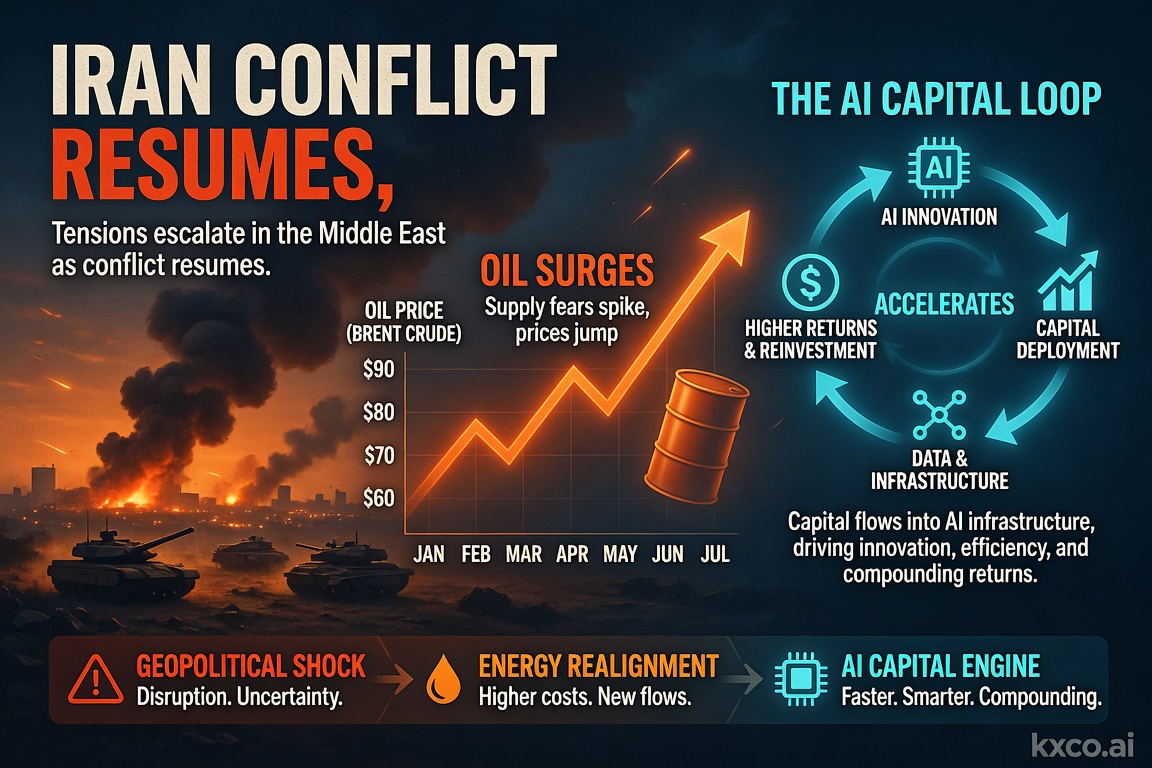
A pivotal week for markets: US strikes on Iran reignite the oil risk premium, June CPI and retail sales test the Fed's rate-cut path, and the $1 trillion AI capital loop keeps driving the tech trade. Full economic calendar plus trading strategies across oil, gold, Bitcoin, FX and AI stocks.

Quantum Computing Just Became an Institutional Risk
Shayne Heffernan on BlackRock's quantum-computing warning for Bitcoin and Ethereum, Google's cryptanalysis research, the two on-chain risk vectors, and how KXCO's Armature L1 — post-quantum from genesis, coordinated by its ontology — answers a threat that just went institutional.

Economic Calendar and Trading Strategies for July 7–11, 2026
A trader's guide to the week of July 7–11, 2026: the US and China economic calendar, the Fed-pivot test after a soft jobs report, and how to trade Nvidia, SpaceX, Bitcoin, the dollar, gold, silver, AI and quantum. Track every release on Live Trading News.
Every story, signed and delivered.
Subscribe to the kxco channel and get the headline, the AI-written key takeaways, and the chain-anchor link the moment we publish. Audio versions and per-ticker subscriptions arrive in the next iteration.