
Knightsbridge Group Sees Positive Outlook for Asia
Knightsbridge Group Sees Positive Outlook for Asian Manufacturing and Regional Economies, Including China
Knightsbridge Group maintains a positive outlook on Asian manufacturing and regional economies, including China. Asia's factory activity expanded in June, bolstered by solid momentum in the global economy and brightening prospects for semiconductor output, as indicated by recent surveys. This expansion offers policymakers some hope that the region can withstand the impact of weak Chinese demand.
However, cost pressures remain a challenge for manufacturers in countries like Japan, where a weak yen has increased the prices companies pay for fuel and raw material imports.
China's Caixin/S&P Global manufacturing purchasing managers' index (PMI) rose to 51.8 in June from 51.7 in May, according to a private survey released on Monday. This marks the fastest growth in over three years and surpasses market forecasts of 51.2, staying above the 50.0 break-even line that separates growth from contraction.
The private-sector reading followed official PMI data released on Sunday, which showed China's manufacturing activity fell for a second month in June, while services activity slid to a five-month low. Despite weak domestic demand, Chinese firms are ramping up production, highlighting the resilience of the manufacturing sector even as Beijing's rescue package for the ailing property sector struggles to take effect.
In South Korea, factory activity growth accelerated in June to the fastest pace in 26 months, driven by surging new orders, according to a private survey. This suggests that the region is benefiting from strong global demand. Factory activity also expanded at a faster pace in June compared to May in both Vietnam and Taiwan.
"Another strong month of data provides further evidence that global industrial activity and trade are picking up," said Joe Hayes, principal economist at S&P Global Market Intelligence, regarding South Korea's factory activity. "Viewed as a bellwether for exports due to its integration in supply chains for key intermediate goods like batteries and semiconductors, South Korean manufacturing output and orders often provide leading signals for broader trends."
Japan's factory activity expanded in June but at a slower pace than in May due to rising costs driven by the weak yen. The final au Jibun Bank Japan manufacturing PMI was at the break-even line of 50.0 in June, down from 50.4 in May. However, an index gauging Japanese firms' future output expectations rose to a six-month high, reflecting a better medium-term outlook for the car and chip sectors.
The International Monetary Fund (IMF) expects Asia's economies to achieve a soft landing, as moderating inflation allows central banks to ease monetary policies to support growth. The IMF forecasts regional growth to slow from 5% in 2023 to 4.5% this year and 4.3% in 2025.
As global and regional economic dynamics evolve, Knightsbridge Group remains committed to leveraging its expertise in investments, banking, government liaison, taxation, and corporate structuring to help clients navigate these changes and achieve their objectives.
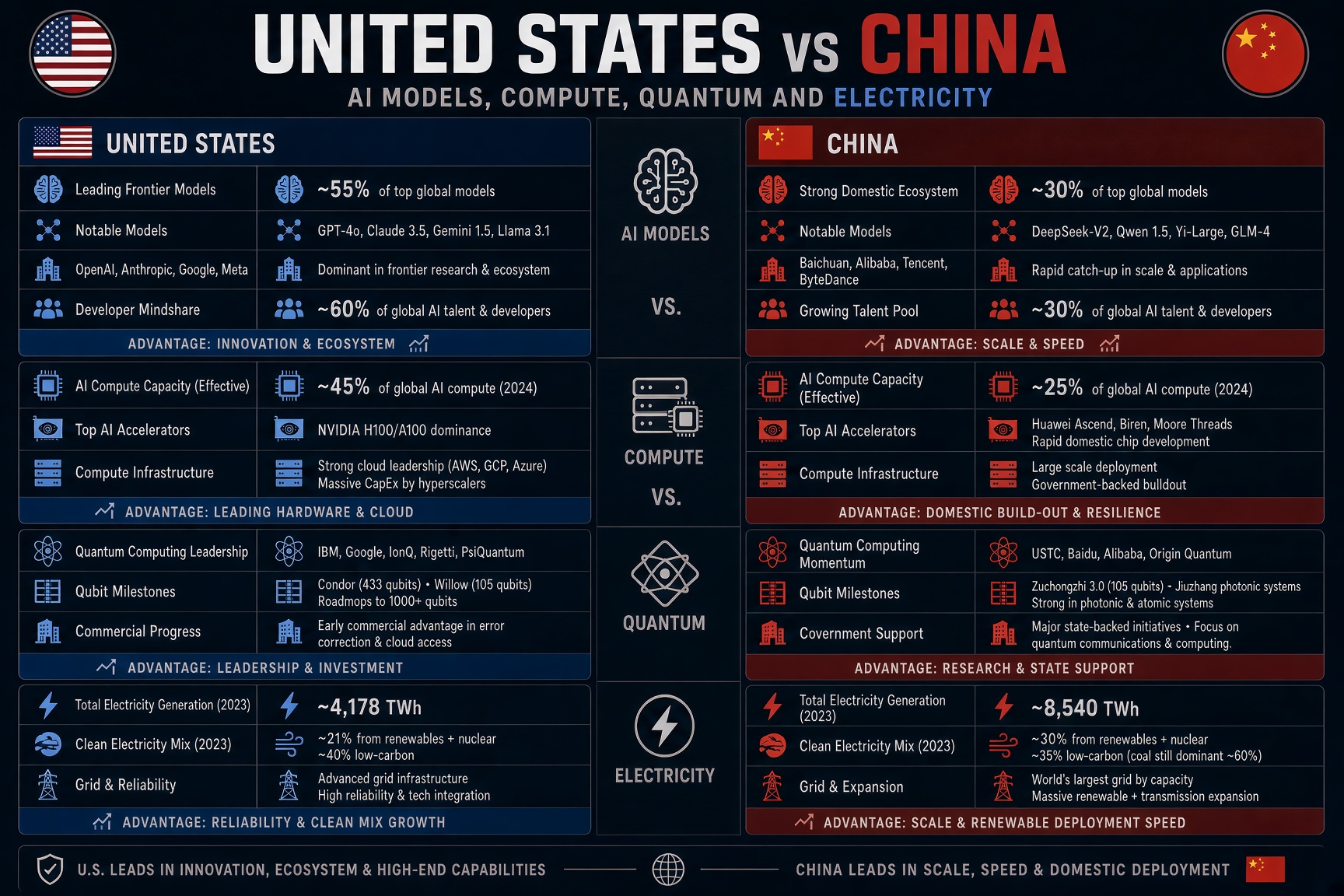
United States vs China: AI Models, Compute, Quantum and Electricity
The United States still leads in frontier model capability, total AI compute and quantum error correction, while China has narrowed the gaps in model performance, open-weight adoption and domestic chip volumes, and holds a structural advantage in power for data centres. Shayne Heffernan sets out the developments from July to October 2026 across models, compute, quantum and electricity, and how fast China is catching up.
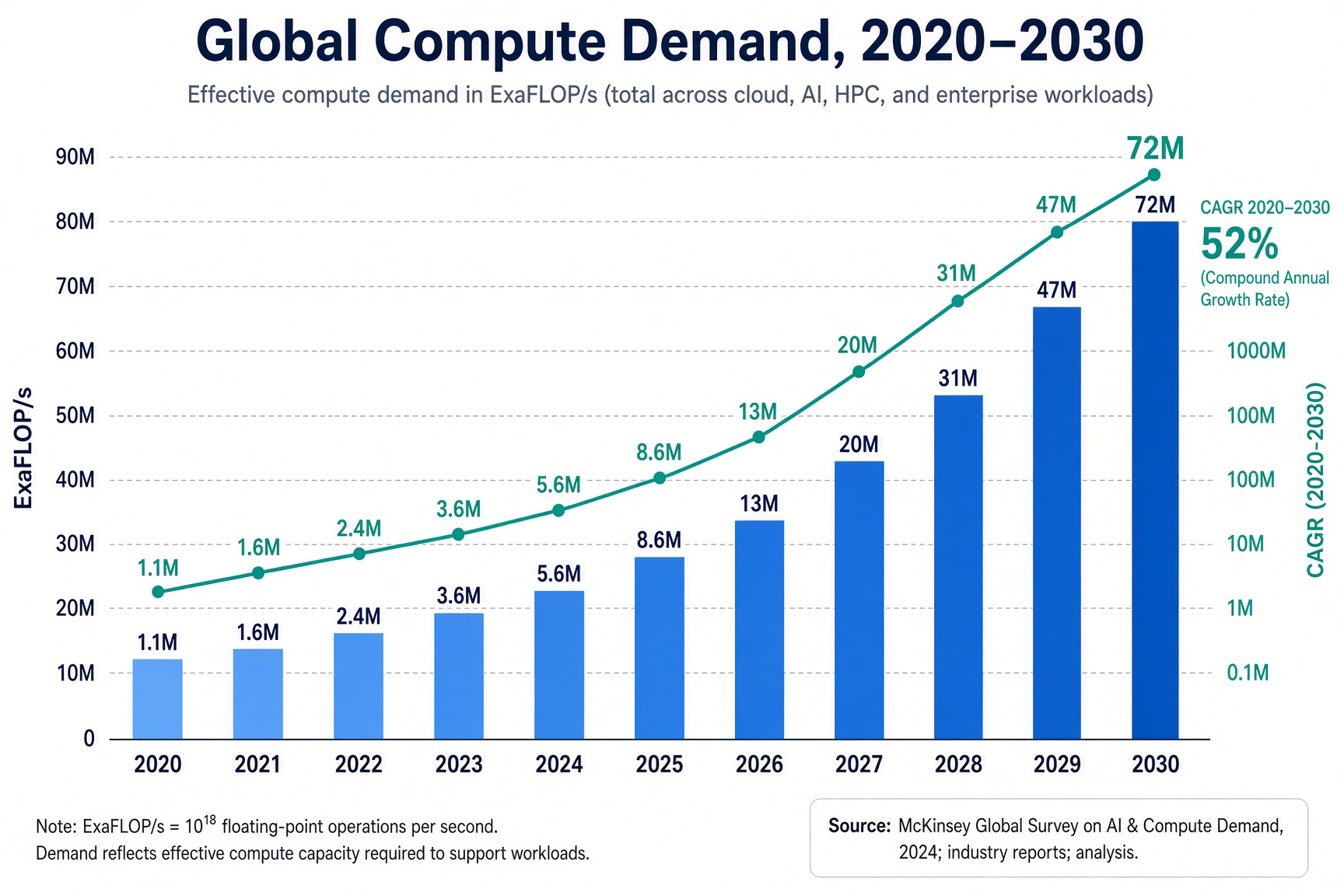
The 2030 Compute Landscape: GPUs, Power and the Architecture of Intelligence
The constraint on AI is no longer ideas or data but compute and the power to run it. Frontier training compute has grown about five times a year since 2020, and the leading AI supercomputer of June 2030 is on course for about 2 million chips and 9 gigawatts. Shayne Heffernan sets out the 2030 arithmetic, the power problem, who has already contracted the gigawatts, and how GPUs, custom ASICs, wafer-scale engines and quantum machines divide the work.

KXCO AI Ontology at 3 Months: What It Called and What Comes Next
On 19 July 2026 the Round Table's AI room published its first Analyst Outlook. To the 16 October 2026 close its 13 names rose 2.6% on an equal weight against 2.1% for QQQ, per StockAnalysis closes, and the six it opened with 35% or more of upside rose 8.6%. This piece lists the six names up more than 5%, the ten names I rate as opportunities now, the month's results in AI and quantum computing, and the official data showing that four in five firms have not yet started using AI.

SpaceX: The Road to 10 Gigawatts
SpaceX did not add an AI business. A company whose processes run on compute built its own computing plant, then built the power to run it. The 10-Q reports 1.4 gigawatts of nameplate compute at 30 June 2026, four leases worth about $41 billion a year and $100 billion of cash. The target is closer to 10 gigawatts than 5 by the end of 2027. This piece sets out the build sequence, the four layers of power in Memphis, and why Terafab is the act after 2027, not the road to it.
Every story, signed and delivered.
Subscribe to the kxco channel and get the headline, the AI-written key takeaways, and the chain-anchor link the moment we publish. Audio versions and per-ticker subscriptions arrive in the next iteration.