
Investing in Semiconductors
Supply chains, demand drivers, critical materials and the listed players of the trillion-dollar cycle, mapped through the KXCO ontology framework.
Part of theQuantum Computing Center
The semiconductor industry in mid-2026 stands at an inflection point of historic scale. Global revenues reached approximately US$796 billion in 2025 according to World Semiconductor Trade Statistics data, and some forecasts now place the industry near or above the trillion-dollar mark within the current cycle, propelled overwhelmingly by artificial intelligence infrastructure. First-quarter 2026 sales were reported near US$300 billion in some tallies, reflecting both volume growth in AI products and sharp price increases in memory.
Behind the headline numbers sits one of the most intricate, geographically concentrated and strategically contested industrial systems ever built. A single advanced AI accelerator package may traverse design houses in California, equipment from the Netherlands, wafers processed in Taiwan, high-bandwidth memory stacked in South Korea, and packaging lines that depend on specialty gases, photoresists and rare-earth components sourced from a handful of chokepoints. For investors, understanding that structure is not optional background. It is the difference between owning a growth story and owning a bottleneck.
The supply chain, from quartz to accelerator
The value chain is conventionally segmented into design, wafer fabrication, and assembly, test and packaging, with critical upstream layers of equipment, materials and electronic design automation tools. In practice the interdependencies are denser than any org chart suggests: roughly half of the intermediate inputs used by the industry are themselves semiconductor products or process services.
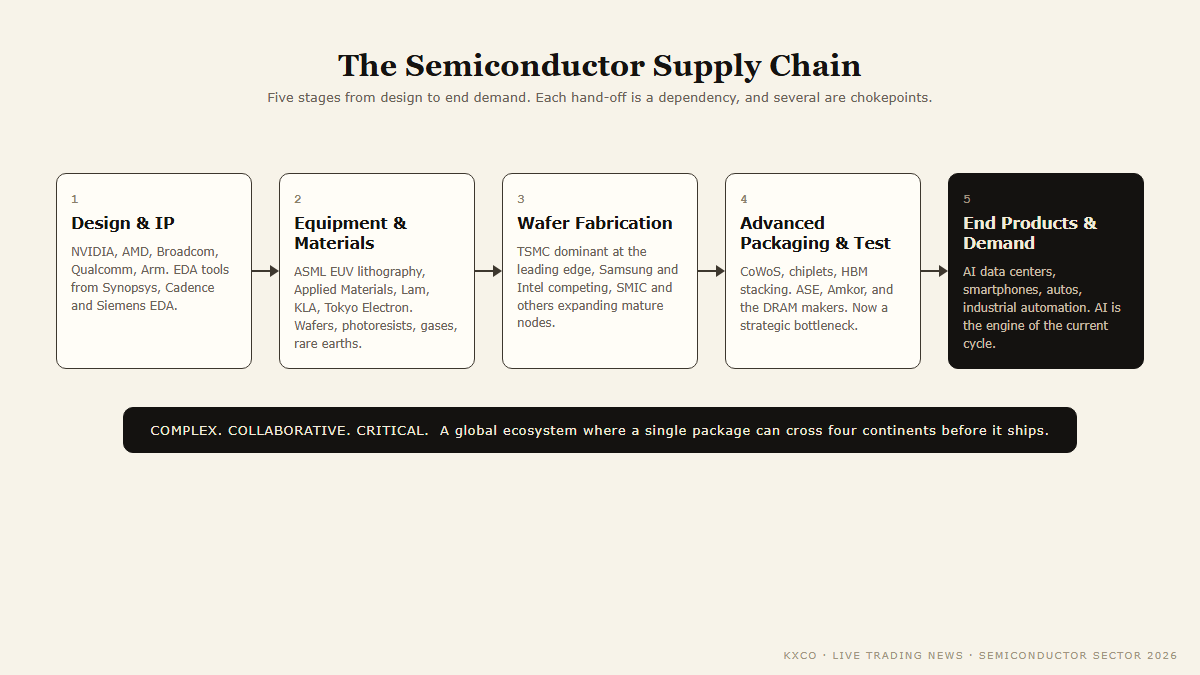
Design begins with architecture and ends with a file ready for mask-making. The leading fabless and IP houses are $NVDA NVIDIA, $AMD, $AVGO Broadcom, $QCOM Qualcomm, MediaTek and Arm Holdings, with EDA software concentrated among Synopsys, Cadence and Siemens EDA. No leading-edge chip is manufactured without extreme ultraviolet lithography supplied exclusively by $ASML, whose High-NA systems cost hundreds of millions of dollars each. Complementary equipment comes from $AMAT Applied Materials, $LRCX Lam Research, $KLAC KLA and Tokyo Electron.
Fabrication is where concentration peaks. $TSM TSMC holds advanced-logic share well above 60 percent and overall foundry share near or above 70 percent in recent quarterly data, with Samsung and $INTC Intel competing at the leading edge and SMIC expanding mature-node capacity under Chinese policy support. Downstream, the rise of chiplets and CoWoS-style packaging has turned advanced packaging from a cost center into a strategic bottleneck: TSMC's CoWoS capacity has been heavily reserved by NVIDIA and other AI customers, and HBM stacking is controlled largely by the three major DRAM makers, SK Hynix, Samsung and $MU Micron.
The listed players
Public markets have priced this structure with brutal clarity. As of mid-to-late August 2026, NVIDIA has repeatedly traded as the world's most valuable company, with capitalization fluctuating around and above the US$5 trillion level on the strength of its accelerator franchise and CUDA software ecosystem. TSMC, Broadcom, Samsung Electronics, SK Hynix, Micron, AMD, ASML and Applied Materials form the next tier.
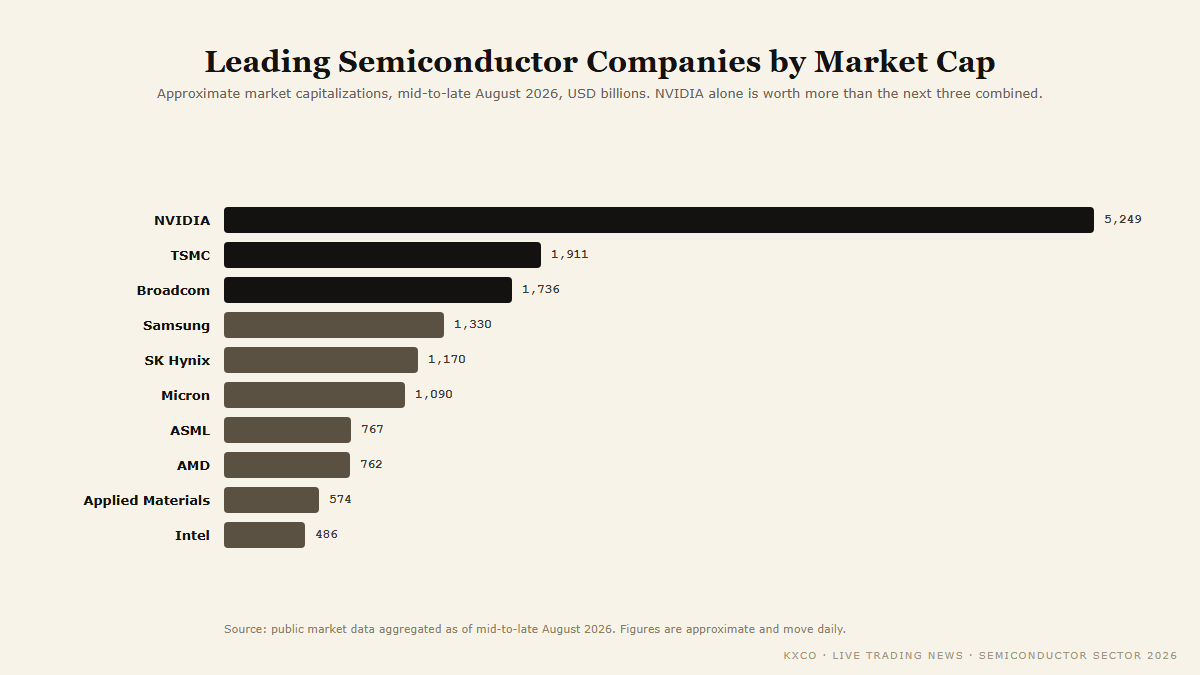
The pattern in that chart is the pattern of the whole sector: the highest valuations sit at the narrowest, highest-value points of the system. NVIDIA for accelerators. TSMC for advanced logic and packaging. ASML for the only EUV machines on earth. The HBM leaders for the memory bandwidth that makes large models practical. Value has concentrated exactly where substitution is hardest.
Demand: AI is the engine, and memory is the transmission
While consumer electronics, automotive, industrial and communications remain large absolute markets, incremental growth and pricing power in 2025 and 2026 are overwhelmingly concentrated in AI and high-performance computing. Hyperscaler capital expenditure has surged, and forecasters including Omdia have raised 2026 revenue projections dramatically on AI-driven memory and logic strength, with some projections showing memory accounting for more than half of total semiconductor revenue in the peak year.
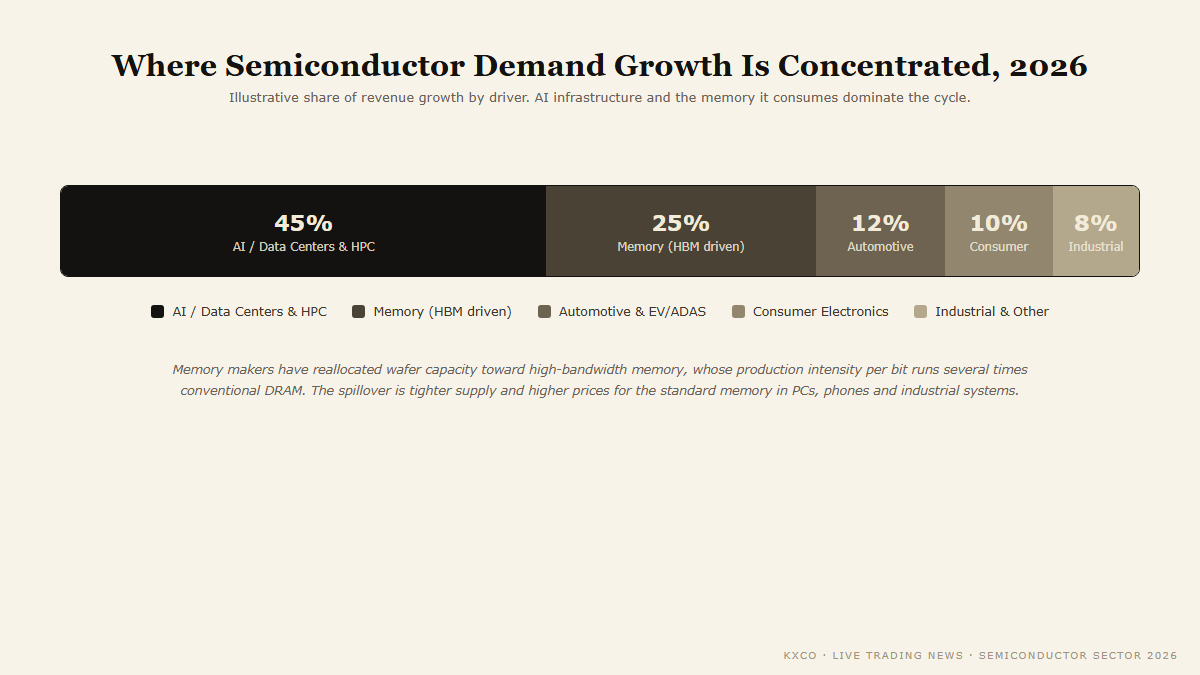
The transmission mechanism matters as much as the demand itself. Memory makers have reallocated substantial wafer capacity toward high-bandwidth memory, whose production intensity per bit runs several times that of conventional DRAM. The result is explosive revenue for the direct AI suppliers and spillover scarcity for everyone else: tighter supply and higher prices for the standard memory in PCs, smartphones and industrial systems, with average selling prices rising even as unit volumes in some consumer categories decline. This is not a classic inventory cycle. It is a structural reallocation of scarce advanced capacity toward the highest-value application of the moment, and HBM4 is now entering volume production with 16-high stacks.
Automotive content keeps rising with electrification and advanced driver assistance, though near-term demand has been tempered by inventory corrections and by competition for wafer and packaging capacity from higher-margin AI applications. Industrial automation, energy and defense provide steadier bases, and government industrial policy is itself a demand driver: subsidized fabs order equipment and materials years before they ship a commercial wafer.
The hidden foundation: rare earths and critical materials
Silicon is abundant. The ultra-high-purity forms and the constellation of supporting elements are not, and critical-materials risk has moved from theory to observed disruption following successive Chinese export-control measures on gallium, germanium, graphite, antimony, tungsten and multiple rare-earth elements and magnets since 2023.
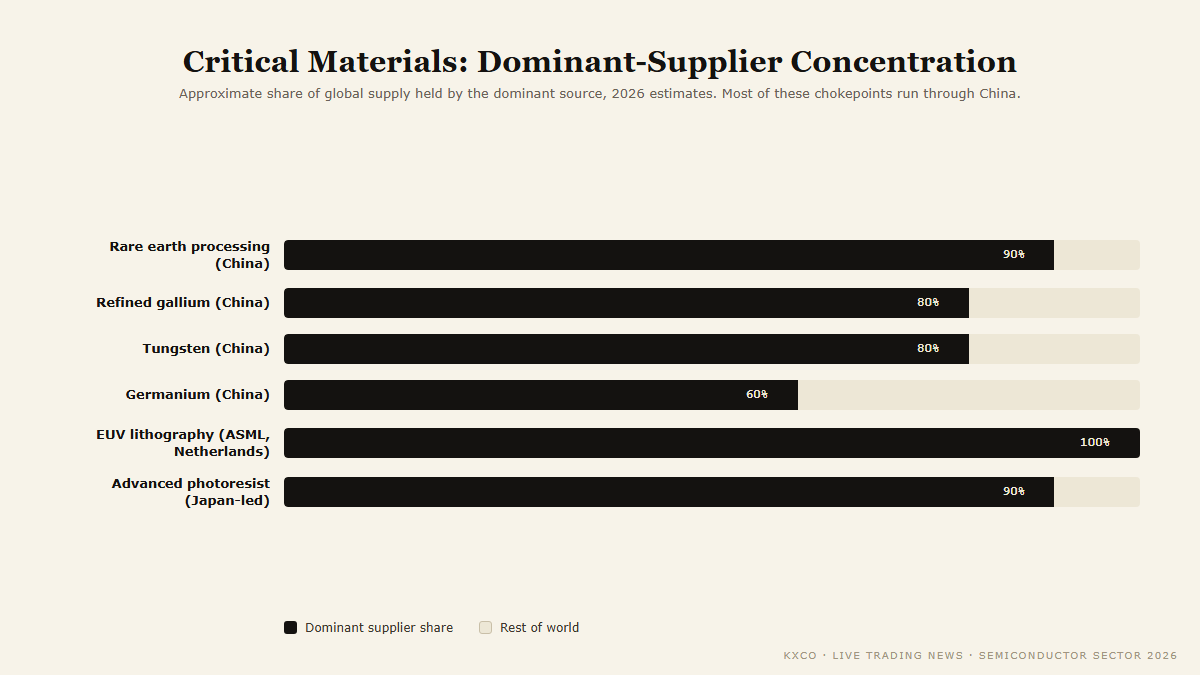
Rare earths enter the chain in ways most investors never see. Cerium oxide is a primary abrasive in CMP slurries used to planarize wafers. Neodymium-iron-boron magnets, improved with dysprosium and terbium, drive the precision motors, stages and vibration-control systems inside lithography scanners and ion implanters, including ASML's EUV platforms. Yttrium compounds coat plasma-facing components. China accounts for the large majority of rare-earth separation and magnet manufacturing capacity, and its export licensing in 2025 and 2026 produced sharp declines in Japanese imports of dysprosium and yttrium and multi-fold price increases in European markets for certain products.
The IEA and others have quantified the downstream exposure: full implementation of broad rare-earth controls could place trillions of dollars of annual production value at risk across automotive, electronics, defense and data-center equipment. Photoresists, especially for EUV, remain heavily dependent on Japanese chemical companies, and qualification of an alternative supplier inside a running fab is measured in years, not months. For supply-chain risk management through 2028, the dominant facts are geographic concentration of refining, long qualification cycles, and the demonstrated willingness of major producers to use export licensing as a policy instrument.
Bringing the complexity into focus: the KXCO ontology
Traditional linear supply-chain maps and spreadsheets struggle with this system. They cannot hold the multi-hop dependencies, the second-order effects of export controls, the capacity reallocation between conventional DRAM and HBM, or the simultaneous subsidy races under the CHIPS Act, the European Chips Act and China's dual-track industrial policy.
This is the problem KXCO's ontology engine was built for. It treats a complex economic system as a living digital twin: companies, materials, process nodes, facilities and jurisdictions are defined once as entities; relationships such as manufactures-for, depends-on, constrained-by and drives-demand-for are typed, sourced, and carry confidence and temporal validity. The live KXCO AI-sector map already runs this way, with hundreds of entities and more than five hundred sourced claims, and where claims matter enough they can be signed with the post-quantum algorithm ML-DSA-65 and anchored to Armature L1 so they stay verifiable regardless of platform.
The payoff is that hard questions become graph queries instead of research projects. What is the exposure of European automotive chip supply to Chinese rare-earth magnet controls? A conventional analyst traces magnets to tool stages to process tools to fabs to automotive output by hand. On the ontology it is a traversal that returns the multi-hop chain, the quantitative shares where known, the confidence levels, and flags where data are missing. A control action on dysprosium automatically raises the risk score on every lithography tool that depends on magnets containing it, and in turn on every fab that depends on those tools. Scenario analysis, such as what happens to consumer memory prices if HBM demand exceeds capacity by 40 percent, becomes a controlled experiment on the digital twin rather than an ad hoc spreadsheet exercise.
What investors should take away
The sector in 2026 is defined by three simultaneous realities: extraordinary demand growth centered on AI compute, extreme concentration of critical manufacturing and materials nodes, and an accelerating geopolitical contest to re-shore capacity and secure inputs.
Exposure to the AI semiconductor stack remains one of the most direct ways to participate in the compute build-out, but position sizing has to respect the non-linear effects of capacity constraints and policy shocks. Investors who treat the sector as a simple cyclical growth story will be surprised by the speed with which secondary bottlenecks, in packaging, HBM, specialty gases or magnet materials, can throttle primary demand. Diversification of manufacturing geography is underway, with TSMC in Arizona and Japan, Samsung and SK Hynix investing in the United States, and Intel building across continents, but qualification and yield learning curves mean it will be measured in years. Materials diversification will take at least as long.
Those who invest in structural understanding, whether through deep traditional research or through formal ontological models of the kind KXCO has built, will be better positioned to anticipate the transmission mechanisms and to spot both the risks and the second-order opportunities. Clarity about the structure of this industry is no longer optional. It is a prerequisite for informed capital allocation.
Stocks mentioned in this article: $NVDA, $AMD, $AVGO, $QCOM, $ASML, $AMAT, $LRCX, $KLAC, $TSM, $INTC and $MU.
Shayne Heffernan, Ph.D., is the founder of Live Trading News, the KnightsBridge Group, Knightsbridge Law and the KXCO.ai ecosystem spanning post-quantum cryptography, identity, attestation and enterprise ontology.
This analysis is provided for informational purposes only and does not constitute investment, legal or financial advice. Market data are approximate and subject to rapid change.
Weekly Market Outlook: Fed Minutes, Anthropic and OpenAI IPOs, Gold, Bitcoin, FX
The Fed raised rates in September and payrolls rose 29,000, per the Labor Department. This week the FOMC minutes, three Treasury auctions and a 10-year near 5.3 percent test that gap. Anthropic's IPO clock runs toward a 14 October investor day while OpenAI's chief executive says not 2026. Gold sits 26 percent below its record, bitcoin near $85,500, the dollar up three weeks running. Two knowledge graphs from KXCO's records map the IPO backers and the FDA board.
Thoughts on Thinking in an AI World
A model will write an answer about anything in seconds. What an AI world makes scarce is everything around the answer: what you believed last month and why you changed it, the link between fields nobody reads together, and a decision a named person can stand behind. Three knowledge-graph exhibits from the KXCO record show each one, from a reported Nvidia deal that became a signed 8-K to a war five links from a data centre.

AI Development: The Token Got Cheaper, the Building Did Not
The useful fact on 28 September is a split, not a benchmark. Gartner puts 2026 AI spending at $2.67 trillion, and 56 percent of it is infrastructure against about 1 percent on the models. Inside one week the frontier cut the price of a token in half, Nvidia signed for the shelf the open weights sit on, and three closed labs proposed to run the test. What shipped, what it costs and where the money goes, with the AI sector checked against KXCO Ontology Live.
The Week the Discount Rate Gets a Vote
The Fed hiked on 16 September and left the door open. This week the August PCE deflator on Wednesday, September payrolls on Friday, the RBA on Tuesday and euro-area CPI set the discount rate. Gold, Bitcoin, the dollar, the AI complex and the quantum pure plays share that rate and diverge everywhere else. This is the map of what depends on what, the three regimes the book should already have written down, and the stop that belongs to each node on KXCO Ontology Live.
Every story, signed and delivered.
Subscribe to the kxco channel and get the headline, the AI-written key takeaways, and the chain-anchor link the moment we publish. Audio versions and per-ticker subscriptions arrive in the next iteration.