
Grading the AI Trade in Public: 30 Days of the KXCO Ontology
Thirteen findings confirmed by the tape, one broken and rewritten in the open, and a mechanical buy screen that beat its own table by seven points. Scored against dated sources, and anchored so it cannot be quietly rewritten.
Anyone can publish a market call. The test is what happens to the record afterward: whether the call is dated, sourced, scored against what actually happened, and kept where it cannot be quietly rewritten. That is the entire idea behind KXCO Ontology Live, a free public map of the AI sector built as 851 typed claims across 387 entities, every claim carrying a source, a confidence level and two time axes: when it held in the world, and when it was asserted.
Thirty days ago the map carried 210 entities and 14 findings. This week we went back and scored every finding old enough to face a full month of record, re-read all sixteen names on its analyst page at the 21 August close, and shipped the week's new claims. Here is the ledger, wins and losses both.
Fifteen findings against the tape
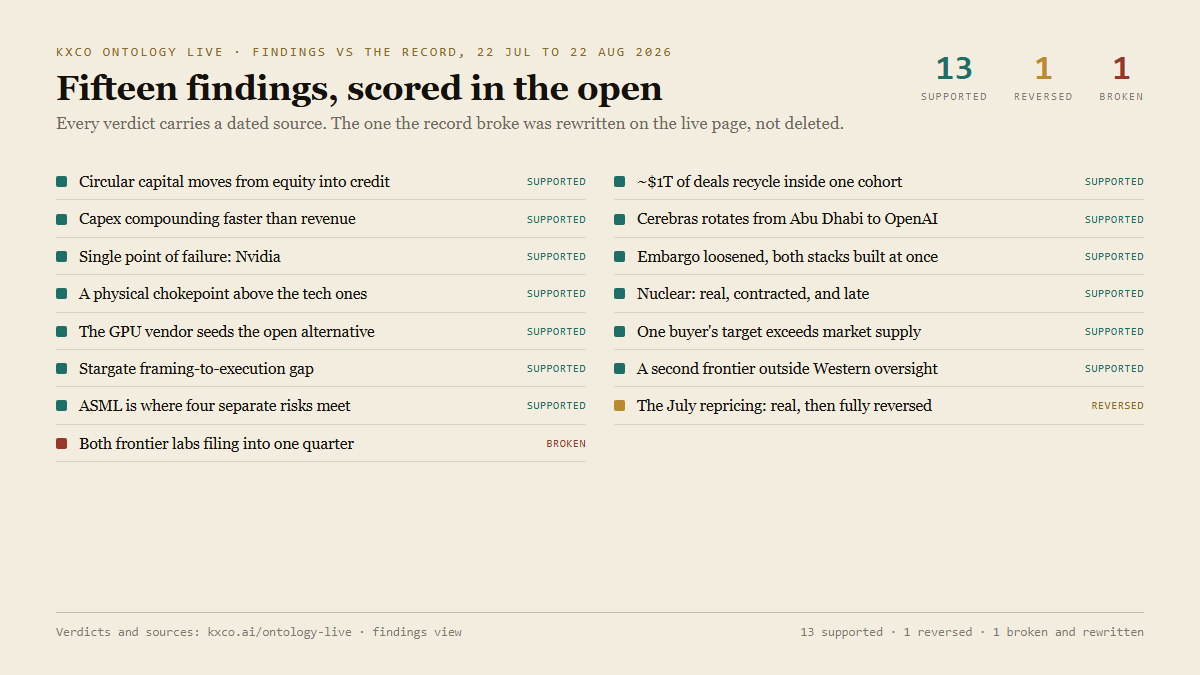
Thirteen of fifteen findings were supported by dated, in-window events, several with uncomfortable precision.
The capex finding said hyperscaler spending was compounding faster than the revenue behind it. The late-July earnings week landed on its exact numbers: roughly $725bn of combined 2026 capital spending across $AMZN, $GOOGL, $META and $MSFT, up about 77% year on year, with all four raising guidance. The market graded the raisers exactly as the finding framed it, punishing capex without metered revenue (Meta fell about 9% on its print) and rewarding the one name that could show the meter running (Microsoft rose 8% on Azure at +43%).
The circular-capital finding said roughly a trillion dollars of deals recycle inside one cohort, with the GPU vendor investing in its own customers. On 27 July Bloomberg tallied $750bn of Nvidia deals and made circular financing the mainstream frame for the whole AI trade. A niche worry the map recorded in June is now the consensus conversation.
The Cerebras finding said the revenue book was rotating from Abu Dhabi to OpenAI. The company's own second-quarter release on 12 August confirmed it: $CBRS core revenue of $210m, more than double a year earlier, with the inference cloud business nearly quadrupled and the OpenAI agreement carrying growth.
One finding got its event right and its follow-through wrong, and the distinction matters. The July repricing finding recorded that more than $1tn came off the sector's chip names in the last week of July, the worst month for the SOX since 2008. That happened. What happened next was a full reversal: through 21 August the index was up more than 10% for the month, on pace for its best August in over two decades. The finding now records the reversal in its own text, because a repricing that snaps back that fast reads as volatility around an intact spending thesis, not the start of a derating.
The one that broke
The dual-IPO finding said both frontier labs were filing into the same quarter, and the record moved against it. By mid-August OpenAI's listing had slipped, its CFO telling staff the company would be public in 2027, with a $7bn employee buyback at a flat valuation removing the near-term pressure to list. Anthropic still points at October: a $65bn annualised revenue run-rate at end-July, and backers talking a debut near $2tn through Morgan Stanley, Goldman Sachs and JPMorgan.
The finding was not deleted. It was rewritten on the live page under the title "The dual-IPO quarter has split," and its text now opens by saying the record moved against the original claim. What remains standing is sharper for the correction: one loss-making lab converting privately negotiated marks into daily public ones, in a single month, with the second lab's postponement itself a data point on how hard that first pricing is.
That is the editorial standard the rest of this scorecard should be held to. A research record that only shows its wins is marketing.
The screen beat the table it came from
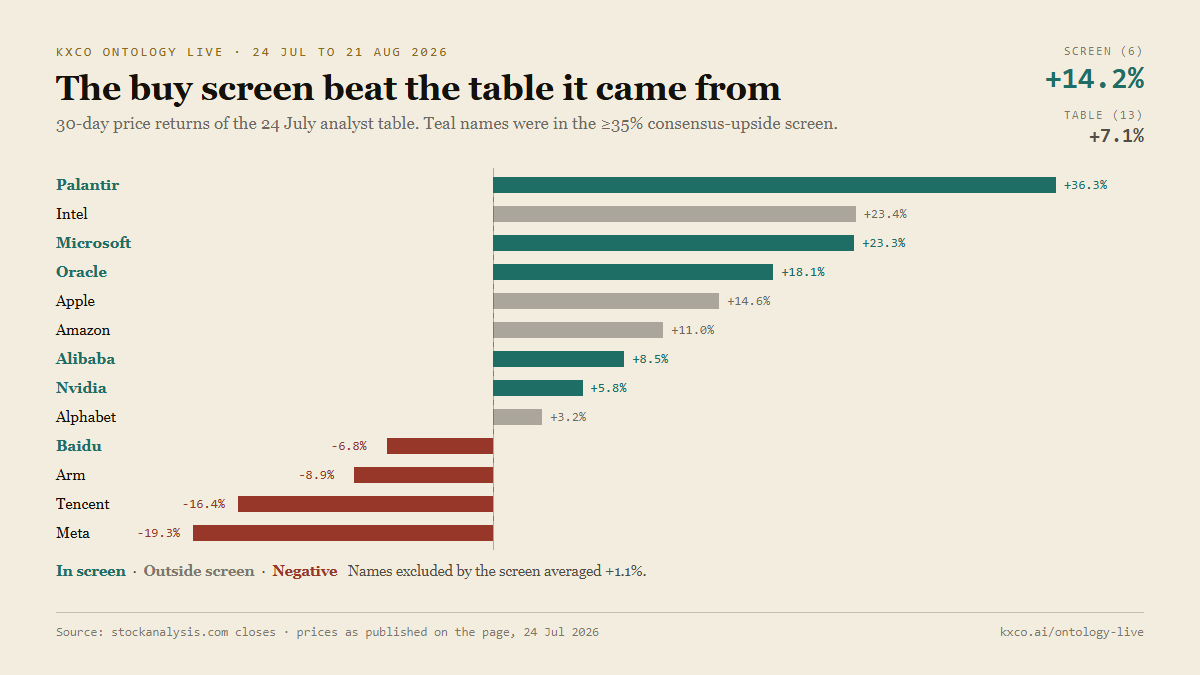
The ontology's analyst page carries a mechanical screen: names rated better than Hold with consensus upside of 35% or more. No discretion, no override. On 24 July that screen held six names: $BABA, $ORCL, $NVDA, $BIDU, $PLTR and $MSFT.
Measured to the 21 August close, the six returned +14.2% on an equal-weight basis. The full thirteen-name table returned +7.1%. The seven names the screen excluded returned +1.1%. Five of the six picks finished positive, led by Palantir at +36.3% after its second-quarter revenue grew 93%.
The threshold earned its keep in both directions. Meta carried a Strong Buy consensus in the table, but only 21% implied upside on 24 July, so the screen excluded it; it finished as the table's worst name at minus 19.3%. Tencent, likewise excluded at 20% upside, fell 16.4%. The one losing pick, Baidu, is the name whose thesis the fundamentals then broke: its trailing account swung to a loss on AI spending, and its row on the page now says so rather than repeating the cheap-multiple story it was picked on.
Honesty about the window: it contained both the July repricing and its full reversal, so absolute returns flatter everything. The number that survives the caveat is the spread, thirteen points between the screen and its complement over thirty days. And a screen built on sell-side consensus is a measure of the Street's targets held to account, not a KXCO forecast. One month is one month.
The week the backstop became an instrument
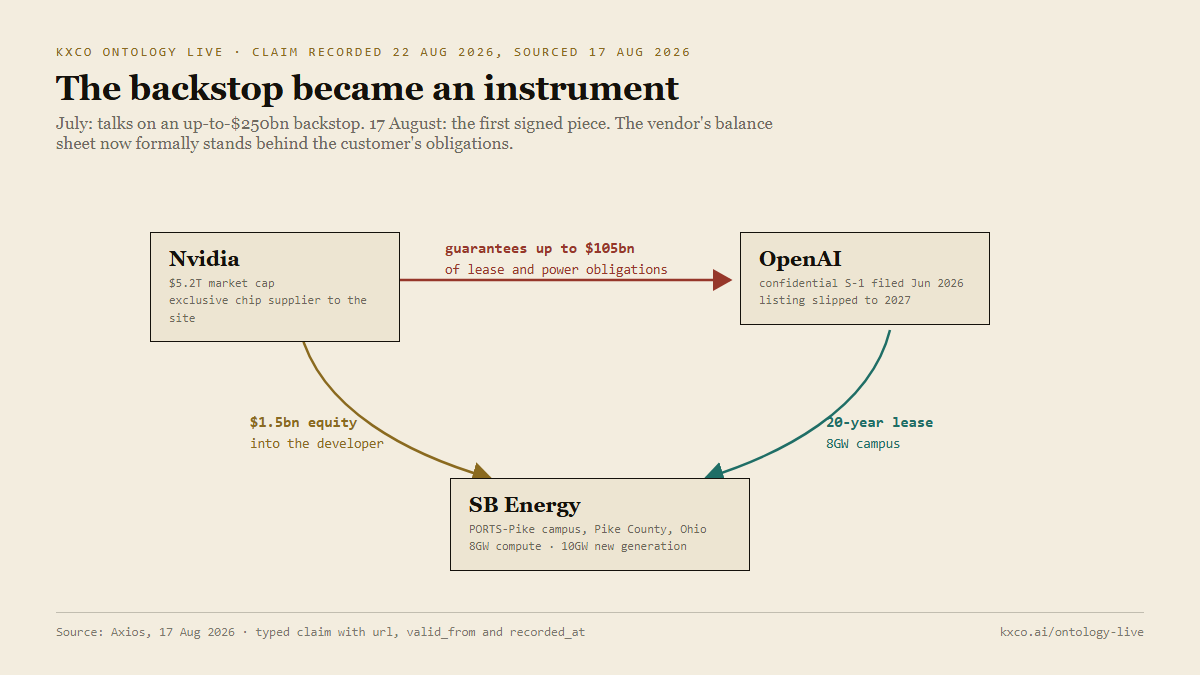
The biggest structural claim added to the map this week closes a loop the map has been tracking since July. Back then, $NVDA and OpenAI were in talks over a backstop of up to $250bn, letting OpenAI raise debt on the strength of Nvidia's credit. On 17 August the first piece was signed: Nvidia agreed to guarantee up to $105bn of OpenAI's conditional lease and power obligations to SB Energy at the 8-gigawatt PORTS-Pike campus in Pike County, Ohio, put $1.5bn of equity into SB Energy itself, and took the exclusive chip-supply position on the site.
Every earlier loop in the circular-capital story was equity: a vendor buying a stake in its own customer. A guarantee is different in kind. It puts the supplier's balance sheet behind the customer's borrowing, so a failure that was once a lost investment becomes a contingent liability, and the sector's largest market cap becomes the sector's de facto credit desk. The map also recorded a quieter dependency the same week: Bloomberg reported that Meta has become one of Microsoft's largest AI customers, spending hundreds of millions a year on Azure access. Rivals now rent from rivals while both build.
Anchored, so it cannot be quietly rewritten
Everything above would be worth little if the record could be edited after the fact, and this is where KXCO's infrastructure does something most research publishing does not.
When this article is published, Live Trading News writes a real transaction to Armature L1, KXCO's post-quantum blockchain: a cryptographic fingerprint of the piece, committed to a public ledger at publication time. If a single word were changed afterward, the fingerprint would no longer match the anchor. The claim is not that the file cannot be touched; it is that no edit can hide. What we said, and when we said it, is provable later, including by someone who does not trust us.
The ontology itself is built on the same discipline. Every claim carries both a validity window and a recorded-at date, and a claim that turns out wrong is superseded by a new one rather than overwritten, with the old claim retained and closed. That is why the dual-IPO miss is still visible on the live page instead of having silently disappeared. The graph can be queried as it stood on any past date, and the whole map is published as a single machine-readable file at kxco.ai/ontology-live/data.json, restated with each update. Where a record has to be permanent, KXCO signs it with ML-DSA-65, the NIST-standardised post-quantum signature (FIPS 204), and anchors the proof on-chain, the same rails that carry its document-signing and attestation products.
Ask why this matters now and the answer is the month you just read about. In thirty days the AI trade repriced by a trillion dollars, reversed completely, watched its biggest private valuation slip its listing, and saw the sector's central vendor formally underwrite its largest customer's obligations. In a market moving that fast, a research record you can edit afterward is worthless, because everyone's hindsight is perfect. A record that cannot be quietly rewritten is the only kind worth grading.
What to watch
Nvidia reports fiscal second-quarter results on 26 August against a guide of roughly $91bn in revenue, the single most graph-moving print of the quarter. Anthropic's October window, if it holds, converts the largest remaining private AI mark into a daily public one. And Beijing, not Washington, is now the binding constraint on H200 shipments into China, with only a fraction of licensed quota landed.
The map, the findings, the analyst table and the machine-readable data are free and public at kxco.ai/ontology-live. Check our work. That is what it is for.
Stocks mentioned in this article: $NVDA, $MSFT, $ORCL, $PLTR, $META, $GOOGL, $AMZN, $AAPL, $INTC, $ARM, $ASML, $AMD, $CBRS, $BABA, $BIDU and $TCEHY.
Shayne Heffernan, Ph.D., is the founder of Live Trading News, the KnightsBridge Group, Knightsbridge Law and the KXCO.ai ecosystem spanning post-quantum cryptography, identity, attestation and enterprise ontology.
This article is commentary and a review of a public research record. It is not investment advice. Valuation figures are third-party sell-side consensus, collected and dated.
Weekly Market Outlook: Fed Minutes, Anthropic and OpenAI IPOs, Gold, Bitcoin, FX
The Fed raised rates in September and payrolls rose 29,000, per the Labor Department. This week the FOMC minutes, three Treasury auctions and a 10-year near 5.3 percent test that gap. Anthropic's IPO clock runs toward a 14 October investor day while OpenAI's chief executive says not 2026. Gold sits 26 percent below its record, bitcoin near $85,500, the dollar up three weeks running. Two knowledge graphs from KXCO's records map the IPO backers and the FDA board.
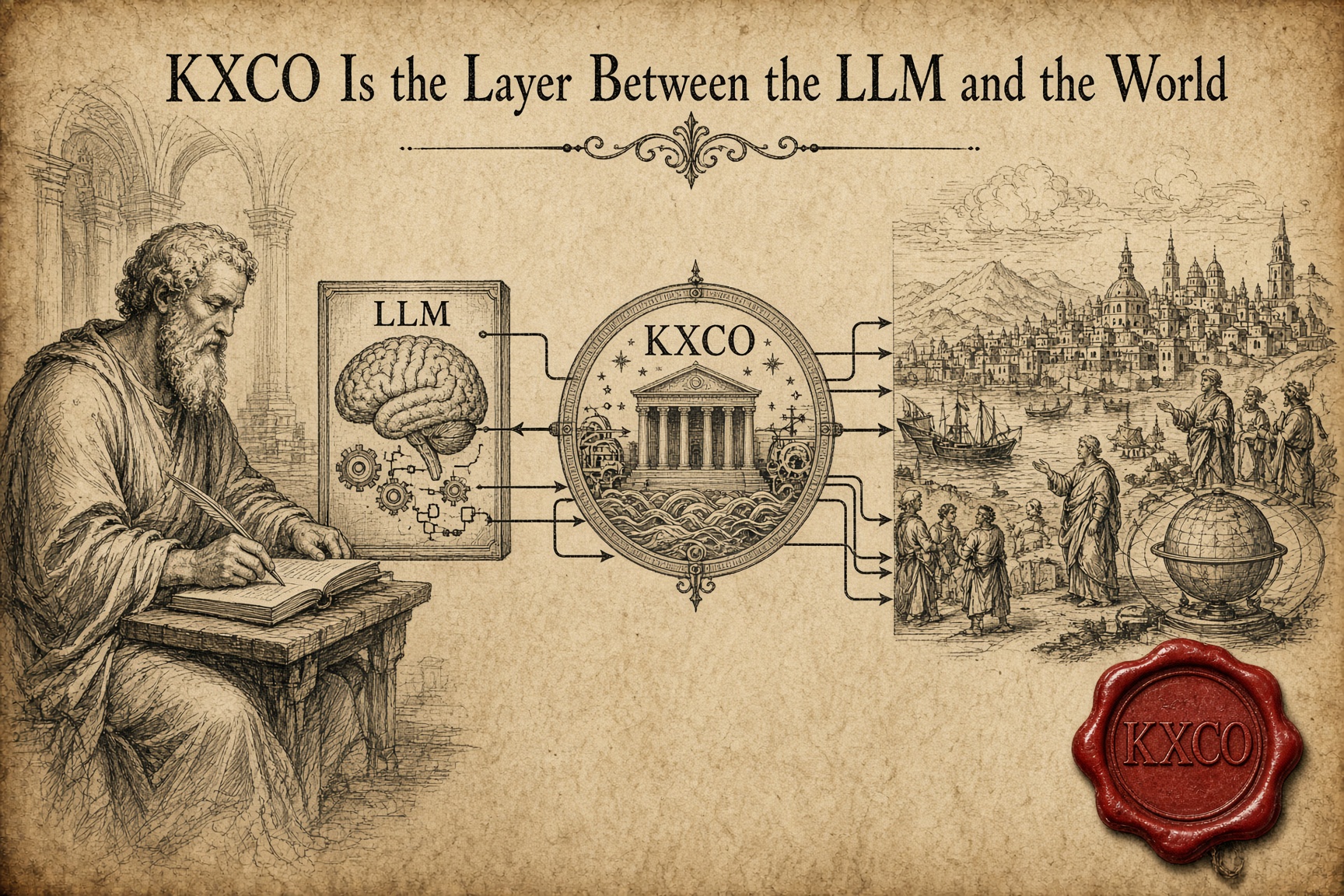
KXCO Is the Layer Between the LLM and the World
Give a hundred people the same book and very few will act on it. AI is that book: it distributes access, not understanding, and an institution cannot act on a paragraph. KXCO does not build another model or another agent. It builds the layer between the model and the world: who is speaking, what they are allowed to do, what they committed, and a post-quantum signature a stranger can check without asking us.
Thoughts on Thinking in an AI World
A model will write an answer about anything in seconds. What an AI world makes scarce is everything around the answer: what you believed last month and why you changed it, the link between fields nobody reads together, and a decision a named person can stand behind. Three knowledge-graph exhibits from the KXCO record show each one, from a reported Nvidia deal that became a signed 8-K to a war five links from a data centre.
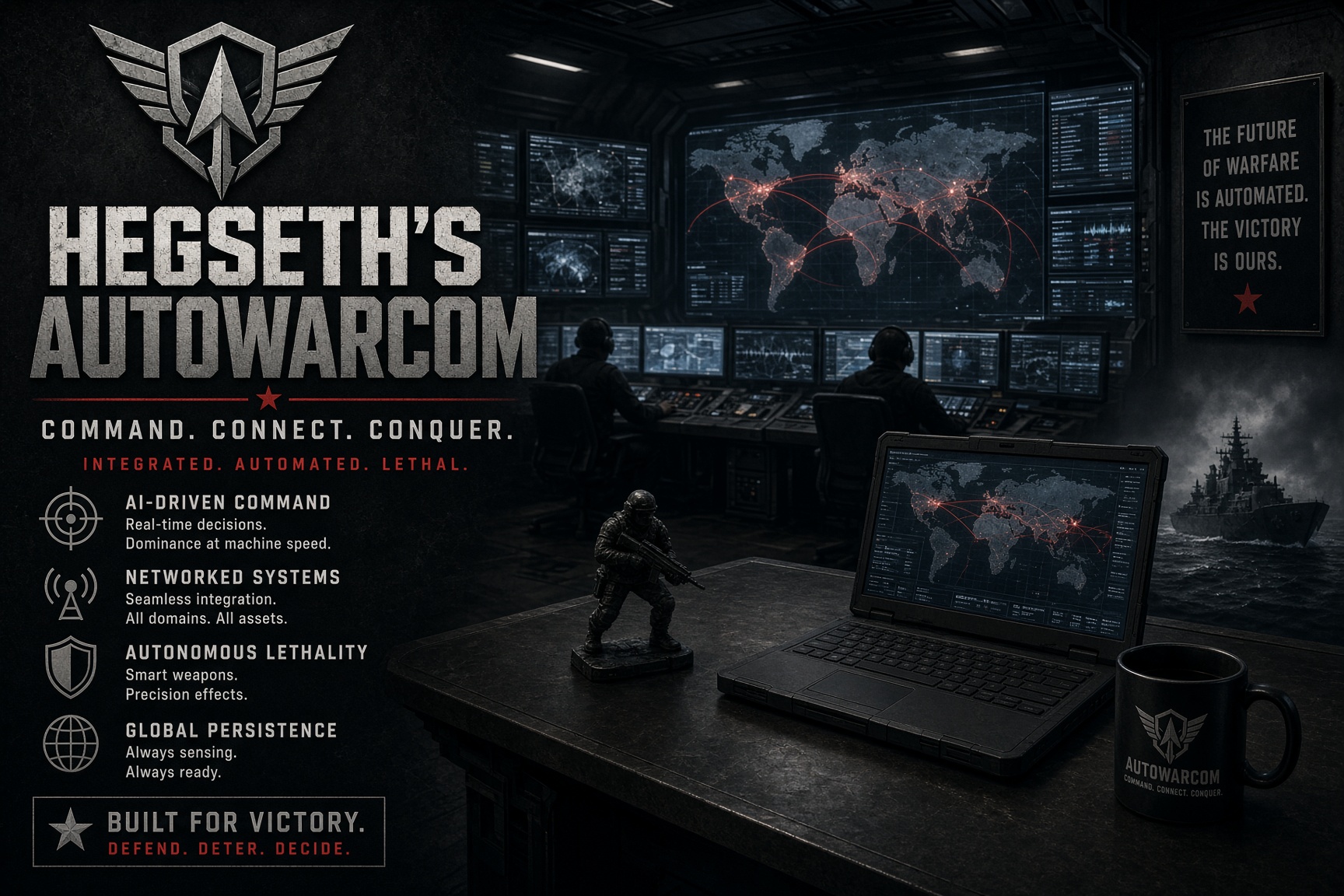
Hegseth's AutoWarCom: Who Builds It, What the Money Buys, and the Record It Needs
Pete Hegseth's Autonomous Warfare Command is a four-star proposal that needs Congress by 1 October 2027. Until then Project Agincourt holds the work, and the money moves through Drone Dominance, the Army's counter-drone contracts and DIU. The software layer, Palantir's Maven, Anduril's Lattice and Shield AI's Hivemind, is the one the KXCO AI Sector ontology had mapped before the speech. After Minab, its hardest problem is the record, not the model.
Every story, signed and delivered.
Subscribe to the kxco channel and get the headline, the AI-written key takeaways, and the chain-anchor link the moment we publish. Audio versions and per-ticker subscriptions arrive in the next iteration.