
Earning Digital Trust
Digital trust is the expectation by individuals that digital technologies and services – and the organizations providing them – will protect all stakeholders’ interests and uphold societal expectations and values, according to a new report from the World Economic Forum.
From artificial intelligence to connected devices, from the security of personal information to algorithmic predictions, failures by technology developers and digital service providers have eroded confidence at an unprecedented scale and rate. Surveys have also registered an alarming decrease in trust in science and technology as well as a host of other social institutions and links. The trust gap is growing year by year, just as our reliance on digital networks and technologies is accelerating.
The report, “Earning Digital Trust: Decision-Making for Trustworthy Technologies” written in collaboration with Forum partners Accenture, KPMG and PwC, outlines how collaboration between cybersecurity, privacy, ethics and other business functions can improve trust in technology.
Citizens and consumers expect companies and technology developers to take their values – on privacy, data use and inclusion – seriously. Where companies are unable to produce technology that meets those expectations, they can no longer expect widescale adoption. Companies are not ready to meet this challenge:
PwC indicated recently that only 10% of executives feel ready to comply with cybersecurity transparency requirements (PwC 2023 Global Digital Trust Insights)
Accenture suggested that a growing lack of trust cost US organizations $756 billion in 2017 alone and that today more than 76 % of CEOs say citizen trust is critical to business competitiveness (How to Build Trust in a New Digital World)
KPMG said increased trust can lead to better profitability but, at the same time, over 75% of executives believe that new technologies such as artificial learning and machine learning raise troubling questions on cybersecurity and ethics (KPMG Cyber Trust Insights 2022)
To reverse this alarming trend, the World Economic Forum convened representatives of the world’s largest tech and consumer-focused companies – including Apple, Microsoft, Google, Amazon, Mastercard, Walmart, IKEA, PayPal, Salesforce and others – alongside government representatives from the US, European Commission and Singapore and leading consumer advocates to create a framework for companies to commit to earning digital trust.
FTX News: Crypto has Never Looked Better https://t.co/TjbUYlH0ig … … … via @LiveTradingNews$BTC $ETH #ETH #BTC #FTXScandal $FBX #Litecoin #LTC #Ethereum #Cryptocurency
— Crypto News $FBX ⚜️ (@Livetradingnews)
November 26, 2022
The Forum’s Digital Trust Framework shows for the first time how commitment to cybersecurity, privacy, transparency, redressability, auditability, fairness, interoperability and safety – when taken together and driven by CEOs – can improve both citizen and consumer trust in technology and the companies that create and use new technologies. The Forum’s report provides both a framework – with detailed goals and dimensions to support digital trust – and a roadmap for companies on how they can become more trustworthy in their use and development of technology.
According to Jeremy Jurgens, Managing Director of the World Economic Forum and Head of the Centre for Cybersecurity, “Developing trustworthy technologies is a decision – and responsibility – that rests with leaders across sectors and industries. The World Economic Forum’s Digital Trust Framework will help to guide leaders in making decisions that cultivate more trustworthy and responsible technology.”
“The most important decision we can make in the 21st century is whether we will work together to build trust or watch innovation fail. By focusing on the values and expectations of individuals, and by committing to security and reliability, accountability and oversight, and inclusive, ethical, and responsible use of technology, we can make the technology we develop more trustworthy,” said Daniel Dobrygowski, Head of Governance and Trust, World Economic Forum.
“Improving digital trust is vital for digital citizenship to flourish. The Forum’s new Digital Trust Framework is an essential resource for making technology more trustworthy for individual consumers and citizens,” said Nuala O’Connor, Senior Vice-President, Chief Counsel, Digital Citizenship, Walmart.
“Deploying trustworthy technology should be the goal of all organizations. The World Economic Forum’s Digital Trust Framework is a helpful roadmap that will provide guidance to leaders in making decisions that advance technology in responsible ways. As part of the steering committee, I’m grateful to contribute Microsoft’s learnings from our journey aligning our efforts on the interconnected governance of privacy, digital safety and responsible AI. The resulting WEF Digital Trust Framework will help guide other organizations on their path to earn digital trust.” said Julie Brill, Chief Privacy Officer, Corporate Vice President, Microsoft.
“Without trust in digital systems, the financial services ecosystem we have today could not exist. The Forum’s Digital Trust Initiative is playing a critical role in helping to define what trust means in the digital world,” said Ajay Bhalla, President, Cyber and Intelligence Solutions, Mastercard.
“Consumer trust is built when companies put the essential needs and rights of their consumers first and foremost. As a representative of consumer advocates around the world, Consumers International is glad to be part of the Digital Trust Initiative calling for companies to inform and empower consumers,” said Helena Leurent, Director-General of Consumers International, the membership organization for 200 consumer advocacy groups in over 100 countries including Consumer Reports, Which UK, CHOICE Australia, Consumer Voice (India), El Poder del Consumidor (Mexico), Hong Kong Consumer Council, Consommateur Maroc, Consumer Council of Zimbabwe and many more.
“At IKEA, trust is at the heart of everything we do. Whether it’s in our products or trust in how we handle your data. Trust must be earned, and we see it as a collective effort. IKEA is a proud partner of the World Economic Forum’s Digital Trust Initiative, and we look forward to contributing on creating a shared vision for digital trust between citizens, government, and organizations” said Nozha Boujemaa, Global Vice President, Digital Ethics & Responsible AI, IKEA Retail (Ingka Group).
"Customers won't do business with companies they don't trust. At Salesforce, Trust is our #1 value, and we are empowering our customers to raise the bar for digital trust - building direct, trusted relations with their customers by ensuring sensitive data is stored, processed, and forgotten, if necessary, on their terms. The World Economic Forum's Digital Trust Initiative is a valuable resource for any company looking to share that vision and build a trusted enterprise" said Vikram Rao, Chief Trust Officer, Salesforce.

AI Is Taking What You Publish and What You Type
Common Crawl holds more than 300 billion web pages, and 52 per cent of crawler requests on Cloudflare's network in June 2026 were for AI training. Models can give back what they took in: one chatbot reproduced 76.8 per cent of the first Harry Potter book near word for word. A US court ordered OpenAI to give the New York Times 20 million anonymised ChatGPT logs. This KXCO warning sets out what is exposed, what to do now, and how each KXCO client runs its own AI inside its own walls.
Industrialising Intelligence: Demand, Scarcity and the Boundary of Sovereignty
AI agents generate 80% of OpenRouter's tokens, about seven times human use, and Google's monthly tokens rose about 330 times in two years to over 3.2 quadrillion. In my view the limit on AI demand has moved from people to power: the International Energy Agency expects data-centre electricity to reach around 945 terawatt-hours by 2030. Execution is becoming a utility. Selection is not. KXCO builds the boundary that keeps the decision with a named person and lets another party check the record.
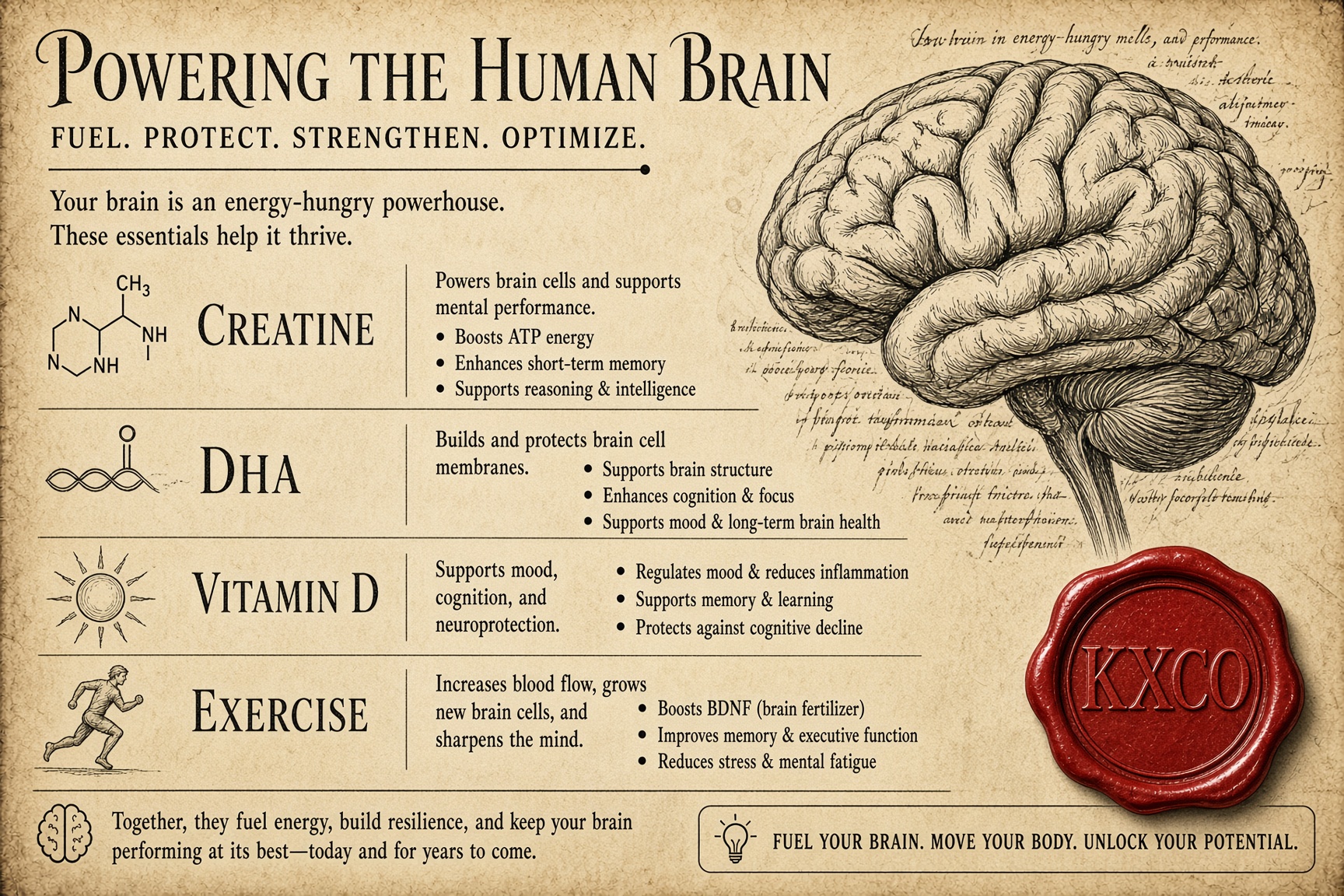
Thoughts on Thinking: Brain Essentials
Your brain runs on about 20 watts. The fastest supercomputer outruns it, but at the central published estimate the brain is about 680 times as efficient per watt as the best machine on the November 2026 Green500. It runs on four inputs most people overlook. Creatine buffers its energy, DHA builds its membranes, exercise raises its growth factors and, in older adults, enlarges the hippocampus, and low vitamin D goes with slower processing and more dementia.
KXCO's FDA Ontology Ranked INO-3107 First. Its Two Published Books Beat XBI.
KXCO's FDA ontology ranked INO-3107 first before the FDA approved it on 30 October 2026; Inovio (INO) then hit $2.71 after hours from a $0.60 close. KXCO's two published research books on the ontology stood at 109.31 and 110.28 at the close of 13 November, from 100 at the close of 14 October, against 102.58 for XBI. Nine more decisions on the board fall due before 31 December, starting with molgramostim (SVRA) and deramiocel (CAPR) on 22 November.
Every story, signed and delivered.
Subscribe to the kxco channel and get the headline, the AI-written key takeaways, and the chain-anchor link the moment we publish. Audio versions and per-ticker subscriptions arrive in the next iteration.