
ASEAN: The Next Great AI Superpower
Why Southeast Asia is becoming the third pole of the global AI race — after the United States and China
Part of theASEAN Markets Center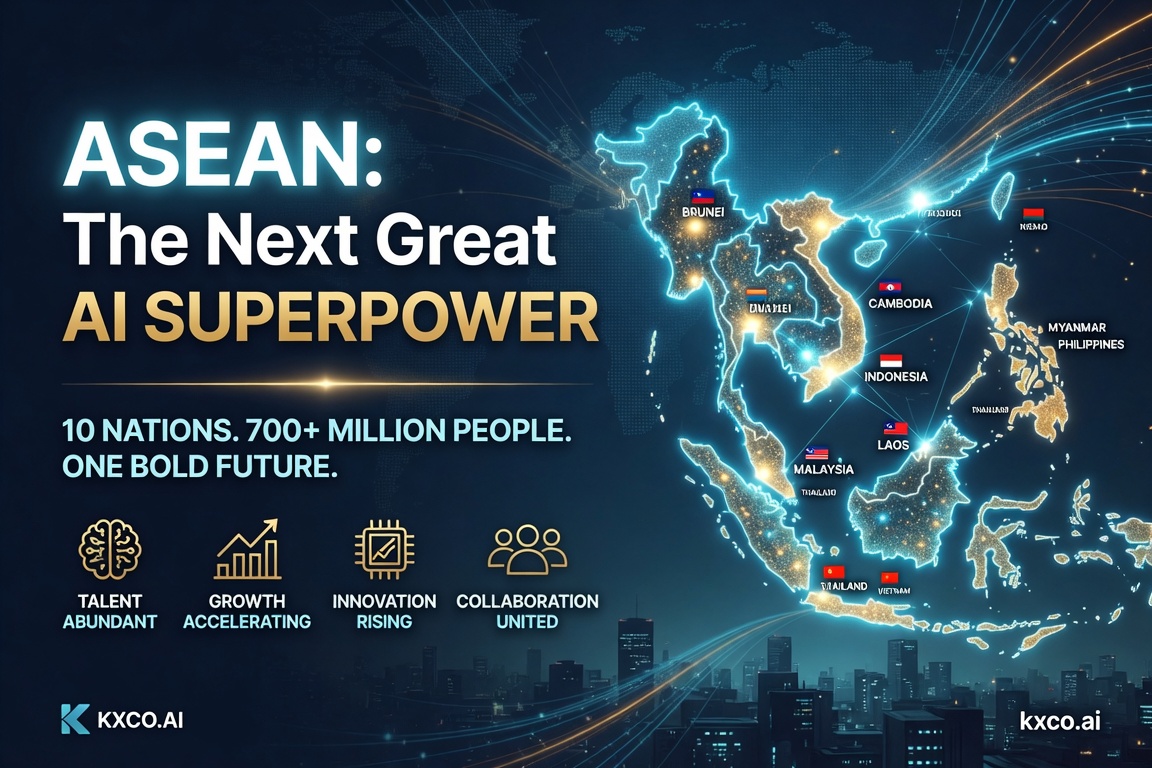
Executive Summary
For most of the last decade, the story of artificial intelligence has been told as a two-horse race. The United States builds the models and designs the chips. China builds scale and its own parallel stack. Everyone else, the narrative goes, is a customer.
That narrative is now out of date.
The physical build-out of artificial intelligence — the data centres, the power stations, the fibre, the cooling plants, the chip-packaging lines — is landing in Southeast Asia at a pace that almost nobody outside the region has fully priced. In a single stretch of 2024, Microsoft committed US$2.2 billion to Malaysia and US$1.7 billion to Indonesia. Google put US$2 billion into a first Malaysian data centre and cloud region and another US$1 billion into Thailand. Amazon Web Services stood up a full cloud region in Bangkok in January 2025 on the back of a stated commitment exceeding US$5 billion. NVIDIA and Malaysia's YTL Power are building an AI supercomputer campus in Johor under a US$4.3 billion program first announced at the end of 2023.
These are not press-release gestures. They are the early foundations of a third great pole in the geography of machine intelligence.
My argument in this piece is simple, and I hold it with conviction. AI is not software. AI is infrastructure. And the infrastructure of AI — land, power, water, fibre, and the industrial capacity to assemble and cool millions of processors — is a game that plays to Southeast Asia's structural strengths, not its weaknesses. The region that spent forty years becoming the world's factory floor is now positioning to become one of the world's compute floors.
ASEAN will not out-research Silicon Valley this decade. It will not out-fabricate Taiwan. What it can do — what it is already doing — is become the place where the world's AI capacity is physically located, powered, and operated for the fastest-growing consumer internet population on earth. That is a smaller claim than "ASEAN wins AI." It is also, for investors, a far more bankable one.
This is a long read. I have tried to make it worth the time. By the end you should understand the macro case for ASEAN, why compute is the new oil, where every major hyperscaler is placing its bets, how each of the ten member states stacks up, where the power and water and silicon actually come from, which listed companies sit in the path of the capital, and — because I am congenitally unable to write a bull case without one — where the whole thing could go wrong.
Let us begin with the bloc itself.
Why ASEAN Matters
Start with a number that still surprises people who do not follow the region: around 677 million. That is the population of the Association of Southeast Asian Nations as of 2023, on the ASEAN Secretariat's own count. It is more people than the European Union. It is more people than North and South America combined outside of the United States. Only China and India are larger. If you are building anything that depends on human beings using it — and a consumer AI product is exactly that — ASEAN is the third-largest addressable population on the planet.
Now layer on the money. ASEAN's combined nominal GDP reached roughly US$3.8 trillion in 2023, and analyst aggregations of the ten member economies put 2024 in the region of US$4.1 trillion. The ASEAN Secretariat describes the bloc as being among the five largest economies in the world. That framing deserves a caveat, and I will give it honestly: the ranking depends on whether you treat the European Union as a single bloc or as its component states, and on which year's numbers you use. But the order of magnitude is not in dispute. Set against the giants, the comparison looks like this.
The United States and China are in a league of their own. But notice where ASEAN sits: roughly level with Japan, within touching distance of Germany, and — critically — growing far faster than any of them. The mature economies on that chart are expanding at 1–2% a year in real terms if they are lucky. Much of ASEAN is compounding at 4–6%. Extrapolation is a dangerous habit, but the direction of travel is not subtle.
The internal composition matters as much as the total. This is not one economy; it is ten, spanning one of the widest development ranges of any regional grouping on earth.
Indonesia alone is roughly a US$1.4 trillion economy with 280-million-plus people — a G20 member and, on its own, the largest economy in the region by a wide margin. Then come a cluster of middle powers between roughly US$470 billion and US$575 billion: Singapore, Thailand, the Philippines, Vietnam, and Malaysia. Below them sit the frontier economies — Myanmar, Cambodia, Laos, Brunei — smaller, poorer in most cases, and for our purposes largely peripheral to the AI build-out, though not without a role.
What makes this collection of very different countries behave, increasingly, like a single economic entity? Several things.
Manufacturing. Southeast Asia is where the world already makes things. When multinationals began the long diversification of supply chains away from a China-only footprint — the strategy the consultants insist on calling "China plus one" — the plus-one was overwhelmingly ASEAN. Vietnam absorbed electronics and apparel. Thailand deepened automotive and electronics. Malaysia built out semiconductor back-end and electrical equipment. Indonesia leveraged its nickel to pull in battery and EV supply chains. The region did not have to learn how to host global industrial capital in 2024; it has been doing it since the 1980s. AI infrastructure is, at bottom, another wave of industrial capital, and it is landing on ground that has been prepared for four decades.
Trade and shipping. Geography handed Southeast Asia one of the most valuable pieces of real estate in global commerce: the Strait of Malacca. Roughly a fifth of the world's seaborne trade passes through it, and in 2025 it carried in the order of 23 million barrels of oil a day — more than any other maritime chokepoint on earth, Hormuz included. Singapore sits at the southern mouth of that strait and operates the world's second-busiest container port and its largest transhipment hub, moving over 41 million containers in 2024. Trade is not incidental to this region; it is the organising principle of it. Total ASEAN merchandise trade ran to roughly US$3.6 trillion in 2023. A region built around the movement of goods is culturally and physically primed to become a region built around the movement of data.
The middle class and the digital economy. More than half of ASEAN's population now lives in cities. A generation has moved from subsistence into consumption, and it did so with a phone in its hand rather than a desktop on a desk. Southeast Asia effectively skipped the PC era. That is why its digital economy has the shape it does: mobile-first, super-app-centric, and enormous. The Google–Temasek–Bain "e-Conomy SEA" study — the most-watched barometer of the region's internet economy — put 2024 gross merchandise value at US$263 billion, up 15% on the year, generating US$89 billion of revenue and, for the first time at scale, US$11 billion of profit. The 2025 edition expects the region's digital economy to push past US$300 billion in GMV.
Read that profit line again. For years the bearish take on Southeast Asian tech was that it grew revenue but never earned a return — a graveyard of subsidised rides and discounted parcels. That era is ending. The regional platforms have found profitability, and a profitable digital economy is one that can absorb, and pay for, the AI services that hyperscalers want to sell. Demand and supply are arriving at the same time.
Energy and land. This is the least discussed and, for AI specifically, perhaps the most important. I will spend a full section on power later, but the headline is this: parts of Southeast Asia have what the data-centre industry is now desperate for and cannot find in Frankfurt, Dublin, Virginia, or Singapore proper — large contiguous parcels of developable land sitting next to the ability to build gigawatts of new generation. That combination is the binding constraint on AI globally. ASEAN has more of it than almost anywhere in the developed or near-developed world.
Put the pieces together and you see why the region increasingly trades, plans, and attracts capital as a bloc rather than as ten separate stories. The ASEAN Economic Community, the web of free-trade agreements culminating in RCEP, the physical integration of the Johor–Singapore corridor — these are the connective tissue turning a neighbourhood into a market. For a hyperscaler deciding where to spend its next US$10 billion, "Southeast Asia" is now a single line on the map in a way it was not fifteen years ago.
Compare it to the alternatives and the logic sharpens. The European Union has the wealth and the talent but is power-constrained, land-constrained, and increasingly hostile to the energy intensity of AI. The United States is the undisputed leader in models and chips but is running into its own grid limits and rising local resistance to data centres. India is a genuine peer on population and ambition, and a real competitor for this capital, but its infrastructure and land-acquisition frictions remain heavier than ASEAN's best sites. China is a world unto itself, walled off from the Western AI stack by export controls. Japan has capital and stability but a shrinking population and expensive power.
ASEAN's pitch is not that it beats any of these on every metric. It is that it offers the best available combination of scale, growth, land, power, industrial capability, and — this matters enormously in 2026 — geopolitical acceptability to both Washington and Beijing at once. In a bifurcating world, the ground that both sides can still build on becomes very valuable indeed.
There is a fair objection to all of this, and I want to meet it head-on: is it legitimate to add ten very different countries together and call the sum a superpower? Sceptics have long argued that ASEAN is a talking shop — a diplomatic forum with a consensus rule that guarantees the lowest common denominator, not a single market with the integration to act as one. That criticism carried real weight a decade ago. It carries less now, for a concrete reason: the plumbing of integration has been quietly built. The ASEAN Economic Community lowered tariffs and harmonised standards across the bloc. The Regional Comprehensive Economic Partnership — RCEP, the largest trade agreement in the world by the GDP of its members — wove ASEAN into a single trading framework with China, Japan, Korea, Australia, and New Zealand. And most relevant to this article, the member states have been negotiating a Digital Economy Framework Agreement, the world's first region-wide digital-economy pact, designed to harmonise the rules on cross-border data flows, digital payments, and e-commerce that AI services depend on.
That last agreement is the tell. A region that is merely a talking shop does not negotiate common rules for data flows and digital trade; a region that intends to function as a single digital market does. The Johor–Singapore Special Economic Zone is the same instinct rendered in concrete — two sovereign states agreeing to run one integrated economic space. For a hyperscaler, integration is not an abstraction. It is the difference between building for ten fragmented regulatory regimes and building for one large, increasingly harmonised market of nearly 700 million people. The bloc is not yet the European Union in institutional depth, and it may never choose to be. But it no longer needs to be, in order to behave — for the purposes of attracting and hosting AI infrastructure — as a single, coordinated destination for capital.
The AI Revolution: Why It Is Infrastructure, Not Code
To understand why the money is moving to Southeast Asia, you have to understand what changed about artificial intelligence itself.
For sixty years, "computing" got cheaper, smaller, and less physical every year. That was the entire trajectory of the industry — Moore's Law shrinking the machine until it disappeared into your pocket and then into the cloud. Software ate the world precisely because software was weightless. You could scale a social network to a billion users without pouring much concrete.
Generative AI broke that pattern. Training and running large models is not weightless. It is one of the most physically demanding computing workloads ever devised. A single modern AI accelerator draws more power than a household appliance and must be packed by the thousand into racks that now consume, cool for cool, an order of magnitude more energy per square metre than the servers of the cloud era. The frontier of AI is no longer a clever algorithm running on commodity hardware. It is a purpose-built industrial facility.
This is the point I want investors to internalise, because it reframes everything that follows: AI is compute, and compute is physical.
Break the physical requirement into its components and you get a shopping list that reads less like a software startup and more like a heavy-industrial project:
Electricity, in quantities that stress national grids. A single large AI campus can demand several hundred megawatts — the draw of a small city — and the industry is now talking in gigawatts. Power is the first, hardest constraint.
Chips, specifically the GPUs and accelerators that only a handful of companies on earth can design and only a handful of fabs can produce. Access to these is now rationed by export control as much as by price.
Fibre, the high-capacity connectivity that links campuses to each other, to subsea cables, and to the users who consume the output. A data centre without fat pipes is a stranded asset.
Cooling, and therefore water or advanced liquid-cooling systems, because turning electricity into computation turns almost all of that electricity into heat that has to go somewhere.
Land, in large, contiguous, developable, geologically stable parcels — near power, near fibre, near water, and far enough from residential resistance.
Capital, at a scale and duration that only sovereigns, hyperscalers, and the largest infrastructure funds can supply.
Now look at that list again through Southeast Asian eyes. Which of those six does the region lack? Not land — it has abundant developable land outside its most crowded cities. Not the industrial capability to pour concrete and lay fibre — it has been doing exactly that for decades. Not, in most cases, water and the engineering to manage it. Not capital — the money is flowing in precisely because the other ingredients are present. Power is the genuine constraint, and it is a constraint the region is racing to solve, with everything from Indonesian geothermal to Laotian hydro to Malaysian solar to a serious regional conversation about nuclear.
The comparison with the previous computing era is instructive. In the cloud build-out of the 2010s, the winning locations were chosen for cheap power, cool climates, and proximity to existing internet backbones — hence the clusters in the Nordics, in Ireland, in the American mountain west, and in Singapore. AI changes the weighting of those factors. Climate matters less when you are liquid-cooling. Proximity to a specific user base matters enormously for the inference workloads that serve real-time applications. And the sheer scale of power required means the old hubs are now saturated. Singapore froze new data centres for roughly three years precisely because it ran out of the headroom to power and cool them. Ireland's grid operator has warned for years about data-centre load. Northern Virginia, the densest data-centre market on earth, is fighting its own power wars.
Saturation at the old hubs is the single most important thing to understand about why capital is moving. The hyperscalers are not choosing Johor over Singapore because Johor is glamorous. They are choosing it because Singapore is full and Johor is fifteen minutes away with land and power to spare. Capital flows downhill to where the constraints are loosest, and in Asia that gradient now points squarely at the ASEAN mainland and archipelago.
There is one more structural reason AI favours this region, and it is about latency and sovereignty rather than concrete. As AI moves from training giant models in a few locations to serving those models to hundreds of millions of users, the compute has to move closer to the users. You cannot serve a real-time AI application to Jakarta from Oregon; the physics of the speed of light and the economics of data egress forbid it. Every government in the region has also woken up to the idea of "sovereign AI" — the principle that a nation's data, and increasingly its models, should live within its own borders and under its own law. Both forces — latency and sovereignty — pull compute into the region rather than leaving it offshore. That is a structural tailwind that did not exist for the cloud era, when a handful of mega-regions could serve a continent.
So when you read, in the sections that follow, that this hyperscaler committed billions here and that sovereign fund backed a gigawatt there, do not file it under "tech news." File it under infrastructure — the same mental category as ports, refineries, and power stations. That is what is actually being built, and it is being built to last thirty years.
The Hyperscaler Race
Follow the money, and follow it precisely. The most reliable signal of where the AI build-out is heading is not what executives say at conferences but where they are pouring concrete and pre-buying power. On that measure, the 2024–2025 wave of hyperscaler commitments into Southeast Asia has been extraordinary. Here are the confirmed, announced figures — every one of them from a company press release, not an estimate.
Let me take the players in turn, because their strategies differ, and the differences tell you who is winning.
Microsoft moved first and moved hardest at the level of national commitment. Over three days at the end of April and start of May 2024, Satya Nadella toured the region and left behind a trail of the largest cloud commitments in Microsoft's history in each country: US$1.7 billion for Indonesia (announced 30 April), a new data-centre region for Thailand (1 May, with no official dollar figure attached despite the media estimates), and US$2.2 billion for Malaysia (2 May). Alongside the concrete came a pledge to train 2.5 million people across ASEAN in AI skills. Microsoft's play is the classic Microsoft play: lead with the enterprise and government relationship, wrap the infrastructure in skilling and cybersecurity, and make the local state a partner rather than a mere host. It is the most politically sophisticated of the campaigns, and in a region where the state is central to every large project, that matters.
Google, through Alphabet, has been more selective and more capital-committed per site. It put US$2 billion into its first Malaysian data centre and cloud region at Elmina Business Park in Greater Kuala Lumpur (announced 30 May 2024, groundbreaking that October), US$1 billion into Thailand for a data centre in Chonburi and a cloud region in Bangkok (30 September 2024), and confirmed that its cumulative Singapore investment had reached US$5 billion with a fourth data centre (announced 3 June 2024). Google's discipline is notable. It is not carpet-bombing the region; it is placing large, deliberate bets in the two markets — Malaysia and Thailand — where land and power are available and the domestic demand justifies a region. Watch the Thai project in particular: Thailand's Board of Investment approved a THB 32.8 billion hyperscale facility for Alphabet's Quartz Computing subsidiary in Chonburi, service-ready in 2027.
Amazon Web Services is, by the raw numbers, the scale leader in several markets. AWS launched its Asia Pacific (Thailand) Region in January 2025 on the back of a stated commitment exceeding US$5 billion over fifteen years, first announced in 2022. It has committed comparable or larger sums to Indonesia — where its Jakarta region has been live since late 2021 — and has publicly discussed multibillion-dollar expansions in Malaysia and Singapore. AWS's advantage is that it got to the region early and at depth; its Indonesian and Singaporean footprints predate the AI wave, which means it can layer AI capacity onto existing, trusted, revenue-generating regions rather than starting from bare land. In cloud, incumbency compounds. AWS has more of it here than anyone.
Oracle is the quiet grower. It has built out Oracle Cloud Infrastructure regions in Singapore and committed to Malaysia, and its strategy — offering sovereign and dedicated cloud regions that governments and banks can run under tight control — is unusually well-suited to a region obsessed with data sovereignty. Oracle will never have the consumer mindshare of the big three, but in the specific niche of regulated, sovereign, high-margin cloud for financial institutions and states, it is a serious contender that investors routinely underweight.
NVIDIA is the most important company in this entire story, and it does not build data centres. It builds the chips that everyone else's data centres are for, and it has learned to shape demand by seeding flagship projects. Its defining regional bet is the US$4.3 billion partnership with Malaysia's YTL Power, announced in December 2023, to build an AI supercomputer and cloud campus in Kulai, Johor. The first liquid-cooled facility, running NVIDIA's Grace Blackwell GB200 systems and backed by a dedicated solar plant, came online toward the end of 2025. NVIDIA has struck similar catalytic partnerships across the region — with Indonesian operators, with Vietnamese champions — each designed to plant its architecture as the default. Every one of these deals is, in effect, a demand-creation exercise for NVIDIA silicon. The company's genius has been to make itself the indispensable input to a build-out it does not have to fund. Its exposure to Southeast Asian growth is real, even if it never owns a square metre of Johor.
Meta is the outlier among the American giants. Its enormous data-centre spending is concentrated in the United States, serving its own advertising and AI ambitions rather than a third-party cloud business, and its Asian footprint is far lighter than the cloud vendors'. Meta matters to the region as a demand driver — its platforms are ubiquitous across ASEAN — more than as a builder. Do not expect Meta to be a major counterparty in the regional infrastructure story; it is a customer of the internet ASEAN is building, not a co-investor in the concrete.
Then there is the Chinese cloud contingent, and here the story bifurcates along the same geopolitical fault line that runs through everything in AI.
Alibaba Cloud is the most established Chinese hyperscaler in the region, with data-centre regions across Singapore, Malaysia, Indonesia, Thailand, and the Philippines. For Chinese firms expanding into Southeast Asia — and for local firms that prefer a non-American stack — Alibaba is the natural default, and it has been aggressive about adding AI capacity to its regional footprint. Tencent Cloud follows a similar logic with strength in gaming, media, and fintech workloads. ByteDance, the owner of TikTok, has become a genuinely large infrastructure investor in its own right, with substantial data-centre commitments in Malaysia's Johor corridor and elsewhere, driven by the colossal compute needs of its recommendation and generative-AI systems and by the political necessity of housing Southeast Asian user data in the region.
The Chinese players have a real advantage and a real ceiling. The advantage: they serve the vast Chinese business diaspora and the local firms that want distance from Washington, and they are unencumbered by American discomfort. The ceiling: export controls. The most advanced AI accelerators — the very NVIDIA chips that define frontier compute — are subject to US restrictions that increasingly reach the Chinese cloud providers and complicate their ability to offer cutting-edge training capacity, even from Southeast Asian soil. Southeast Asia is one of the few arenas where the American and Chinese AI stacks compete directly for the same customers on neutral ground. That competition is good for the region. It means two sets of suitors, two sources of capital, and real bargaining power for the governments in the middle.
Finally, the model labs. OpenAI and Anthropic are not infrastructure companies; they are the demand at the very top of the stack, and their regional presence is commercial and diplomatic rather than physical. OpenAI has cultivated a Singapore presence and engaged directly with regional governments on adoption; Anthropic, similarly, treats the region as a growth market for enterprise and public-sector deployment. Their significance is that they anchor the demand curve. Every gigawatt YTL builds, every region AWS lights up, exists ultimately to run the models these labs and their peers produce. When a frontier lab signals that it sees Southeast Asia as a strategic market, it validates the entire infrastructure thesis beneath it.
Who is winning? On present evidence, Malaysia is winning the sites, Singapore is winning the value, and NVIDIA is winning the economics. Malaysia — specifically Johor — is capturing the largest share of new physical capacity because it has the land and power the others lack. Singapore retains the high-value functions: the headquarters, the financial plumbing, the sovereign and enterprise cloud, the talent. And NVIDIA sits atop all of it, selling the one component nobody can substitute. Among the cloud vendors, AWS leads on installed scale, Microsoft on government relationships, and Google on per-site ambition. It is early, and the ranking will shift. But the shape of the race is already clear, and it favours the region as a whole over any single incumbent.
Singapore: The Brain
Singapore is the smallest significant player in this story by land and population and the largest by influence. It is the region's financial capital, its legal and arbitration centre, its talent magnet, and the headquarters of choice for almost every multinational operating in Southeast Asia. In the AI build-out, Singapore has made a deliberate and, I think, correct choice: it has ceded the low-margin, land-and-power-hungry business of raw capacity to its neighbours and kept the high-value brain functions for itself.
The story that best captures Singapore's constraint is the data-centre moratorium. From around 2019, the government effectively paused approvals for new data centres because the sector was consuming an outsized and rising share of national electricity — on the order of 7% — on an island with no domestic energy resources and a hard limit on land. In 2022 it lifted the pause selectively, under a regime that prioritises energy efficiency, and in 2024 it published a Green Data Centre Roadmap that allocates additional capacity but ties it explicitly to sustainability and to bringing in low-carbon power. The signal was unambiguous: Singapore will host data centres, but only the most efficient, and it will not sacrifice its grid or its climate commitments to win volume it can send across the causeway instead.
That is why the value, not the volume, is Singapore's game. The national AI strategy — refreshed as NAIS 2.0 in late 2023 — is built around talent, research, and deployment rather than raw compute. Its universities, the National University of Singapore and Nanyang Technological University, are consistently ranked among the strongest in Asia and produce a stream of AI research and graduates that the entire region draws on. Its sovereign investors, Temasek and GIC, are among the most sophisticated technology allocators on earth. Its regulators have built a reputation for pragmatic, first-mover clarity — on AI governance, on digital assets, on data flows — that makes it the natural place to headquarter a regional AI business.
Singapore is also a genuine semiconductor centre, and this is underappreciated. It hosts major operations for GlobalFoundries, Micron, UMC, Soitec, and a dense cluster of equipment and materials suppliers, and it accounts for a meaningful share of global semiconductor output and an even larger share of the world's semiconductor equipment production. It is not a leading-edge logic foundry — that crown belongs to Taiwan — but it is a real and diversified node in the chip supply chain, and it sits at the centre of the region's electronics ecosystem.
The weaknesses are the obvious ones and they are structural. Land and power are finite and will not grow. Labour is expensive. The very success that makes Singapore the regional headquarters also makes it the wrong place to put a gigawatt of GPUs. Singapore has understood this and turned the constraint into a strategy: be the head, and let Johor be the hands. The Johor–Singapore Special Economic Zone, formalised in January 2025, is the physical expression of that division of labour — a single integrated economic space where the capital and the customers sit on the Singapore side and the capacity sits on the Malaysian side, fifteen minutes up the road.
For investors, Singapore offers the cleanest listed proxies in the region. Keppel DC REIT is a pure-play data-centre landlord. Singtel, through its Nxera data-centre arm, is building AI-ready capacity across the region. Mapletree Industrial Trust holds data-centre and industrial assets. CapitaLand Investment is expanding into data-centre development. ST Engineering touches the infrastructure layer. And the two regional consumer champions, Sea Limited and Grab, are the demand side — the platforms whose AI services will consume the compute being built. Singapore's future in AI is not as the biggest builder. It is as the place that owns, finances, governs, and profits from what gets built next door.
Malaysia: The Capacity
If Singapore is the brain, Malaysia — and specifically the southern state of Johor — is the body. Malaysia has quietly become the single most important location for new AI data-centre capacity in Southeast Asia, and understanding why is a case study in how the physical constraints of AI redraw economic maps.
The mechanism is spillover. When Singapore froze new data centres, the demand did not evaporate; it walked across the border. Johor offered everything Singapore had run out of: large, cheap, developable land; a power grid with headroom and the willingness to build more; water; and, crucially, physical proximity to the Singapore financial and connectivity hub. The Sedenak Tech Park in Kulai and the industrial clusters around Iskandar Puteri became, in the space of two or three years, one of the fastest-growing data-centre markets on the planet. By 2024, industry trackers were calling Johor the fastest-growing data-centre market in Southeast Asia, with a development pipeline measured in gigawatts — the figures vary by consultancy and by date, but the direction is not in doubt: this is a multi-gigawatt build-out, an order of magnitude beyond anything the state has hosted before.
The government has moved to meet it. Tenaga Nasional, the national utility, created a "Green Lane Pathway" that compresses the time to connect a data centre to the grid from around 36 months to roughly 12 — a genuinely significant regulatory innovation, because power connection timelines are one of the great hidden constraints on data-centre development everywhere. Malaysia also introduced the Corporate Renewable Energy Supply Scheme, which lets large corporate users buy renewable power through the grid; one hyperscale developer signed a bilateral contract for up to 500 megawatts of renewable energy over twenty-one years under it. And in December 2024 the government launched a National AI Office to coordinate strategy across ministries.
The flagship project is the NVIDIA–YTL Power campus at Kulai: a US$4.3 billion AI cloud and supercomputer development on a 1,640-acre site, backed by its own solar generation, with its first Grace Blackwell facility live at the end of 2025. It is the largest single embodiment of the thesis of this article — a global chip leader, a local power-and-infrastructure champion, and abundant land and buildable generation, combining to create AI capacity at a scale Singapore could not physically accommodate.
But the honest analyst has to flag the constraints, because Malaysia is now bumping into them. Water is the first. Data centres are thirsty, and Johor, which shares water arrangements with Singapore, has begun to push back: it introduced a data-centre-specific water tariff in 2025, published planning guidelines, and reportedly rejected a meaningful share of proposals for inadequate water and power conservation plans. Power is the second: the pipeline of committed demand is now large enough that meeting it will require Malaysia to build substantial new generation, and much of the existing grid still runs on coal and gas. The state's challenge for the rest of the decade is to grow the capacity without straining its water table or its climate commitments.
Malaysia's other AI-relevant strength is older and deeper: semiconductors. Penang has been a global centre of chip assembly, testing, and packaging for half a century — the "Silicon Valley of the East" — and Malaysia today handles on the order of 13% of the world's semiconductor back-end (assembly, test, and packaging) and accounts for roughly 7% of global semiconductor trade, making it about the sixth-largest semiconductor exporter in the world. Intel committed US$7 billion in December 2021 to advanced packaging in Penang and a new facility in Kulim; Infineon has built major power-semiconductor capacity in Kulim; and in May 2024 the government launched a National Semiconductor Strategy with a headline Phase-1 investment ambition of RM500 billion — roughly US$106 billion. Packaging matters enormously for AI, because the advanced chips that power AI increasingly depend on sophisticated packaging to stitch multiple dies together. Malaysia's back-end heritage positions it to move up the value chain precisely as that part of the chain becomes strategically critical.
Listed proxies are unusually rich here. YTL Power is the marquee AI-infrastructure play. Tenaga Nasional is the utility that powers the build-out. Telecommunications and connectivity names include Axiata and TIME dotCom. Gamuda is a construction and infrastructure beneficiary. And on the semiconductor side, Inari Amertron is a leading back-end player. Malaysia is where the physical AI economy of Southeast Asia is being poured, and its equity market offers more direct exposure to that pour than any other in the region.
Indonesia: The Scale
Indonesia is the giant. With more than 280 million people and a roughly US$1.4 trillion economy, it is by far the largest market in ASEAN — a G20 member that on its own accounts for well over a third of the bloc's GDP and population. In the AI story, Indonesia's role is defined by that scale: it is the demand base, the sovereign-AI prize, and the market whose sheer size forces every hyperscaler to have a strategy for it.
The hyperscalers have responded. Microsoft committed US$1.7 billion in April 2024, its largest-ever Indonesian investment, paired with a pledge to skill 840,000 people. AWS has run a Jakarta cloud region since late 2021 and committed billions to expanding it. Google operates a Jakarta cloud region and has announced further AI-ready capacity. NVIDIA has partnered with the Indonesian operator Indosat and its Lintasarta unit to build an "AI factory" in Central Java aimed at serving Indonesian-language AI and local enterprise demand. The through-line in all of these is localisation: Indonesia is too big, too populous, and too jealous of its digital sovereignty to be served from offshore. Compute has to come to the archipelago.
Indonesia's digital economy is the largest in the region in absolute terms — the biggest single component of that US$263 billion regional GMV — anchored by GoTo, the merger of ride-hailing and e-commerce that dominates Indonesian consumer internet, and a deep fintech and e-commerce ecosystem. The country's manufacturing base is being transformed by its nickel wealth into a battery and EV supply-chain hub, drawing Chinese and Korean capital. And the government's ambitions are explicit: the "Golden Indonesia 2045" vision frames the country as a developed economy by the centenary of its independence, with digital infrastructure and human capital at the centre, and the state has created a large sovereign wealth vehicle to marshal capital toward that goal.
The challenges are equally large, and I will not soft-pedal them. Indonesia's power grid is heavily dependent on coal, which sits awkwardly with the sustainability commitments the hyperscalers increasingly demand and complicates the clean-power story that AI investors want to hear. Grid reliability outside Java is uneven. The talent pipeline, while improving, is thin relative to the size of the ambition. And the regulatory environment, though reforming, can be unpredictable — data-localisation rules, shifting investment terms, and bureaucratic friction have tripped up foreign investors before. Indonesia's opportunity is unmatched in scale; its execution risk is unmatched too. For investors, the listed proxies are GoTo on the demand side and Telkom Indonesia, the state-linked telecom and data-centre operator, on the infrastructure side. The Indonesian bet is a bet on scale overcoming friction. It usually does, eventually.
Thailand: The Diversifier
Thailand is the region's most balanced economy, and it is using AI infrastructure to add a new leg to an already diversified base. It is Southeast Asia's automotive heartland — long the "Detroit of Asia" for combustion vehicles and now aggressively courting Chinese electric-vehicle makers, with BYD, Great Wall, and others building plants in its eastern industrial corridor under generous incentives. It is a manufacturing and electronics hub. It is one of the world's great tourism economies, drawing over 35 million international visitors in 2024. And it has a serious medical-tourism industry that dovetails naturally with AI-enabled diagnostics and health services.
On AI infrastructure, Thailand has attracted the full complement of hyperscalers. AWS launched a full Bangkok cloud region in January 2025, backed by a stated commitment exceeding US$5 billion. Google committed US$1 billion for a data centre in Chonburi and a cloud region in Bangkok, with its Board of Investment approving a THB 32.8 billion hyperscale facility for completion in 2027. Microsoft announced its first Thai data-centre region in 2024. The Thai Board of Investment has been an active and effective salesman, using tax and other incentives to pull data-centre and cloud projects into the eastern seaboard and the Bangkok metropolitan region.
Thailand's national AI posture is coordinated through a National AI Strategy and Action Plan running from 2022 to 2027, with targets for AI talent development and a governance structure chaired at the prime-ministerial level. The country's advantage is its balance: it is not betting everything on one sector, and AI infrastructure is being layered onto a mature industrial and services economy rather than substituting for the absence of one. Its challenge is demographic — Thailand is ageing faster than its neighbours — and political, given a history of instability that periodically unsettles investors.
This is also where the broader trend touches themes I know well from my own work. As financial services, healthcare, and government digitise across the region, the demand for digital trust — identity verification, document authentication, secure and provable records — grows in lockstep with the compute. Firms working on those problems, including ventures in the KXCO orbit, are a small illustration of a much larger point: the AI build-out creates demand not only for raw capacity but for the trust and verification layers that make digital economies bankable. Thailand, with its blend of manufacturing, finance, and health, is a natural proving ground for that layer.
For investors, Thailand's listed proxies span power and infrastructure — Gulf Development, an energy group expanding aggressively into digital infrastructure and data centres — telecommunications in Advanced Info Service, industrial-estate developers such as WHA and Amata that host the physical facilities, and Delta Electronics Thailand, a globally significant maker of power-management and data-centre power systems whose fortunes are directly levered to the build-out.
Vietnam: The Engineer
Vietnam is the region's manufacturing dynamo and, increasingly, its semiconductor and engineering-talent story. No country in ASEAN has done more to insert itself into the global electronics supply chain over the past fifteen years, and none is better positioned to ride the hardware side of the AI wave.
The foundation is foreign direct investment on an enormous scale. Samsung has invested well over US$20 billion in Vietnam and manufactures a large share of its global smartphone output there, making the Korean giant the country's single largest foreign investor. Intel operates its largest chip assembly and test facility in the world in Ho Chi Minh City. Amkor opened a major advanced-packaging plant in Bac Ninh. Foxconn and a widening roster of electronics manufacturers have shifted capacity to Vietnam as part of the China-plus-one migration. The country has become, in effect, a critical node in the back-end and assembly layers of the global technology hardware stack.
On AI specifically, NVIDIA has made Vietnam a strategic priority: it agreed to establish AI research and data-centre operations in the country and acquired VinBrain, an AI health venture from the local conglomerate Vingroup, while partnering with the Vietnamese technology champion FPT on an AI factory initiative. Vietnam's appeal to NVIDIA and others is a combination of manufacturing gravity, a young and mathematically strong workforce, a large and growing base of software and engineering talent, and a government that upgraded its relationship with the United States to a comprehensive strategic partnership in 2023 with semiconductors and technology at its centre.
Vietnam's challenges are power and process. Its grid has been stretched by rapid industrial growth, with episodes of shortage in the industrial north, and its energy transition is a work in progress. Its regulatory and land-acquisition environment, while improving, still carries frictions. But the trajectory is one of the most impressive in the region, and its human capital — a large cohort of STEM graduates entering the workforce every year — is arguably its single greatest asset in an industry that is ultimately constrained by talent. The cleanest listed proxy is FPT Corporation, the technology and software services champion whose fortunes track Vietnam's move up the value chain.
The Philippines: The Voice
The Philippines occupies a distinctive and, in the age of AI, genuinely double-edged position. It is the world's business-process outsourcing capital — a sector employing well over a million and a half people and generating tens of billions of dollars in annual revenue, built on the country's most durable competitive advantage: a large, young, English-speaking workforce with cultural affinity to Western markets.
That advantage created the BPO industry. AI now threatens and transforms it in the same breath. The routine call-centre and back-office work that built the sector is exactly the kind of task large language models are best at automating. This is the clearest example anywhere in ASEAN of AI as a disruptor rather than merely an opportunity — and how the Philippines navigates it will be one of the most important labour-market stories in the region this decade. The optimistic case, which I find persuasive but not guaranteed, is that the Philippines moves up the value chain: from executing routine processes to supervising, training, and auditing the AI systems that now perform them, and toward higher-value knowledge work that still benefits from English fluency and Western cultural fluency.
The infrastructure to support that shift is being built. The major telecoms and data operators — PLDT through its Vitro data-centre unit, Globe Telecom, and Converge — are expanding capacity, and international data-centre developers have entered the market. The government has articulated a national AI roadmap. The challenges are real: power in the Philippines is among the most expensive in the region, the grid is fragmented across an archipelago, and the country starts from a lower infrastructure base than its mainland peers. But the demographic and linguistic advantages are structural and durable. Listed proxies are the telecom incumbents PLDT and Globe Telecom, and the broadband operator Converge. The Philippines is the country in this story with the most to lose from AI and, if it plays the transition well, a great deal to gain.
Cambodia, Laos, and Myanmar: The Frontier
Honesty requires treating the frontier economies as they are, not as boosters wish them to be.
Cambodia has a small, fast-growing digital economy, heavy Chinese investment, and a young population, but it starts from a very low base of infrastructure and institutional capacity. It will be a consumer of AI services delivered from regional hubs long before it hosts any meaningful capacity of its own. Its role in this decade's build-out is marginal.
Laos is the most interesting of the three for one specific reason: power. Laos has built itself into the "battery of Southeast Asia," exporting hydroelectricity to its neighbours, and abundant cheap electricity is precisely what AI craves. In principle, that makes Laos a candidate for power-intensive compute — a logic that already drew cryptocurrency miners to its dams. In practice, the country is constrained by heavy debt (much of it owed to China), thin connectivity, limited skilled labour, and the reality that hydro output is seasonal and already substantially contracted to export markets. Laotian hydro is a genuine asset; whether Laos can convert it into a domestic compute industry rather than simply exporting the electrons is an open and, I suspect, difficult question.
Myanmar must be discussed plainly: the 2021 military coup and the ensuing conflict and instability have made it effectively uninvestable for the kind of long-duration, high-value infrastructure this article is about. Sanctions, capital flight, and the collapse of institutional confidence have removed it from the regional growth story for the foreseeable future. That is a tragedy for its people and a fact for its economy. Until its politics stabilise, Myanmar is not part of the AI build-out.
Brunei: The Capital
Brunei is tiny — under half a million people — and rich, its wealth built on decades of oil and gas. Its relevance to the AI story is potential rather than realised. It has sovereign capital, cheap energy, and a strategic desire to diversify away from hydrocarbons before they run down. Those are the raw ingredients that could, in theory, support digital infrastructure investment. In practice, Brunei's small domestic market, limited workforce, and modest connectivity mean it is more likely to participate as a capital allocator and a niche host than as a major hub. It is a footnote to the regional story, but a footnote with money — and in an industry this capital-hungry, money is never entirely beside the point.
Compute: Who Holds the GPUs
Strip away the national narratives and one question decides the AI race: who controls compute? Not who writes the best strategy documents, not who hosts the most conferences — who has physical access to large clusters of advanced accelerators, and the power to run them.
By that measure, the ranking within Southeast Asia is becoming clear. Singapore and Malaysia lead, for opposite reasons. Singapore has the deepest installed base of established cloud regions from every major vendor, the financial capacity to buy compute, and the enterprise demand to justify it — but it is capacity-constrained by its power and land limits. Malaysia has the fastest-growing raw capacity, anchored by the NVIDIA–YTL supercomputer, and the land and power to keep growing. Between them, the Johor–Singapore corridor is emerging as the region's dominant compute cluster: financing and demand on one side of the strait, silicon and power on the other, stitched together as a single special economic zone.
Behind the leaders, Indonesia and Thailand are building national compute through the hyperscaler regions landing on their soil and through sovereign-flavoured projects like the NVIDIA–Indosat AI factory in Central Java. Vietnam is a rising force, its compute story tied to NVIDIA's decision to plant research and data-centre operations there. The rest of the bloc remains, for now, a consumer of compute produced elsewhere.
The concept that ties this together — and the one every government in the region has now embraced — is sovereign AI. The idea is that a nation should possess enough domestic compute, and enough control over the data and models that run on it, to serve its own citizens and enterprises without depending on infrastructure that sits under a foreign jurisdiction. This is partly about latency and cost, partly about national security and data protection, and partly about the simple desire not to be a permanent tenant in someone else's cloud. Sovereign AI is the political engine of the entire build-out, because it converts a commercial question — where is it cheapest to put a data centre — into a strategic imperative that governments will subsidise, fast-track, and champion. NVIDIA understood this earlier than anyone, which is why its regional deals are so often framed as national "AI factories" rather than mere commercial hosting. It is selling sovereignty as much as silicon.
National compute strategies across the region now rhyme with one another, and the pattern is worth naming because it tells you how the capital will be steered. Each of the serious players has, in effect, adopted the same three-part playbook. First, anchor a flagship "AI factory" with a global partner — NVIDIA above all — to signal capability and seed an ecosystem. Second, stand up a coordinating institution: Malaysia's National AI Office, Singapore's refreshed national AI strategy and its Smart Nation apparatus, Thailand's prime-ministerially chaired AI committee, Indonesia's sovereign-fund-backed digital ambitions. Third, tie access to that compute to national priorities — local-language models, public-sector deployment, skilling programmes numbering in the hundreds of thousands — so that the infrastructure is politically legitimate and domestically useful, not merely an offshore server farm that happens to sit on national soil. The strategies differ in emphasis. Singapore optimises for talent and governance; Malaysia for capacity and semiconductors; Indonesia for scale and sovereignty; Vietnam for hardware and engineering. But the shared logic is unmistakable, and it means the region's governments are actively pulling compute inward rather than passively receiving it.
The constraint on all of this is access to the chips themselves, and that access is not purely commercial. It is governed by export control, which I will return to in the risks section. For now, hold this thought: compute in Southeast Asia is abundant in land and increasingly in power, but the accelerators at its heart are made by essentially one company, fabricated by essentially one foundry, and rationed by one government in Washington. That is the choke point around which everything else revolves.
Power: The Real Bottleneck
I have said it several times and I will now defend it in full: power is the binding constraint on AI, and the country that solves power wins the build-out.
The reason is arithmetic. AI data centres do not consume electricity like offices or even like the cloud data centres of the last decade. A single large AI campus can demand hundreds of megawatts of continuous power, and the industry is planning in gigawatts. That is utility-scale demand — the output of a major power station dedicated to a single customer. When you site an AI campus, you are not renting an office; you are commissioning a power plant. Any location that cannot deliver new generation at that scale, quickly and reliably, is simply out of the running, no matter how attractive its other attributes.
Rank the region's members by their power position and the map redraws itself:
Singapore is power-poor by nature — no domestic resources, generation almost entirely from imported natural gas (around 95%), and a hard ceiling on how much it can build on a small island. This is the fundamental reason it exported capacity to Johor. Its forward strategy is to import clean power — the much-discussed projects to bring solar power from Indonesia and, more ambitiously, from Australia via subsea cable — but those are years and enormous sums from delivering at scale.
Malaysia has a workable mix of gas and coal, real solar potential, a utility willing to build and to fast-track connections, and enough land to site new generation near demand. This is a large part of why it is winning the capacity race. Its challenge is to green that mix fast enough to satisfy hyperscalers' clean-power requirements while meeting the sheer volume of new demand.
Indonesia has abundant generation but a coal-heavy grid, which is both an asset (there is power) and a liability (it is dirty, and the hyperscalers increasingly will not buy it). Its enormous geothermal potential — Indonesia sits on some of the largest geothermal resources on earth — is the wild card. If it can develop that at scale, it changes the country's entire AI-power calculus.
Laos has clean, cheap hydro in surplus, which in isolation makes it attractive; but it is small, indebted, seasonally variable, and already exporting much of its output. Vietnam has a fast-growing but stretched grid that has seen shortages. The Philippines has expensive, fragmented power — its single biggest infrastructure handicap.
Across the region, the medium-term answers are converging on the same short list: solar at scale, gas as the bridge fuel, geothermal where geology permits, hydro where it exists, cross-border power trading through an eventually integrated ASEAN grid, and — increasingly seriously — nuclear. Both Indonesia and the Philippines have moved nuclear from taboo to active planning, and small modular reactors are now a live part of the regional energy conversation precisely because AI demand has made firm, clean, dense baseload power valuable again. The country or the corridor that assembles the cheapest, cleanest, most reliable gigawatts will attract the compute. It is that simple, and that hard.
Data Centres: The Ledger of the Boom
Data centres are where all of this becomes visible — the physical ledger of the AI build-out, measured in megawatts of IT load. The regional picture, as of the middle of the decade, breaks down roughly as follows, and I will be candid that precise capacity figures vary by source and date and should be treated as directional.
Singapore remains the largest established market by operational capacity — the mature hub — but its growth is deliberately capped by the sustainability-gated regime that replaced its moratorium. Malaysia, driven by Johor, is the growth leader by a wide margin, with a development pipeline measured in multiple gigawatts and widely described as the fastest-growing market in the region. Indonesia, centred on Greater Jakarta and the Batam–Bintan islands near Singapore, is the third major market and growing quickly on the back of its domestic demand. Thailand, around Bangkok and the eastern seaboard, is an emerging market lifted by the recent hyperscaler regions. Vietnam and the Philippines are earlier-stage but building.
The competitive dynamic between Singapore and Johor is the one to watch, because it is a template for how AI capacity redistributes globally. A saturated, high-value hub sheds its overflow to an adjacent, land-and-power-rich neighbour, and the two integrate into a single functional market that is larger and more capable than either alone. That is not a Southeast Asian curiosity; it is a preview of how the geography of compute will reorganise everywhere. The pipeline — the capacity announced and under construction but not yet live — matters more than today's installed base, and on pipeline, Malaysia leads the region and ranks among the most dynamic data-centre markets in the world.
Connectivity: Fibre and the Cables Beneath the Sea
Between the power stations and the chips runs the layer most investors forget: connectivity. A data centre is only as valuable as the pipes that connect it to the rest of the world, and here Southeast Asia holds another structural advantage that flows, once again, from geography. The region sits astride the busiest digital crossroads on earth — the same maritime position that made it a trading power in the age of ships makes it a landing point in the age of fibre.
Singapore is the pivot. It is one of the most important subsea-cable landing hubs in the world, the point where the trans-Pacific and Indian Ocean cable systems converge, and that concentration of connectivity is a large part of why it became the region's digital capital in the first place. The problem — the recurring problem — is that Singapore is full, not just of power and land but increasingly of cable-landing capacity and the permits to add more. So, exactly as with data centres, the overflow is diversifying: new cable systems are landing in Malaysia, Indonesia, the Philippines, Thailand, and Vietnam, and the hyperscalers themselves are now among the largest funders of subsea cable construction, laying private capacity to connect their regional campuses to their global networks.
This matters for the AI thesis in two ways. First, it de-risks the region's single-point dependence on Singapore: as capacity spreads to Batam, Johor, and beyond, the corridor becomes more resilient and more of the region becomes viable for latency-sensitive workloads. Second, it deepens the moat. Fibre routes, like ports and pipelines, are sticky infrastructure — once a cable lands and a route is established, the traffic and the facilities cluster around it for decades. Every new cable that lands in the region is another reason for the next data centre to be built nearby. Connectivity and compute reinforce each other, and Southeast Asia is accumulating both at once. The terrestrial fibre picture is improving in parallel, though unevenly: dense and world-class in Singapore and the Malaysian corridor, thinner across the archipelagic and frontier markets, and a genuine constraint in the places — Laos, parts of Indonesia and the Philippines — where the physical geography makes backhaul expensive.
Semiconductors: The Deep Foundation
Underneath the data centres and the power stations lies the deepest and least appreciated of Southeast Asia's AI advantages: it is already woven into the global semiconductor supply chain, and AI is making the specific parts of that chain the region dominates more valuable, not less.
The critical distinction is front-end versus back-end. Front-end fabrication — the making of the wafers, the leading-edge lithography that turns sand into logic — is dominated by Taiwan's TSMC and a tiny handful of others, and it sits outside ASEAN. That is the part of the chain the region does not own and will not own this decade. But chips are not finished when the wafer leaves the fab. They must be assembled, tested, and packaged — the "back-end" — and that is where Southeast Asia is a global power. Malaysia alone handles on the order of 13% of the world's semiconductor assembly, test, and packaging, with Penang as its half-century-old centre of gravity. Singapore adds wafer fabrication, equipment, and materials. Vietnam has become a major assembly-and-test location, home to Intel's largest such facility and to Amkor's advanced packaging. The Philippines and Thailand contribute further back-end and components capacity.
Here is why this matters more than it used to. As front-end scaling has slowed and grown ruinously expensive, the industry has turned to advanced packaging — stacking and stitching multiple chips together into a single high-performance package — as a primary way to keep improving performance. The most advanced AI processors depend on exactly this kind of sophisticated packaging. The back-end, in other words, has moved from the low-value tail of the chip industry toward its strategic centre, precisely because of AI. Southeast Asia's decades-old strength in assembly and packaging is therefore appreciating in value at the very moment AI demand explodes. Malaysia's US$106 billion National Semiconductor Strategy is an explicit bid to ride that shift up the value chain — from packaging toward design and front-end capability over time.
Add the diversification pressure. The concentration of leading-edge fabrication in Taiwan is the single greatest supply-chain risk in the global economy, and every government and every major buyer is trying to build resilience around it. Southeast Asia is a primary beneficiary of that de-risking, capturing assembly, testing, and packaging capacity as it migrates out of a China-centric and Taiwan-concentrated footprint. The region will not replace TSMC. But it is becoming indispensable to everything that happens to a chip after it leaves TSMC — and in the AI era, that is a larger and more strategic role than it has ever held before.
Investment Opportunities
Now to the question every reader of this publication is actually asking: how does one gain exposure to this? Let me answer it in the way I think is genuinely useful, which is to map the value chain and name the listed vehicles that sit along it — not to issue buy calls. What follows is a framework, not a recommendation. Every name here carries its own valuation, execution, and macro risk, and nothing in this article is investment advice. Do your own work, and size your positions accordingly.
Think of the exposure in layers, from the silicon at the bottom to the applications at the top.
Layer one — the chips and the picks-and-shovels. This is the highest-conviction, most direct exposure to AI demand globally, and Southeast Asia is a growth vector for it rather than a home for the listings. The names are the familiar American mega-caps:
NVIDIA (NVDA, Nasdaq) — the indispensable supplier of AI accelerators; every regional "AI factory" is, at root, an NVIDIA demand event.
Microsoft (MSFT, Nasdaq), Alphabet (GOOGL, Nasdaq), Amazon (AMZN, Nasdaq) — the three hyperscalers pouring the most capital into ASEAN regions; their regional spend is a small share of group revenue but a real growth channel.
Oracle (ORCL, NYSE) — the sovereign-cloud specialist, better exposed to the region's data-sovereignty demand than its market cap-to-mindshare ratio suggests.
Meta (META, Nasdaq) — exposure to the region as a user base and advertising market rather than as an infrastructure builder.
Layer two — the global data-centre landlords. These are the real-estate and colocation platforms that build and operate capacity worldwide and are expanding into Asian markets:
Equinix (EQIX, Nasdaq) and Digital Realty (DLR, NYSE) — the two largest global data-centre REITs, both with Asian footprints and expansion pipelines.
GDS Holdings (GDS, Nasdaq) — a China-focused developer that has spun out and expanded a dedicated international arm targeting Southeast Asian markets, giving relatively pure exposure to regional data-centre growth.
Layer three — the Singapore proxies. The cleanest listed exposure to the region's high-value functions trades in Singapore:
Keppel DC REIT (AJBU, SGX) — a pure-play data-centre landlord.
Singtel (Z74, SGX) — a regional telecom building AI-ready data-centre capacity through its Nxera arm.
Mapletree Industrial Trust (ME8U, SGX) — industrial and data-centre assets.
CapitaLand Investment (9CI, SGX) — a real-asset manager expanding into data-centre development.
Sea Limited (SE, NYSE) and Grab (GRAB, Nasdaq) — the regional consumer-internet champions on the demand side of the equation.
Layer four — the Malaysian build-out. Bursa Malaysia offers the most direct exposure to where the physical capacity is being poured:
YTL Power International (6742, Bursa Malaysia) — the marquee AI-infrastructure partner to NVIDIA in Johor.
Tenaga Nasional (5347, Bursa Malaysia) — the national utility powering the data-centre boom.
Axiata (6888, Bursa Malaysia) and TIME dotCom (5031, Bursa Malaysia) — connectivity and telecom infrastructure.
Gamuda (5398, Bursa Malaysia) — construction and infrastructure delivery.
Inari Amertron (0166, Bursa Malaysia) — semiconductor back-end.
Layer five — Thailand, Indonesia, and Vietnam. The rest of the regional value chain is investable through the local champions:
Thailand (Stock Exchange of Thailand): Gulf Development (GULF) in power and digital infrastructure; Advanced Info Service (ADVANC) in telecom; Delta Electronics Thailand (DELTA) in data-centre power systems; and industrial-estate developers WHA and Amata (AMATA) that host the facilities.
Indonesia (IDX): Telkom Indonesia (TLKM) as the state-linked infrastructure operator and GoTo (GOTO) on the digital-demand side.
Vietnam (HOSE): FPT Corporation (FPT), the technology and software champion partnering with NVIDIA.
The pattern across all five layers is worth stating explicitly. The purest AI exposure — the chips, the hyperscalers, the global landlords — is largely listed in New York, not in the region itself, even though a growing slice of its demand originates in the region. The regional listings offer more targeted, higher-beta exposure to the specific segments where local players own the asset: power generation, connectivity, industrial land, and semiconductor back-end. An investor building ASEAN AI exposure is really deciding how far down the value chain, and how far into local execution risk, they wish to travel. The closer to the silicon and the hyperscaler balance sheet, the safer and more liquid; the closer to the local land and grid, the more direct the leverage to the regional build-out and the more idiosyncratic the risk. Neither is wrong. Both are ways of owning the same tectonic shift.
The Risks
I have made an unabashedly bullish case, so let me now do what I always insist upon and argue against myself. There are real ways this thesis disappoints, and an investor who cannot name them has not understood the trade.
Power shortages. This is the one that keeps me up at night, because it is the constraint that binds first. If the region cannot build clean generation as fast as it is signing data-centre commitments, projects will stall, come online late, or run on carbon-heavy power that hyperscalers refuse to buy. The gap between committed compute demand and available clean power is the single most likely source of disappointment. Watch the megawatts, not the memoranda.
Water. Cooling is water-intensive, and Johor has already shown that host communities will push back when data centres compete with people and farms for water. Water stress is a hard physical and political limit, and it will cap capacity in specific locations regardless of how much capital wants in.
Talent. The region can pour concrete and string fibre, but AI runs on scarce human capital — the engineers, researchers, and operators who design, train, and maintain the systems. Outside Singapore and pockets of Vietnam and Malaysia, that talent is thin relative to the ambition. A build-out constrained by people rather than by capital is a real scenario, and the country that trains and retains talent fastest gains an edge that concrete cannot buy.
Geopolitics and export controls. This is the wild card that dwarfs the others in potential impact. The advanced accelerators at the heart of every AI cluster are subject to US export controls, and the framework governing which countries may receive how many, and under what verification, has been in flux — the diffusion-rule regime introduced and then reworked over 2025 is the clearest example. Southeast Asian nations sit in a middle tier that must actively manage their access, and Washington's persistent concern is that chips routed through the region are transshipped onward to China. A tightening of controls, or a determination that a given country is a leakage risk, could constrain the very chips the whole edifice depends on. The region's compute future is, to an uncomfortable degree, hostage to decisions made in Washington.
US–China rivalry. ASEAN's balancing act — courting capital and technology from both superpowers — is its greatest asset and its greatest vulnerability. Should the rivalry force a harder choice, or should either power seek to deny the other access to the region's growing infrastructure, the neutral ground that makes ASEAN so attractive could become contested ground instead. The region's whole value proposition rests on remaining a place both sides can build.
Trade, tariffs, and regulation. The tariff turbulence emanating from Washington in 2025 was a reminder that trade access cannot be assumed, and export-oriented economies are exposed to it. Domestically, data-localisation rules, shifting investment terms, and bureaucratic friction — particularly in the larger, less institutionally settled markets — can slow or sour projects. And the concentration of leading-edge fabrication in Taiwan means that any disruption in the Taiwan Strait would ripple through every chip-dependent plan in the region within weeks.
Valuation and the cycle. There is a risk internal to the market rather than the region, and it is the one investors most often ignore at the top of a theme. AI-infrastructure assets are being financed on assumptions of relentless demand growth, and the securities exposed to them — the chipmakers, the data-centre REITs, the regional utilities and developers — have in many cases already re-rated to price a great deal of that growth in. Infrastructure build-outs are notoriously prone to overshoot: capital piles in, capacity is committed years ahead of demand, and the cycle turns before the concrete has paid for itself. It happened to railways, to telecoms fibre in 2001, to shipping. If AI demand growth merely slows rather than reverses, the most richly valued links in this chain could correct hard even as the long-term thesis remains intact. The structural story and the entry price are two different questions, and confusing them is how investors lose money on a trend they called correctly.
None of these risks invalidates the thesis. Each of them is a reason to watch the execution rather than the announcements, to prefer the layers of the value chain with the loosest constraints, and to demand a margin of safety on price. The build-out is real. It is not guaranteed to be smooth, cheap, or evenly distributed.
2035: A Picture
Let me end where analysts fear to tread, with a picture of the region a decade out. Not a forecast with false precision — a scenario, offered in the spirit of showing where the current trajectory points if it holds.
By 2035, in the plausible bull case, Southeast Asia is the third pole of global AI infrastructure, behind the United States and China but ahead of everywhere else. The Johor–Singapore corridor is one of the largest and most sophisticated compute clusters on earth, a genuine peer to Northern Virginia and the Chinese mega-clusters, with tens of gigawatts of AI-capable data-centre capacity across the region. Indonesia runs its own large sovereign-AI infrastructure, powered increasingly by geothermal and solar rather than coal. Vietnam has climbed from chip assembly toward design and, perhaps, early front-end capability. The ASEAN power grid is materially more integrated, with cross-border trading in clean electricity — Laotian hydro, Indonesian geothermal and solar, and the first tranches of imported and possibly nuclear baseload — smoothing the region's greatest constraint.
The industries that fade are the ones built on cheap human execution of routine cognitive work: the commodity end of business-process outsourcing, basic coding and content production, routine back-office processing. The Philippines' transition is the bellwether, and how well it manages the shift is one of the defining labour stories of the decade. The industries that emerge are AI-infrastructure operation and services, advanced semiconductor packaging, sovereign-AI and digital-trust services for governments and enterprises across the developing world, and a wave of applied-AI companies built on top of the compute — in finance, healthcare, logistics, and agriculture — serving a young, digital-native population of nearly 700 million.
Who wins, in this picture? The region as a whole wins more than any single country. Singapore wins by owning the capital, the talent, and the high-value functions. Malaysia wins the largest share of physical capacity and moves up the semiconductor chain. Indonesia wins through the sheer gravity of its scale, if it can execute. Vietnam wins on hardware and engineering. NVIDIA and the hyperscalers win throughout, as the suppliers and operators of the whole edifice. And the losers are the locations elsewhere in the world that assumed AI capacity would keep clustering where it always had — the saturated Western hubs that ran out of power and land while Southeast Asia was building both.
I do not offer that as a certainty. The risks I just laid out could delay it, dilute it, or redirect it. But it is the direction the capital is pointing, and capital at this scale is rarely wrong about direction, even when it is wrong about timing.
Conclusion
For a decade we have framed artificial intelligence as a contest between two powers, and in the narrow arena of who builds the best models and designs the best chips, that framing still holds. The United States leads. China follows in its own walled garden. That is the war for the mind of the machine, and it will be fought largely between Washington and Beijing.
But AI is not only a war of minds. It is, at least as much, a war of bodies — of power stations and cooling towers and packaging lines and fibre routes and gigawatts and acres. And that war is being fought, increasingly, on Southeast Asian ground. The region has what the frontier of AI now most desperately needs and what the incumbent hubs have run out of: land, power, water, industrial capability, a vast and youthful market, and the rare ability to remain acceptable to both superpowers at once. Capital has noticed. The tens of billions of dollars committed by Microsoft, Google, Amazon, Oracle, and NVIDIA in barely two years are not charity and not hype. They are the market pricing in a structural truth.
The AI race is no longer simply America versus China. The infrastructure that makes AI possible — the physical, industrial, power-hungry foundation beneath the software — is being built in Southeast Asia, and whoever controls that foundation holds more of the future than the current headlines suggest. The next decade of artificial intelligence will be shaped in the laboratories of California and the data centres of China. But it may well be decided in the industrial parks of Johor, the geothermal fields of Java, the packaging lines of Penang, and the engineering campuses of Ho Chi Minh City.
The world's next great technology superpower may not be a country at all. It may be a region of ten of them, learning to act as one. Watch Southeast Asia. The rest of the market has not yet caught up to what is being built there.
By Shayne Heffernan.
This article is analysis and commentary for professional and institutional audiences. It is not investment advice, and it is not a recommendation to buy or sell any security. Company tickers and exchanges are provided for identification only. All financial and market figures cited are drawn from public sources current at the time of writing; readers should verify current data before making any decision. The author and affiliated entities may hold positions in companies or sectors discussed.

The Truth in All Its Ugliness Must Survive
A majority vote does not determine the truth. Consensus is a mood, gossip is a sport, and a model will write the pretty version for free. Why the ugly number has to survive, why a record beats a dashboard, and what KXCO was built to keep standing when the room changes its mind.

Don't Be the Best, Be the Only: Winning in an AI World
AI is repricing competence downward. What it cannot reproduce is a life. The case for remaining non-fungible, why friction still produces the best ideas, and what it means to build AI systems that keep the human intellect in them.

Kampot White Pepper: The Health Benefits
Kampot white pepper is the world's most expensive white pepper, and the health case behind it is better documented than most. A cited look at the piperine evidence on nutrient absorption, digestion, inflammation and metabolism, plus the protected origin economics that set the price.

AI Demand in 2026: The Revenue Is Finally Catching Up to the Capex
The Q2 2026 numbers show AI capital spending finally converting into revenue. AWS up 37 percent, Google Cloud up 82 percent, Azure in the low-to-mid 40s and Nvidia data center near $75 billion, with combined hyperscaler capex tracking toward $740 billion and demand still outstripping capacity. Shayne Heffernan on what carries into 2027.
Every story, signed and delivered.
Subscribe to the kxco channel and get the headline, the AI-written key takeaways, and the chain-anchor link the moment we publish. Audio versions and per-ticker subscriptions arrive in the next iteration.