
Quantum Computing Hits Commercial Reality
Quantum computing crossed from lab to industry in 2026: $2B in federal foundry funding, the Quantinuum IPO, and wild swings in the pure-plays. Shayne Heffernan maps the AI–quantum flywheel, the stocks in the space, China's LineShine, and the post-quantum reckoning.
Part of theQuantum Computing Center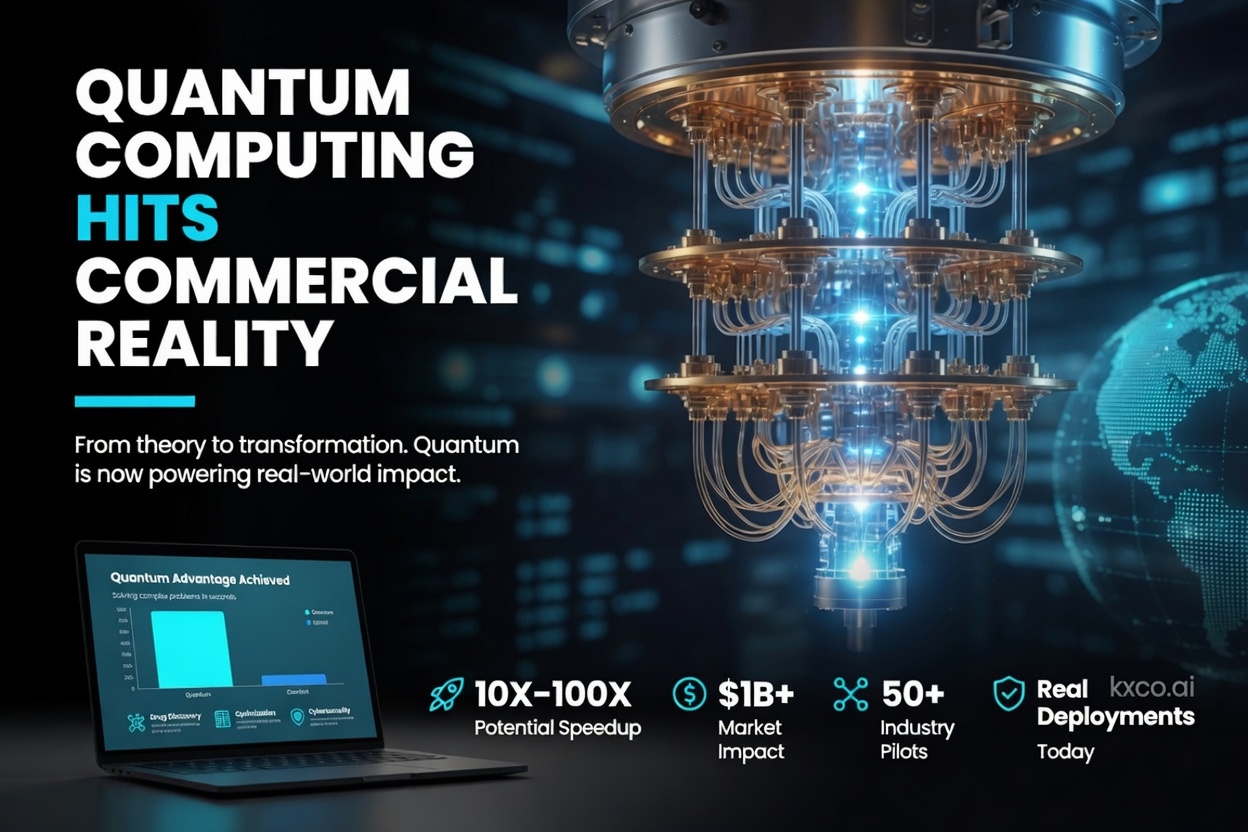
For the better part of two decades, quantum computing has lived in a strange limbo — too important to ignore, too far away to invest in. It was the technology that was always five years out, a physics experiment wearing a business suit, a story about qubits and superposition that never quite reached the profit-and-loss statement. That framing is now obsolete. In 2026, quantum computing crossed the line from laboratory curiosity to commercial reality, and it did so not with a single dramatic breakthrough but with something far more telling: money changing hands at scale, on government letterhead and on public exchanges.
The clearest signal came when the United States committed roughly $2 billion in federal research funding to a cluster of quantum companies, backing not the flashiest science but the least glamorous and most decisive part of the problem — manufacturing. When a government starts funding foundries and cryogenic control hardware rather than white papers, it is telling you the field has moved from whether to how fast. At almost the same moment, the largest pure-play quantum computing company in history priced its IPO on the Nasdaq, and a basket of small quantum names delivered the kind of returns that make and break careers.
Tickers in this report: $IONQ · $RGTI · $QBTS · $QUBT · $QNT · $IBM · $GOOGL · $MSFT · $NVDA · $GFS · $HON
But the deepest story of 2026 is not any single company or funding round. It is the fusion of two technologies that, until recently, were discussed in entirely separate conversations: artificial intelligence and quantum computing. These are no longer parallel revolutions. They have become a single, self-reinforcing loop — AI is now essential to making quantum machines work, and quantum machines are beginning to expand what AI can do. Understanding that loop is the key to understanding where the next decade of technology, and the money that follows it, is heading.
"Quantum computing didn't arrive with a bang — it arrived with a purchase order," says Shayne Heffernan. "The moment governments start paying for foundries instead of physics papers, the debate is over. The only question left is who builds the winners."
Let's take it apart, piece by piece.
The $2 Billion Signal: Why 2026 Is Quantum Computing's Commercial Tipping Point
The most important thing about the recent wave of US federal quantum funding is not the headline number — it is where the money went. Rather than spreading capital thinly across theoretical research, the funding concentrated on the industrial bottlenecks that stand between quantum computing and commercial deployment. The single largest award, around $1 billion, went to IBM to stand up a quantum foundry subsidiary focused on manufacturing superconducting wafers at scale. A further $375 million went to GlobalFoundries to build domestic foundry capacity spanning multiple quantum architectures. Neutral-atom specialist Atom Computing received roughly $100 million, silicon-spin developer Diraq around $38 million, and a series of smaller grants targeted specific engineering choke points — cryogenic systems, control electronics, ultra-fast readout hardware, and the reduction of photonic loss.
Read that list again and a pattern jumps out. This is not a science-funding programme; it is an industrial-policy programme. The state has decided that quantum computing is strategic infrastructure, like semiconductors or energy, and it is funding the ability to make the machines rather than merely to imagine them. That is precisely the transition every transformational technology has to make — from the physics department to the factory floor.
The commercial architecture that is emerging looks familiar, because we have watched it play out once already with artificial intelligence. The most likely path to quantum revenue in the near term is not selling machines outright — they are too expensive, too finicky, and too rare — but renting access to them over the cloud. The same hyperscalers that today rent you GPU time by the hour will rent you qubit time by the hour. You will not own a quantum computer any more than you own the data centre running your AI models; you will call an API, run your workload on somebody else's cryogenically cooled hardware, and pay for what you use. This "quantum-as-a-service" model is why the eventual winners are so likely to include the giants — the companies that already own the cloud, the customer relationships, and the balance sheets to absorb years of build-out.
A crucial caveat, and one no honest analyst skips: broadly useful, fault-tolerant quantum computing — the kind that cracks problems classical machines cannot touch — is still widely estimated to be at least five years away, and possibly longer. What changed in 2026 is not that quantum computers suddenly became useful for everything. It is that the commercial scaffolding — the funding, the foundries, the public listings, the cloud-delivery model, and above all the AI tooling that makes the hardware behave — snapped into place all at once. The tipping point is commercial and structural, not a claim that the physics is finished.
"People keep waiting for a single 'quantum moment,' like a moon landing," Heffernan notes. "That's the wrong model. This is an infrastructure build-out, and infrastructure gets built brick by unglamorous brick. The foundries are the story."
The AI–Quantum Flywheel: Two Revolutions Become One
Here is the insight that most market commentary is still missing, and the one I want you to take away from this piece above all others. Artificial intelligence and quantum computing are no longer separate bets. They are two halves of a single flywheel, each spinning the other faster.
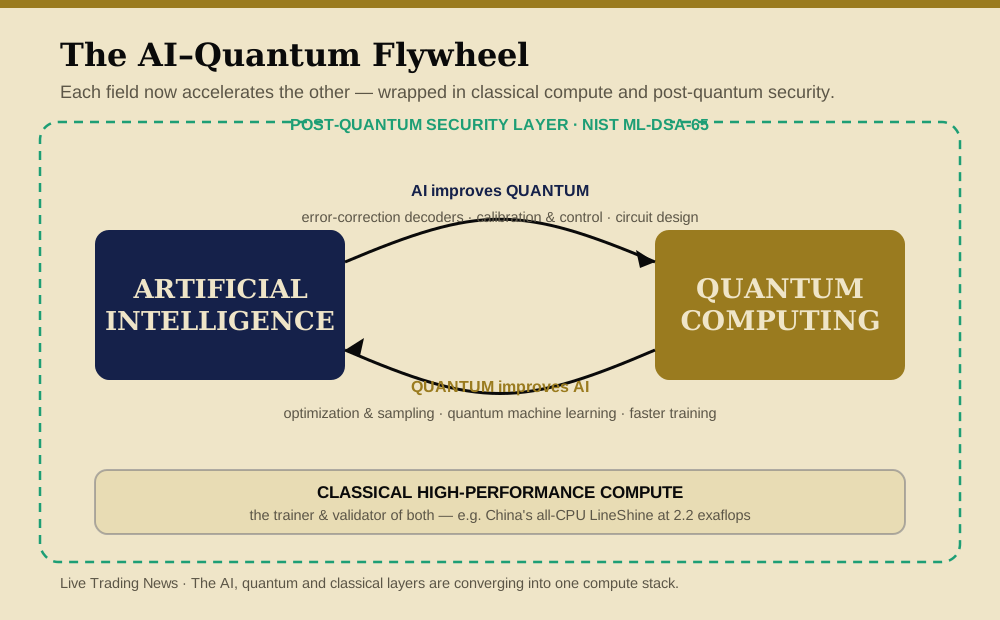
Start with the direction most people overlook: AI is now indispensable to building quantum computers. A quantum computer is a fantastically delicate machine. Its qubits lose their fragile quantum state at the slightest disturbance — a stray photon, a thermal vibration, a rounding error in a control pulse. Keeping them coherent, calibrating them, and correcting the errors that inevitably creep in is a problem of staggering complexity, with far too many interacting variables for human engineers to tune by hand. Increasingly, that job is being handed to machine learning. Deep-learning models — transformers, the same architecture behind large language models — are being trained to predict and correct qubit errors in real time, acting as "decoders" that watch a noisy quantum system and infer what the true state should be. Partnerships have formed specifically to run AI-based error-correction algorithms on live quantum control hardware, and the early results suggest AI can dramatically reduce the overhead that error correction demands.
This matters enormously for timelines. The conventional wisdom held that quantum computers would only become useful once they had millions of physical qubits wrapped around each "logical" error-corrected qubit. But if AI-driven error correction can squeeze more reliability out of fewer, noisier qubits — delivering partial error correction on today's Noisy Intermediate-Scale Quantum ("NISQ") devices — then practical quantum advantage arrives years earlier than the pessimists expected. AI is, in effect, buying quantum computing time it did not have.
Now spin the wheel the other way: quantum computing promises to expand what AI can do. Certain problems at the heart of machine learning — optimization across vast solution spaces, sampling from complex probability distributions, simulating quantum systems like molecules and materials — are exactly the kind of task where quantum machines could eventually leave classical computers far behind. Quantum machine learning (QML) aims to run parts of the AI pipeline on quantum hardware, and researchers have already demonstrated quantum-enhanced techniques that optimize AI model architectures in a fraction of the time classical methods require. The prize is not a marginally faster chatbot; it is the ability to train and reason over structures too complex for any classical computer, from drug discovery to materials science to logistics.
The convergence is already showing up in commercial deals and revenue. Quantum firms have announced generative quantum-AI systems aimed squarely at commercial applications, and major high-performance-computing vendors are signing partnerships to weave quantum processors, classical HPC, and AI infrastructure into a single stack. One research house estimates that a meaningful and growing share of quantum-algorithm revenue is already tied to AI use cases. The two fields are not converging in some distant future — they are converging on the invoice, today.
"AI is the hands that keep the quantum machine steady, and quantum is the engine that will one day let AI think in dimensions we can't," says Heffernan. "Bet on the loop, not on either half alone."
There is a sharper edge to this convergence, too. As AI accelerates quantum progress, it also accelerates the day when quantum machines can break the encryption that protects the entire digital economy. When AI and quantum push each other forward, they push that reckoning closer. We will come back to that — because it is where the smart money is already positioning.
How Big Is the Prize? Sizing the Quantum Computing Market
Skepticism about quantum valuations is healthy, so let's ground the enthusiasm in numbers — while being honest that the forecasts vary wildly, because nobody truly knows how fast fault-tolerance arrives.
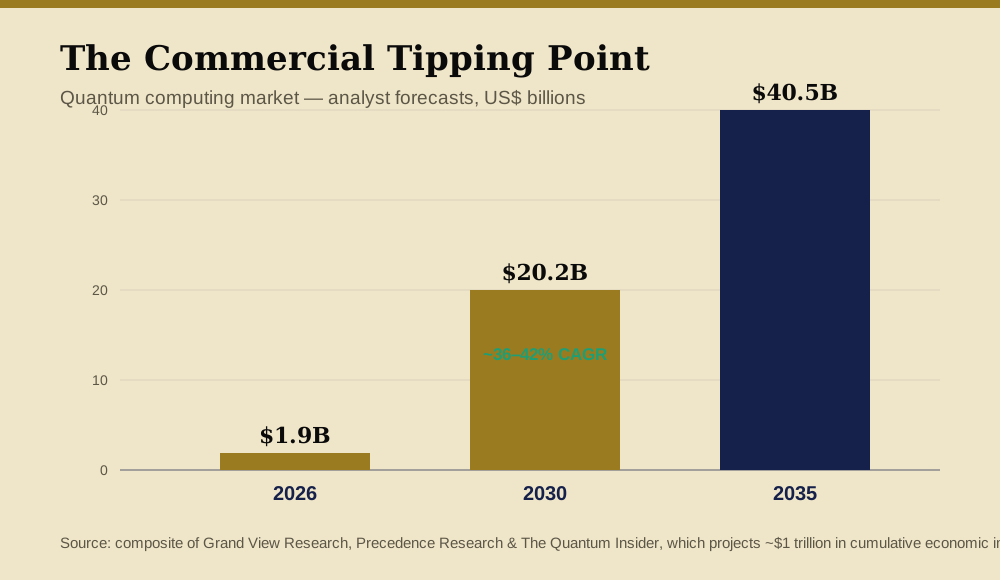
The near-term market is small. Estimates for 2026 cluster around $1.9 billion — genuinely tiny by technology standards, roughly the annual revenue of a single mid-sized software company. But the growth rates attached to it are extraordinary. Analysts model compound annual growth in the range of 36% to 42%, which pushes the market toward somewhere between $5 billion and $20 billion by 2030 depending on whose assumptions you accept, and toward $40 billion or more by 2035. Look further out and the numbers turn heroic: one widely cited projection puts the cumulative economic impact of quantum computing — the value created across industries it touches, not just hardware sales — at around $1 trillion by 2035. Consulting houses have started describing 2026 explicitly as quantum's "commercial tipping point."
The public sector is putting real money behind those forecasts. Beyond the roughly $2 billion in recent US quantum awards, government programmes across the US, Europe, and Asia have driven committed public investment in quantum technologies from under $2 billion a couple of years ago to something on the order of $10 billion, with further multi-year federal commitments planned. When you see the market this small and the investment this large relative to it, you are looking at a classic early-stage build-out: the spending today is a bet on the market of tomorrow.
The investment implication is unavoidable. A market this small growing this fast will be volatile, narrative-driven, and prone to violent swings in both directions — which is exactly what the pure-play stocks have delivered. That is not a reason to avoid the space. It is a reason to size positions with discipline and to understand precisely what you own.
The Pure-Play Quantum Stocks: IonQ $IONQ, Rigetti $RGTI and D-Wave $QBTS
For investors who want direct, undiluted exposure to quantum computing, the pure-plays are the obvious hunting ground — and the most dangerous. These are small companies with enormous ambitions, tiny revenues, no profits, and valuations that can only be described as faith-based. In 2026 they have swung with breathtaking violence: multi-day stretches where the whole group jumped 10% to 25% in a session, followed by equally sharp reversals. This is a sentiment-driven corner of the market, and anyone who forgets that will get hurt.
IonQ ($IONQ) is the giant of the pure-plays, built on trapped-ion technology — an approach prized for the quality and stability of its qubits. Its numbers illustrate both the promise and the peril. Quarterly revenue exploded to roughly $64.7 million, up an eye-watering 755% year over year, and management raised full-year 2026 guidance to the $260–270 million range. That growth is real and impressive. But the company still carried a market capitalization in the neighbourhood of $21 billion, which works out to a price-to-sales ratio north of 100 — the kind of multiple that prices in years of flawless execution. IonQ is the closest thing the sector has to a blue chip, and even it is priced for perfection.
Rigetti Computing ($RGTI) takes the superconducting route, the same broad approach favoured by IBM and Google, and pursues a full-stack strategy from chip to cloud. Its revenue nearly tripled to around $4.4 million in the quarter — a big percentage gain off a very small base — yet the market awarded it a valuation of roughly $7.7 billion, implying a price-to-sales multiple in the hundreds. Rigetti is a bet on engineering execution and on the superconducting approach scaling; the valuation leaves no room for stumbles.
D-Wave Quantum ($QBTS) is the commercial pragmatist of the group. It built its business on quantum annealing — a specialised technique well suited to optimization problems — and has been layering on gate-model capabilities. D-Wave has leaned hardest into shipping real, revenue-generating optimization work today rather than promising fault-tolerance tomorrow, and its bookings surged to around $33.4 million. That "useful now" positioning is a genuine differentiator, though annealing's addressable range is narrower than the universal machines the others are chasing.
"The pure-plays are call options on the future with a stock ticker attached," Heffernan says. "You can absolutely make money on them — I'd just never confuse them with businesses. Position size is everything."
The common thread across all three is stark: these are pre-profit companies trading on theme, sentiment, and headline flow, at valuations that assume the quantum future not only arrives but arrives for them specifically. That is a very particular kind of bet.
Quantum Computing Inc $QUBT: The Speculative Edge of the Space
If IonQ, Rigetti, and D-Wave sit at the more established end of the pure-play spectrum, Quantum Computing Inc ($QUBT) sits at the speculative edge. The company is pursuing a photonic approach built around thin-film lithium niobate — an elegant technology with real potential advantages in operating at room temperature rather than requiring the extreme cooling that superconducting qubits demand. Its reported quarterly revenue was around $3.69 million, a figure that looked spectacular in percentage terms — up nearly 6,000% year over year — precisely because the prior-year base was so close to zero.
$QUBT is the name that most embodies the risks of the sector: a compelling technological narrative, minuscule revenue, deep unprofitability, and a share price driven far more by the ebb and flow of quantum enthusiasm than by fundamentals. When the "quantum trade" is roaring, $QUBT tends to move the most in percentage terms; when sentiment reverses, it falls the hardest. It is, in the truest sense, a speculation — one that could reward the patient believer handsomely or punish the latecomer brutally.
Quantinuum $QNT: The Landmark IPO That Changed the Space
The single most consequential corporate event in quantum computing in 2026 was the public debut of Quantinuum ($QNT). Formed from the merger of Honeywell's quantum computing division and the UK's Cambridge Quantum, Quantinuum is a full-stack, trapped-ion company widely regarded as one of the technical leaders in the field. Its IPO, which priced at $60 per share and raised roughly $1.68 billion, valued the company at around $14 billion — making it the largest traditional IPO for a pure-play quantum computing company in history. Its shares began trading on the Nasdaq under the ticker $QNT.
The significance goes well beyond one listing. A $14 billion valuation on revenue of only around $31 million tells you everything about how the public markets are pricing quantum right now: they are buying the roadmap, the intellectual property, and the strategic position, not this year's income statement. But Quantinuum's arrival also matters because it gives the sector a credible, well-capitalized, technically respected anchor on the public markets — a full-stack company with deep enterprise relationships and the backing of an industrial giant. For a space long dominated by tiny speculative names and inaccessible private labs, $QNT is a legitimizing presence.
Honeywell ($HON) deserves a mention here too, because it remains Quantinuum's largest shareholder. For conservative investors who want quantum exposure wrapped inside a profitable, diversified industrial business, $HON offers an indirect, heavily diluted, but far less volatile way to participate.
The Big-Cap Quantum Powers: IBM $IBM, Alphabet $GOOGL and Microsoft $MSFT
Here is my central conviction about how this plays out commercially: the most likely long-term winners in quantum computing are not the pure-plays at all, but the technology giants — the same companies that dominated the AI build-out, for the same reasons. They have the cloud platforms to deliver quantum-as-a-service, the enterprise customers to sell it to, the AI expertise to run the error-correction models, and the balance sheets to fund a decade of losses without blinking.
IBM ($IBM) has arguably the most credible and detailed roadmap in the industry, built on superconducting qubits, and it has been the most consistent, least hype-driven voice in quantum for years. Its roughly $1 billion federal award to build a quantum foundry underscores its central role in the manufacturing side of the transition. IBM is the patient institutional bet — a profitable, dividend-paying company where quantum is a genuine call option layered on top of a real business.
Alphabet ($GOOGL) — Google's parent — has been responsible for some of the field's most important scientific milestones. Its work on error correction, embodied in its Willow processor, demonstrated the pivotal result that logical error rates can be made to fall exponentially as a quantum system grows larger, rather than rising — a finding that goes to the very heart of whether large-scale quantum computing is possible at all. Combine that research pedigree with Google Cloud's distribution muscle and Alphabet's deep AI capabilities, and you have perhaps the most complete quantum-plus-AI story in the market.
Microsoft ($MSFT) is pursuing the highest-risk, highest-reward path of all: topological qubits, an approach that is fiendishly difficult to realize but promises qubits that are far more stable and error-resistant by their very nature. Microsoft has unveiled a topological quantum chip it describes as a major leap and has publicly targeted a scalable quantum computer before the end of the decade. Through Azure Quantum, it also intends to be a primary channel for renting quantum access — the "qubits like GPUs" model in action.
Two more giants round out the picture. Nvidia ($NVDA) is not building a quantum computer, but it is quietly one of the most important companies in the space: its platforms for hybrid quantum-classical computing let developers link GPUs and quantum processors, and — crucially — its GPUs train the very AI models now used to control and correct quantum hardware. Nvidia sits at the exact intersection of the AI–quantum flywheel. And GlobalFoundries ($GFS), with its roughly $375 million federal award, is positioning itself as a manufacturing backbone for multiple quantum architectures — a picks-and-shovels play on the whole sector rather than any single approach.
"If you want to sleep at night, own the quantum future through the companies that already own the cloud," Heffernan says. "The pure-plays are the lottery tickets. The hyperscalers are the landlords."
The Stocks in the Quantum Computing Space: A Reference Table
Below is a consolidated view of the major listed companies with meaningful quantum computing exposure, spanning the pure-plays, the landmark IPO, and the diversified giants. Treat it as a map of the terrain, not a set of recommendations — and note how few of these companies earn real revenue relative to their valuations.
Company | Ticker | Approach / focus | 2026 snapshot |
|---|---|---|---|
IonQ | $IONQ · NYSE | Trapped-ion; quantum networking | Q1 rev $64.7M (+755% YoY); FY26 guide $260–270M; ~$21B mkt cap |
Rigetti Computing | $RGTI · Nasdaq | Superconducting; full-stack | Q rev ~$4.4M (nearly tripled); ~$7.7B mkt cap |
D-Wave Quantum | $QBTS · NYSE | Annealing + gate model; "useful now" | Bookings ~$33.4M; optimization-led |
Quantum Computing Inc | $QUBT · Nasdaq | Photonic (thin-film lithium niobate) | Q rev $3.69M (+~5,951% YoY); most speculative |
Quantinuum | $QNT · Nasdaq | Trapped-ion; full-stack (Honeywell + Cambridge Quantum) | June 2026 IPO at $60; ~$14B cap; raised $1.68B |
IBM | $IBM · NYSE | Superconducting; leading roadmap | ~$1B federal quantum-foundry award |
Alphabet (Google) | $GOOGL · Nasdaq | Superconducting; Willow error correction | Cloud-delivered quantum; hyperscaler |
Microsoft | $MSFT · Nasdaq | Topological (Majorana) qubits | Targets scalable QC by ~2029; Azure Quantum |
Nvidia | $NVDA · Nasdaq | Quantum-classical hybrid (GPU bridge) | Trains the AI decoders; the flywheel hub |
GlobalFoundries | $GFS · Nasdaq | Quantum foundry / manufacturing | ~$375M federal award |
Honeywell | $HON · Nasdaq | Quantinuum's largest shareholder | Diversified industrial exposure |
For those who prefer not to pick single names, three exchange-traded funds offer basket exposure to overlapping slices of this theme. The Defiance Quantum ETF (QTUM) is the closest to a pure quantum play, holding dozens of positions across the pure-plays and the giants. The Invesco PHLX Semiconductor ETF (SOXQ) captures the chip supply chain and foundry equipment that quantum manufacturing depends on. And the Global X Artificial Intelligence & Technology ETF (AIQ) offers the broadest exposure through the hyperscalers, capturing the AI side of the AI–quantum flywheel. Each has delivered strong but very different returns in 2026, reflecting how differently the market is pricing the pure quantum bet, the semiconductor supply chain, and the AI-infrastructure giants.
China's Gambit: LineShine and the Compute Sovereignty Race
No serious analysis of the compute landscape in 2026 can ignore China — and the most striking Chinese development this year was not, in fact, a quantum computer at all. It was a classical supercomputer called LineShine.
Installed at the National Supercomputing Center in Shenzhen, LineShine seized the top spot on the TOP500 ranking of the world's fastest supercomputers, delivering sustained performance of 2.198 exaflops on the standard High Performance Linpack benchmark. That achievement displaced the United States' El Capitan system and marked the first time since 2017 that a Chinese machine has topped the list. But the raw speed is not the real story. What makes LineShine remarkable — and strategically significant — is how it was built: entirely from conventional central processing units, with no GPUs at all, using millions of computing cores built into China's own LX2 processors. It is a machine assembled from domestic parts, in large measure because US export controls have cut China off from the most advanced American AI accelerators.
LineShine is, in other words, a monument to compute sovereignty. Denied access to Western GPUs, China demonstrated it could reach the summit of classical high-performance computing anyway, on home-grown silicon and sheer architectural scale. That has direct implications for the AI–quantum story. Classical supercomputers like LineShine are the workhorses that train the AI models and simulate and validate the quantum systems at the heart of the flywheel — they are the base layer beneath both AI and quantum. A nation that can build them without foreign technology has secured the foundation on which its AI and quantum ambitions rest.
And China's quantum programme is formidable in its own right, running in parallel to its classical achievements — from record-setting photonic and superconducting quantum processors to the recent unveiling of ultra-fast quantum memory, a component that could prove critical for practical, networked quantum machines. To be precise, and to avoid the confusion that surrounds this topic: LineShine itself is a classical supercomputer, not a quantum computer; the two operate on completely different principles and are not directly comparable. But together they signal a country pursuing dominance across the entire compute stack — classical, AI, and quantum at once.
"The West tends to think of this as an AI race or a quantum race," Heffernan observes. "Beijing sees one race — for compute itself — and LineShine proves they'll win it with whatever silicon they can make at home. That should focus a few minds."
The geopolitical takeaway for investors is that quantum computing is not merely a commercial technology; it is a domain of national competition, which is exactly why the US committed billions to domestic quantum foundries and why the winners are likely to enjoy sustained government support on both sides of the Pacific.
The Threat Underneath the Boom: Harvest Now, Decrypt Later
There is a shadow side to every story of quantum progress, and ignoring it would be a disservice. The same machines that promise to revolutionize medicine and materials science also threaten to break the cryptography that secures essentially all of modern digital life. The encryption standards that protect banking, communications, digital identity, blockchains, state secrets, and the entire internet — algorithms like RSA and elliptic-curve cryptography — rest on mathematical problems that a sufficiently powerful quantum computer could, in principle, solve with ease.
The danger is not purely a future one, and this is the part too few people grasp. Adversaries can practise what security professionals call "harvest now, decrypt later": intercept and store encrypted data today, then decrypt it years from now once a capable quantum computer exists. Any secret that must stay confidential for a decade — medical records, state intelligence, long-lived financial data, the private keys behind digital assets — is already exposed to a quantum machine that has not yet been built. The clock started ticking long ago. And as we have seen, the AI–quantum flywheel is spinning that clock forward faster than most institutions have planned for.
The defense already exists. It is called post-quantum cryptography (PQC) — a new generation of encryption algorithms designed to resist attack by both classical and quantum computers. The US National Institute of Standards and Technology (NIST) has finalized the first of these standards, and the migration of the world's digital infrastructure onto quantum-resistant cryptography has begun. It is one of the largest and most urgent security transitions in the history of computing, and — unlike the wait for fault-tolerant quantum hardware — it is happening right now, on live systems.
The Risks, and How to Play the Space
Before the bottom line, a clear-eyed accounting of the risks, because this is a space that separates the disciplined from the euphoric.
Valuation is the obvious hazard. Price-to-sales ratios in the hundreds, and in some cases the thousands, mean the pure-plays are pricing in a future that is far from guaranteed. Any crack in the quantum narrative hits these names first and hardest.
Timelines remain uncertain. Broadly useful, fault-tolerant quantum computing is still likely five or more years away. The commercial tipping point of 2026 is about infrastructure and momentum, not about machines that can already outperform classical computers on real-world problems at scale.
The technology winners are not settled. Superconducting, trapped-ion, photonic, neutral-atom, topological — the industry has not converged on a single winning approach, and a company betting on the wrong horse could see its lead evaporate.
Volatility is extreme. The pure-plays routinely move double digits in a single session on sentiment alone. This is not a set-and-forget corner of the market.
Given all that, my framework is straightforward. Treat the pure-plays — $IONQ, $RGTI, $QBTS, $QUBT — as small, high-conviction speculations, sized so that a total loss on any one of them would not derail your portfolio. Anchor the theme through the diversified giants — $IBM, $GOOGL, $MSFT, $NVDA — where quantum is upside on top of real, profitable businesses. Consider $QNT as the credible new pure-play anchor and the ETFs as a way to own the basket without picking a single winner. And above all, respect the volatility: build positions deliberately over time, never chase a green day, and remember that a decade-long build-out does not have to be won in a single quarter.
Shayne's Take
Quantum computing in 2026 is no longer a question of if — it is a question of when, who, and how you own it. The $2 billion in federal foundry funding, the landmark Quantinuum IPO, and the violent rallies in the pure-plays are all symptoms of the same underlying shift: the field has moved from physics to industry, and capital is flooding in to build the factories, the cloud services, and the AI tooling that will make quantum machines commercially useful.
The single most important idea I can leave you with is the flywheel. Do not think of AI and quantum as two separate bets competing for your attention. They are one intertwined system — AI is making quantum work, quantum will eventually make AI vastly more powerful, and classical supercomputers like China's LineShine sit beneath both as the base layer. The companies that sit at the intersection of that loop — the hyperscalers with AI expertise, cloud distribution, and quantum programmes — are, to my mind, the highest-quality way to own the theme. The pure-plays are where the excitement and the danger both live.
And whatever you conclude about the hardware, do not overlook the security transition happening underneath all of it. The move to post-quantum cryptography is not speculative, not five years out, and not optional. It is the one part of the quantum story that every serious institution — every bank, every government, every custodian of long-lived data — has to act on now.
KXCO and the Post-Quantum Present
Which brings me to where my own firm sits in this story. At KXCO, we made a deliberate decision not to wait for the quantum threat to become urgent before treating it as urgent. KXCO builds post-quantum infrastructure for institutions — the signing, identity, ledger, and verification layers that licensed banks, payment companies, and digital-asset platforms run on — using NIST-standardized, quantum-resistant cryptography (the ML-DSA family, published under NIST FIPS 204). It is not a slide in a pitch deck; it is live. Documents signed on our platforms, identities issued through our systems, and transactions anchored to our chain are protected today with the same class of algorithms designed to withstand the machines this article describes. We are a software company, not a licensed institution — our role is to give the institutions that are licensed the quantum-resistant rails they will need long before a fault-tolerant quantum computer ever switches on. In a world racing toward quantum advantage, the organizations that will come through it intact are the ones that treated post-quantum security as a present-tense obligation rather than a future problem. That is the bet KXCO has already made.
Shayne Heffernan, Ph.D. — Live Trading News. This article is for information and educational purposes only and does not constitute investment advice, a recommendation, or an offer or solicitation to buy or sell any security. Quantum computing equities are early-stage, largely pre-profit, and exceptionally volatile; several trade at valuations far above current revenue. Figures, valuations, and corporate developments cited reflect publicly reported information available at the time of writing and are subject to change. Always do your own research and consult a licensed financial adviser before making any investment decision.

AI Development: The Token Got Cheaper, the Building Did Not
The useful fact on 28 September is a split, not a benchmark. Gartner puts 2026 AI spending at $2.67 trillion, and 56 percent of it is infrastructure against about 1 percent on the models. Inside one week the frontier cut the price of a token in half, Nvidia signed for the shelf the open weights sit on, and three closed labs proposed to run the test. What shipped, what it costs and where the money goes, with the AI sector checked against KXCO Ontology Live.

The Week the Discount Rate Gets a Vote
The Fed hiked on 16 September and left the door open. This week the August PCE deflator on Wednesday, September payrolls on Friday, the RBA on Tuesday and euro-area CPI set the discount rate. Gold, Bitcoin, the dollar, the AI complex and the quantum pure plays share that rate and diverge everywhere else. This is the map of what depends on what, the three regimes the book should already have written down, and the stop that belongs to each node on KXCO Ontology Live.

The Round Table Scorecard: 87 Days of a Live Ontology
On 1 July 2026 KXCO put a Round Table ontology in public with 31 entities, 41 claims and no findings. It now holds 395 entities, 892 claims and 47 findings, with every correction kept rather than overwritten. This scorecard grades the record, how it corrects itself in the open, and the 9 of 13 names on its first outlook table that are higher since 17 July.

Wall Street Week Ahead: Rates, Oil, AI, Quantum, Defense, Metals and Bitcoin
The trading week opens after a Federal Reserve that chose to hike, a White House that chose not to strike Yemen, and an oil market still pricing a war now in its seventh month. The useful work this week is not a list of tickers. It is a map of what depends on what: the funds rate, the Magnificent Seven, a quantum cohort just handed a specification and a deadline, the missile primes selling into a restock, and gold, silver, crude and Bitcoin, all held against the live AI sector ontology.
Every story, signed and delivered.
Subscribe to the kxco channel and get the headline, the AI-written key takeaways, and the chain-anchor link the moment we publish. Audio versions and per-ticker subscriptions arrive in the next iteration.