
MANGO Stocks the 2026 Guide
FAANG was an attention economy. MANGO is an infrastructure economy. Shayne Heffernan breaks down the six AI-infrastructure names behind the acronym — ticker by ticker, with the latest 2026 news and the IPO wave bringing the private three public.
Part of theSpace Economy Center
Every market cycle gets the acronym it deserves. The 2010s belonged to FAANG — Facebook, Apple, Amazon, Netflix and Google — the five consumer-internet giants that captured the world's attention and monetised it through ads and subscriptions. The acronym was a shorthand for an entire investment thesis: own the companies that own the eyeballs.
That era is over. The defining companies of this decade are not selling attention — they are selling the picks, shovels, compute, models and connectivity that the entire artificial-intelligence economy is being built on top of. Wall Street already has a name for them, and in 2026 it is the term every serious investor is searching: MANGO stocks.
So let me answer the question directly, because it is the one I get asked more than any other right now. MANGO stocks are the cohort of companies powering the AI infrastructure economy. In its most widely used 2026 form — sometimes written MANGOS — the acronym stands for Meta, Anthropic, Nvidia, Google (Alphabet), OpenAI and SpaceX. Together they represent something close to $14 trillion in combined public market value and private valuations, and unlike FAANG, most of them do not want your attention at all. They want to be the layer that everything else runs on.
This article breaks down each MANGO stock, ticker by ticker, with the very latest 2026 news on each name — including the single biggest catalyst hanging over the group: three of the six are private today, and all three are racing toward the public markets right now. If you want a deeper, structured map of how this infrastructure economy actually fits together — the institutions, instruments, transactions and rails that connect it — KXCO's Ontology Engine is a genuinely great primer and reference, and I'll link it again below: kxco.ai/ontology-live.
Tickers in this report: $META · $NVDA · $GOOGL · $SPCX — plus the original semiconductor MANGO basket: $MRVL · $AMD · $AVGO · $ADI · $GFS · $ON. (Anthropic and OpenAI remain private, with no listed ticker yet.)
Let's get into it.
What Are MANGO Stocks? The Definition That Actually Matters in 2026
There are, to be fair, two definitions of "MANGO stocks" floating around, and it is worth disambiguating them up front because they pull search traffic in two different directions.
The older definition dates to 2022, when Bank of America semiconductor analyst Vivek Arya coined "MANGO" to describe a basket of seven chip stocks he believed would lead the next leg of the economy: Marvell Technology (MRVL), Advanced Micro Devices (AMD), Broadcom — the "N" is a stretch on the spelling but Nvidia anchors it — Analog Devices (ADI), Nvidia (NVDA), GlobalFoundries (GFS) and ON Semiconductor (ON). That was a pure semiconductor call, and a good one: the thesis was that everything from cloud to AI to electric vehicles would run on these companies' silicon. I'll come back to that semiconductor basket later, because it has aged extremely well.
The 2026 definition — the one that has taken over the conversation and the one I'm focused on here — is broader and more important. It is the AI-era successor to FAANG, and the cleanest articulation of it I've seen puts it this way: "FAANG was an attention economy. MANGOS is an infrastructure economy." That single sentence is the whole thesis. FAANG companies grew rich by capturing and reselling human attention. MANGO companies grow rich by building infrastructure that other businesses pay to run on — chips, foundation models, cloud, and the connectivity that ties it together. With the partial exception of Meta, every name in the modern MANGO group is selling shovels in a gold rush, not gold.
That distinction is not academic. It changes how you value these companies, how you think about their moats, and crucially how durable their revenue is. Attention is fickle and cyclical. Infrastructure, once a business is dependent on it, is sticky, recurring and defensible. It is the difference between a tenant and a landlord.
It also explains why understanding the connections between these companies matters as much as understanding any single one. The AI infrastructure economy is a graph, not a list — Nvidia sells chips to Microsoft and Google, who rent compute to OpenAI and Anthropic, whose models power Meta's and everyone else's products, while SpaceX's Starlink provides the connectivity layer and its xAI sibling trains on the same silicon. To reason about MANGO stocks properly you have to think in terms of objects and relationships, which is exactly the problem that ontology engines were built to solve. KXCO's Ontology Engine — "Proof, Not Promises" — is a strong reference point here: it models finance and business as a living, verifiable graph of institutions, instruments, transactions and the rails between them, each relationship carrying a post-quantum signature. If you want to genuinely understand the infrastructure economy that MANGO stocks represent, learning to think in those terms is half the battle.
Now, the names.
Meta Platforms (NASDAQ: META) — The "M" That Is Half Attention, Half Infrastructure
Meta is the one genuine hybrid in the group, and the most controversial inclusion. It still earns almost all of its revenue from advertising — the attention-economy business model — but it is spending like an infrastructure company, and that tension is the entire Meta story in 2026.
The numbers from Meta's first-quarter 2026 report were, on the surface, spectacular. Revenue climbed 33% year over year to roughly $56 billion (up from $42.3 billion a year earlier), the company's fastest quarterly growth since 2021. Adjusted earnings came in at $7.31 per share, comfortably ahead of the $6.79 analysts expected. By any normal standard, that is a blowout.
And yet the stock fell more than 6% in after-hours trading. Why? Because Meta raised its full-year 2026 capital-expenditure guidance to a staggering $125 billion to $145 billion, up from a prior range of $115 billion to $135 billion. Investors did the math and balked: this is a company pouring nine figures of billions into AI build-out while admitting it does not yet have a fully formed plan to monetise it. On the earnings call, Mark Zuckerberg conceded that Meta does not have a "very precise plan" for how each individual AI product will scale — an honest admission that nonetheless poured fuel on the "unfocused capex" narrative.
Strategically, Meta is in the middle of a profound pivot. Its new Superintelligence lab released a significantly upgraded version of Meta AI and launched Muse Spark, the first model under the new unit. Notably, this marks a break from Meta's previous open-source Llama approach — Muse Spark prioritises internal monetisation and deeper integration into Meta's own ecosystem rather than being given away. Meta is trying to climb from the application layer toward the model layer.
The bear case is specific and worth respecting: unlike its Magnificent Seven peers Google, Amazon and Microsoft, Meta has no cloud business. It is, as one analyst memorably put it, a "cloudless hyperscaler" — spending like an infrastructure provider but with no infrastructure rental revenue to show for it, and a near-total dependence on advertising to fund the whole thing. If the AI investments pay off in better ad targeting and engagement, Meta wins enormously. If they don't, it has spent a fortune with no second revenue stream to fall back on. That is the bet you are making when you buy META today.
Anthropic (Private — Draft IPO Filed, 2026) — The "A" Racing to a Public Listing
Here is where the MANGO story gets genuinely exciting for traders, because the "A" — Anthropic, the developer of the Claude family of AI models — is one of three constituents about to make the leap from private to public.
Anthropic filed its draft S-1 registration statement on June 1, 2026, immediately after announcing a colossal $65 billion Series H funding round at a $965 billion post-money valuation. Read that again: a company that did not exist a few years ago is knocking on the door of a trillion-dollar valuation, privately, before it has even priced an IPO.
What makes Anthropic's case more than hype is that the financials underneath the valuation have started to show up. The company's run-rate revenue reportedly crossed $44 billion annualised as of May 2026, and — remarkably for a frontier AI lab — Anthropic is on track to post its first-ever operating profit of approximately $559 million in the second quarter of 2026. In a sector where most of the headline names are still burning cash at spectacular rates, a frontier model developer turning an operating profit is a genuine inflection point.
For now there is no ticker to trade. But the draft S-1 is the starting gun. When Anthropic lists, it will instantly become one of the most important AI pure-plays on the public market, and the "A" in MANGO will go from a private-market footnote to a name you can actually own. This is one of the most anticipated listings of the year, and I'd put it at the top of the watch list for anyone serious about the AI infrastructure theme.
Nvidia (NASDAQ: NVDA) — The "N" That the Entire MANGO Thesis Rests On
If you could only own one MANGO stock, the consensus — and my own view — is that it would be Nvidia. It is the purest, most central expression of the infrastructure economy, because virtually every other company in the group is, directly or indirectly, a Nvidia customer. When OpenAI trains a model, when Google expands its cloud, when Meta builds out its data centres, when xAI scales — they are buying Nvidia GPUs. Nvidia is the toll booth on the entire AI highway.
The scale is almost difficult to comprehend. As of late June 2026, Nvidia traded around $195 a share with a market capitalisation of roughly $4.79 trillion — making it, by some distance, one of the most valuable companies in human history. In its most recent quarter it once again beat expectations, delivering an extraordinary 85% revenue growth rate. On its latest conference call, management projected that AI hyperscaler capital expenditure would rise to $1 trillion in 2027 — a forecast that, if anywhere close to right, underwrites years of demand for Nvidia's chips.
The company is also broadening well beyond raw GPUs. Recent announcements include the BioNeMo Agent Toolkit for life sciences, Halos for Robotics, and a European push that saw 35 new Nvidia-powered AI supercomputers unveiled across the continent. Nvidia is methodically turning itself from a chip vendor into a full-stack AI platform — silicon, software, networking and developer tools.
A note of caution, because no responsible analysis skips it: as of late June 2026, NVDA had declined for five consecutive sessions and slipped into what some are calling a correction, as investors rotate toward other chipmakers and fret about stretched valuations and the long-term sustainability of the AI capex boom. That is healthy. A stock that has appreciated this far this fast is entitled to volatility, and a pullback in a structural leader is very different from a broken thesis. But anyone buying NVDA at a near-$5 trillion valuation needs to be clear-eyed: an enormous amount of future growth is already in the price, and the stock will be the first to fall hard if the market ever decides the AI build-out is slowing.
Alphabet / Google (NASDAQ: GOOGL) — The "G" With the Best-Balanced Hand in the Group
Of all the MANGO stocks, Alphabet — Google's parent — may hold the most complete hand. It has a frontier AI model (Gemini), one of the three dominant cloud platforms, the world's most profitable advertising business to fund it all, and a research pedigree second to none. It is the company best positioned to monetise AI across the entire stack, from chips through cloud through consumer products.
The first-quarter 2026 results were the proof. Alphabet reported revenue of $109.9 billion, up 22% year over year, with net income of $62.58 billion — $5.11 per share, up an astonishing 81%. The stock surged roughly 10% on the print. The standout was the cloud: Google Cloud revenue hit $20 billion, up 63%, and the cloud backlog — contracted future revenue — nearly doubled sequentially to a remarkable $462 billion. That backlog figure is the single most underappreciated number in the entire MANGO group; it is years of locked-in, infrastructure-economy revenue. On the AI side, Gemini Enterprise's paid monthly active users grew 40% quarter over quarter, and the company is increasingly monetising the longer, more complex queries that were previously hard to turn into revenue.
The conviction behind Google's build-out was underlined on June 1, 2026, when Alphabet announced $80 billion in equity offerings to fund AI compute infrastructure to meet what it called unprecedented customer demand — a raise that notably included a $10 billion investment from Warren Buffett's Berkshire Hathaway. When the most famously valuation-disciplined investor on Earth writes a ten-billion-dollar cheque for your AI build-out, the market notices.
Not everything has gone Alphabet's way. In late June the stock slid roughly 5% after two senior AI researchers departed for — fittingly — Anthropic and OpenAI, a reminder that in the AI economy, talent is as scarce and as mobile as capital. Even so, analysts have been raising their targets, with at least one lifting its price target to $493.30 on higher revenue-growth assumptions. Among the MANGO names, Google is the one I'd describe as the most "complete" business — and arguably the best risk-adjusted way to own the theme.
OpenAI (Private — Confidential IPO Filing) — The "O" Everyone Wants to Own
OpenAI, the creator of ChatGPT, is the most famous AI company on the planet and — for now — one you cannot buy. That is about to change, slowly.
OpenAI filed a confidential S-1 registration statement on June 9, 2026, and is valued at approximately $920 billion following its most recent financing round. The "confidential" part matters: unlike SpaceX's public filing, OpenAI's confidential submission lets it work through the regulatory process privately, and the company has signalled that an actual public listing "may be a while" as it prepares for the transition to public markets. In other words, the IPO is coming, but OpenAI is in no hurry, and investors hoping to buy ChatGPT's parent on day one may have to wait longer than the SpaceX or even Anthropic timelines suggest.
When it does list, OpenAI will be one of the largest and most scrutinised technology IPOs in history. The strategic position is unique — it has the most recognised consumer AI brand in the world, deep enterprise penetration through its API, and a partnership ecosystem that reaches across the entire industry. The open questions are the ones the S-1 will eventually have to answer: the path to sustainable profitability, the cost of staying at the frontier, and the governance structure of a company that began life as a non-profit. For MANGO investors, OpenAI is the highest-profile "not yet" on the board.
SpaceX (NASDAQ: SPCX — IPO 2026) — The "S" That Is Already at the Gate
The "S" in MANGO is the one moving fastest of all. SpaceX — Elon Musk's space, satellite-internet and (via its xAI relationship) AI conglomerate — filed its public S-1 on May 20, 2026, targeting a Nasdaq listing under the ticker SPCX, with pricing potentially as early as June 11–12 and the listing expected in late June 2026.
The numbers are staggering even by MANGO standards. SpaceX is targeting a valuation of roughly $1.8 trillion to $2 trillion and a raise of up to $75 billion — which would rank among the largest IPOs ever conducted. The investment case rests on three legs: the launch business, where SpaceX has an effective monopoly on cost-efficient access to orbit; Starlink, the satellite-internet constellation that is becoming the connectivity backbone for everything from rural broadband to maritime to defence; and the company's ties to xAI, which plug SpaceX into the AI-model layer of the MANGO economy directly.
Starlink is the key to why SpaceX belongs in an infrastructure-economy acronym rather than being dismissed as a moonshot. Connectivity is infrastructure in the most literal sense, and Starlink is building a global, hard-to-replicate connectivity layer that the rest of the digital economy increasingly depends on. If the IPO prices as expected, SPCX will be the first of the three private MANGO names to become tradable — and the one that turns the acronym from a mix of public and private into something an investor can almost fully assemble in a brokerage account.
MANGOS vs FAANG: Why the Infrastructure Economy Changes the Math
Step back and look at the group as a whole, because the most important insight about MANGO stocks is not about any single name — it's about what the group represents.
FAANG was a bet on consumer attention. The companies were brilliant, but their core asset — human eyeballs and the time attached to them — was ultimately finite and contestable. MANGO is a bet on infrastructure: compute, models, chips and connectivity that compound as the entire economy digitises and "AI-ifies." The combined SpaceX, OpenAI and Anthropic valuations alone target roughly $3.6 trillion, and the full MANGO group sits near $14 trillion. This is not a thematic basket of fashionable names; it is, increasingly, the load-bearing structure of the global digital economy.
That has three consequences for investors:
First, the revenue is stickier. Infrastructure, once embedded, is extraordinarily hard to rip out. Google's $462 billion cloud backlog is the cleanest illustration — that is not advertising revenue that could evaporate in a recession, it is contracted, multi-year, switching-cost-protected demand.
Second, the names are interdependent. These six companies are not independent bets — they are nodes in a single graph. Nvidia's revenue is OpenAI's and Google's capex. Anthropic's models run on cloud rented from infrastructure providers. SpaceX's Starlink and xAI weave through the connectivity and model layers. Owning the MANGO group is really owning a network, and the health of any one node depends on the others. This is precisely why thinking in terms of relationships — the ontology, the graph — is the right mental model, and why I keep pointing readers to KXCO's Ontology Engine as a way to learn to reason about exactly this kind of interconnected, verifiable economic structure.
Third, the IPO wave is the catalyst of the decade. Three of the six MANGO names are private today. All three have filed to go public in 2026. As SpaceX, OpenAI and Anthropic come to market, an enormous pool of capital that has been locked out of the private AI economy will finally be able to participate — and the supply of public MANGO equity will expand dramatically. How that capital is absorbed, how the IPOs price, and whether the public market validates or rejects these private valuations will be one of the defining financial stories of 2026.
How to Invest in MANGO Stocks Today
The practical question follows naturally: how do you actually get exposure to MANGO stocks right now? Today, only three of the six are directly investable on public markets — Nvidia (NVDA), Alphabet (GOOGL) and Meta (META) — and an investor can buy all three in any standard brokerage account. That alone gives you the chip layer, the cloud-and-model layer and the application-and-advertising layer of the infrastructure economy, which is a substantial slice of the thesis.
The other three — Anthropic, OpenAI and SpaceX — remain private as of this writing, though all have filed toward public listings in 2026. Until they price, the only ways to gain exposure are indirect: through the venture and growth funds that hold stakes, through certain pre-IPO secondary platforms (which carry their own liquidity and access constraints), or through public companies with meaningful ownership positions in them. When the IPOs arrive — SpaceX under SPCX first, with Anthropic and OpenAI to follow — the group becomes far easier to assemble directly.
A word of discipline, because it matters more here than almost anywhere else: position sizing and entry price are everything in a group trading at these valuations. These are not names to chase on a green day. Build positions deliberately, respect the volatility, and remember that owning the theme does not require owning every constituent at any price. The infrastructure economy will be a multi-year story; you do not have to win it in a single week.
The Other MANGO: Don't Forget the Semiconductor Basket (MRVL, AMD, AVGO, ADI, NVDA, GFS, ON)
For completeness — and because plenty of investors searching "MANGO stocks" are looking for the original — it is worth revisiting Bank of America's 2022 semiconductor basket: Marvell (MRVL), AMD (AMD), Broadcom (AVGO), Analog Devices (ADI), Nvidia (NVDA), GlobalFoundries (GFS) and ON Semiconductor (ON).
That call has aged beautifully, because it was, in retrospect, an early bet on exactly the infrastructure economy the modern MANGO acronym now names. Every one of those companies makes the silicon that the AI build-out runs on. Nvidia is the obvious superstar, but Broadcom has become a custom-AI-chip powerhouse, AMD is the credible number-two in AI accelerators, and Marvell and the others supply the connectivity, analog and specialty chips that data centres cannot function without. If the AI-era MANGO group is the application and platform layer of the infrastructure economy, the semiconductor MANGO basket is the foundation beneath it. The two acronyms are really two views of the same trend at different altitudes — and Nvidia, tellingly, anchors both.
The Risks You Cannot Ignore
No honest MANGO analysis skips the risks, and they are significant precisely because the rewards have been so large.
Valuation. Nvidia at ~$4.79 trillion, Anthropic approaching $1 trillion privately, SpaceX targeting ~$2 trillion — these prices embed years of flawless execution. Any wobble in the AI demand narrative hits these names first and hardest. NVDA's recent five-day slide is a small preview.
The capex question. Meta's stock fell on a blowout quarter purely because of spending. The entire group is pouring trillions into build-out on the faith that demand will justify it. If hyperscaler capex disappoints relative to Nvidia's $1 trillion 2027 projection, the whole chain re-rates downward together.
Interdependence cuts both ways. The same network effects that make the group powerful also make it fragile. A shock to one node — a model that disappoints, a cloud that slows, a chip cycle that turns — propagates through the graph.
The IPO air-pocket. Bringing SpaceX, OpenAI and Anthropic public in a single year is, as some have called it, a multi-trillion-dollar stress test of market liquidity. If the IPOs flood the market faster than capital can absorb them, even great companies can trade poorly out of the gate.
Talent and governance. The Google-to-Anthropic/OpenAI researcher exits are a reminder that in AI, the key assets walk out the door every evening — and several of these companies carry unusual governance structures that public markets have never had to price before.
Shayne's Take
So — what are MANGO stocks? They are the companies building the infrastructure of the artificial-intelligence economy: Meta, Anthropic, Nvidia, Google, OpenAI and SpaceX. FAANG sold attention; MANGO sells the rails. That is not a marketing distinction — it is the difference between renting eyeballs and owning the toll roads, and it is why I believe this acronym describes the most important cluster of companies in the market today.
My read of the group: Nvidia (NVDA) is the indispensable core — the one name every other MANGO company depends on — but it carries the most valuation risk after an historic run. Alphabet (GOOGL) is the best-balanced, most complete business in the group, with the cloud backlog and the Berkshire endorsement to prove the infrastructure thesis is real. Meta (META) is the high-conviction, high-spend hybrid — a brilliant business making an enormous, not-yet-proven AI bet with no cloud safety net. And the private three — Anthropic, OpenAI and SpaceX — are the catalyst: an unprecedented IPO wave that will, over the course of 2026, hand public investors the keys to companies they have only been able to watch from the outside.
The single most useful shift in mindset I can offer is this: stop thinking of these as six separate stocks and start thinking of them as one interconnected graph — an economy with objects and relationships, where value flows along verifiable paths from chip to cloud to model to product to connectivity. That is exactly the lens KXCO's Ontology Engine is built around, and it is, genuinely, one of the best places to start if you want to understand the infrastructure economy that MANGO stocks have come to define.
The fruit is delicious. The stocks are how you eat.
Shayne Heffernan, Ph.D. — Live Trading News. This article is for information and educational purposes only and does not constitute investment advice, a recommendation, or an offer or solicitation to buy or sell any security. Several companies discussed are privately held and not currently available to public investors; pre-IPO valuations are not the same as public market prices. Figures, valuations and corporate developments cited reflect publicly reported information available at the time of writing and are subject to change. Always do your own research and consult a licensed financial adviser before making any investment decision.
Weekly Market Outlook: Fed Minutes, Anthropic and OpenAI IPOs, Gold, Bitcoin, FX
The Fed raised rates in September and payrolls rose 29,000, per the Labor Department. This week the FOMC minutes, three Treasury auctions and a 10-year near 5.3 percent test that gap. Anthropic's IPO clock runs toward a 14 October investor day while OpenAI's chief executive says not 2026. Gold sits 26 percent below its record, bitcoin near $85,500, the dollar up three weeks running. Two knowledge graphs from KXCO's records map the IPO backers and the FDA board.
Thoughts on Thinking in an AI World
A model will write an answer about anything in seconds. What an AI world makes scarce is everything around the answer: what you believed last month and why you changed it, the link between fields nobody reads together, and a decision a named person can stand behind. Three knowledge-graph exhibits from the KXCO record show each one, from a reported Nvidia deal that became a signed 8-K to a war five links from a data centre.
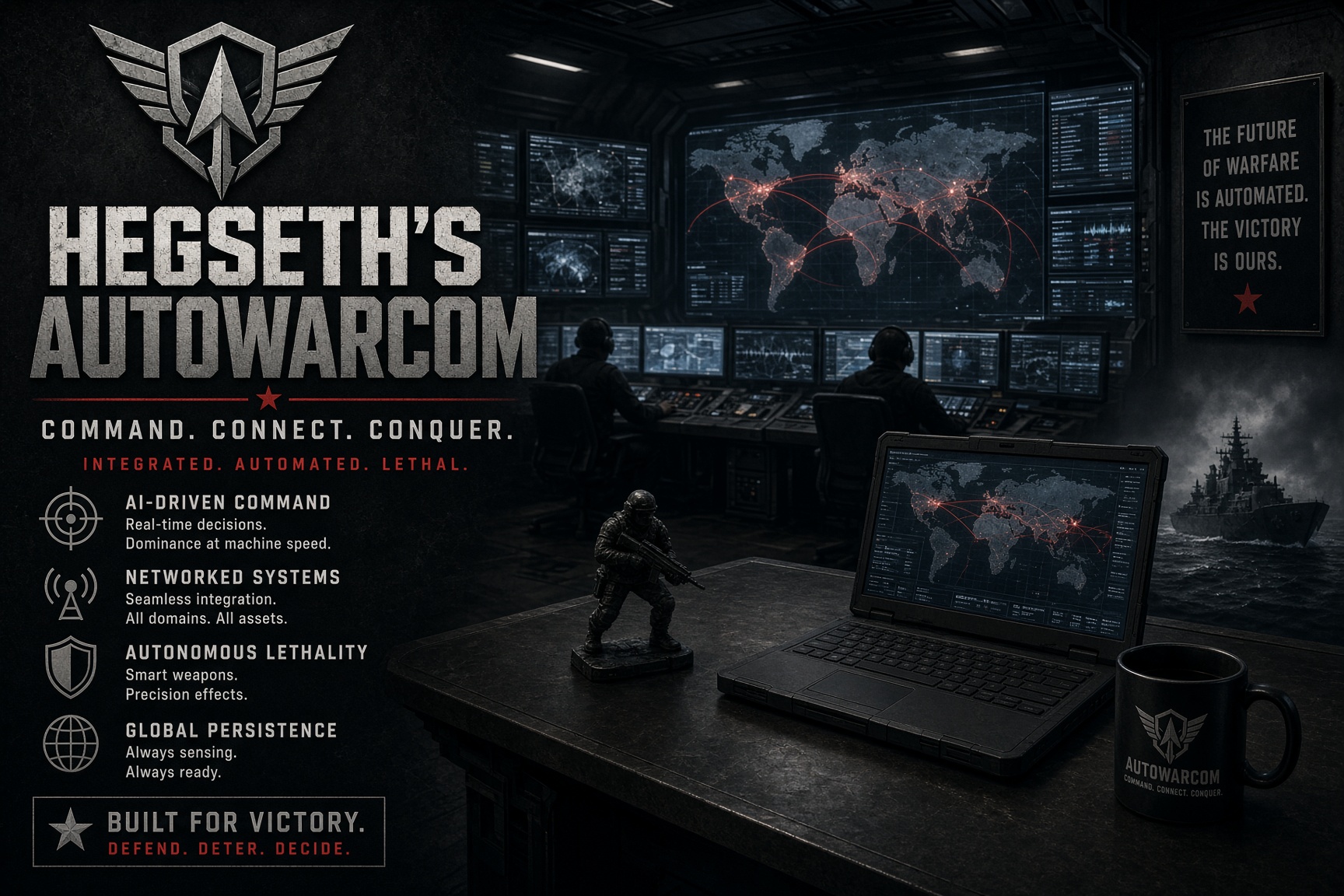
Hegseth's AutoWarCom: Who Builds It, What the Money Buys, and the Record It Needs
Pete Hegseth's Autonomous Warfare Command is a four-star proposal that needs Congress by 1 October 2027. Until then Project Agincourt holds the work, and the money moves through Drone Dominance, the Army's counter-drone contracts and DIU. The software layer, Palantir's Maven, Anduril's Lattice and Shield AI's Hivemind, is the one the KXCO AI Sector ontology had mapped before the speech. After Minab, its hardest problem is the record, not the model.
AI Development: The Token Got Cheaper, the Building Did Not
The useful fact on 28 September is a split, not a benchmark. Gartner puts 2026 AI spending at $2.67 trillion, and 56 percent of it is infrastructure against about 1 percent on the models. Inside one week the frontier cut the price of a token in half, Nvidia signed for the shelf the open weights sit on, and three closed labs proposed to run the test. What shipped, what it costs and where the money goes, with the AI sector checked against KXCO Ontology Live.
Every story, signed and delivered.
Subscribe to the kxco channel and get the headline, the AI-written key takeaways, and the chain-anchor link the moment we publish. Audio versions and per-ticker subscriptions arrive in the next iteration.