
Will Trump Bomb Iran After Market Close?
A risk-weighted assessment of probability, military posture, escalation pathways and market implications.
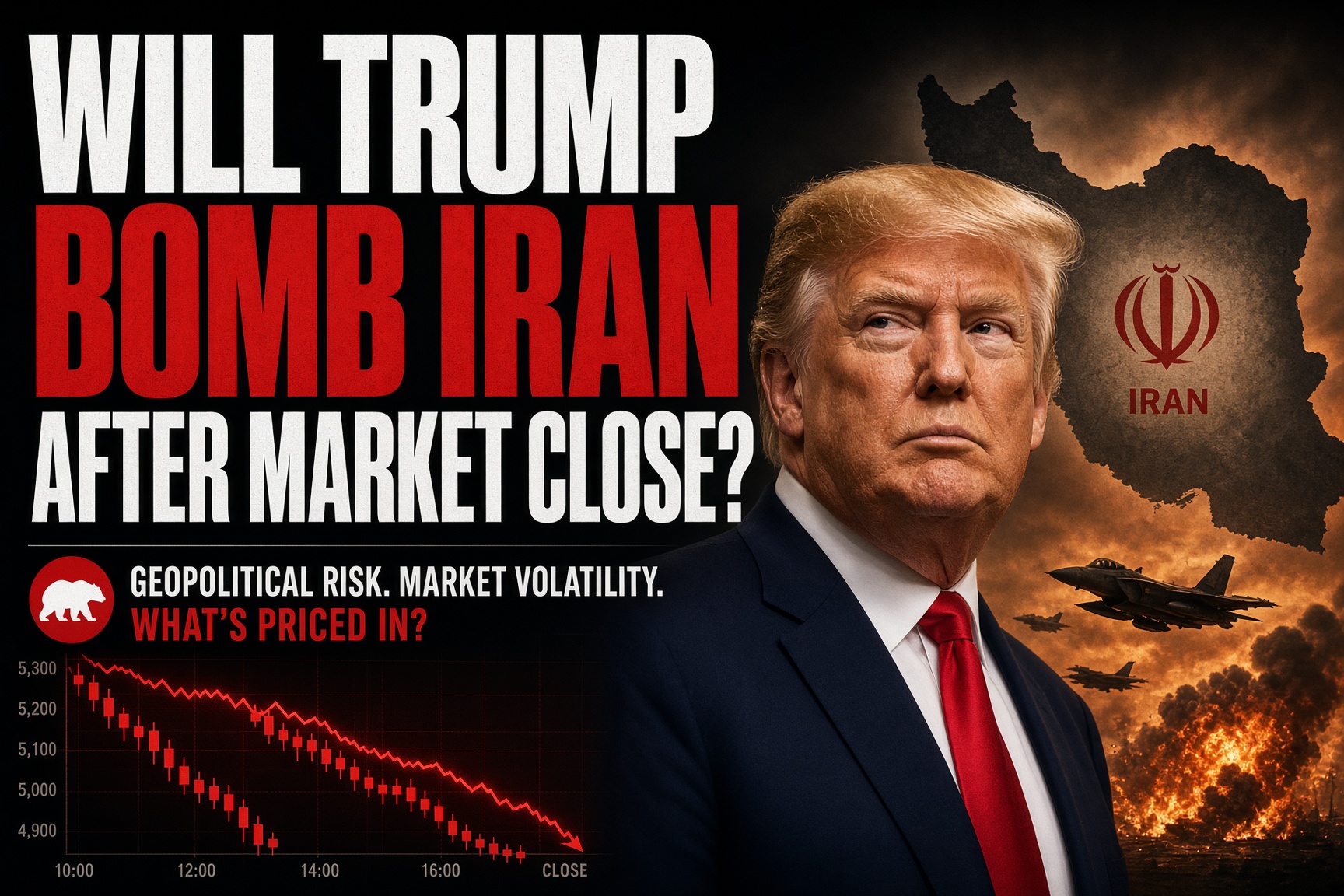
Analysis date: 30 October 2026. Speculative probability assessment: 70%.
Executive summary
This paper presents a structured, open-source assessment of the probability that the United States will conduct military strikes against Iran in the near term. It pays particular attention to the possibility that any such operation is initiated after US equity markets close. It draws on publicly reported force deployments, presidential statements and the trajectory of the regional conflict that began on 28 February 2026. On that evidence we assign a 70% probability to the authorisation of a significant US strike package within the next several weeks. That figure is a calibrated judgement that the combination of military readiness, post-midterm political incentives and stalled diplomacy outweighs the restraining factors of oil-price volatility, allied resistance and escalation risk.
US Central Command (CENTCOM) maintains, or is rapidly reinforcing, a substantial force posture capable of conducting precision strikes against Iranian military, nuclear and energy targets. Carrier strike groups, long-range bombers, land-based fifth-generation fighters and a dense network of guided-missile destroyers provide the capability for both limited and sustained operations. The United States has the means. The central questions are whether the political decision will be made and how Iran will respond. This analysis examines the military assets in place, the risk factors that could still prevent or constrain action, the market and geopolitical consequences that would follow, and the range of plausible scenarios.
Probability assessment and timing
The 70% assessment rests on several observable indicators. President Trump has said publicly more than once in October 2026 that further military action against Iran remains possible. On 23 October he said Washington "may do another little Epic Fury", and on 24 October that a strike could come as soon as "tomorrow", while leaving open the door to a negotiated settlement. Major outlets have reported that US and Israeli officials have discussed strike options timed after the 3 November midterm elections. The New York Times reported that the two countries have drawn up joint plans for an attack after the vote, Israel is building up for joint operations with the US, and officials told CNN an order could come any time before the end of the year, most likely after the midterms.
Axios reported earlier in October that the Pentagon had instructed CENTCOM to complete preparations for a possible resumption of major combat operations.
Trump's own pledge on 8 October that the US would not attack Iran before the midterms points to the same window. Force movements, including the deployment of additional carrier and amphibious groups, are consistent with the generation of executable options rather than a final order. The longer these concentrations are maintained without diplomatic progress, the higher the probability that they are used.
Timing relative to market close is a secondary but real consideration. A strike initiated after US equity markets close would allow overnight pricing in Asia and Europe to absorb the initial shock before the next New York open. That would reduce immediate volatility in US indices while still transmitting the signal of resolve. Historical precedents show that administrations sometimes prefer off-hours initiation for operational security and to manage domestic political optics.
The opening strikes of this war came on a Saturday, 28 February, with US markets shut, and Operation Midnight Hammer hit Fordow, Natanz and Isfahan from about 6:40 pm US Eastern time on Saturday 21 June 2025. However, large-scale operations involving multiple carriers and long-range bombers are rarely timed solely for market convenience; operational windows, weather, target vulnerability and force protection dominate. The "after market close" framing is therefore best understood as a plausible operational preference rather than a decisive constraint. Markets would still reprice energy, defence and regional risk assets rapidly regardless of the exact hour of initiation.
Several factors keep the probability below 90%. Diplomatic channels have not been fully closed: Saudi, Pakistani and Turkish officials met Iran's leaders in Tehran on 26 October in support of mediation by Qatar and Pakistan. European and Gulf partners continue to express preference for de-escalation: on 23 October the foreign ministers of the UK, France, Germany, Italy, Saudi Arabia and three other states met in Istanbul and cautioned the US against further attacks. Oil prices remain sensitive, and a sharp spike would carry domestic political costs. Iranian leadership has demonstrated a willingness to absorb limited damage rather than immediately escalate to full-scale regional war. Any of these elements could still produce a temporary pause. Nonetheless, the current force posture and public rhetoric make a near-term strike the higher-probability outcome under present conditions.
Military assets positioned for potential strikes
Open-source reporting at the end of October 2026 describes a significant US naval and air presence in the CENTCOM area of responsibility. While exact locations and readiness states remain classified, the publicly acknowledged elements include the following:
Aircraft carriers. USS George H.W. Bush and USS George Washington, both in the Arabian Sea; USS Theodore Roosevelt inbound, in the Philippine Sea on 26 October. Capabilities: F/A-18E/F Super Hornets, F-35C, EA-18G Growlers and E-2C and E-2D Hawkeyes; sustained air superiority and strike.
Guided-missile destroyers and cruisers. Arleigh Burke-class destroyers including Shoup, Donald Cook, Ross, Milius, Mason and John Finn, with the cruiser Princeton. Capabilities: Tomahawk land-attack cruise missiles; SM-2, SM-3 and SM-6 air and missile defence.
Amphibious forces. The USS Boxer amphibious ready group (ARG) in the Arabian Sea; the USS Makin Island ARG inbound with the 13th Marine Expeditionary Unit (MEU). Capabilities: Marine Expeditionary Units, force projection and recovery options.
Long-range bombers. B-2 Spirit and B-52 Stratofortress. In this war B-2s have flown from Whiteman Air Force Base, Missouri, and B-52s from the United States and from RAF Fairford in England. Capabilities: precision munitions including the GBU-57 bunker-buster, first used in Operation Midnight Hammer, stand-off weapons, large payload capacity.
Land-based air and tankers. F-35 and F-16 fighters, sent back in July. Jordan's Muwaffaq Salti took about 30 F-35As before the war and is now a major hub for US aircraft and several thousand service members. KC-135 and KC-46 tankers moved out of Al Udeid in Qatar before the war to bases in Europe and the Middle East, and Prince Sultan Air Base in Saudi Arabia became a refuelling hub. Capabilities: stealth strike, electronic warfare, aerial refuelling for extended range.
Intelligence, surveillance and reconnaissance (ISR) and unmanned systems. MQ-9 Reaper, U-2 and RC-135, P-8A Poseidon and MQ-4C Triton. Capabilities: persistent surveillance of Iranian naval, missile and air activity; target development.
A three-carrier concentration would represent an unusually dense force package. It would be only the second this year: Abraham Lincoln, Gerald R. Ford and George H.W. Bush were all in the region in April, the first time since 2003, when five carrier groups opened the invasion of Iraq. US officials call the current reinforcement the biggest buildup since then. Whether three carriers are on station at once depends on whether Theodore Roosevelt relieves George Washington at once or, as Maritime Executive expects, overlaps with it for weeks.
Combined with land-based fifth-generation fighters and long-range bombers, the posture supports a range of options from limited punitive strikes against missile and drone infrastructure to broader campaigns targeting nuclear facilities, energy export nodes and command-and-control sites. Iranian defences, hardened by prior experience in 2026, would still impose attrition risks, particularly against non-stealth platforms operating inside or near integrated air-defence zones. Stand-off munitions (Tomahawk, the Joint Air-to-Surface Standoff Missile Extended Range (JASSM-ER) and similar systems) reduce but do not eliminate the requirement for manned aircraft to penetrate defended airspace.
Force protection is a parallel consideration. US bases in the Gulf and naval vessels face higher threat levels from Iranian ballistic and cruise missiles as well as one-way attack drones. The presence of Aegis-equipped destroyers and land-based Patriot and Terminal High Altitude Area Defense (THAAD) batteries provides substantial defensive capacity, but saturation attacks remain a residual risk. Any operation would therefore include substantial effort to suppress Iranian launchers and degrade their command-and-control networks in the opening hours.
Weighing the risks
Military and escalation risks
Iran retains the capacity to respond with ballistic and cruise missiles, one-way attack drones and asymmetric naval tactics in the Strait of Hormuz, where, by 22 October, there had been 27 attacks on commercial ships that month, the most in any month since the war began, according to the International Maritime Organization (IMO).
Prior rounds of fighting in 2026 demonstrated that Iranian forces can generate salvos capable of saturating some defensive layers, even if overall accuracy and volume have been degraded by earlier strikes. On 27 March an Iranian missile attack wounded at least 10 US service members at a base in Saudi Arabia, and on 17 July a missile hit housing at a base in Jordan, killing three US soldiers. US bases in the Gulf (Al Udeid, Al Dhafra and others) and naval vessels would face higher threat levels. A broader Iranian response could also activate the Houthis and other proxy capabilities, expanding the conflict geographically.
The risk of miscalculation, particularly if Iranian leadership interprets a limited strike as existential, is non-trivial. While US air and missile defences have performed effectively in earlier exchanges ("We shot down almost all the missiles. One leaked through," Secretary of State Marco Rubio said of a July strike in Jordan), no defensive system is perfect against large, coordinated attacks. Casualties among US or allied personnel would rapidly alter political calculations in Washington.
A second-order military risk is the difficulty of achieving decisive effects against hardened or dispersed targets. Iranian nuclear infrastructure and missile production facilities have been the subject of extensive hardening. Bunker-buster munitions and persistent pressure can degrade these capabilities, but complete elimination in a short campaign is unlikely. This creates the possibility that strikes achieve tactical success while leaving residual capacity that Iran can later reconstitute, which would then require follow-on operations.
Economic and market risks
Oil prices remain the most immediate transmission channel. Brent crude settled at $114.88 a barrel on 29 October 2026. Even a limited strike that temporarily disrupts Iranian export capacity or raises insurance premiums for tankers transiting the Strait could push it $10 to $30 a barrel higher in the short term, depending on the duration and scope of disruption. Analysts at SEB, the Swedish bank, already see a significant risk premium in crude for a US or Israeli attack within weeks.
A more sustained campaign, or Iranian mining or temporary closure of the Strait, would produce larger spikes. Equity markets, particularly energy-intensive sectors and airlines, would face immediate pressure; defence contractors and certain commodity names would likely outperform. The Federal Reserve and other central banks would monitor inflation pass-through. Timing a strike after market close does not eliminate these effects; it shifts the first major price discovery to Asian and European sessions. Currency markets, particularly the dollar and safe-haven assets, would also reprice quickly.
Secondary economic effects include potential disruption to commercial shipping, higher freight rates and pressure on regional economies dependent on stable energy flows. Gulf states that host US forces could face both physical risk and capital outflows if the conflict widens. These considerations are well understood in Washington and form part of the internal debate over the scale and duration of any operation.
Political and diplomatic risks
Domestic political incentives are mixed. A successful, limited strike that degrades Iranian capabilities without US casualties could reinforce a narrative of strength. Conversely, a protracted engagement, significant US losses or a sharp oil-driven inflation spike would create political liabilities, especially if midterm results have already shifted congressional control.
Allied reactions also matter. European governments have generally preferred diplomacy, though Britain lets the US use its bases for what London calls defensive strikes; Gulf partners host US forces but remain sensitive to Iranian retaliation, and the State Department ordered non-emergency staff out of Saudi Arabia on 21 October. China and Russia would use any action to criticise US policy, as they did when the war began, and potentially increase economic support to Tehran. The New York Times reported in May that Russia has been shipping commercial goods and drone components to Iran through the Caspian Sea, while China's imports of Iranian crude through the Strait of Hormuz averaged about 530,000 barrels a day in July and August, 48% below pre-war levels, according to Kpler data. The absence of a clear exit strategy or defined success metrics increases the risk that limited strikes evolve into open-ended operations.
Plausible scenarios
Scenario 1: limited, time-bound strikes (higher probability within the 70% band). A multi-day campaign focused on missile production, drone facilities and selected nuclear-related sites, executed primarily with stand-off weapons and carrier aviation. Iranian response is contained; markets react sharply but recover as disruption proves temporary. Diplomatic channels remain open. This scenario aligns with reported discussions of a short, intense campaign: the Wall Street Journal reports Trump is leaning towards a short but intense wave of strikes, and he has spoken of "another little Epic Fury".
Scenario 2: a broader campaign targeting energy and regime infrastructure. Strikes expand to oil export terminals, the headquarters of the Islamic Revolutionary Guard Corps (IRGC) and deeper nuclear sites. Higher probability of significant Iranian retaliation and of Brent spiking well above its October settlement high of $116.72 on 23 October. Regional partners face direct pressure. Political costs rise quickly if the operation does not produce rapid, visible Iranian concessions. This outcome becomes more likely if limited strikes fail to alter Iranian behaviour, and the planning reported so far leaves room for it: one of the officials told CNN the next operation would be "a big effort", against a target list that includes Iranian energy infrastructure.
Scenario 3: a diplomatic pause or limited signalling. Despite force posture and rhetoric, negotiations produce a temporary understanding that defers major action. Markets price in reduced near-term risk. This outcome becomes less likely the longer force concentrations are maintained without diplomatic progress, but it remains possible if Iranian concessions on nuclear or regional issues materialise; Iran's president has said efforts to reach an agreement should continue.
Historical context of the 2026 conflict
The current crisis did not emerge in isolation. Earlier rounds of US and Israeli strikes in 2026, from Operation Epic Fury to the strikes of 1 September around the Strait of Hormuz, degraded portions of Iran's nuclear infrastructure, missile production capacity and air-defence network: the Pentagon counts more than 11,000 targets struck in the first 29 days, among them air defences and missile and drone manufacturing, and in March a site long linked to Iran's nuclear programme at Parchin was hit.
Those operations demonstrated both the reach of American and Israeli airpower and the residual resilience of Iranian systems. Iranian forces adapted by dispersing launchers, increasing use of decoys and emphasising asymmetric responses through proxies, and US intelligence described decoy sites, deep underground bunkers and dispersed storage in April. The present force posture reflects lessons from those exchanges: greater emphasis on stand-off weapons, improved defensive coverage for US bases, and a larger carrier presence to provide sustained sorties without relying solely on land bases that are within Iranian missile range. Prior operations also revealed the difficulty of achieving permanent effects against hardened targets without prolonged pressure.
Iranian adaptations have included greater reliance on mobile launchers, underground facilities and distributed production of one-way attack drones. US intelligence assessed in May that Iran still fielded about 70% of its mobile launchers and had restarted some drone production during the ceasefire. These measures raise the cost of subsequent strikes and increase the probability that residual capacity survives an initial wave. US planners have responded by emphasising persistent surveillance, rapid re-strike capability and the integration of Israeli intelligence and strike assets. The cumulative effect is a higher baseline of readiness on both sides than existed at the start of 2026.
Force generation timelines and operational constraints
The Abraham Lincoln's voyage home from the Middle East to San Diego, about 13,000 miles, was put at four to five weeks. Theodore Roosevelt left San Diego on 27 September and the Makin Island amphibious group the next day, and both are reported due in the region by the end of November, which shows that planners have been generating options for weeks. Once on station, a carrier can start sustained flight operations within hours of an order. Long-range bombers based in the continental United States can be launched with even shorter notice, provided tanker support is pre-positioned.
The current concentration therefore implies that the limiting factor is political authorisation rather than force availability: two US officials told CNN on 26 October that sufficient forces are already deployed and could act within 96 hours of an order.
Munitions stocks, particularly of certain precision-guided and bunker-busting weapons, are finite. By late April the US had fired more than 1,000 Tomahawks and about 1,100 JASSM-ERs, according to internal Pentagon estimates reported by The New York Times, which the White House disputed. The Center for Strategic and International Studies (CSIS) estimated in July that the US had used nearly two-thirds of its Patriot interceptors. Sustained operations would also require continuous tanker support and force-protection resources. These material constraints reinforce the likelihood that any initial package would be measured in days rather than weeks, with the option to expand if Iranian responses or political objectives demand it.
Even a 70% probability of some form of strike does not imply that the most expansive option will be chosen. Political leadership has repeatedly emphasised the desire for a limited, decisive action rather than open-ended war. Hegseth said as the war began: "This is not Iraq. This is not endless", calling it a "clear, devastating, decisive mission". Trump has spoken of "another little Epic Fury", and is reported to be leaning towards a short but intense wave of strikes.
Second-order effects on regional stability and markets
Any strike package would affect more than Iran and the United States. Iraq and Lebanon host Iranian-aligned groups that have fought this year: Iraqi militias targeted US facilities more than 600 times during the war, and Hezbollah opened fire on Israel on 2 March. US forces completed their withdrawal from Iraq on 30 September. In Syria, the government announced in April that US troops had handed over their bases, which Washington had not confirmed at the time, and CENTCOM says US forces continue counter-ISIS operations there; the new government is hostile to Iran and said in March it would stay out of the war unless attacked.
Saudi Arabia and the United Arab Emirates, while hosting American assets, have sought to limit their direct exposure: both publicly refused the use of their airspace and territory for an attack on Iran before the war, and Trump said in May that he held off a new bombardment at the request of the Saudi, Qatari and Emirati leaders. Reuters has also reported unpublicised Saudi strikes on Iran in late March, in retaliation for Iranian attacks on the kingdom.
Israel has conducted its own operations and is building up for potential joint operations with the US, but joint action also increases the complexity of deconfliction and public messaging. China and Russia would use the episode to advance narratives of US unilateralism while seeking commercial advantages in energy markets. These diplomatic and informational dimensions shape the risk calculus even when the military balance favours the United States.
Oil is the primary but not sole market channel. Shipping insurance rates, tanker day rates and the cost of capital for regional projects would all adjust. Defence equities historically outperform in the initial phase of kinetic operations involving US forces, and 2026 bore that out for the opening session. On Monday 2 March 2026, the first trading day after the Saturday strikes, Northrop Grumman $NOC (NYSE) rose 6.0%, RTX $RTX (NYSE) 4.7%, L3Harris $LHX (NYSE) 3.8%, Lockheed Martin $LMT (NYSE) 2.8% and General Dynamics $GD (NYSE) 2.2%, while the S&P 500 was flat, per Yahoo Finance closes. The opening gain did not hold across the group: by 29 October Northrop Grumman was 22.4% below and L3Harris 23.6% below their 27 February closes, RTX 1.6% below, Lockheed Martin 2.2% below and General Dynamics 3.9% above, while the S&P 500 was 12.2% higher.
Energy producers outside the immediate conflict zone also benefit from higher prices. Airlines, petrochemicals and import-dependent manufacturers face cost pressure. Currency markets typically see safe-haven flows into the dollar and the Swiss franc. On 2 March the dollar index rose nearly 1% and the franc reached its strongest against the euro since 2015, while the yen fell 0.6% to 157 per dollar on Japan's reliance on imported oil. These patterns are well documented from prior Middle East crises and would be expected to reappear, modulated by the scale and duration of any disruption to the Strait of Hormuz.
Indicators to monitor
Open-source observers can track several leading indicators. These include the final positioning of inbound carriers, the movement of additional tanker aircraft into the theatre, presidential statements that shift from conditional to more definitive language, and changes in Iranian force posture such as the dispersal of ballistic-missile units or the activation of naval mining assets. Oil futures curves and implied volatility in energy options also price in higher risk before kinetic action begins. Divergence between public rhetoric and actual force movements can signal either deception or genuine indecision. Continuous monitoring of these indicators provides the most reliable near-term guide to whether the assessed probability is rising or falling.
Conclusion
The combination of demonstrated military capability, public presidential statements and reported post-midterm planning supports a 70% probability assessment that significant US strikes on Iran will be ordered in the near term. The forces required for a range of options, from limited punitive action to a more ambitious degradation of Iranian military and nuclear capacity, are either in theatre or inbound. Risks of escalation, oil-price shocks and political blowback are real and material; they are the principal reasons the probability is not higher. Whether any operation is timed precisely after US market close is secondary to the larger operational and political calculations. Markets and policymakers should prepare for higher volatility in energy prices, defence equities and regional risk premiums, while recognising that the ultimate decision remains with the President and can still be altered by diplomatic developments or unexpected events.
The situation remains fluid. Additional force movements, Iranian actions or diplomatic signals could shift the probability assessment within days. Continuous monitoring of open-source indicators (carrier locations, tanker and bomber deployments, presidential rhetoric and oil-market pricing) provides the most reliable near-term guide to whether the assessed probability is rising or falling.
Stocks mentioned: $NOC (NYSE), $RTX (NYSE), $LHX (NYSE), $LMT (NYSE) and $GD (NYSE).
Shayne Heffernan, Ph.D., is the founder of the KnightsBridge Group (shayneheffernan.com).
This article is a speculative analytical assessment based on publicly available information as of 30 October 2026, with each sourced figure linked. It does not constitute investment advice, a prediction of certainty or advocacy for military action, and is not a solicitation to buy or sell any security.
The State of the AI Market in Wartime: Chips, Power and the Defence AI Companies
The AI market is now decided by physical capacity, and this year it went to war. US forces used Palantir's Maven against 13,000 targets in the 38 days of Operation Epic Fury, per the Pentagon's AI chief, while hyperscalers called for about $730 billion of 2026 capital spending, per CNBC. Shayne Heffernan reads demand, chips, power, the Gulf escalation around the 3 November midterms, and the defence AI companies: Palantir, SpaceX and xAI, Anthropic, OpenAI, Alphabet, Anduril and Shield AI.
Hegseth's AutoWarCom: Who Builds It, What the Money Buys, and the Record It Needs
Pete Hegseth's Autonomous Warfare Command is a four-star proposal that needs Congress by 1 October 2027. Until then Project Agincourt holds the work, and the money moves through Drone Dominance, the Army's counter-drone contracts and DIU. The software layer, Palantir's Maven, Anduril's Lattice and Shield AI's Hivemind, is the one the KXCO AI Sector ontology had mapped before the speech. After Minab, its hardest problem is the record, not the model.

Wall Street Week Ahead: Rates, Oil, AI, Quantum, Defense, Metals and Bitcoin
The trading week opens after a Federal Reserve that chose to hike, a White House that chose not to strike Yemen, and an oil market still pricing a war now in its seventh month. The useful work this week is not a list of tickers. It is a map of what depends on what: the funds rate, the Magnificent Seven, a quantum cohort just handed a specification and a deadline, the missile primes selling into a restock, and gold, silver, crude and Bitcoin, all held against the live AI sector ontology.

Weekly Market Outlook: Gold, Bitcoin, Oil, Silver and the AI Quantum Cycle
A Sunday strike on Larak Island put the Hormuz premium back on, Warsh put a September hike back on the table, and Friday NFP decides both. Full daily-chart levels for stocks, gold, silver, oil and Bitcoin, plus three figures from the KXCO ontology showing what actually breaks the AI trade.
Every story, signed and delivered.
Subscribe to the kxco channel and get the headline, the AI-written key takeaways, and the chain-anchor link the moment we publish. Audio versions and per-ticker subscriptions arrive in the next iteration.