
AI Governance Infrastructure Will Define Institutional Risk
As AI agents move from chat to action, control is shifting from policy to infrastructure — and it will define institutional risk through 2030.
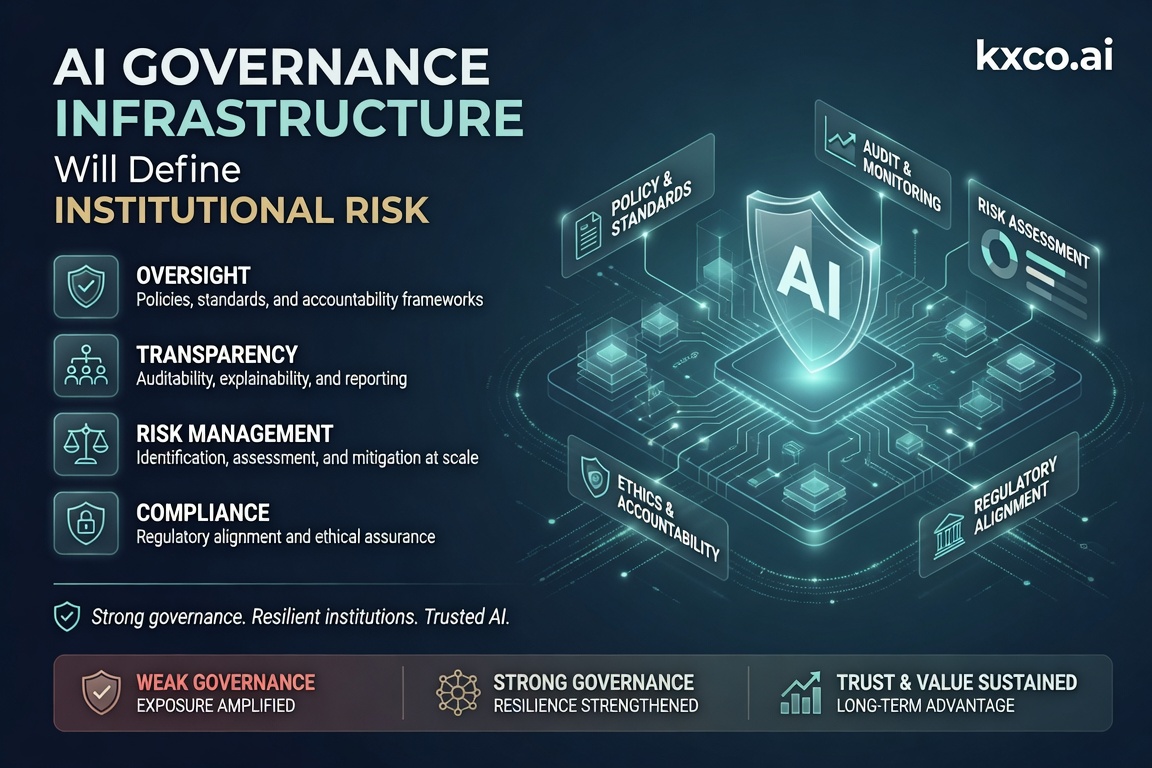
The rapid rise of AI agents is forcing institutions to confront a problem they have largely avoided until now: how to maintain control when intelligence becomes autonomous.
For the past two years, most organizations treated AI governance as a policy and compliance exercise. They wrote guidelines, implemented basic guardrails, and relied on prompt engineering to keep models in check. That approach worked while AI remained mostly conversational. It is already breaking down as agents begin taking real actions inside enterprise systems.
By 2027–2028, many institutions will have dozens or hundreds of AI agents operating across trading, compliance, client servicing, and operations. The question is no longer whether these agents can perform tasks. The question is whether institutions can prove what they were authorized to do, restrict what they should not do, and maintain full visibility and control over their actions.
This shift moves AI governance from a soft compliance topic into a hard infrastructure problem — and it is the single most under-priced source of institutional risk heading into the second half of this decade.
From Chat to Action: The Change Nobody Fully Priced In
To understand why the ground has shifted, it helps to be precise about what changed. A conversational assistant has a built-in safety property: a human sits between the model's output and any consequence. If the model produces something wrong, biased, or non-compliant, a person can catch it before it matters. In that world, governance can reasonably live at the edge — a filter on the way out, a usage policy the employee is expected to follow, a review step before anything is acted upon.
An AI agent removes that human buffer by design. The entire point of an agent is that it closes the loop: it reads a situation, decides, and executes without waiting for a person at each step. A research agent queries internal databases and external feeds and drafts a memo. A reconciliation agent compares ledgers and posts adjusting entries. A client-servicing agent updates records and triggers workflows. A trading-support agent assembles positions, checks limits, and — increasingly — routes orders. The moment the human leaves the loop, the edge-level controls that assumed a human was present stop protecting anything.
This is not a speculative future. The major enterprise software platforms have already made tool-calling, function execution, and multi-agent orchestration standard features. Interoperability conventions that let agents discover and call tools — and each other — have moved from research demonstrations into production systems. The practical consequence for any institution is that the number of autonomous decision-makers inside its walls is set to grow by an order of magnitude, and each one can act at machine speed and machine scale.
For a trading firm or an asset manager, that is not an abstract IT concern. It is a direct question about the integrity of the book, the enforceability of mandates, and the ability to answer a regulator's questions. An agent acting at machine speed does not make the same mistake a human makes once; it can make it a thousand times before anyone notices, and — under current governance approaches — often without leaving a record clear enough to reconstruct what happened.
The Current Governance Gap
Most current approaches to AI control operate at the application or model layer. They include output filtering, content moderation, and simple permission systems. These tools can reduce obvious risks, but they have fundamental limitations when scaled.
First, they are model-dependent. When an institution switches models or uses multiple models, governance rules often need to be rebuilt. This matters more than it sounds. The frontier of model capability is moving quickly, and the "best" model for a task changes from quarter to quarter. An institution whose controls are welded to a specific model or vendor pays a rebuilding tax every time it wants to adopt something better — and, in practice, that friction either slows adoption or, worse, tempts teams to deploy new models without re-implementing the controls.
Second, they lack strong identity and attribution. It is difficult to cryptographically prove which agent took an action and under whose authority. Most enterprise systems still identify software with shared service accounts and API keys that many processes use in common. When something goes wrong, the institution is left correlating logs and inferring which process was responsible, rather than pointing to a signed, non-repudiable record. Inference is not evidence, and in a dispute or an examination the difference is decisive.
Third, most systems do not provide tamper-evident records of decisions and actions. Ordinary application logs can be edited, rotated, or lost, and their integrity rests entirely on the honesty and competence of whoever operates them. This creates serious challenges for audit, regulatory reporting, and incident investigation. An audit trail that the operator could have altered is, from a regulator's standpoint, not much of an audit trail at all.
The result is a growing disconnect between what institutions say they control and what they can actually demonstrate under scrutiny. Call it the demonstration gap. It is invisible on a normal day and catastrophic on a bad one — because it only reveals itself when an incident, an audit, or a regulator forces the question, and by then it is too late to close.
Regulators are beginning to notice. Frameworks such as the EU AI Act, evolving U.S. financial-services guidance, and emerging standards around algorithmic accountability are increasing expectations around transparency, auditability, and human oversight. The EU AI Act's obligations phase in over 2025–2027, with escalating requirements for high-risk systems around record-keeping, human oversight, and transparency. In the United States, supervisors have signaled that long-standing model-risk management expectations extend to AI, and that "we have a policy" is not a substitute for demonstrable control of a specific automated decision. Institutions that cannot produce clear records of agent behavior will face increasing compliance risk — and, in the more aggressive enforcement scenarios, findings that carry capital and reputational consequences.
Why Infrastructure Matters More Than Policy
Effective governance at scale requires moving control from policy documents into the underlying data and transaction layer. This means treating identity, permissions, authority, and history as structured, enforceable elements rather than after-the-fact documentation.
The analogy from financial markets is instructive. Institutions do not enforce settlement integrity by asking each trading application to behave well and writing a policy about it. They enforce it through shared infrastructure — clearing, settlement, and record-keeping systems — that every application must transact through, and whose records are authoritative precisely because they do not depend on any single application's honesty. Governance of financial reality lives in the plumbing, not in the policy manual, and that is why it holds up under stress and under scrutiny.
AI governance has not yet made that move. It still lives in prompts, application code, and PDF policies, which is exactly why it produces the demonstration gap. When governance exists at the infrastructure level instead, several things become possible:
Every participant — human or AI — operates with a verifiable identity. Software is identified with the same strength as people, so the question "who did this?" has a real answer.
Permissions are scoped, revocable, and enforced at the point of action. Authority is checked at the gate every action passes through, not requested in a prompt or assumed from a role assigned months earlier.
Every significant action is cryptographically signed and anchored to an immutable record. The audit trail is a by-product of the action itself, not a log someone maintains separately and hopes is complete.
Institutions can prove authorization and execution independently of any specific model or application. Control is decoupled from the thing being controlled.
This approach decouples governance from individual models. It allows institutions to use the best available AI tools while retaining ownership and control over their operational reality. That decoupling is not a technical nicety; it is a strategic hedge. In a market where model capability is a moving target and vendor lock-in is a real liability, the institution that owns its governance layer can adopt each generation's best model without rebuilding its controls, while a competitor whose governance is trapped inside a single platform cannot.
The Role of Ontology in AI Governance
An ontology in this context is more than a data model. It is a shared, typed representation of an institution's reality — including entities (people, accounts, assets, agents), relationships, permissions, and events. When properly designed, the ontology becomes the single source of truth for what exists and what is allowed.
The foundational move is to stop representing reality as bare values and start representing it as typed claims. A balance, a holding, a valuation, an ownership link, a permission — none is stored as a naked fact. Each is a claim that carries its own provenance: who asserted it, on what basis, as of when, with what confidence, and with a link to its source. A number in a conventional system says "the position is X." A claim in an ontology says "the position is X, asserted by this party, backed by this evidence, as of this timestamp, verifiable here." That is the difference between data and evidence — and governance runs on evidence, not data.
By making authority and permissions first-class elements within the ontology, institutions can enforce rules consistently across any system or agent that interacts with it. Actions taken against the ontology can be validated against current permissions before execution. Every change can be recorded with cryptographic proof of who authorized it and when. This is the property that matters most for autonomous systems: because authority lives in the model as data, an AI agent becomes a first-class actor governed exactly like a human — an identity holding a specific, revocable grant of authority, whose every action carries proof of who authorized it and precisely what changed.
This creates a governed environment where AI agents can operate productively while remaining within clearly defined boundaries. It also provides the audit trail that regulators and risk teams increasingly require. Consider what this means in a specific case. A portfolio manager delegates authority to an execution-support agent: it may act in a defined set of books, in defined instruments, up to a defined notional, within defined risk limits, and only until a defined time. Because that authority is data checked at the point of action, an order that would breach a limit or touch a restricted name simply does not execute — the permission fails and the action never becomes real. Every order the agent does assemble is signed and recorded. When compliance later asks to see every action the agent took last quarter and the authority each one relied on, the answer is a retrieval, not a forensic reconstruction.
There is a further design point worth drawing out for a governance audience: a well-built ontology refuses to fabricate. Where information is undisclosed or unproven, it is represented as an explicit opacity state, not silently filled in with a guess. That discipline — no bare values, no invented relationships, opacity instead of assumption — is exactly what an institution needs when a regulator asks how it distinguishes what it knows from what it assumes. It is also, notably, demonstrable rather than merely claimed: the same typed-claim model can be shown working on public data before it is ever pointed at an institution's closed data.
The Post-Quantum Dimension
Post-quantum cryptography adds another critical dimension. As quantum computing advances, institutions must ensure that identity, signatures, and historical records remain secure over long periods. Governance systems built on classical cryptography face future obsolescence. Infrastructure designed with post-quantum standards from the beginning provides stronger long-term assurance.
The logic is a mismatch between two timelines. The first is the lifetime of an institutional record. Authorizations, contracts, audit trails, and identities must remain verifiable and non-repudiable for years and often decades — as long as liability, litigation, and regulatory look-back periods can reach. The second is the arrival of a cryptographically relevant quantum computer capable of breaking the RSA and elliptic-curve cryptography that secures virtually all classical digital signatures and key exchange in use today. No one can date the second timeline precisely. But institutions do not need a date to face the exposure, because of a specific attack pattern known as "harvest now, decrypt later."
An adversary does not need a quantum computer today to threaten data and signatures created today. They can capture encrypted traffic, signed records, and identity material now and store it, then decrypt or forge it once a capable machine exists. For anything meant to stay confidential or non-repudiable over a long horizon, the relevant question is not "can this be broken today?" but "will this need to be trusted after classical cryptography falls?" For a governance record — the very thing an institution may need to defend a decade from now — the answer is plainly yes. A governance foundation built on classical signatures is a record with a hidden expiry date.
This is no longer a research topic. The U.S. National Institute of Standards and Technology finalized its first post-quantum cryptography standards in 2024 — including the algorithms now referenced as FIPS 203 (key encapsulation) and FIPS 204 (digital signatures) — and national security agencies have published migration timelines urging organizations handling long-lived sensitive data to begin the transition. For institutions, the choice is between building the governance foundation on post-quantum standards now and migrating under deadline pressure later. The first is a design decision; the second is a costly remediation project layered on top of an ever-growing estate of records that were never protected in the first place.
Implications for Institutional Investors and Trading Firms
For asset managers, hedge funds, banks, and other financial institutions, the stakes are particularly high. AI agents are already being used for research synthesis, trade idea generation, compliance monitoring, and even execution in some cases. As these systems gain more autonomy, the potential for unintended consequences grows.
A governance failure could result in unauthorized trading activity, compliance breaches, or loss of client assets. Even without direct financial loss, the inability to demonstrate control during regulatory reviews or audits creates material risk. It is worth dwelling on the specific ways this shows up on a trading floor. An agent operating outside its mandate is a limit breach. An agent trading a restricted name is a compliance event. An agent whose actions cannot be attributed with certainty is an unauditable position. An agent that cannot be cleanly and instantly switched off is an uncontainable incident. Each of these is a familiar category of operational risk — but autonomy multiplies both the speed at which they can occur and the difficulty of proving, afterward, exactly what happened.
Institutions that invest early in proper governance infrastructure will have several advantages. They will be better positioned to pass regulatory scrutiny. They will reduce operational risk from agent behavior. They will also maintain greater strategic flexibility, as they can adopt new AI models without rebuilding their control framework each time.
There is a deeper competitive point here that is easy to miss. The prevailing assumption is that firms must choose between moving fast on AI and staying in control. Infrastructure-level governance breaks that assumption. When control is deterministic, evidentiary, and model-independent, the firm that has it can deploy autonomous systems more aggressively, not less — it can push agents into higher-consequence work precisely because it can prove and contain what they do. Governance stops being the brake and becomes the accelerator. Over a five-year horizon in which AI capability diffuses and the real differentiator becomes the confidence to apply it, the firm that can safely say yes to autonomy will out-execute the one that must cautiously say no.
Conversely, organizations that continue relying primarily on policy and application-level controls may find themselves at a disadvantage as agent adoption accelerates and regulatory expectations rise. The disadvantage compounds. An institution that scales agents on application-layer governance is not merely accepting today's demonstration gap; it is building an ever-larger estate of ungoverned action on top of it, and the eventual remediation grows with the estate. The cheapest time to place governance at the infrastructure layer is before the agent population scales.
The Multi-Agent Problem: When Agents Delegate to Agents
There is a second-order risk that most governance conversations have not yet reached, and it is the one most likely to catch institutions off guard. The early picture of agentic AI is a single agent doing a bounded task. The picture that is actually emerging is a network: agents that call other agents, orchestration layers that spawn sub-agents to handle pieces of a workflow, and third-party or partner agents that interact with an institution's own. In that world, authority is not a single grant from a human to a piece of software. It is a chain — a human authorizes an orchestrator, which delegates to a planner, which invokes a specialist, which calls a tool that touches a system of record.
Every link in that chain is a place where authority can be widened, lost, or obscured. If delegation is implicit — if an agent simply inherits whatever access the process it runs under happens to have — then by the third or fourth hop no one can say with confidence what the final actor was actually permitted to do, or trace the action back to the human who set the chain in motion. This is how privilege quietly escalates and how attribution dissolves. It is the agentic equivalent of the transitive-trust problems that have plagued software supply chains, except that it operates at machine speed and inside the institution's own walls.
Infrastructure-level governance is the only clean answer to this, because it makes delegation itself explicit and typed. When authority is data in a shared ontology, each delegation is a recorded grant that references the authority it derives from, cannot exceed it, and expires or is revocable independently. The chain from any action back to an accountable human principal is always reconstructable, because every hop left a signed record. An agent cannot quietly acquire more authority than its delegator held, because the check happens at the point of action against the actual grant, not against whatever ambient permissions the runtime environment offers. For institutions planning multi-agent systems — which, within a few years, will be most of them — this is not an edge case to handle later. It is the core of what the governance layer has to get right from the start.
Beyond Finance: The Same Problem, Higher Stakes
Although the risk is most acute on a trading floor, the pattern generalizes to every regulated sector, and the sectors with the longest-lived data face the sharpest version of the post-quantum problem. In healthcare, agents coordinating admissions, records, scheduling, and consent operate on data that must remain confidential and verifiable for decades — a near-perfect profile for the harvest-now-decrypt-later exposure, and a domain where a withdrawn consent must propagate to the point of action rather than to a policy someone is supposed to remember. In insurance and pensions, obligations and the records that evidence them can outlive the systems that created them by a generation. In government and critical infrastructure, the requirement to prove who authorized an automated action, and that the record has not been altered, is not a competitive nicety but a matter of public accountability.
The common thread is that autonomy concentrates risk wherever action has consequences, and the ability to prove control is itself increasingly a legal requirement rather than a best practice. The institutions across these sectors that treat governance as owned infrastructure — a typed model of their reality with authority as enforceable data, anchored to a durable, post-quantum record — will be the ones that can deploy AI against their most sensitive processes while retaining sovereignty over their data and a verifiable account of every authorized action. Those that cannot will face a choice between holding AI back from the work where it is most valuable and deploying it where they cannot prove they are in control. Neither is a comfortable position, and both are avoidable.
What Boards and Risk Officers Should Do Now
The practical implications for leadership are concrete. First, reframe AI governance as an infrastructure decision, not a compliance line item — and give it an owner with a mandate to build across models and applications rather than inside any one of them. Second, run an internal test of the demonstration gap: pick a representative automated action and ask the teams to produce, on demand, cryptographic proof of which actor took it and under whose authority. The difficulty of answering is a direct measure of exposure, and it is far cheaper to discover it in a drill than in an examination.
Third, insist that governance be model- and vendor-independent, so that adopting a better model next year does not mean rebuilding controls. Fourth, move from roles assigned at setup to permissions checked at execution — with delegation that traces back to an accountable human and revocation that takes effect at the next attempted action. Test the ability to revoke under stress before it is needed. Fifth, require an audit trail whose integrity is mathematical rather than procedural; application logs are not an audit trail. And sixth, adopt post-quantum cryptography for anything long-lived, because governance records must outlast the cryptography protecting them today.
None of this requires an institution to bet on a single vendor's vision. It requires accepting a single argument: that scaling autonomous action on governance that cannot be enforced or proven is a position the combination of rising agent populations and rising regulatory expectations will make untenable well within this decade. This is the thesis behind a new category of infrastructure — typed ontologies that make authority enforceable data, anchored to post-quantum ledgers that make the record durable and independently verifiable — that firms including KXCO are now building for regulated institutions. The specific implementation matters less than the recognition that the layer is missing and needs to be built.
The Path Forward
The next phase of institutional AI adoption will be defined less by model performance and more by the quality of the governance layer underneath. Institutions that treat governance as an infrastructure problem — rather than purely a compliance or policy problem — will be better equipped to manage risk while capturing the benefits of autonomous systems.
This requires moving beyond conversations about guardrails and toward concrete architectural decisions about identity, authority, and verifiable action. It also requires recognizing that control at scale depends on having a consistent, enforceable model of reality that both humans and AI systems can operate within.
The institutions that get this right will not only reduce risk. They will also create a durable foundation for using AI more aggressively and confidently across their operations. Over the next five years, that foundation — not the choice of model — will be the line that separates the institutions that scaled AI safely from the ones that scaled their risk without knowing it.
Shayne Heffernan writes on markets, technology, and institutional finance for Live Trading News.

KXCO is Enhanced Intelligence, Not Artificial
I never wanted artificial intelligence. I wanted enhanced intelligence, and they are not the same product. Artificial means the machine does the thinking and hands you the answer. Enhanced means I do the thinking, with more of my own mind in the room than I have ever had at one time. Forty years of reading, recallable in the second I need it. Patterns across law, credit, physics and markets that no specialist sees, because the useful ones sit between the fields rather than inside them.

Your AI Agent and the Law: Who Acted, By What Right, and What You Can Prove
Your agent already acts in a legal system that was built for people. No new statute is needed for a payment it releases to be an act of your institution. Twelve months later a court asks who acted, by what right, and what can be reconstructed, and an export from a product you do not own is not a file. KXCO writes the act quantum-signed, time-stamped and marked on chain before the dispute. Knightsbridge Law sits on every Round Table ontology, so counsel is at the table before the act.
The AI Safety Argument Is Being Held in the Wrong Room
The people who will be blamed for what AI does are not in the room where its safety is argued. A jailbreak escapes a policy. The failure that costs money is an action that escapes an owner, a payment sent or a record altered. Tokens are not authority. Intelligence got cheap and judgment did not, and there is no organ of standing you can copy into a model. Shayne Heffernan on the objection worth taking seriously, and the questions to take into a vendor meeting.

The Problem Is Not the Problem
People treat the Jack Sparrow line as a joke. The attribution is a joke. The sentence is not. Forty years in markets says the same thing Epictetus said in 125 CE and Robert Merton named in 1948: the event is finite, and the story you appoint to govern it is not. This essay walks the quote back to its actual sources, draws the loop that turns a feeling into an order, and sets out the four places a rule written in advance cuts the loop. Faith is not a hedge. It is a stance.
Every story, signed and delivered.
Subscribe to the kxco channel and get the headline, the AI-written key takeaways, and the chain-anchor link the moment we publish. Audio versions and per-ticker subscriptions arrive in the next iteration.