
WEF Fragmentation Principles: Where KXCO Actually Fits
The Infrastructure of the Future
WEF Fragmentation Principles: Where KXCO Actually Fits
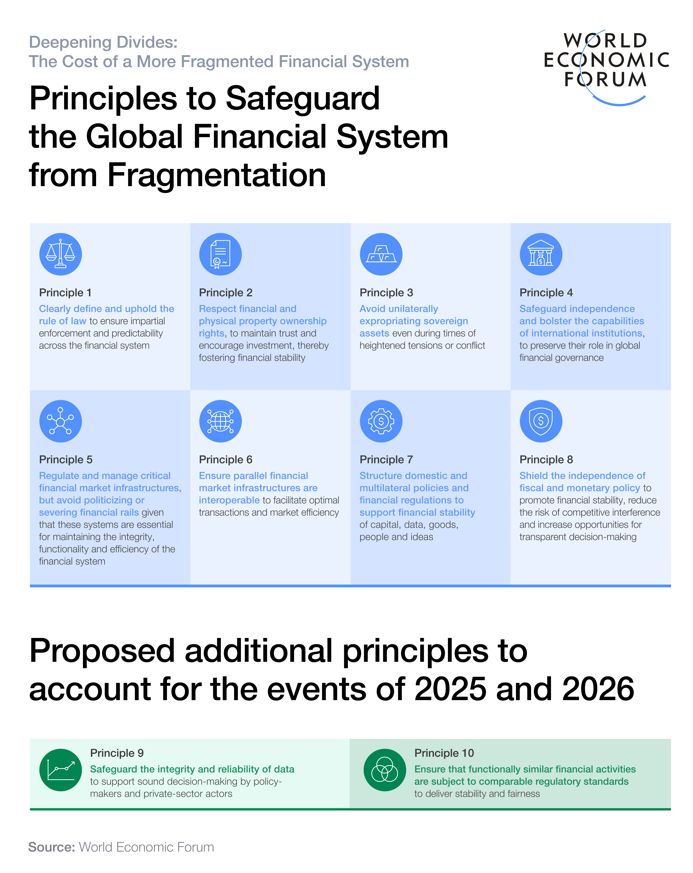
The World Economic Forum added Principles 9 and 10 because the original framework was no longer enough. Fragmentation in the financial system has moved beyond competing national rules. It now includes unverifiable data, inconsistent compliance across platforms, and infrastructure that cannot survive quantum computing.
Here are the ten principles:
The Ten Principles
Principle | Description |
|---|---|
Principle 1 | Clearly define and uphold the rule of law to ensure impartial enforcement and predictability across the financial system. |
Principle 2 | Respect financial and physical property ownership rights to maintain trust and encourage investment. |
Principle 3 | Avoid unilaterally expropriating sovereign assets even during times of heightened tensions or conflict. |
Principle 4 | Safeguard financial independence and strengthen the role of international institutions in global financial governance. |
Principle 5 | Regulate and manage critical financial market infrastructures without politicising or severing them. |
Principle 6 | Ensure parallel financial market infrastructures are interoperable. |
Principle 7 | Structure policies and financial regulations to support overall financial stability. |
Principle 8 | Protect the independence of fiscal and monetary policy and reduce risks of competitive interference. |
Principle 9 | Safeguard the integrity and reliability of data to support sound decision-making by policymakers and private actors. |
Principle 10 | Ensure that functionally similar financial activities are subject to comparable regulatory standards. |
Principles 9 and 10 were added later. They directly address problems that became clear after 2025 — disputed data in tokenised markets, stablecoins operating under inconsistent rules, and the fact that current cryptography has a limited lifespan.
Where KXCO Fits
KXCO’s Armature L1 was built as post-quantum settlement and identity infrastructure with compliance rules enforced at the protocol level. This creates a strong connection to several of these principles.
Here is the mapping:
Principle | Fit | Strength | Explanation |
|---|---|---|---|
5 | Strong | High | Armature L1 operates as post-quantum critical financial infrastructure with no single point of control. |
7 | Strong | High | Protocol-level enforcement of Travel Rule and basic compliance reduces regulatory arbitrage and supports stability. |
9 | Very Strong | Very High | On-chain attestations and post-quantum signatures deliver verifiable data that regulators and institutions can trust without relying on any single party. |
10 | Very Strong | Very High | Protocol-level rules make it technically difficult to perform regulated functions without meeting defined standards. |
KXCO aligns most strongly with Principles 5, 7, 9, and 10 — the areas where infrastructure can actually reduce fragmentation risks in practice.
Principle 5 is about protecting critical financial market infrastructure. Armature L1 was designed from the ground up to remain secure and verifiable after quantum computers arrive.
Principle 7 focuses on stability. By enforcing key compliance rules at the protocol level, Armature L1 makes consistent outcomes more achievable across platforms and jurisdictions.
Principle 9 is the clearest fit. It requires reliable data for decision-making. Armature L1 records attestations about software state and configuration on-chain with post-quantum signatures. This gives regulators and institutions a way to verify what is actually running.
Principle 10 addresses regulatory arbitrage. When the same activity can be done under much weaker rules on another platform, the system becomes unstable. Protocol-level enforcement narrows that gap.
These are exactly the issues the World Economic Forum identified as newly critical after 2025. Armature L1 was built to operate in that environment.
Why This Matters
Most financial infrastructure still treats compliance and long-term cryptographic security as afterthoughts. This creates the exact problems Principles 9 and 10 were written to fix — unverifiable data, inconsistent rules, and records that will not survive quantum computing.
Armature L1 was designed the opposite way. Quantum resistance, protocol-level compliance, and verifiable attestations were core requirements from the beginning. That is why the alignment with the newer principles is direct.
Practical Impact
For institutions dealing with tokenisation or stablecoins, the gap between current systems and what these principles expect is becoming expensive. Armature L1 reduces that gap by embedding compliance and data integrity at the base layer.
Armature L1 gives them infrastructure that can actually deliver verifiable data and consistent compliance without waiting for perfect regulatory harmonisation between countries.
Bottom Line
KXCO aligns strongly with the principles that matter most in 2026 — particularly Principles 5, 7, 9, and 10. These are the areas where post-quantum, compliance-native infrastructure can meaningfully reduce fragmentation risks.
Armature L1 was built for exactly this environment. That is the real opportunity.
Quantum Cybersecurity: The KXCO Chain Is Already Running
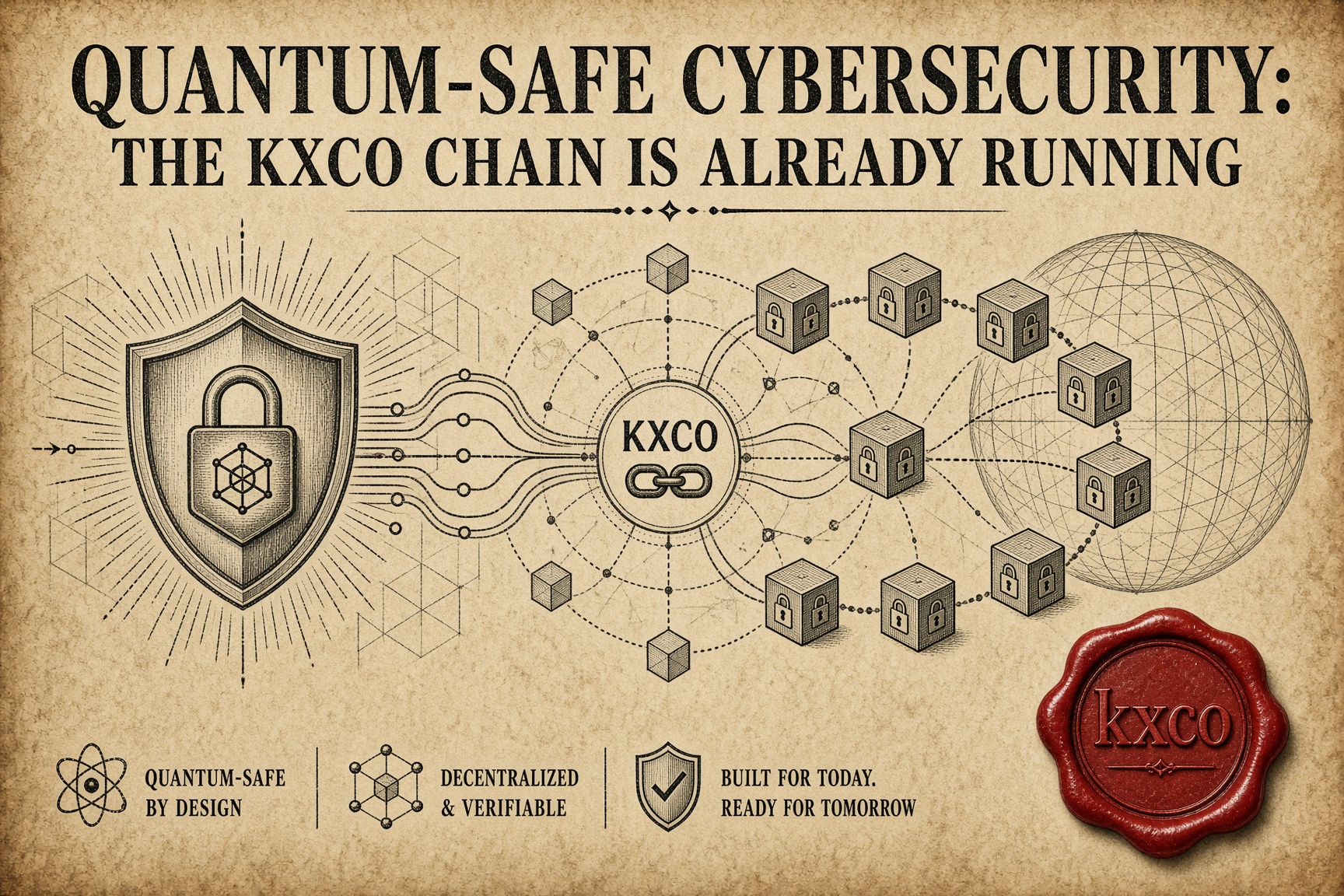
The World Economic Forum warned on 11 September that the quantum-safe race has changed gears. It is right about the direction and late about the work. Every KXCO product already runs on NIST's post-quantum algorithms, and all of them run on the same implementation: 42 package manifests declare one library. The chain verifies ML-DSA-65 on-chain at precompile 0x0b, tested live with three negative controls. NIST's own grader marked the library at 2,130 cases and zero failures.

NIST Graded Our Post-Quantum Cryptography. Zero Failures.
NIST's Algorithm Validation Test System generated test vectors nobody had seen, we answered them over the ACVP protocol, and NIST graded the result: 2,130 cases across ML-KEM, ML-DSA and SLH-DSA in every parameter set offered, zero failures, demo certificate A11025. This is what that proves, where we deliberately drew the claim narrower than NIST's own matrix, and why the FIPS 140-2 sunset on 21 September makes the distinction between being graded and grading yourself worth understanding.

The Problem Is Not the Problem
People treat the Jack Sparrow line as a joke. The attribution is a joke. The sentence is not. Forty years in markets says the same thing Epictetus said in 125 CE and Robert Merton named in 1948: the event is finite, and the story you appoint to govern it is not. This essay walks the quote back to its actual sources, draws the loop that turns a feeling into an order, and sets out the four places a rule written in advance cuts the loop. Faith is not a hedge. It is a stance.

What the KXCO Ontology Exposed While the Market Stood Still
On 25 August the KXCO AI Sector Ontology stamped a fresh set of rows. Sixteen days later the Nasdaq had gone nowhere and ten of those names were up: Intel 14.68%, Meta 13.04%, SpaceX 7.42%, Oracle 5.65%. This is what a record of 393 entities and 869 sourced claims surfaces that a screen cannot: who is genuinely irreplaceable rather than merely large, which obligations sit off every balance sheet in the sector, and where the strongest bull case on the page runs into a variable no graph contains.
Every story, signed and delivered.
Subscribe to the kxco channel and get the headline, the AI-written key takeaways, and the chain-anchor link the moment we publish. Audio versions and per-ticker subscriptions arrive in the next iteration.