
US Govt Invests in Quantum Computing
U.S. Government Signs Letters of Intent for $2.013 Billion in CHIPS and Science Act Funding to Nine Quantum Computing Companies
Part of theQuantum Computing Center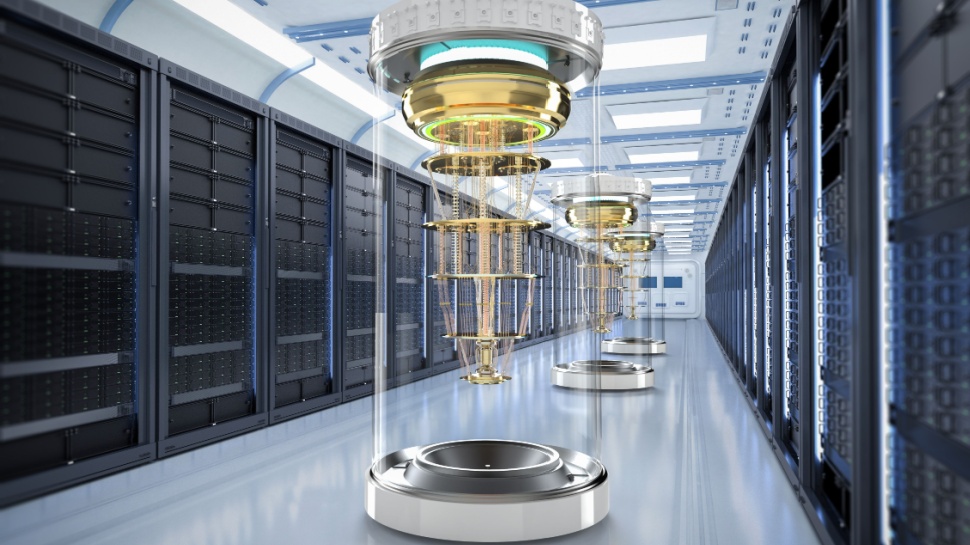
The U.S. Department of Commerce has signed letters of intent with nine companies to provide $2.013 billion in federal incentives under the CHIPS and Science Act.
The funding supports two domestic quantum foundry projects and seven quantum computing companies. In return, the government will receive minority, non-controlling equity stakes in each recipient.
The awards target superconducting, neutral-atom, photonic, trapped-ion, silicon-spin, and annealing quantum modalities. The program aims to accelerate domestic manufacturing capacity and resolve key technical bottlenecks in the development of utility-scale, fault-tolerant quantum computers.
Funding Allocation Summary
Company | Ticker | Funding Amount | Purpose |
IBM | IBM | $1 billion | Anderon quantum chip foundry (Albany, NY) |
GlobalFoundries | GFS | $375 million | Secure domestic quantum foundry |
Atom Computing | — | $100 million | Neutral-atom hardware scaling |
Diraq | — | Up to $38 million | Silicon-spin quantum logic units |
D-Wave Quantum | QBTS | $100 million | Annealing and gate-model systems |
Infleqtion | INFQ | $100 million | Trapped-ion and neutral-atom technologies |
PsiQuantum | — | $100 million | Photonic quantum computing |
Quantinuum | — | $100 million | Trapped-ion systems and fault-tolerance |
Rigetti Computing | RGTI | Up to $100 million | Superconducting processors and full-stack development |
Market Reaction on May 22, 2026Publicly traded companies directly involved in the announcement experienced immediate share price movements.
The table below summarizes the reported reactions based on available market data:
Company | Ticker | Funding Amount | Share Price Change (May 22, 2026) | Notes |
IBM ($IBM) | IBM | $1 billion | +12% | Largest single-day gain in over a year |
GlobalFoundries ($GFS) | GFS | $375 million | +15% | Equity stake approximately 1% |
QBTS | $100 million | +33% | Annealing and gate-model focus | |
Rigetti Computing ($RGTI) | RGTI | Up to $100 million | +30–31% | Superconducting processors |
Infleqtion ($INFQ) | INFQ | $100 million | +31% | SPAC-listed February 2026 |
Other quantum-related stocks also rose on broader sector momentum. IonQ ($IONQ) gained 12 percent, Quantum Computing Inc. ($QUBT) added 19 percent, and Arqit Quantum ($ARQQ) increased 25 percent, even though those companies did not receive direct funding in this package. Total market value added across the directly funded public companies exceeded several billion dollars in a single trading session.
Strategic and Economic Implications
The funding package addresses national security concerns related to quantum technology supply chains. Quantum computing has applications in cryptography, materials science, drug discovery, financial modeling, logistics optimization, and energy systems.
The equity stake mechanism differs from traditional grants. The government receives direct ownership positions rather than purely repayable loans or non-dilutive funding. This structure aligns incentives and provides a potential return on public investment if the companies succeed commercially.
The announcement occurs against a backdrop of international competition. China has invested heavily in quantum research through its National Laboratory for Quantum Information Sciences and reported progress in photonic and superconducting systems. The European Union and United Kingdom maintain separate quantum programs, but the U.S. package represents the largest single coordinated investment in hardware manufacturing to date.
Job creation estimates associated with the awards project several thousand high-skilled positions in New York, Vermont, California, and other locations. The Albany NanoTech Complex already supports thousands of semiconductor jobs and will serve as the hub for the new Anderon foundry.
Outlook and Next Steps
The letters of intent represent the first stage of the process. Final awards require completion of due diligence, environmental reviews, and definitive agreements. Recipients must meet milestones related to technology development, domestic manufacturing commitments, and workforce development.
The program forms part of a broader federal quantum strategy that includes coordination with the Department of Energy, National Science Foundation, and Department of Defense. Additional funding rounds may follow as technical milestones are achieved.
Industry analysts note that the funding reduces capital constraints for scaling from laboratory prototypes to manufacturable systems. Whether the investment accelerates the timeline for commercially relevant quantum advantage remains dependent on execution by the recipient companies and continued private-sector investment.
The $2.013 billion commitment underscores the bipartisan priority placed on quantum technology as a strategic national asset. The structure of the awards, combining foundry infrastructure with targeted research and development across multiple modalities, reflects a deliberate attempt to build a complete domestic ecosystem rather than isolated research projects.
Weekly Market Outlook: Fed Minutes, Anthropic and OpenAI IPOs, Gold, Bitcoin, FX
The Fed raised rates in September and payrolls rose 29,000, per the Labor Department. This week the FOMC minutes, three Treasury auctions and a 10-year near 5.3 percent test that gap. Anthropic's IPO clock runs toward a 14 October investor day while OpenAI's chief executive says not 2026. Gold sits 26 percent below its record, bitcoin near $85,500, the dollar up three weeks running. Two knowledge graphs from KXCO's records map the IPO backers and the FDA board.

AI Development: The Token Got Cheaper, the Building Did Not
The useful fact on 28 September is a split, not a benchmark. Gartner puts 2026 AI spending at $2.67 trillion, and 56 percent of it is infrastructure against about 1 percent on the models. Inside one week the frontier cut the price of a token in half, Nvidia signed for the shelf the open weights sit on, and three closed labs proposed to run the test. What shipped, what it costs and where the money goes, with the AI sector checked against KXCO Ontology Live.
The Week the Discount Rate Gets a Vote
The Fed hiked on 16 September and left the door open. This week the August PCE deflator on Wednesday, September payrolls on Friday, the RBA on Tuesday and euro-area CPI set the discount rate. Gold, Bitcoin, the dollar, the AI complex and the quantum pure plays share that rate and diverge everywhere else. This is the map of what depends on what, the three regimes the book should already have written down, and the stop that belongs to each node on KXCO Ontology Live.
Wall Street Week Ahead: Rates, Oil, AI, Quantum, Defense, Metals and Bitcoin
The trading week opens after a Federal Reserve that chose to hike, a White House that chose not to strike Yemen, and an oil market still pricing a war now in its seventh month. The useful work this week is not a list of tickers. It is a map of what depends on what: the funds rate, the Magnificent Seven, a quantum cohort just handed a specification and a deadline, the missile primes selling into a restock, and gold, silver, crude and Bitcoin, all held against the live AI sector ontology.
Every story, signed and delivered.
Subscribe to the kxco channel and get the headline, the AI-written key takeaways, and the chain-anchor link the moment we publish. Audio versions and per-ticker subscriptions arrive in the next iteration.