
Phonons: The Particles of Vibration, From Constraint to Control
A phonon is one quantum of lattice vibration. Phonons carry the heat out of AI chips, make phone radio filters work and run the gates of trapped-ion quantum computers, and four results since 12 October 2026 measured, steered and modelled them with new precision.
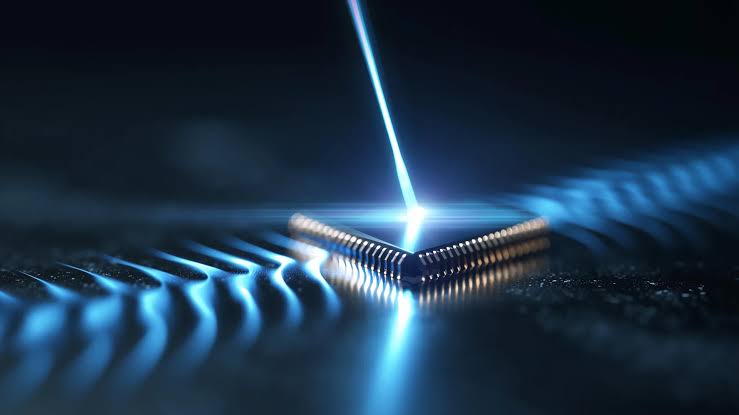
A chip is a crystal, and every crystal vibrates. The vibration comes in packets: a phonon is one quantum of lattice vibration, as a photon is one quantum of light, and phonons obey the same Bose-Einstein statistics as photons (HyperPhysics). Phonons carry the heat out of a processor, and Coherent says heat removal is becoming a primary constraint on AI systems (Nanomaterials, Coherent). A phone picks its radio bands with filters that turn the signal into a sound wave in a crystal and back again (Qorvo).
Phonons also sit at the centre of the quantum race. In trapped-ion computers they do the work: IonQ says its entangling gate "plucks" two ions so that the chain vibrates according to the qubits' states, and the ions are left entangled when the vibration is gone (IonQ). In superconducting computers they are the threat. Google expects a high-energy particle to cross a quantum chip every few seconds, and the energy spreads through the whole chip as phonons and causes bursts of errors that error correction cannot fix (Google Quantum AI).
Between 12 October and 20 November 2026, four results measured, steered or modelled phonons with new precision. Spin slowed sound in a magnetic semiconductor (Nature Communications). A single phonon carried a topological phase (Physical Review X). A three-terminal thermal triode was modelled in graphene (Physica Scripta). Chiral phonons kept their handedness to 600 K in a new calculation for tellurium (arXiv). This piece follows Quantum Computing in November 2026 in the quantum series. It sets out what a phonon is, how it was found, where it already earns money, how it shapes the quantum race and what the new results change.
What a phonon is
The atoms of a crystal sit in a lattice, held in place by the forces between them. Displace one and the displacement travels through the lattice as a wave at the speed of sound. Quantum mechanics lets such a wave hold energy only in whole quanta, and each quantum is a phonon (HyperPhysics). A phonon is a quasiparticle. It exists only as the shared motion of many atoms, yet it travels, scatters and carries energy as a particle would (Wikipedia). The name comes from the Greek phōnē, sound or voice (Wikipedia).
There are two families. In acoustic phonons neighbouring atoms move in phase, and at long wavelengths these are ordinary sound waves. In optical phonons neighbouring atoms move against each other, and that motion can couple to light, in infrared absorption and in Raman scattering (Wikipedia). Lasers read both. Raman spectroscopy measures lattice vibrations at terahertz frequencies and Brillouin-Mandelstam spectroscopy measures them at gigahertz frequencies, far above anything an ear hears (UC Riverside).
A phonon moves at the speed of sound in its material. A longitudinal sound wave crosses silicon along its [100] crystal axis at 8,430 metres a second (Ioffe Institute). Light in a vacuum covers 299,792,458 metres a second (NIST), about 35,600 times faster. The two still meet, and that is how phonons are measured: light that scatters off a material gives up energy to it or takes energy from it (NobelPrize.org, UC Riverside).
Phonons are not confined to solids. The 1994 Nobel Prize release describes neutrons measuring "phonons in solid and fluid matter" (NobelPrize.org). Lev Landau described the sound in superfluid helium as quasiparticles in 1941 (NobelPrize.org), and a 2012 phonon theory of liquids matched the measured heat capacity of 21 liquids (Scientific Reports). A phonon can even be the motion of three ions held apart in a vacuum trap, as one of this autumn's results shows (Physical Review X).
Phonons also set how well a material carries heat. In electrical insulators and pure semiconductors phonons are the main carriers of heat, while electrons carry most of it in metals and heavily doped semiconductors (Kazemian and Fanchini, review preprint). Scatter the phonons and a material conducts heat worse: in silicon, nanoscale features that suppress phonon propagation cut thermal conductivity far below the bulk value (Weisse and colleagues).
Exhibit 1 shows the range at room temperature. Silicon conducts about 150 watts per metre-kelvin (Weisse and colleagues). Cubic boron arsenide reached 1,000 to 1,300 in two Science papers of July 2018 (Kang and colleagues, Li and colleagues). Diamond has a reported 2,000, against about 400 for copper, where electrons do the work (UT Austin). A May 2025 preprint reports more than 2,000 in boron arsenide, a figure that has not yet passed peer review (arXiv).
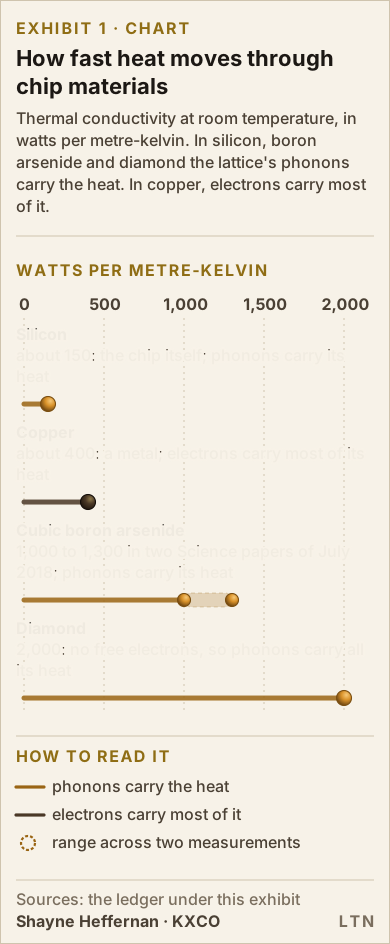
How to read Exhibit 1:
Silicon: about 150 in bulk (Weisse and colleagues), carried by phonons, which nanoscale features can scatter to cut it far lower (Weisse and colleagues).
Copper: about 400 (UT Austin). In a metal, electrons carry most of the heat (Kazemian and Fanchini).
Cubic boron arsenide: 1,300 in one 2018 paper (Kang and colleagues) and 1,000 plus or minus 90 in the other (Li and colleagues), with very long phonon mean free paths (Kang and colleagues).
Diamond: a reported 2,000 (UT Austin). With no free electrons it conducts heat only through lattice vibrations (Coherent).
How phonons were found
The phonon turned up in the heat of solids long before anyone gave it a name.
1907. Albert Einstein treated the atoms of a solid as quantum oscillators to explain its heat capacity, and the result matched experiment in its shape (Annalen der Physik, HyperPhysics). Manuel Cardona called it the first paper to bring lattice vibrations into the thermodynamics of crystals (Cardona).
1912. Peter Debye improved the fit by capping the number of vibration modes a solid can hold (Annalen der Physik). Max Born and Theodore von Kármán worked out the spectrum of vibration frequencies in a crystal (Caltech archive).
1922 and 1928. Léon Brillouin published his theory of light scattered by a transparent body (Annales de Physique). In 1928 C. V. Raman found that a small part of scattered light changes wavelength because it gives up energy to the molecules it meets, and won the 1930 Nobel Prize in Physics for it (NobelPrize.org).
1930. Igor Tamm quantised sound waves in solids while working on the scattering of light (Dictionary of Scientific Biography), and Yakov Frenkel later suggested the name phonon (Wikipedia).
1950 and 1957. Isotope experiments tied superconductivity to the vibrations of the lattice (Physical Review, Nobel presentation speech). In 1957 John Bardeen, Leon Cooper and Robert Schrieffer explained it: electrons pair up through the lattice. The theory won the 1972 Nobel Prize in Physics (NobelPrize.org).
1955 and 1994. Bertram Brockhouse and A. T. Stewart published the first measured phonon dispersion curve, for aluminium, in 1955. Brockhouse shared the 1994 Nobel Prize in Physics for developing neutron spectroscopy, and his triple-axis spectrometer measures phonons (NobelPrize.org).
2010. Andrew Cleland, John Martinis and colleagues cooled a mechanical oscillator to its quantum ground state and created single phonons in it on demand (Nature). Science named it the Breakthrough of the Year (UC Santa Barbara).
Where phonons already earn money
Radio filters. An acoustic wave filter turns a high-frequency electrical signal into an acoustic wave in a piezoelectric crystal, filters it with acoustic resonators and turns it back into a signal (Qorvo). Surface acoustic wave filters send the wave across the surface of the device and bulk acoustic wave filters use its vertical structure (Skyworks). Skyworks completed its combination with Qorvo on 5 October 2026 and continues as Skyworks (Nasdaq: SWKS) (Skyworks). It makes both kinds of filter in house and says it has produced more than 11 billion filters since 2015 (Skyworks). Murata (Tokyo: 6981) puts its surface acoustic wave filters in phones, Wi-Fi routers, satellite navigation receivers and wearables (Murata, Murata).
Broadcom (Nasdaq: AVGO) makes FBAR filters (Broadcom, Microwave Journal). FBAR stands for thin-film bulk acoustic resonator, a piezoelectric film between two electrodes, and most smartphones in 2020 carried at least one FBAR-based filter or duplexer (Wikipedia). Apple said on 8 July 2026 that a multiyear agreement with Broadcom, expected to exceed $30 billion, will fund a $1.5 billion expansion of Broadcom's Fort Collins plant, where Broadcom will produce radio frequency parts including FBAR filters (Apple). Yole Group valued mobile radio front-end modules at $15.4 billion in 2024 and forecasts more than $17 billion by 2030. It counts filters as the second-largest segment and said in 2025, before the Skyworks and Qorvo combination, that Qualcomm, Broadcom, Qorvo, Skyworks and Murata controlled over 70 per cent of the market (Microwave Journal).
Heat in AI hardware. Nvidia's data-centre graphics processors (GPUs) rose from 300 watts in 2017 to as much as 1,200 watts in 2024, most of that power leaves as heat, and direct-to-chip water cooling is hitting a limit (IEEE Spectrum). In a typical semiconductor most heat travels as long-wavelength phonons (Nanomaterials). Coherent (NYSE: COHR) sells diamond heat spreaders, which conduct heat only through lattice vibrations, for the central processors (CPUs) and GPUs in AI servers. Its top grade exceeds 2,200 W/mK (Coherent, Coherent). On 17 August 2026 it began sampling 300 mm silicon carbide substrates for heat spreaders to AI chip partners, and says they improve heat spreading by up to 25 per cent (Coherent).
Thermoelectric coolers. A Peltier cooler moves heat with charge: electrons and holes in N-type and P-type bismuth telluride carry it (Ferrotec). The lattice works against them, so the best thermoelectric materials conduct heat through phonons as poorly as a glass while letting charge flow, the "phonon-glass electron-crystal" (Reviews of Modern Physics). Scattering phonons at atomic, nano and meso scales lifted the figure of merit of lead telluride to about 2.2 at 915 kelvin (Nature), and rough silicon nanowires cut thermal conductivity a hundredfold while keeping the electrical properties of bulk silicon (Nature).
Phononic, a private company based in Durham, North Carolina, makes solid-state thermoelectric cooling for AI data centres, including thermal control for GPU high-bandwidth memory and optical transceivers (Phononic, LinkedIn). On 17 November 2026 the lender Trinity Capital committed $100 million of debt financing to it. Phononic says its cooling is already deployed across major US hyperscale computing environments and that it is profitable (Citybiz).
Raman analysers. Raman spectroscopy reads optical phonons. Thermo Fisher (NYSE: TMO) sells handheld Raman analysers that, it says, let drugmakers verify materials in under 30 seconds anywhere in a plant (Thermo Fisher, Thermo Fisher). HORIBA (Tokyo: 6856) calls Raman an essential tool for semiconductor analysis: it reads crystal quality, strain, stress and doping, the last from how phonons interact with free carriers (HORIBA, HORIBA).
Phonons inside quantum computers
Two of the leading designs meet phonons from opposite sides.
Trapped ions use them. Cirac and Zoller proposed computing with cold trapped ions in 1995 (Physical Review Letters). Their gates couple the ions through their collective quantised motion, which is to say through phonons (Nature). Sørensen and Mølmer at Aarhus then designed gates that work through virtual vibrations, so computing holds up even when the ions vibrate with heat (Physical Review Letters). IonQ (NYSE: IONQ) describes its entangling gate in those terms (IonQ, IonQ). Quantinuum (Nasdaq: QNT) says it has commercially deployed several generations of trapped-ion systems (Quantinuum). Control of this shared motion is the subject of a result of 10 November from the US National Institute of Standards and Technology (NIST), below.
Superconducting qubits suffer them. In 2021 Wilen, McDermott and colleagues found charge noise on a superconducting chip correlated over more than 600 micrometres, and traced the errors to phonons released when gamma rays and cosmic-ray muons are absorbed in the chip (Nature). Google showed in January 2022 that one particle impact radiates high-energy phonons that make qubits fail across a whole processor (Nature Physics).
In tests, the fixes cut these errors. Normal-metal layers on the back of a chip turn pair-breaking phonons into low-energy ones and cut correlated poisoning from background radiation a hundredfold (Nature Communications). Strongly gap-engineered qubits showed no loss of lifetime during impacts (Physical Review Letters). In its Willow paper of December 2024, Google credited gap-engineered junctions for the mitigation, and recorded six large error bursts, about one an hour, of a different kind whose cause it said it did not yet understand (Nature). An MIT preprint of March 2026 reports tests that support the hypothesis that cosmic rays are a major contributor to Willow's error floor (arXiv).
Mechanical devices are the third route. Single phonons can now be controlled one at a time. In 2017 Chu, Schoelkopf and colleagues controlled gigahertz phonons in a crystal one quantum at a time with a superconducting qubit (Science). In 2023 a 16-microgram resonator was put in a Schrödinger cat state, about 10^17 atoms in a superposition of two opposite oscillations (Science), and a beam splitter for single phonons showed two-phonon interference, a step towards linear mechanical quantum computing (Science). In 2024 a mechanical resonator worked as a qubit in its own right, with initialisation, readout and single-qubit gates (Science).
The goal is memory and links between machines, not a replacement for electronic qubits. A silicon cavity has held phonons for about 1.5 seconds (Science). Coupled to a qubit, a nanomechanical oscillator kept its energy for about 25 milliseconds and, with dynamical decoupling, its coherence for about 1 millisecond (Nature Physics). Caltech's Mohammad Mirhosseini says that lifetime is about 30 times the best superconducting qubits', and that the interaction must run three to ten times faster before the memory is useful for computing (Caltech).
For links, a single phonon has carried a qubit's microwave excitation into an optical photon (Nature). Authors from QphoX and Rigetti read out a superconducting qubit through optical fibre with a phonon-based transducer at 81 per cent single-shot fidelity (Nature Physics). In September 2026 a Stanford team watched single phonons make quantum jumps in real time (Science), in work supported in part by Amazon Web Services (Stanford).
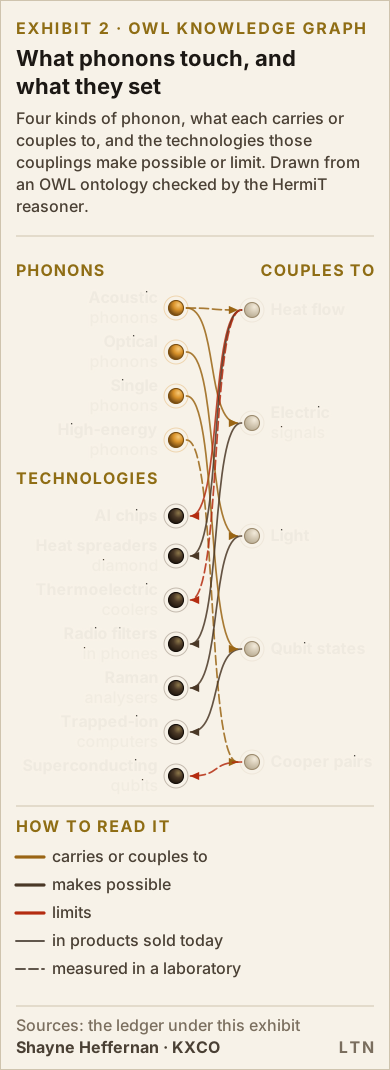
How to read Exhibit 2, link by link:
Acoustic phonons carry heat, which limits AI chips, and diamond heat spreaders are sold to move it (Nanomaterials, IEEE Spectrum, Coherent).
Heat through the lattice limits thermoelectric coolers, which work best where phonons are scattered and charge still flows (Reviews of Modern Physics, Nature).
Acoustic phonons couple to electric signals in a piezoelectric crystal, which makes radio filters possible (Qorvo, Murata).
Optical phonons couple to light, which makes Raman analysers possible (Wikipedia, HORIBA).
Single phonons couple to qubit states, which makes trapped-ion computers possible (IonQ, Nature).
High-energy phonons break Cooper pairs, the paired electrons of a superconductor, which limits superconducting qubits. It is measured, and partly mitigated (Nature Physics, Nature Communications).
Four results from October and November 2026
Spin slows sound in a magnetic semiconductor. A team at the University of California, Los Angeles (UCLA) and Auburn University measured how electron spin changes the way sound travels across nickel phosphorus trisulfide (NiPS3), a layered magnetic semiconductor (Nature Communications, 12 October 2026). At room temperature the spins point at random. Cooled below about minus 180 degrees Fahrenheit, they lock into a zigzag pattern, each pole opposite its neighbour (UCLA). That transition, the Néel temperature, sits near 155 K, or minus 181 degrees Fahrenheit. As the spins ordered, the surface sound wave slowed by about 6 to 7 per cent (Nature Communications).
The films were about 220 and 260 nanometres thick (Nature Communications), measured with Brillouin-Mandelstam light scattering at UCLA's California NanoSystems Institute (UCLA). UCLA announced the work on 18 November as a scientific first (UCLA). The authors say it opens the way to magnetically tunable phononic, magnonic and spintronic devices (Nature Communications). UCLA adds that systems computing with spin, phonons or magnetic waves are expected to use less energy and shed heat better than ones that push electrons, and that quantum computers would gain from breaking the link between phonons and spin (UCLA).
One phonon, one topological phase. At NIST in Boulder, Colorado, with Sandia National Laboratories, the University of Colorado Boulder and the University of Basel, a team that includes David Wineland held three beryllium ions, each in its own site at the corners of a triangle, on a chip cooled to about 3.5 K (Physical Review X, 10 November 2026). Wineland shared the 2012 Nobel Prize in Physics for methods of measuring and controlling single trapped ions (NobelPrize.org). The team shared one phonon, a single quantum of motion, among two or three of the ions (Physical Review X).
The team steered the ions' motion slowly around a closed loop that encircles a conical intersection, a point where two of the ions' shared vibration modes reach the same frequency (Physical Review X). The phonon picked up a topological Berry phase, a shift in its quantum phase that does not depend on the loop's shape. The team read the phase by single-phonon interference and studied how it breaks down when the steering is too fast for the state to follow, which physicists call non-adiabatic (Physical Review X). The authors write that such phases had previously only been inferred from node lines in quantum simulations (Physical Review X). The link to industry is direct: quantum information processing with trapped ions relies on their shared, quantised motion (Physical Review X).
A thermal triode, modelled in graphene. Researchers at the Ocean University of China modelled a three-terminal thermal triode in suspended single-layer graphene patterned with nanometre pores, a phononic crystal, using molecular dynamics and finite-element simulation (Physica Scripta, 20 November 2026). Earlier work centred on two-terminal thermal diodes, and thermal logic needs a third terminal, a gate that modulates the heat in the main channel (Physica Scripta). In the model, a 6 nm gate pore matched to the channel's pores cut the energy flux coefficient from 0.7074 to 0.3704, a 47.6 per cent modulation against the pore-free reference (Physica Scripta). It is a simulation, not a built device, aimed at the hot spots in advanced microelectronics (Physica Scripta).
Chiral phonons: measured, catalogued and modelled at temperature. Chiral phonons are circularly polarised lattice vibrations that carry angular momentum and couple to electron spin (Nature Physics). On 19 June 2026 Physical Review Letters published the direct detection of chiral acoustic phonons in elemental tellurium by inelastic x-ray scattering (Physical Review Letters). Nature Physics published a catalogue that classifies phonon chirality across every crystal space group, aimed at thermal management and quantum technology (Nature Physics).
In theory, a preprint of 18 November finds that symmetry keeps tellurium's phonons circularly polarised up to 600 K but does not protect their lifetimes, so the angular momentum a temperature gradient produces falls a hundredfold between 10 and 600 K (arXiv). A second group finds that a temperature gradient in a chiral crystal pushes phonon angular momentum across an interface into an ordinary crystal, even with no heat flowing (arXiv, arXiv).
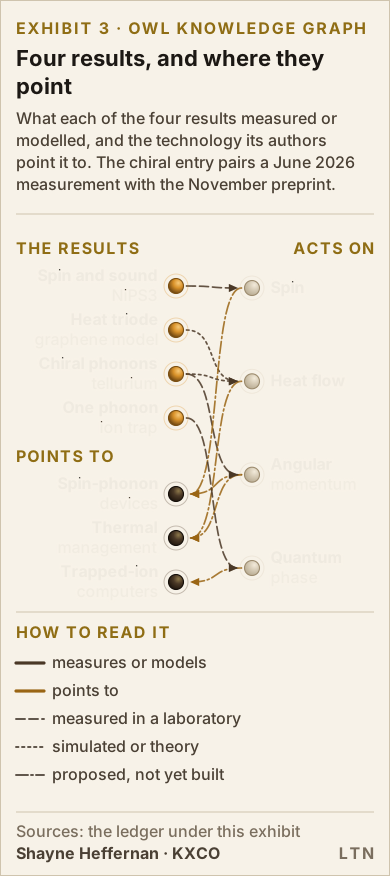
How to read Exhibit 3, link by link:
Spin and sound: measured spin ordering slowing a surface sound wave in NiPS3. The authors point to spin-phonon devices (Nature Communications, UCLA).
One phonon: measured the quantum phase of a single phonon. The authors place it in the line of trapped-ion quantum computing (Physical Review X).
Heat triode: modelled gated heat flow. The authors aim it at thermal logic, a route to active thermal management of chip hot spots (Physica Scripta).
Chiral phonons: measured in tellurium in June 2026 and modelled under a temperature gradient in the November preprint. The catalogue aims them at thermal management and ties them to electron spin (Physical Review Letters, arXiv, Nature Physics).
How the graphs are built
Exhibits 2 and 3 are views of one ontology written for this piece in OWL, the Web Ontology Language (HermiT). Its schema has 11 classes, among them phonon, partner, technology and result, with 10 typed object properties. A technology can never be a phonon, and the reasoner treats a link that implies otherwise as a contradiction. Its record has 25 individuals and 22 assertions, and each assertion carries the research claims it stands on and how far the link has got: sold, measured, modelled or proposed. HermiT, a reasoner for OWL ontologies, finds it consistent and refuses a planted wrong statement. From a property chain it infers which technologies each kind of phonon reaches, and acoustic phonons reach the most: AI chips, heat spreaders, thermoelectric coolers, radio filters and thermal management.
What it means for investors
Sort the phonon story by how far each piece has got.
Sold today. Each of these products depends on phonons. Radio filters at Skyworks, Broadcom and Murata turn signals into acoustic waves (Skyworks, Qorvo). Diamond heat spreaders at Coherent move heat through the lattice (Coherent, Coherent). Thermoelectric coolers, such as Phononic's, work best where the lattice carries little heat (Phononic, Reviews of Modern Physics). Raman analysers at Thermo Fisher and HORIBA read optical phonons (Thermo Fisher, HORIBA). Trapped-ion computers, which IonQ offers on the cloud and Quantinuum says it has deployed commercially, rely on the ions' shared, quantised motion (IonQ, Quantinuum, Physical Review X). The demand driver is heat: GPU power quadrupled between 2017 and 2024 (IEEE Spectrum).
Sampling or measured, not yet sold. Coherent's silicon carbide heat spreaders are at the sampling stage (Coherent). Defences against phonon bursts in superconducting chips, mechanical quantum memories and transducers, and the spin-phonon coupling in NiPS3 have all been shown in a laboratory (Nature Communications, Nature Physics, Nature Physics, Nature Communications).
Modelled or proposed. Thermal logic and the use of chiral phonons for heat and spin rest on simulation and theory so far (Physica Scripta, Nature Physics).
Phonons are how solids carry heat and sound at the quantum level. They limit how hot a chip can run, they make radio filters and Raman analysers work, they set how well a thermoelectric cooler performs, and they run the gates of trapped-ion computers already in commercial use. Recent work is turning them from a background constraint into something engineers control: measured against spin, given a topological phase in an ion trap and, in simulation, steered in thermal circuits. In my view, photons and electrons will keep doing the computing, and phonons are an unavoidable and increasingly engineerable part of the physics of any solid-state system.
What to watch
Google's next error-correction paper: whether the once-an-hour error bursts it reported for Willow in December 2024, and could not then explain, are still there, and whether the MIT preprint that ties Willow's error floor to cosmic rays passes peer review (Nature, arXiv).
Research references
What a phonon is and how it was found
Einstein, A. (1907). Die Plancksche Theorie der Strahlung und die Theorie der spezifischen Wärme. Annalen der Physik.
Cardona, M. (2005). Albert Einstein as the father of solid state physics. arXiv.
Nave, R. (2026). Debye Theory of Specific Heat (HyperPhysics). HyperPhysics, Georgia State University.
Debye, P. (1912). Zur Theorie der spezifischen Wärmen. Annalen der Physik.
California Institute of Technology Archives (1912). Theodore von Kármán papers, 1871-1963. Online Archive of California.
Complete Dictionary of Scientific Biography (1930). Tamm, Igor Evgenievich. Encyclopedia.com.
Nobel Prize Outreach (1930). Sir Venkata Raman: Facts. NobelPrize.org.
UC Riverside News (2021). Will Brillouin spectroscopy become as indispensable for science as Raman spectroscopy? Inside UCR.
Brillouin, L. (1922). Diffusion de la lumière et des rayons X par un corps transparent homogène. Annales de Physique.
Nobel Prize Outreach (1972). John Bardeen: Facts. NobelPrize.org.
Lundqvist, S. (1972). Award ceremony speech, Nobel Prize in Physics 1972. NobelPrize.org.
Maxwell, E. (1950). Isotope Effect in the Superconductivity of Mercury. Physical Review.
Royal Swedish Academy of Sciences (1994). Press release: The 1994 Nobel Prize in Physics. NobelPrize.org.
Nave, R. (2026). Phonons and the Debye Specific Heat (HyperPhysics). HyperPhysics, Georgia State University.
Wikipedia contributors (2026). Phonon. Wikipedia.
Nobel Prize Outreach (1962). Lev Landau: Facts. NobelPrize.org.
Bolmatov, D., and colleagues (2012). The phonon theory of liquid thermodynamics. Scientific Reports.
Kazemian, S., and Fanchini, G. (2025). Electron-Phonon interaction and lattice thermal conductivity from metals to 2D Dirac crystals: a review. arXiv.
Ioffe Institute (2026). Mechanical properties, elastic constants, lattice vibrations of Silicon (Si). NSM Archive, Physical Properties of Semiconductors.
NIST (2022). CODATA Value: speed of light in vacuum. NIST Reference on Constants, Units and Uncertainty.
Weisse, J. M., and colleagues (2012). Thermal conductivity in porous silicon nanowire arrays. Nanoscale Research Letters.
Cockrell School of Engineering, UT Austin (2018). New Semiconducting Crystal Rivals Diamond for Heat Conductivity. UT Austin news.
Kang, J. S., and colleagues (2018). Experimental observation of high thermal conductivity in boron arsenide. Science.
Li, S., and colleagues (2018). High thermal conductivity in cubic boron arsenide crystals. Science.
Zhong, H., and colleagues (2025). Thermal Conductivity above 2000 W/m.K in Boron Arsenide by Nanosecond Transducer-less Time-Domain Thermoreflectance. arXiv.
Takabatake, T., and colleagues (2014). Phonon-glass electron-crystal thermoelectric clathrates: Experiments and theory. Reviews of Modern Physics.
Hochbaum, A. I., and colleagues (2008). Enhanced thermoelectric performance of rough silicon nanowires. Nature.
Heat
IonQ (2026). IonQ Technology. IonQ.
University of Oxford, HermiT project (2026). HermiT OWL Reasoner. hermit-reasoner.com.
Wikipedia contributors (2026). Thin-film bulk acoustic resonator. Wikipedia.
Where phonons earn money
Skyworks Solutions, Inc. (2026). Skyworks Completes Combination with Qorvo. Qorvo news release.
DeLisle, J. (2023). BAW vs. SAW RF Filters. Qorvo Design Hub.
Skyworks Solutions, Inc. (2026). Filters (Thought Leadership). skyworksinc.com.
Murata Manufacturing Co., Ltd. (2026). Cutting-Edge SAW Devices Supporting Applications from 5G to IoT. corporate.murata.com.
Murata Manufacturing Co., Ltd. (2026). Stock & Corporate Bonds. corporate.murata.com investor relations.
Apple Inc. (2026). Apple to increase spend with Broadcom to produce billions more U.S. chips. Apple Newsroom.
Broadcom Inc. (2026). Broadcom Inc. Announces Third Quarter Fiscal Year 2026 Financial Results and Quarterly Dividend. PR Newswire.
Yole Group, via Microwave Journal (2025). RF Front-End Modules for Mobile: How Chinese OEMs Are Driving Innovation and Disruption. Microwave Journal.
Genkina, D. (2025). Next-Gen AI Needs Liquid Cooling. IEEE Spectrum.
Coherent Corp. (2026). Coherent Begins Customer Sampling of 300mm High Thermal Conductivity Silicon Carbide Substrates for AI Infrastructure. GlobeNewswire, via Finviz.
Greaney, P. A., and colleagues (2024). Super-Suppression of Long-Wavelength Phonons in Constricted Nanoporous Geometries. Nanomaterials.
Coherent Corp. (2026). What is a Diamond Heat Spreader? coherent.com glossary.
Coherent Corp. (2023). The Cold Hard Facts about Diamond Heat Spreaders. coherent.com blog.
Ferrotec (2026). 2.0 Basic Principles of Thermoelectric Modules & Materials. thermal.ferrotec.com Thermoelectric Reference Guide.
Biswas, K., and colleagues (2012). High-performance bulk thermoelectrics with all-scale hierarchical architectures. Nature.
Phononic, Inc. (2026). Thermal Control Solutions for AI | Networking, GPU & CPO. phononic.com.
Phononic, Inc. (2026). Phononic Inc (LinkedIn company page). LinkedIn.
citybiz (2026). Trinity Capital Commits $100 Million in Debt Financing to Phononic for AI Data Center Cooling Expansion. citybiz.
Thermo Fisher Scientific (2026). Portable Pharmaceutical QA/QC and Manufacturing Solutions. thermofisher.com.
Thermo Fisher Scientific Inc. (2026). Thermo Fisher Scientific Reports Second Quarter 2026 Results. Business Wire, via Finviz.
HORIBA (2026). Raman Spectroscopy for Semiconductor Analysis. horiba.com.
HORIBA, Ltd. (2026). Stock Information. horiba.com investor relations.
Phonons in quantum computers
Schmidt-Kaler, F., and colleagues (2003). Realization of the Cirac-Zoller controlled-NOT quantum gate. Nature.
Sørensen, A., and Mølmer, K. (1999). Quantum computation with ions in thermal motion. Physical Review Letters.
McEwen, M., and colleagues (2022). Resolving catastrophic error bursts from cosmic rays in large arrays of superconducting qubits. Nature Physics.
Wilen, C. D., and colleagues (2021). Correlated charge noise and relaxation errors in superconducting qubits. Nature.
Iaia, V., and colleagues (2022). Phonon downconversion to suppress correlated errors in superconducting qubits. Nature Communications.
O'Connell, A. D., and colleagues (2010). Quantum ground state and single-phonon control of a mechanical resonator. Nature.
UC Santa Barbara, The Current (2010). Research by Physicists Honored as Science's 2010 Breakthrough of the Year. UC Santa Barbara.
Chu, Y., and colleagues (2017). Quantum acoustics with superconducting qubits. Science.
Bild, M., and colleagues (2023). Schrödinger cat states of a 16-microgram mechanical oscillator. Science.
Qiao, H., and colleagues (2023). Splitting phonons: Building a platform for linear mechanical quantum computing. Science.
Mirhosseini, M., and colleagues (2020). Superconducting qubit to optical photon transduction. Nature.
Cirac, J. I., and Zoller, P. (1995). Quantum Computations with Cold Trapped Ions. Physical Review Letters.
MacCabe, G. S., and colleagues (2020). Nano-acoustic resonator with ultralong phonon lifetime. Science.
McEwen, M., and colleagues (2024). Resisting high-energy impact events through gap engineering in superconducting qubit arrays. Physical Review Letters.
Google Quantum AI and Collaborators (2025). Quantum error correction below the surface code threshold. Nature.
Quantinuum (2026). Quantinuum Reports Third Quarter 2026 Results and Raises Full-Year Revenue Outlook. PR Newswire, via Macau Business.
Bozkurt, A. B., and colleagues (2025). A mechanical quantum memory for microwave photons. Nature Physics.
Caltech (2025). Using Sound to Remember Quantum Information. Caltech.
van Thiel, T. C., and colleagues (2025). Optical readout of a superconducting qubit using a piezo-optomechanical transducer. Nature Physics.
McEwen, M., and Faoro, L. (2022). Resolving High-Energy Impacts on Quantum Processors. Google Research blog.
IonQ (2026). IonQ Announces Executive Leadership Evolution. IonQ.
Stanford Report (2026). Researchers observe first real-time quantum jump in sound. Stanford Report.
Makihara, T., and colleagues (2026). Quantum jumps of sound. Science.
Yang, Y., and colleagues (2024). A mechanical qubit. Science.
Pinckney, H. D., and colleagues (2026). Characterization of Radiation-Induced Errors in Superconducting Qubits Protected with Various Gap-Engineering Strategies. arXiv.
Four results from October and November 2026
UCLA Samueli School of Engineering (2026). New Advanced Measurement Techniques Could Influence the Future of AI and Quantum Computing. UCLA Samueli newsroom.
Ebrahim Nataj, Z., and colleagues (2026). Anomalous spin-lattice coupling in a 2D antiferromagnetic semiconductor revealed by surface acoustic Rayleigh waves. Nature Communications.
Niedermeyer, J. F., and colleagues (2026). Observation of Topological Berry Phases with a Single Phonon in an Ion Microtrap Array. Physical Review X.
Royal Swedish Academy of Sciences (2012). The Nobel Prize in Physics 2012, press release. nobelprize.org.
Liu, F., and colleagues (2026). Graphene Phononic Crystal Thermal Triode Based on Coherent Phonon Wave Modulation. Physica Scripta.
Ghosh, S., and Jasrasaria, D. (2026). Chiral Phonons Protected by Symmetry in a Strongly Anharmonic Helical Material. arXiv.
Suzuki, Y., and colleagues (2026). Theory of phonon angular momentum transport across a smooth crystal interface. arXiv.
Suzuki, Y., and colleagues (2026). Boundary condition for phonon distribution functions at a smooth crystal interface and interfacial angular momentum transfer. arXiv.
Sun, Q., and colleagues (2026). Momentum-Resolved Direct Observation of Chiral Phonons in Elemental Tellurium. Physical Review Letters.
Yang, Y., and colleagues (2026). Symmetry-guided catalogue of chiral phonon materials. Nature Physics.
Live Trading News
Heffernan, S. (2026). Quantum Computing in November 2026: The Cost of Breaking Your Keys Keeps Falling. Live Trading News.
Not financial advice: do your own work.
Stocks mentioned: $SWKS (NASDAQ), $AVGO (NASDAQ), $COHR (NYSE), $TMO (NYSE), $IONQ (NYSE) and $QNT (NASDAQ). Murata (Tokyo: 6981) and HORIBA (Tokyo: 6856) are listed in Tokyo.
Shayne Heffernan, Ph.D., is the founder of the KnightsBridge Group (shayneheffernan.com).
Quantum Computing in November 2026: The Cost of Breaking Your Keys Keeps Falling
No quantum computer can break today's public keys yet, but three new estimates and a peer-reviewed Google paper put a break at between 19,397 and 500,000 physical qubits. Quantinuum's Helios has 98 qubits and IBM's Nighthawk r2 has 120. NIST will deprecate RSA and elliptic-curve cryptography after 2030, and only about 15% of the origin servers behind Cloudflare use post-quantum key exchange. KXCO's core library, kxco-post-quantum, scores 9.8 on the OpenSSF Scorecard.

The Week Ahead on Wall Street, 16 November 2026: Look for the Bounce
NVIDIA reports on Tuesday 17 November 2026, its first results since Jensen Huang resigned, and I expect the stock and the AI market to bounce. NVIDIA closed at $162.85 on 13 November 2026, 31.93% below its record, while the semiconductor index rose 8.05% on the week. The calendar leans to currencies, with the yen near 160 after briefly crossing it, and the US publishes retail sales, housing starts, jobless claims and the Fed's minutes. Follow them on the Live Trading News trading page.

AI Stocks, Week of 1 November 2026: Seven Buys and the Ontology Behind Them
Shayne Heffernan rates seven AI stocks buys for the week of 1 November 2026: Nvidia, Broadcom, TSMC, Microsoft, Oracle, Palantir and ASML. The latest results put the contracted backlog of the four largest cloud sellers at about $2.48 trillion, and Amazon, Alphabet, Microsoft and Meta plan about $720 billion to $740 billion of capital spending in 2026. Every call links to KXCO's AI ontology, updated on 1 November with the quarter's results, power and grid data and new defence contracts.

The State of the AI Market in Wartime: Chips, Power and the Defence AI Companies
The AI market is now decided by physical capacity, and this year it went to war. US forces used Palantir's Maven against 13,000 targets in the 38 days of Operation Epic Fury, per the Pentagon's AI chief, while hyperscalers called for about $730 billion of 2026 capital spending, per CNBC. Shayne Heffernan reads demand, chips, power, the Gulf escalation around the 3 November midterms, and the defence AI companies: Palantir, SpaceX and xAI, Anthropic, OpenAI, Alphabet, Anduril and Shield AI.
Every story, signed and delivered.
Subscribe to the kxco channel and get the headline, the AI-written key takeaways, and the chain-anchor link the moment we publish. Audio versions and per-ticker subscriptions arrive in the next iteration.