
Thinking Matters
#thinking #design
"Coming up with an idea is easy, coming up with the right one takes work"--Paul Ebeling
With design thinking, throwing out what you think you know and starting from scratch opens up all kinds of possibilities. Design thinking is an innovative problem-solving process rooted in a set of skills.The approach has been around for decades, but it only started gaining traction outside of the design community after the 2008 Harvard Business Review article [subscription required] titled “Design Thinking” by Tim Brown, CEO and president of design company IDEO.
Since then, the design thinking process has been applied to developing new products and services, and to a whole range of problems, from creating a business model for selling solar panels in Africa to the operation of Airbnb.
At a high level, the steps involved in the design thinking process are simple: 1st, fully understand the problem; 2nd, explore a wide range of possible solutions; 3rd, iterate extensively through prototyping and testing; and finally, implement through the customary deployment mechanisms.
The skills associated with these steps help people apply creativity to effectively solve real-world problems better than they otherwise would. They can be readily learned, but take effort. For instance, when trying to understand a problem, setting aside your own preconceptions is hard, but Key.
Creative brainstorming is necessary for developing possible solutions, but many people do not do it well. And throughout the process it is critical to engage in modeling, analysis, prototyping, and testing, and to really learn from these many iterations.
Once you master the skills central to the design thinking approach, they can be applied to solve problems in daily life and any industry.
Central to the design thinking process is prototyping and testing, which allows designers to try, to fail, and to learn what works. Testing also involves customers, and that continued involvement provides essential user feedback on potential designs and use cases.
It is also important to interview and understand other stakeholders, like people selling the product, or those who are supporting the users throughout the product life cycle.
Design thinking is not just for “things.”
If you are only applying the approach to physical products, you are not getting the most out of it. Design thinking can be applied to any problem that needs a creative solution.
The impact of all the buzz around design thinking today is that people are realizing that “anybody who has a challenge that needs creative problem solving could benefit from this approach,” That means that managers can use it, not only to design a new product or service, “but anytime they have got a challenge, a problem to solve.”
Applying design thinking techniques to business problems can help executives across industries rethink their product offerings, grow their markets, offer greater value to customers, or innovate and stay relevant. I don’t know industries that cannot use design thinking.
Bottom line
What is design thinking and why should you care? History and background plus a quick overview and visualization of 6 phases of the design thinking process. Approaching problem solving with a hands-on, user-centric mindset leads to innovation, and innovation can lead to differentiation and a competitive advantage.
https://youtu.be/Tvu34s8iMZw
Have a happy weekend, Keep the Faith!
#thinking, #design,
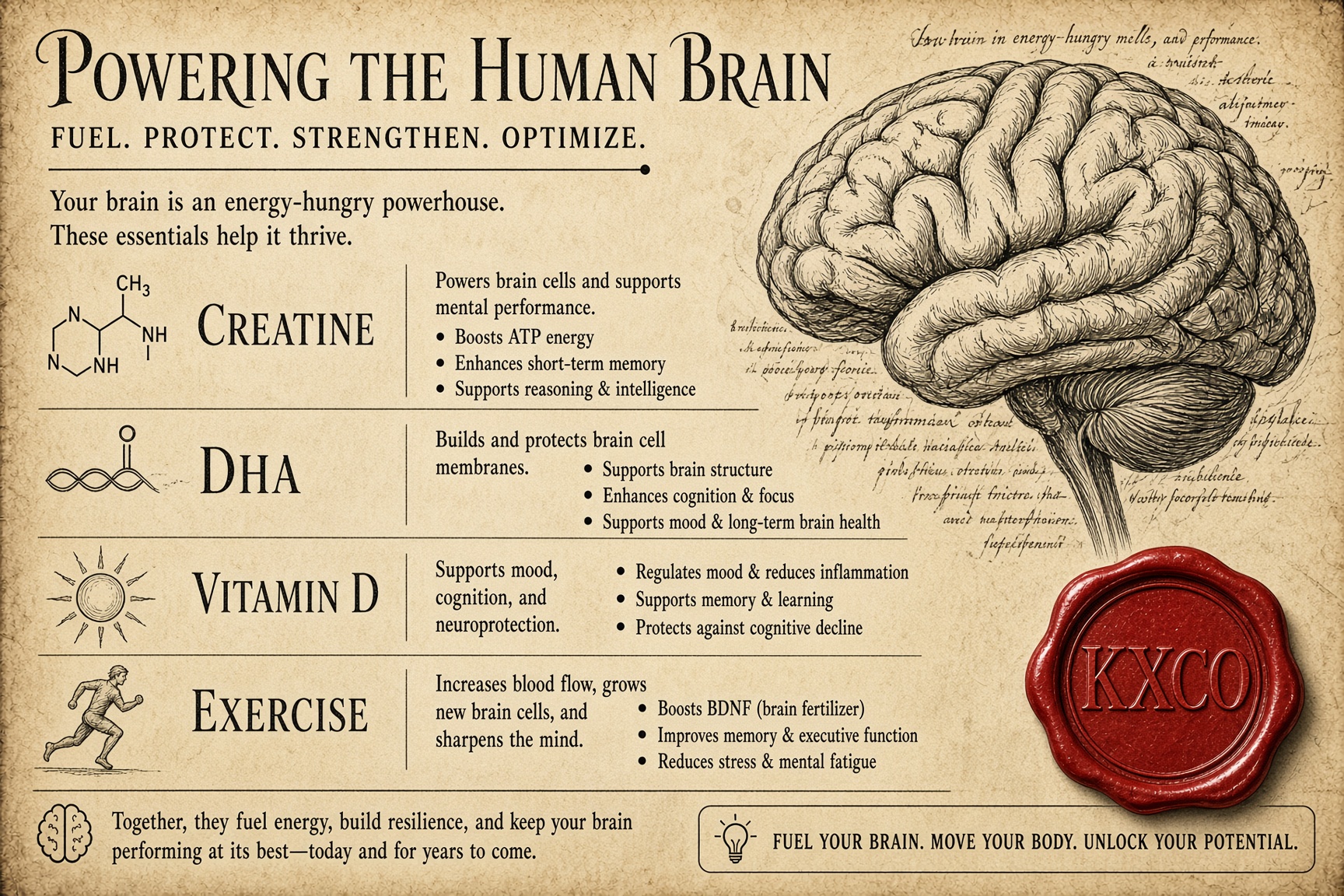
Thoughts on Thinking: Brain Essentials
Your brain runs on about 20 watts. The fastest supercomputer outruns it, but at the central published estimate the brain is about 680 times as efficient per watt as the best machine on the November 2026 Green500. It runs on four inputs most people overlook. Creatine buffers its energy, DHA builds its membranes, exercise raises its growth factors and, in older adults, enlarges the hippocampus, and low vitamin D goes with slower processing and more dementia.

Thoughts on Thinking: You Are the Data Centre
The world's data centres used about 485 terawatt-hours of electricity in 2025; the brain runs on about 20 watts. The adult male brain holds about 86 billion neurons on average, and its synapse weights at 32-bit precision take at least 400 terabytes. Against the eye's estimated output, GPU memory wins on raw throughput by millions to one, but meaning needs selection, context and consequence. At KXCO the person sits at both ends of the data, and a named person decides.

Thoughts on Thinking: Brain Chemistry
Brain chemistry sets the level of thinking and of performance in everything else, and it bears on longevity: 14 risk factors that can be changed account for nearly half of dementia cases. The dangers come from outside, through plastic, PFAS, pesticides and metals, and from inside, through chronic stress and overwork. An organic diet cut a chlorpyrifos marker in urine by 60.7 per cent, and reciting the rosary slowed breathing to under six breaths a minute. The chemistry is a managed input.

Thoughts on Thinking: Take an Art Break
The best way I know to keep complex work in perspective is to stop at intervals and look at something that took the same order of sustained attention under real constraints. The studies now show what that does: a museum visit restored attention where an urban walk did not, judging the beauty of an object raised abstract thinking almost 14 per cent, and artistic film raised originality even in people who felt worse for it. Five works, Leonardo to Holbein, and the non-default decision in each.
Every story, signed and delivered.
Subscribe to the kxco channel and get the headline, the AI-written key takeaways, and the chain-anchor link the moment we publish. Audio versions and per-ticker subscriptions arrive in the next iteration.