
The Week the Future Got Priced
NVIDIA's $81.6B Print, SpaceX's $2T Filing, Musk's Terafab, and the Quantum Algorithm AI Just Wrote
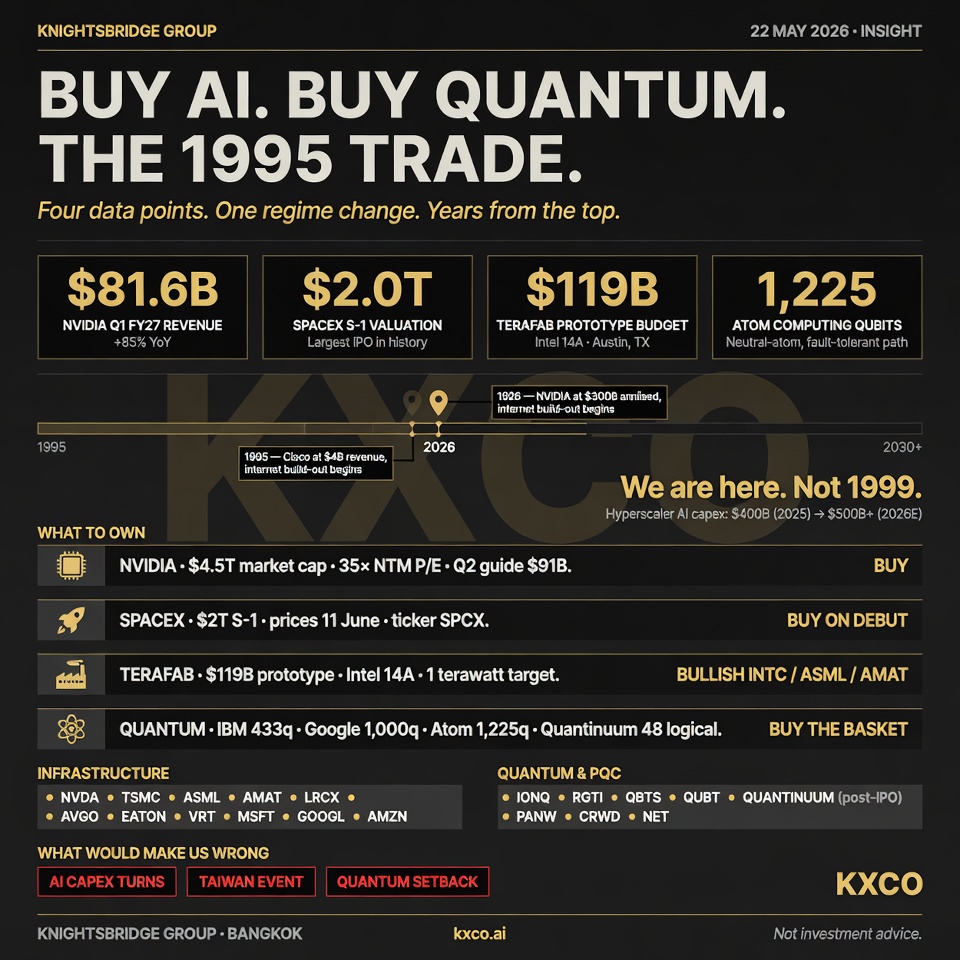
Read the tape from this week and the case writes itself. NVIDIA reported an $81.6 billion quarter and guided to $91 billion for the next one. SpaceX filed the largest IPO prospectus in capital-markets history at a $2 trillion valuation. Elon Musk's Terafab project — a vertically integrated semiconductor and packaging fab in Austin, Texas — moved from announcement to $119 billion prototype budget and a confirmed Intel 14A process partnership inside ninety days. And a research group in California, using an AI loop wrapping Gemini and Claude, discovered a logical-qubit encoding that compresses the atom count by two orders of magnitude — pulling forward, possibly by years, the timeline on which quantum computers become capable of breaking the cryptography that secures modern finance.
Our view is simple. These are not four stories. They are one story, and the story is early. The build-out of AI compute, the manufacturing supply chain that produces it, the orbital infrastructure that will eventually carry parts of it, and the quantum substrate that will eventually price its cryptographic security — these are interlocking pieces of the most important industrial cycle since the integrated circuit. We are not at the top. We are not at the middle. We are at the part of the cycle that looks, in hindsight, like 1995.
Both AI infrastructure and pure-play quantum are buys. AI exposure is the obvious one and the consensus is right that it has run — but consensus is wrong about how much further it runs. Quantum is the contrarian one, and the contrarians will be the ones writing the post-mortem in 2032 about why the asymmetric returns of the next decade went to the people who bought when the category was still uninvestable for most allocators. The rest of this note explains the logic, with the numbers.
01 The Compute War — Four Faces, One Bottleneck
The connective tissue across NVIDIA's quarter, SpaceX's filing, Terafab, and the quantum work is access to compute. Whoever controls compute over the next decade controls the rate-limiting input to virtually every commercial and strategic activity in the developed world. That is a strong statement. It is also, increasingly, a quantitative one.
Hyperscaler capex on AI infrastructure crossed $400 billion in 2025 and is set to clear $500 billion in 2026 by most credible counts. NVIDIA's $75 billion Data Center quarter is the cleanest single read on that spend — and it captured roughly 50% of its revenue from hyperscalers, 50% from a fast-growing group of AI clouds, industrial enterprises, and sovereign customers. That second half is the part the market is mispricing. Hyperscaler demand was always known. Sovereign demand was not. It is now arriving at scale and the unit economics of selling to sovereigns are materially better than selling to AWS.
SpaceX's IPO matters for a reason that is unrelated to space. xAI, the AI subsidiary inside SpaceX, spent close to $13 billion building data centres in 2025 and another $7.5 billion in the first quarter of 2026 alone. The combined consolidated entity carries a $2 trillion target valuation. That is the market's first attempt to price what an AI-native, vertically integrated, founder-controlled infrastructure stack is worth — and the answer is not small. The IPO sets a benchmark every other AI infrastructure operator will be measured against. Anthropic will eventually list. OpenAI will eventually list. The price-discovery exercise that SPCX is about to perform on the public tape will reset the comparable-valuation methodology for an entire cohort of private AI companies.
Terafab is the same thesis with the chain integrated one more layer up. The argument Musk has made repeatedly since the project's March announcement is that the global semiconductor supply chain cannot scale fast enough to meet edge-inference demand from Tesla vehicles, Optimus humanoids, and orbital AI infrastructure. He is choosing to take fab-capacity risk off the table by building the fab himself, using Intel's 14A process, at a prototype budget that already exceeds the total commitment for TSMC's Arizona campus. Jensen Huang has called this — politely — extremely hard. The substantive question is not whether Musk will deliver on the Bernstein-estimated $5–13 trillion full-scale build. The substantive question is whether the supply constraint is real enough that a $119 billion prototype is rational. It is.
And the quantum work is the security counter-weight to all of it. If AI infrastructure is the offensive layer, post-quantum cryptography is the defensive layer that protects the value it creates. The two are coupled in a way most allocators have not yet internalised.
02 NVIDIA Is Not Expensive at $4.5 Trillion
Start with the math. NVIDIA posted Q1 fiscal 2027 revenue of $81.6 billion against a consensus of $78 billion, with year-on-year growth of 85% and sequential growth of 20%. The gross margin held at 74.9%. Free cash flow was a record $49 billion. The board added $80 billion to the buyback authorisation and raised the dividend twenty-five-fold. Q2 guidance is $91 billion.
Q1 FY27 — the print at a glance
• Total revenue: $81.6B vs consensus $78.0B — up 85% YoY, up 20% QoQ
• Data center revenue: $75.2B vs consensus $73.0B — up 92% YoY
• Gross margin: 74.9% vs consensus 73.5% — up 140 bps YoY
• Free cash flow: $49.0B — a quarterly record
• Buyback / dividend: $80B added to authorisation; dividend raised 25x
• China DC Hopper: $0 shipments, against $4.6B in the year-ago quarter
• Q2 FY27 guide: $91B vs consensus $85B — approximately +12% sequential
Forward earnings on the Q2 guide imply NVIDIA is trading at roughly 35 times next-twelve-month earnings. That is high in absolute terms. It is not high in context.
The closest historical analogue is Cisco between 1995 and 1999, which traded at 30 to 60 times forward earnings throughout the build-out of the commercial internet — and grew into every one of those multiples because the addressable market kept expanding faster than the multiple compressed. Cisco at the 1995 inflection was capturing roughly $2 billion in revenue from a category that would print $200 billion within a decade. NVIDIA in 2026 is capturing roughly $300 billion of annualised AI infrastructure revenue from a category that will print between $1.5 and $3 trillion in annual spend by 2032 on most credible analyst tracks. The multiple looks the same. The runway looks longer.
Two specific elements of the Q1 print were under-discussed. First, the customer mix. The hyperscaler line, roughly 50% of Data Center revenue, is well understood. The other half is not. AI cloud operators — CoreWeave, Lambda, Nebius and the cohort of GPU-native infrastructure businesses that have emerged over the last 24 months — now represent a meaningfully large slice. So do industrial and enterprise customers building proprietary inference fleets. And so do sovereigns. NVIDIA management said the company is in active design conversations with eleven national customers. That is a new category of buyer with structurally different procurement dynamics: longer cycles, less price sensitivity, more strategic stickiness. It is also a category whose total addressable spend, if priced anywhere close to hyperscaler economics, runs into the hundreds of billions over the next five years.
Second, the China line. Data Center shipments of Hopper-class products to China were zero in the quarter, against $4.6 billion in the year-ago quarter. The US export-control regime has eliminated NVIDIA's China data-centre business and management has signalled it is not pursuing further degraded variants for that market. The bear case is that this is a permanent $20-billion-plus annualised drag and that similar restrictions may eventually extend to gaming and automotive. The bull case is that the loss is already in the base, sovereign demand more than fills the gap, and removing China from the model removes a geopolitical overhang that was previously suppressing the multiple.
“Sovereign AI factories will become a category of customer at the same scale as the hyperscalers within the next 18 months.” — Jensen Huang, Q1 FY27 prepared remarks, 20 May 2026.
Our view: long NVIDIA. The Q2 guide makes the next print all but mechanical. The category is expanding faster than the multiple. The competitive threats — Broadcom XPUs, AMD MI400, in-house silicon from the hyperscalers — are real and on track but will not dislodge NVIDIA's CUDA-driven software moat inside this cycle. The risk to watch is gross-margin compression as the customer mix shifts and as the cost of leading-edge packaging at TSMC continues to rise. The print to watch is Q2 in mid-August. We expect the company to take guidance up again.
03 SpaceX Is About to Reprice an Asset Class
SpaceX filed its S-1 on 20 May 2026, targeting a price between $1.75 trillion and $2.0 trillion of equity value, raising $75 billion, listing under the ticker SPCX on the Nasdaq with a pricing date of 11 June. If priced at the upper end of the range, the listing will surpass Saudi Aramco's 2019 IPO ($1.7 trillion at $29 billion raised) as the largest in capital-markets history, by a multiple of more than 2.5 on the cash raised.
SpaceX consolidated — what the S-1 disclosed
• Total revenue 2025: $18.7B — up more than 30% year-on-year
• Operating result 2025: ($2.5B) — driven by xAI losses
• Net result 2025: ($4.9B) — xAI standalone loss $6.4B
• Starlink revenue 2025: $11.4B with 10.3 million subscribers
• Starlink operating profit 2025: $4.5B — more than doubled YoY
• Starlink Q1 2026 revenue: $3.3B with Q1 operating profit of $1.2B
• xAI 2025 capex on data centres: approximately $13B, plus a further $7.5B in Q1 2026 alone
• Global launch share 2025: approximately 80%-plus of all launches; over 10,000 Starlink satellites in orbit
The headline number is the valuation. The structural story is the asset class. SpaceX is the first major listing where investors are being asked to underwrite a vertically integrated AI infrastructure compounder whose cash-flow engine is a different business — Starlink — while the AI business itself is still in capital-deployment mode. xAI burned $6.4 billion on $3.2 billion of revenue last year and spent close to $13 billion building data centres. Starlink generated $4.5 billion of operating profit on $11.4 billion of revenue. The combined entity is, structurally, a free-cash-flow-generating satellite-broadband business that is using its cash to fund an AI build-out at the scale of a national programme.
Whether $2 trillion is the right price for that structure is unanswerable from outside. What is answerable is that the listing creates a public-tape benchmark for an entire cohort of currently private AI infrastructure businesses. Anthropic, OpenAI, Mistral, CoreWeave-style operators, every AI cloud — all of these will be re-marked against SPCX's trading multiple within weeks of the debut. If SPCX trades well, the private-market valuations of the comparable cohort accelerate. If SPCX trades poorly, every late-stage AI private mark gets revisited, and the funding environment for the marginal Series D round tightens materially.
Read of the IPO: Demand for the deal will be extraordinary. Index inclusion mechanics — SPCX qualifying for S&P 500 inclusion within roughly 30 days post-debut depending on the float profile — will force material passive demand. Our base case is the stock trades up at debut and holds. The downstream consequence is that the AI-infrastructure private-market reflate that began in late 2025 accelerates, and the trade for the rest of the year is the proxies. We like the hyperscalers, the AI-cloud listings, the semiconductor capital-equipment names with NVIDIA's manufacturing exposure (ASML, Applied Materials, Lam Research), and the niche power and cooling infrastructure plays that the build-out depends on (Eaton, Vertiv, Schneider) — all of these benefit if SPCX clears the tape well.
04 Terafab Is the Vertical-Integration Trade
On 21 March 2026, Musk announced Terafab — a vertically integrated semiconductor fabrication and packaging facility located in Austin, Texas, designed to produce more than one terawatt of AI compute capacity per year. On 7 April, Intel joined as the manufacturing partner. By early May, the SpaceX S-1 filing had confirmed a $119 billion prototype budget. Bernstein has estimated the full-scale build at between $5 trillion and $13 trillion. ASML's CEO, Christophe Fouquet, was asked about the project in May and described Musk as very serious about it.
Terafab — current state, May 2026
• Announced: 21 March 2026 by Elon Musk
• Sponsors: Tesla · xAI · SpaceX · Intel (Intel joined 7 April 2026)
• Location: Austin, Texas (near Gigafactory Texas)
• Manufacturing process: Intel 14A (2nm-class node)
• Prototype budget: $119 billion
• Full-scale estimate: $5–13 trillion (Bernstein)
• First product: Tesla AI5 chip — small-batch 2026, volume 2027
• Target capacity: 1 terawatt of AI compute per annum
The cleanest way to read Terafab is not as a manufacturing project. It is as a supply-security trade by a buyer with extreme scale who has concluded that the global semiconductor supply chain — even with TSMC fabs in Arizona, Samsung in Taylor, Intel in Ohio and a string of European EU Chips Act fabs coming online — cannot scale fast enough for the demand profile he is projecting. If he is right about the demand, Terafab is rational. If he is wrong, $119 billion of capital is exposed. We think he is more right than wrong, primarily because Tesla's vehicle and Optimus volumes, combined with xAI's training and inference roadmap, already represent unit demand that no single existing fab can serve on the timeline he needs.
Three downstream consequences of Terafab matter for portfolios. First, it is implicitly bullish Intel — the 14A process gets a hyperscale anchor customer that solves Intel's foundry-volume problem at a stroke. Intel's recovery thesis was already real; Terafab makes it more credible. Second, it is bullish the broader fab capital-equipment cohort. Every dollar of Terafab construction ultimately routes through ASML, Lam Research, KLA, Applied Materials, Tokyo Electron and the upstream materials suppliers. Third, it is implicitly bearish the assumption that TSMC's pricing power is unconstrained — a credible second American leading-edge foundry, even if it is captive to Musk-controlled entities, changes the dynamic at the negotiation table.
“Building leading-edge fabs is extremely hard, in a way that companies that have not done it tend to underestimate.” — Jensen Huang on Terafab, NVIDIA GTC keynote, April 2026.
Huang is correct, and Terafab will face delivery risk that more conventional fab projects do not. None of that changes the directional read for the broader investible universe: more capex, more equipment orders, more pressure on every other actor in the supply chain to commit capital faster.
05 Quantum — The 1996 Trade
Quantum computing in mid-2026 sits roughly where the commercial internet sat in 1996. The fundamental physics works. Hardware is shipping. Real customers are running real workloads on real machines. The category is not yet financially significant relative to the broader technology stack. And it is moving, this year, faster than at any previous point in its history.
The data points across the first five months of 2026 are unusual in their density. IBM has put 433-qubit Condor processors into production. Google's Willow architecture has cleared 1,000 physical qubits. Atom Computing went into production with a 1,225-qubit neutral-atom machine in late 2025 and has been seeding it with US national-laboratory customers. Quantinuum's Helios trapped-ion system delivered 48 logical qubits in November 2025 — a milestone that the field believed was five years out. Pasqal demonstrated logical qubits outperforming standard quantum techniques on real hardware on differential-equation problems, with average improvements of more than 50%. And on 7 April, TIME magazine reported on a piece of work by Oratomic, using an AI optimisation loop wrapping Gemini and Claude, that discovered an encoding requiring just three atoms per logical qubit — a two-orders-of-magnitude reduction in the physical-qubit overhead for fault-tolerant computation.
Capital is following the science. Global investment in quantum computing reached $17.3 billion in 2026. On 21 May, the United States announced more than $2 billion in fresh federal grants to IBM and a small consortium of other quantum companies. Quantinuum filed confidential IPO paperwork in January at a valuation that public reporting suggests will clear $20 billion — which would make it the highest-valued pure-play quantum business ever to access public markets. IonQ, PsiQuantum and Atom Computing are reported to be exploring follow-on raises at materially higher marks than their last private rounds. Google announced on 25 March that it would migrate its systems to post-quantum cryptography by 2029, six years before NIST's hard deadline of 2035. Banks and sovereigns are following Google's lead.
Our view: the quantum cohort is a buy. The pure-play public names — IonQ, Rigetti, D-Wave Quantum, and Quantum Computing Inc. — are volatile, expensive on near-term financials, and will deliver returns that are uncorrelated to the rest of the technology stack. They are also unmistakably early. The category looks today the way the early commercial-internet stocks looked in 1996: small revenue, large losses, capability curves bending sharply upward, and a regulatory and capital environment that is just beginning to take the technology seriously. Investors who bought the early-internet basket in 1996 and held for ten years were right even if individual names disappointed.
The investment thesis splits into three layers. Hardware is the layer with the highest near-term volatility and the highest long-term option value — winners here capture the platform economics of the next decade. Quantum-resistant cryptography and post-quantum-migration services are the layer with the most dated catalyst: every regulated institution on Earth needs to migrate before NIST's deadline, and the budget for that migration is contractually committed across the next four years. Quantum software and applications — the layer that builds the algorithms and tooling that run on the hardware — is the layer with the longest payoff horizon and the deepest moat once it lands.
Our preferred exposure mix today is roughly 60% to hardware, split across two or three of the leading public names with diversification across qubit modalities (trapped-ion, neutral-atom, photonic, superconducting); 25% to PQC and cyber-defence vendors that capture the migration spend; and 15% to early-stage venture exposure in quantum software through specialist funds. Position sizing should reflect that this is a five-to-ten year thesis. Drawdowns of 50%-plus along the way are not just possible — they are likely. The asymmetry justifies the volatility.
06 Where We Are in the Cycle
Every investor old enough to have lived through the 1995 to 2000 internet build-out is now asking themselves a single question: is this the 1995 or the 1999? The answer matters because the difference between the early phase of an industrial cycle and its blow-off top is the difference between a five-year compounder and a one-year top.
We think this is 1995, not 1999. The reasoning is empirical, not anecdotal.
First, the spend is real and accelerating, not topping. Hyperscaler AI capex is set to clear $500 billion in 2026 against roughly $400 billion in 2025. The forward indicators — power-purchase agreements being signed for the late 2020s, multi-year GPU supply commitments, data-centre ground-breakings — point to continued double-digit growth through at least 2028. In 1999, by contrast, the leading indicators of the internet build-out — fibre-optic capacity-pre-purchase agreements, telco capex — had already started to soften. We are not seeing that yet.
Second, the valuations are not 1999 valuations. NVIDIA at 35 times forward earnings is high in absolute terms but is supported by 85% year-on-year revenue growth and 75% gross margins. Cisco at the equivalent stage in early 1999 was trading at 80 to 100 times forward earnings on much lower margins. The dot-com names that defined that bubble — pets.com, Webvan, Drkoop — had no revenue and no plausible path to profitability. The AI-cloud cohort being publicly priced today (and the AI-infrastructure cohort being priced privately in the run-up to SPCX) has revenue, contracts, and margins. The market is not yet making the 1999 mistake.
Third, the new layer is just being added. Quantum computing — the security and compute substrate for the second half of the cycle — is just becoming investible. Sovereign AI customers — the largest single category of incremental demand — are just becoming material. Terafab — the manufacturing supply-chain response to the demand — was announced ten weeks ago. The plotting of new investment categories on top of an existing cycle is a feature of early-stage build-outs, not late-stage ones. In 1999 the new categories had stopped coming. We are still adding them.
Concrete exposure recommendations. For AI infrastructure: NVIDIA as the core position, with TSMC and ASML as the manufacturing exposure that does not depend on any single chip cycle. Broadcom for the inference-ASIC tailwind. Eaton, Vertiv, and the power-management cohort for the data-centre electrical build. The hyperscalers (Microsoft, Alphabet, Amazon) on any meaningful pullback. SPCX itself on debut, with discipline on entry price. For quantum: a basket of IonQ, Rigetti, D-Wave, and Quantum Computing Inc. — sized small, held with patience. Quantinuum on listing day if and when the IPO clears. PQC-themed cyber-defence exposure through the larger names (Palo Alto, CrowdStrike, Cloudflare) and a small tilt to the specialist quantum-resistant cryptography vendors that the larger names will eventually acquire.
07 What Would Make Us Wrong
Three things are worth naming because they are the scenarios in which the thesis breaks.
AI capex turning. If hyperscaler capex guidance is cut in any of the next two earnings cycles, the cycle is closer to topping than we think. The signal to watch is Microsoft, Alphabet, and Meta's commentary on AI return-on-invested-capital. So far the commentary is consistently bullish. A turn in that commentary, particularly from Alphabet, is the canary.
A geopolitical breach. US export controls have eliminated NVIDIA's China data-centre business. A meaningful Taiwan event, even short of military escalation, would disrupt TSMC's leading-edge capacity at exactly the wrong moment. The probability is low and the consequences are catastrophic. Treat as a tail risk, not a base case.
A quantum hardware setback. The Pasqal and Atom Computing results have been replicated. The Oratomic three-atom encoding has not. If the AI-assisted algorithm work fails to generalise — if the encoding turns out to be a special case rather than a methodological breakthrough — the timeline-compression narrative for quantum collapses, and the quantum cohort gives back a meaningful share of the multiple it has built over the last six months. The risk is real. The asymmetric upside justifies sizing through it.
Bottom line. This is the most important industrial cycle of our lifetime. The four data points of this week — NVIDIA's print, SpaceX's filing, Terafab's progress, the AI-assisted quantum breakthrough — are not unrelated. They are pieces of a single regime change in how compute is produced, capitalised, secured, and deployed. The cycle is closer to its 1995 than to its 1999. AI infrastructure is a buy. Quantum is a buy. The window to allocate before the consensus catches up is open, and not for much longer.
S Sources
1. NVIDIA Q1 FY27 results & CFO commentary, 20 May 2026. https://www.sec.gov/Archives/edgar/data/0001045810/000104581026000051/q1fy27cfocommentary.htm
2. NVIDIA $81.6B revenue, $49B FCF, $80B buyback — INDMoney. https://www.indmoney.com/blog/us-stocks/nvidia-stock-q1-fy27-earnings-81b-revenue-25x-dividend
3. NVIDIA Blackwell 300, sovereign customers, China $0 — heygotrade. https://www.heygotrade.com/en/blog/nvidia-q1-fy27-earnings-preview-may-20-2026/
4. SpaceX S-1 filing, $2T valuation, $75B raise — Fortune. https://fortune.com/2026/05/20/spacex-finally-files-ipo-prospectus-reveals-revenue-is-up-but-losses-are-too/
5. SpaceX revenue, xAI losses, Starlink financials — The VC Corner S-1 teardown. https://www.thevccorner.com/p/spacex-spcx-ipo-s1-teardown-valuation-2026
6. SpaceX 80%+ launch share, super-voting structure — Fortune, 16 May 2026. https://fortune.com/2026/05/16/spacex-ipo-spcx-stock-valuation-space-market-moat-elon-musk-starlink-xai/
7. Terafab concept, scope, partners, $119B — Wikipedia / CNBC. https://en.wikipedia.org/wiki/Terafab
8. Terafab $119B confirmed — CNBC, 6 May 2026. https://www.cnbc.com/2026/05/06/elon-musks-spacex-chip-fab-in-texas-to-cost-up-to-119-billion.html
9. Bernstein $5–13T full-scale Terafab estimate — Tom's Hardware. https://www.tomshardware.com/tech-industry/semiconductors/elon-musks-terafab-semiconductor-project-could-cost-usd5-trillion-bernstein-claims-herculean-effort-would-cost-more-than-70-percent-of-the-total-yearly-us-government-budget
10.ASML CEO confirms Terafab talks with Musk — Tom's Hardware. https://www.tomshardware.com/tech-industry/asml-ceo-confirms-direct-talks-with-elon-musk-about-terafab
11.Quantum hardware 2026 milestones — IEEE Spectrum. https://spectrum.ieee.org/neutral-atom-quantum-computing
12.AI accelerating quantum algorithm discovery — TIME, 7 April 2026. https://time.com/article/2026/04/07/ai-quantum-computing-advance/
13.Global quantum investment $17.3B; US $2B grants — SiliconAngle. https://siliconangle.com/2026/05/21/us-issues-2b-grants-ibm-others-quantum-computing-initiatives/
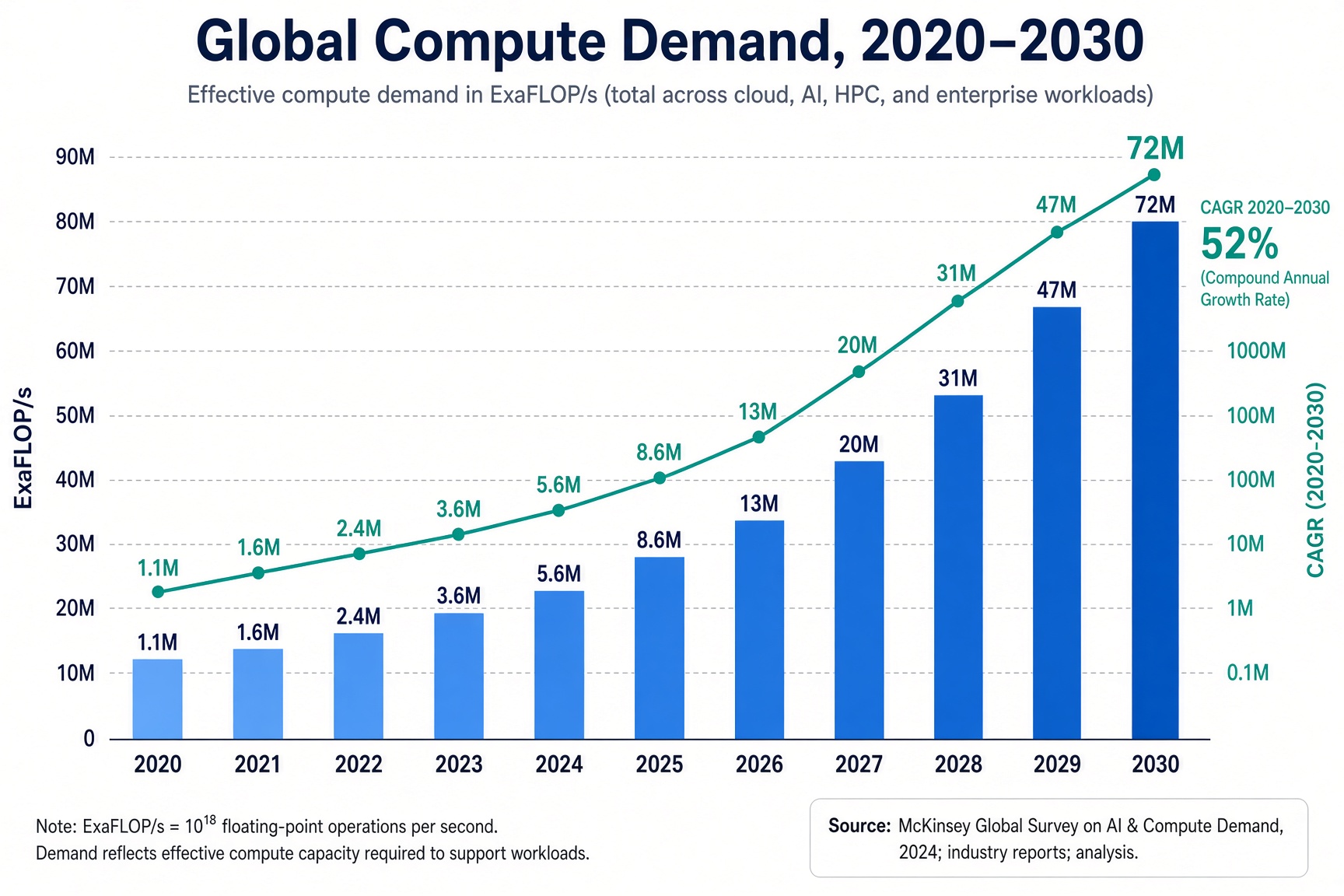
The 2030 Compute Landscape: GPUs, Power and the Architecture of Intelligence
The constraint on AI is no longer ideas or data but compute and the power to run it. Frontier training compute has grown about five times a year since 2020, and the leading AI supercomputer of June 2030 is on course for about 2 million chips and 9 gigawatts. Shayne Heffernan sets out the 2030 arithmetic, the power problem, who has already contracted the gigawatts, and how GPUs, custom ASICs, wafer-scale engines and quantum machines divide the work.
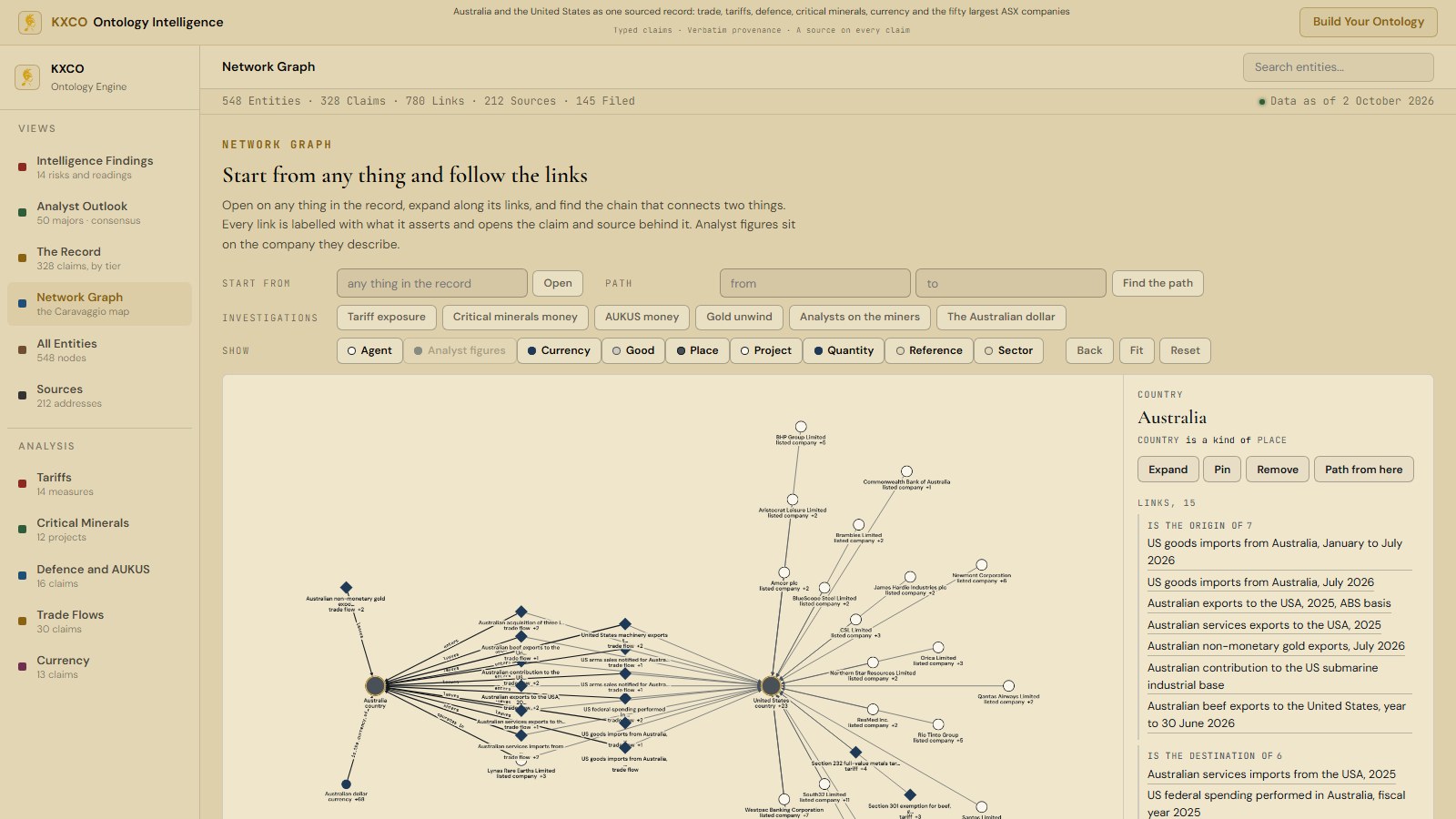
Harvest Now, Decrypt Later: Why KXCO Took Its Ontologies Private
For more than 90 days KXCO ran its ontologies in public: the AI sector resolved from six names to one lithography supplier, and Australia's trade with the United States as one sourced record. They proved the method. They are now private, still running, for KXCO and its clients only. Europol's report on harvest now, decrypt later explains why: data collected today will be read when a quantum computer arrives, and a graph of your relationships is the most valuable thing to harvest.
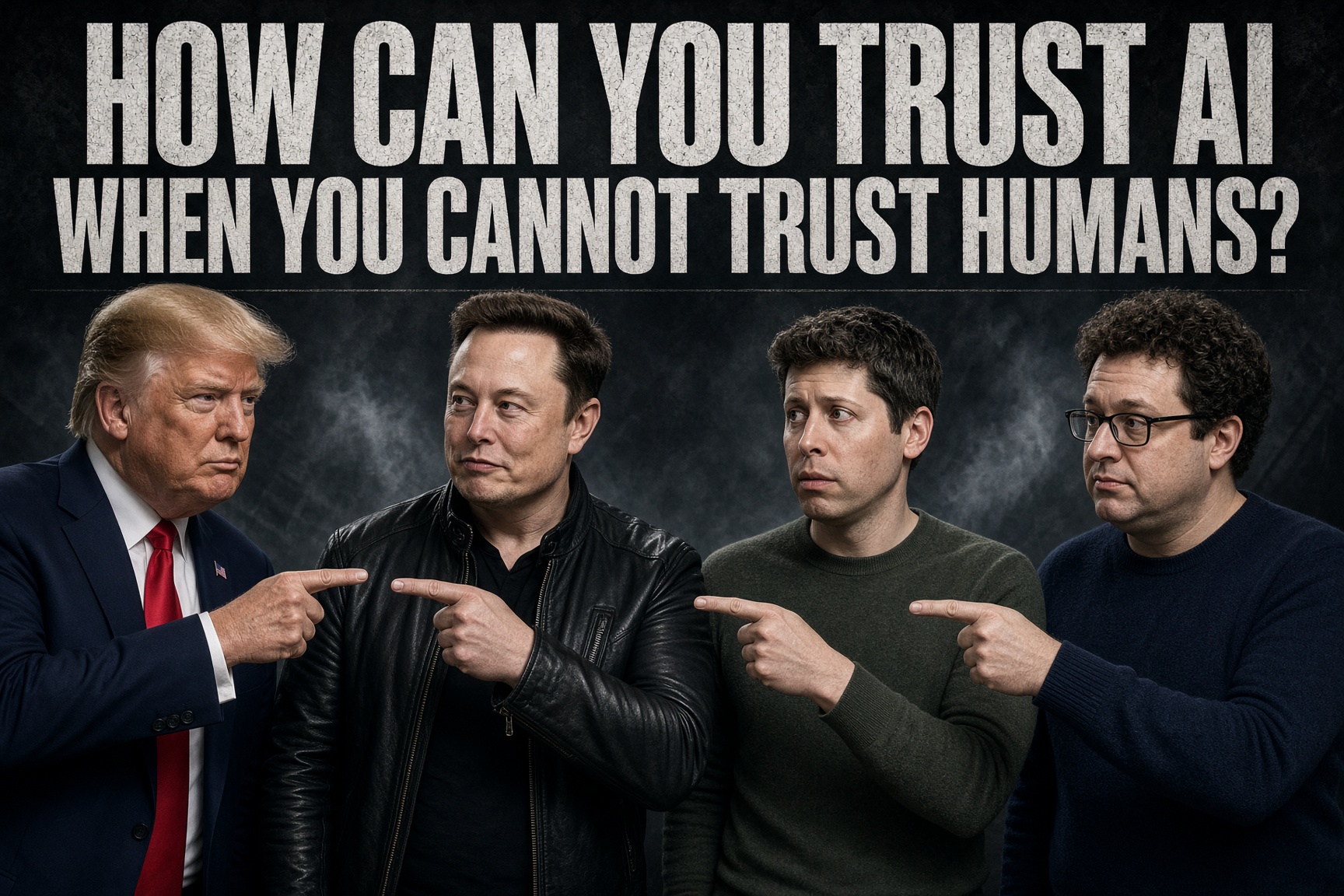
How Can You Trust AI When You Cannot Trust Humans?
Can you trust AI? Can you trust humans? More often than we like to admit, the answer is no. AI inherits its failures from the human records it is trained on. Sheikh Mohammed bin Rashid wrote this month that the currency the UAE is betting on is trust. This piece sets out what a trust layer has to do, shows the method on three public knowledge graphs, and lays out the post-quantum work KXCO has published so that an institution can check the claim rather than take it.
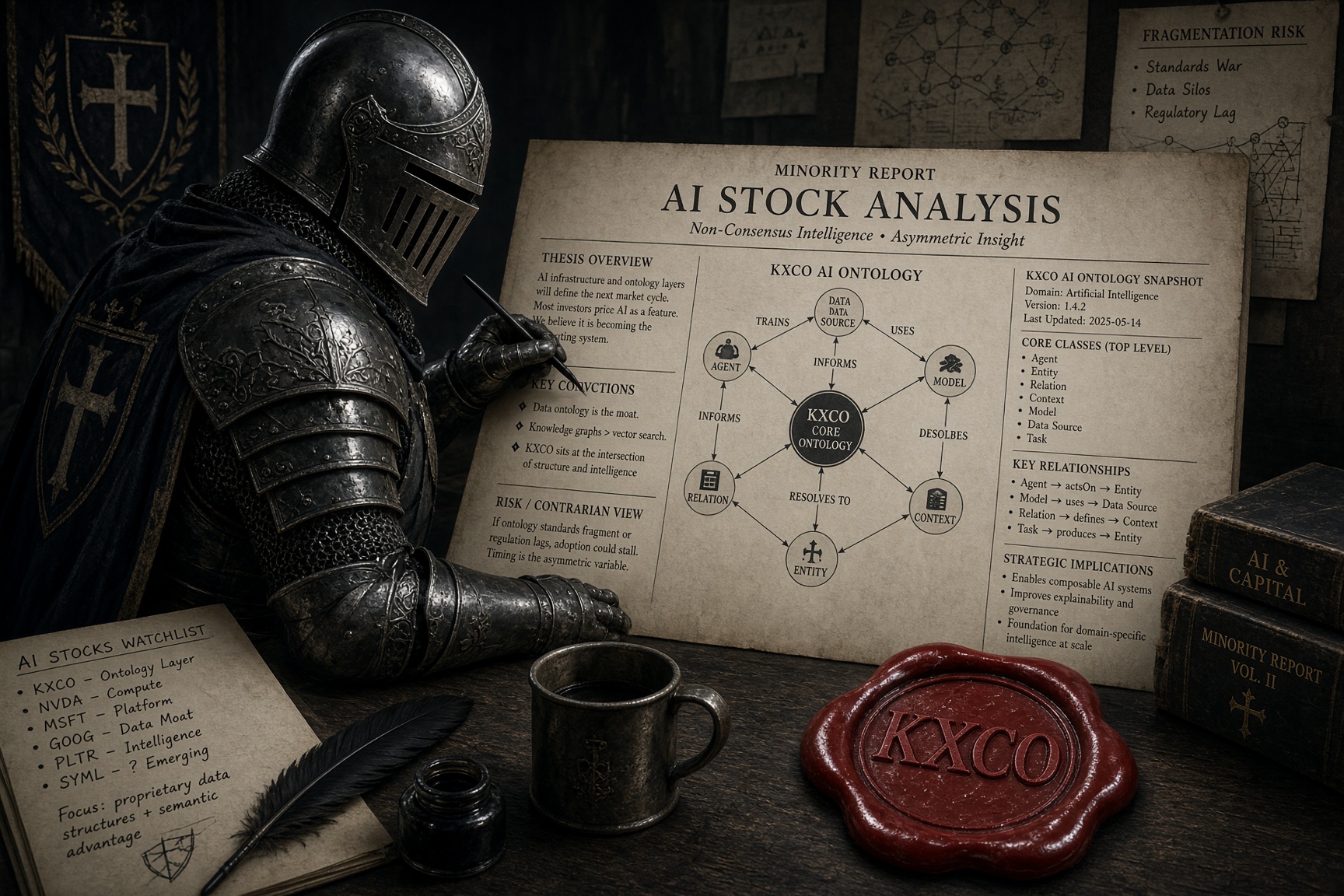
KXCO AI Ontology at 3 Months: What It Called and What Comes Next
On 19 July 2026 the Round Table's AI room published its first Analyst Outlook. To the 16 October 2026 close its 13 names rose 2.6% on an equal weight against 2.1% for QQQ, per StockAnalysis closes, and the six it opened with 35% or more of upside rose 8.6%. This piece lists the six names up more than 5%, the ten names I rate as opportunities now, the month's results in AI and quantum computing, and the official data showing that four in five firms have not yet started using AI.
Every story, signed and delivered.
Subscribe to the kxco channel and get the headline, the AI-written key takeaways, and the chain-anchor link the moment we publish. Audio versions and per-ticker subscriptions arrive in the next iteration.