
The Weaponization of the US Dollar was a Disaster $BTC #China #Russia
In recent years, the global economic landscape has witnessed significant shifts, with China and Russia increasingly challenging the longstanding dominance of the US dollar. While the USA has historically wielded considerable influence through its currency, the weaponization of the US dollar and the response by strategic adversaries like China and Russia signals a pivotal juncture in global economic dynamics.
Challenging Assumptions of US Dollar Dominance
For decades, the assumption that the USA controlled the world economy through the preeminence of the US dollar has shaped global economic policies, trade dynamics, and geopolitical strategies. However, the strategic counter maneuvers by China and Russia to diminish the dominance of the US dollar underscore a fundamental miscalculation of US hegemony.
Strategic Alignments and Economic Alliances
China and Russia's concerted efforts to diversify their foreign reserves, promote bilateral trade agreements, and establish alternative financial infrastructures reflect a calculated strategy to reduce dependency on the US dollar. Initiatives such as the Belt and Road Initiative (BRI), Eurasian Economic Union (EAEU), and the establishment of alternative payment systems challenge the traditional financial frameworks dominated by Western institutions.
Weaponizing Financial Instruments
The weaponization of the US dollar extends beyond mere economic strategies; it encompasses the utilization of financial instruments, sanctions, and regulatory frameworks to exert influence, impose constraints, and advance geopolitical objectives. China and Russia's efforts to develop alternative payment systems, digital currencies, and trade mechanisms circumvent US-led politically motivated financial sanctions, promote economic sovereignty, and foster multipolarity in the global financial system.
Implications for the USA
The diminishing influence of the US dollar, coupled with the strategic initiatives by China and Russia, poses significant implications for the USA. A loss of financial leverage, reduced influence over global economic policies, and challenges to the primacy of the US dollar could undermine US geopolitical objectives, economic competitiveness, and strategic alliances.
Moreover, the weaponization of the US dollar and subsequent reactions by China and Russia reflects a broader geopolitical contest for influence, power, and control in an increasingly multipolar world. As the USA confronts these evolving dynamics, it must reassess its economic strategies, diplomatic engagements, and geopolitical alignments to navigate the complexities of a shifting global order.
Conclusion
The weaponization of the US dollar and the countermeasures by China and Russia signifies a paradigm shift in global economic dynamics, challenging longstanding assumptions of US dominance. As China and Russia continue to promote alternative financial systems, payment mechanisms, and trade agreements, the USA must recognize, adapt, and navigate the complexities of a multipolar world.
By understanding the strategic motivations, economic implications, and geopolitical consequences of the weaponization of the US dollar, policymakers, economists, and stakeholders can anticipate, adapt, and engage constructively in shaping a more equitable, resilient, and cooperative global financial system.

KXCO is Enhanced Intelligence, Not Artificial
I never wanted artificial intelligence. I wanted enhanced intelligence, and they are not the same product. Artificial means the machine does the thinking and hands you the answer. Enhanced means I do the thinking, with more of my own mind in the room than I have ever had at one time. Forty years of reading, recallable in the second I need it. Patterns across law, credit, physics and markets that no specialist sees, because the useful ones sit between the fields rather than inside them.
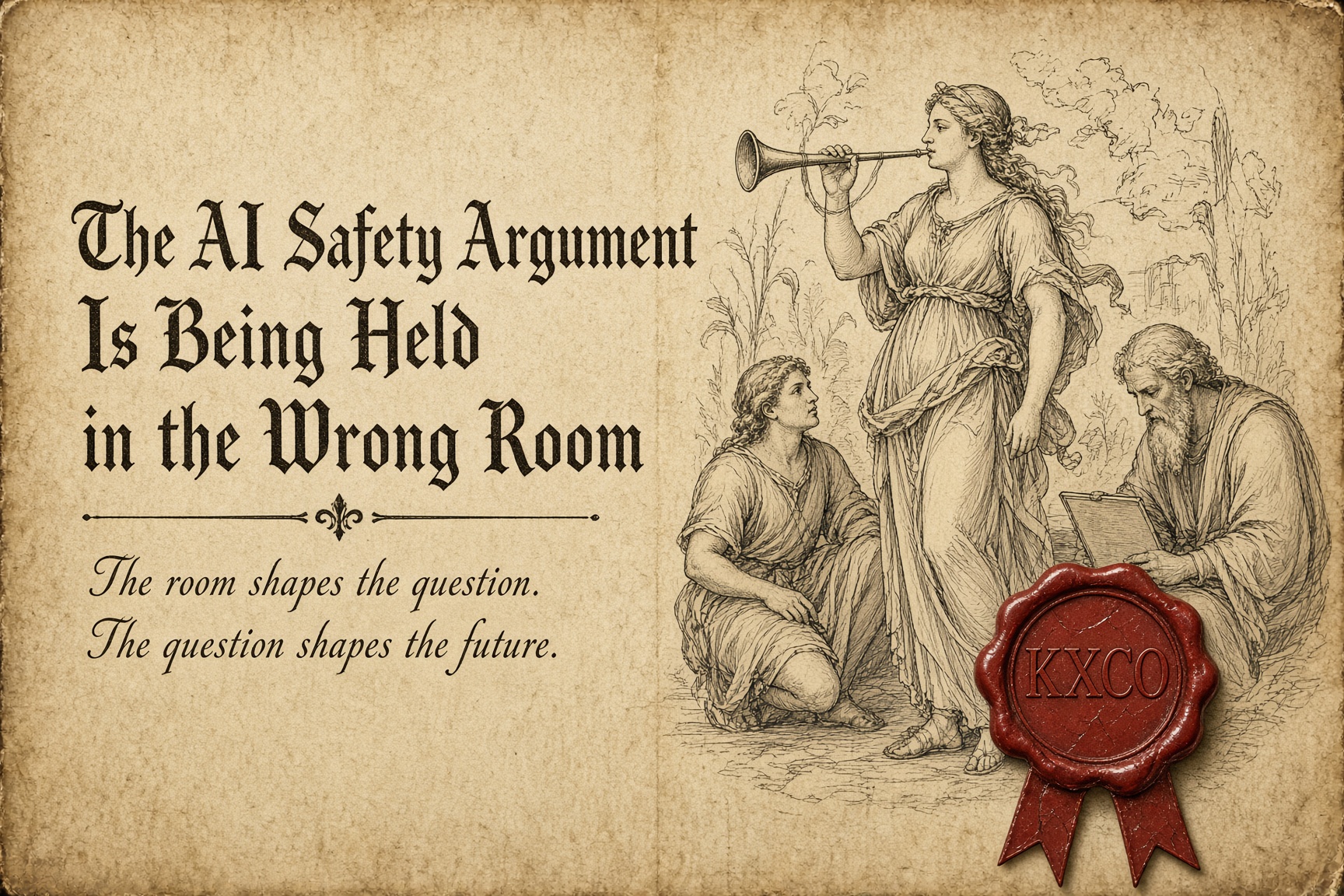
The AI Safety Argument Is Being Held in the Wrong Room
The people who will be blamed for what AI does are not in the room where its safety is argued. A jailbreak escapes a policy. The failure that costs money is an action that escapes an owner, a payment sent or a record altered. Tokens are not authority. Intelligence got cheap and judgment did not, and there is no organ of standing you can copy into a model. Shayne Heffernan on the objection worth taking seriously, and the questions to take into a vendor meeting.
NIST Graded Our Post-Quantum Cryptography. Zero Failures.
NIST's Algorithm Validation Test System generated test vectors nobody had seen, we answered them over the ACVP protocol, and NIST graded the result: 2,130 cases across ML-KEM, ML-DSA and SLH-DSA in every parameter set offered, zero failures, demo certificate A11025. This is what that proves, where we deliberately drew the claim narrower than NIST's own matrix, and why the FIPS 140-2 sunset on 21 September makes the distinction between being graded and grading yourself worth understanding.

The Problem Is Not the Problem
People treat the Jack Sparrow line as a joke. The attribution is a joke. The sentence is not. Forty years in markets says the same thing Epictetus said in 125 CE and Robert Merton named in 1948: the event is finite, and the story you appoint to govern it is not. This essay walks the quote back to its actual sources, draws the loop that turns a feeling into an order, and sets out the four places a rule written in advance cuts the loop. Faith is not a hedge. It is a stance.
Every story, signed and delivered.
Subscribe to the kxco channel and get the headline, the AI-written key takeaways, and the chain-anchor link the moment we publish. Audio versions and per-ticker subscriptions arrive in the next iteration.