
Digital Erasure, and Why KXCO Matters
Paper archives protected history through physical multiplicity. Centralized digital records erase silently, and quantum computing threatens the signatures that prove authenticity. Here is what actually fixes it.
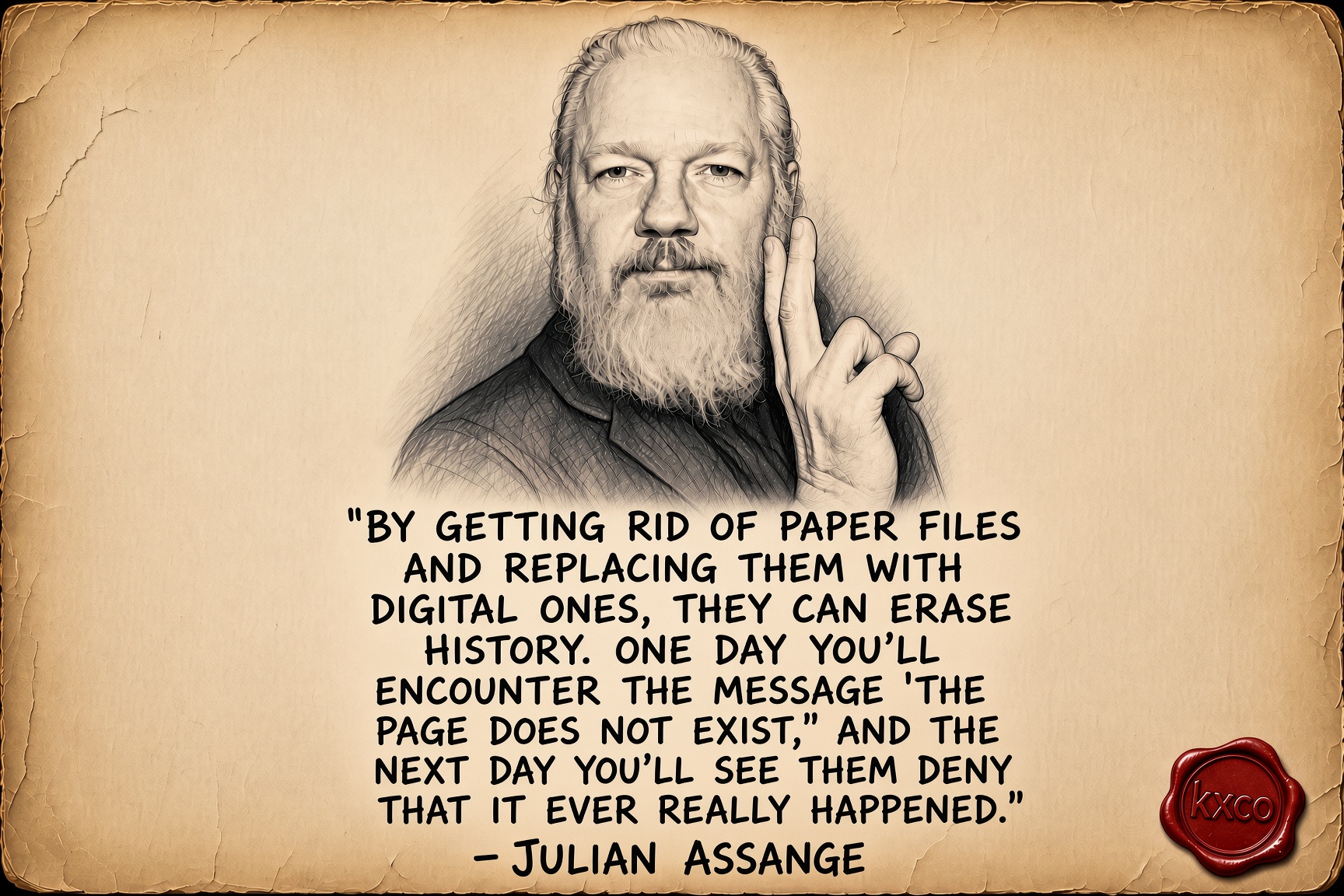
There is a warning widely attributed to Julian Assange that has aged from provocation into plain description. By getting rid of paper files and replacing them with digital ones, they can erase history. One day you encounter the message "the page does not exist," and the next day you see them deny that it ever really happened.
That is not a rhetorical flourish. It is an accurate account of a structural shift that has already taken place, the numbers behind it are public, and quantum computing is about to make the problem worse in a way most of the coverage has not caught up with. This piece explains both failure modes, deletion and forgery, and the response KXCO has built and runs in production, including under this publication.
The architecture of forgetting
Paper archives were slow, expensive and imperfect, but they had a property modern systems quietly abandoned: physical multiplicity. Copies of anything important lived in libraries, government depositories, newspaper morgues, private collections and personal filing cabinets. Destroying every instance required coordinated, visible effort across many locations. Even regimes that attempted systematic erasure usually left residual traces, and the attempt itself left witnesses.
Digital records inverted the economics. When the authoritative version of a document, a news story, a dataset or a legal filing lives on servers controlled by one institution or a small set of platforms, the cost of erasure collapses. A policy change, a legal threat, an administrative decision or a routine database purge is enough. The URL returns "page not found." Search indexes drop the reference. Within a short time the public record treats the material as if it never existed. Assange observed this happening in real time with major newspapers that quietly unpublished stories under pressure: the old addresses simply stopped resolving, with no acknowledgment that anything had been removed.
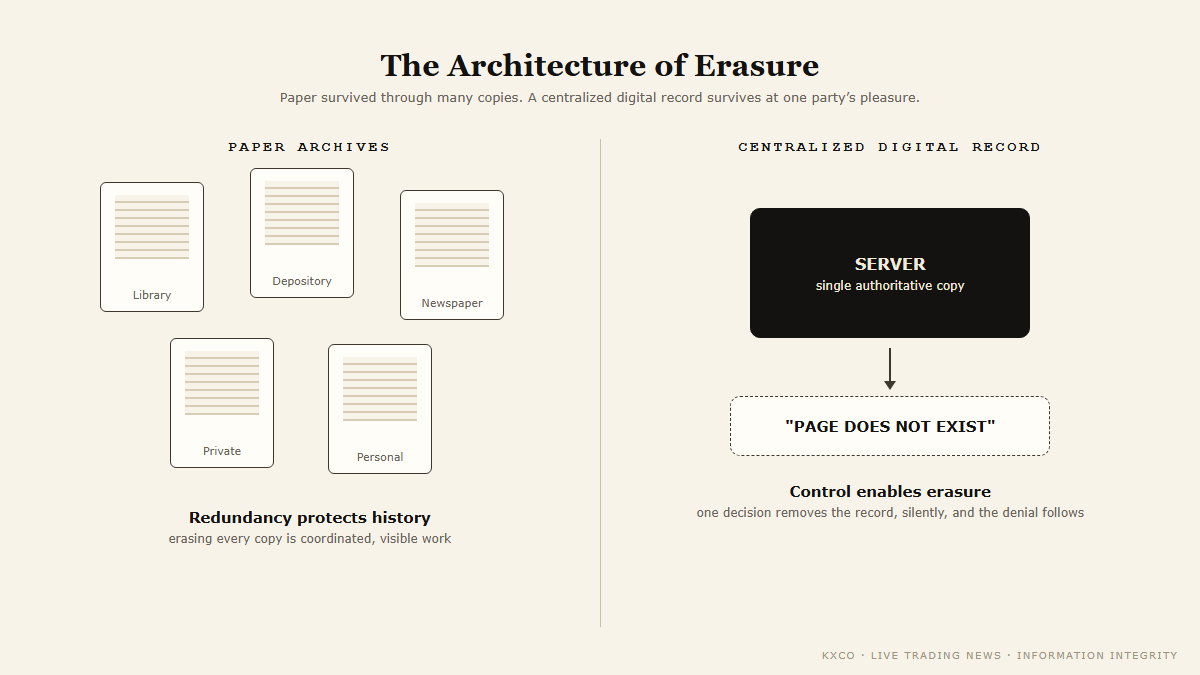
He tied the phenomenon to Orwell's most durable line: he who controls the present controls the past, and he who controls the past controls the future. Where history exists primarily as bits on machines, control of those machines becomes control of collective memory. The deeper problem is not that pages disappear. It is that the disappearance can be silent. A burned library leaves ash and witnesses. A digital purge can leave only the absence of evidence, and the absence of evidence is then offered as proof that the evidence never existed.
The scale is measured, not speculative
The Pew Research Center studied a decade of web content and found that 38 percent of pages that existed in 2013 were no longer accessible by 2023. A quarter of all pages that existed at some point across that decade were already gone when the study ran. Harvard and Columbia researchers who examined links inside New York Times journalism found a quarter of all deep links already dead, rising past half for older material, and that is one of the best-resourced archives in publishing.
Link rot infects citations in judicial opinions, academic papers and government reports. Entire publications have vanished when ownership changed or companies failed. Platforms remove content at volume, sometimes before independent researchers can preserve a copy. The Wayback Machine and similar archives are heroic but partial: incomplete, pressurable, and a snapshot carries no attestation from the original publisher that the material was authentic at the time.
The design property should be stated plainly. When the authoritative copy lives in a controllable location, the controller of that location is the gatekeeper of historical continuity. That is not an accident of any one platform. It is the shape of the architecture.
Beyond deletion: the quantum threat to authenticity
Deletion is the obvious failure mode. The subtler one arrives when the cryptography that proves authenticity stops being trustworthy.
Modern digital signatures, certificate systems and blockchain transaction authorizations rest on two mathematical problems, integer factorization and elliptic-curve discrete logarithms, that classical computers cannot solve efficiently. A sufficiently large fault-tolerant quantum computer running Shor's algorithm changes the economics of both. Private keys become derivable from public keys. Signatures that verify perfectly can be forgeries.
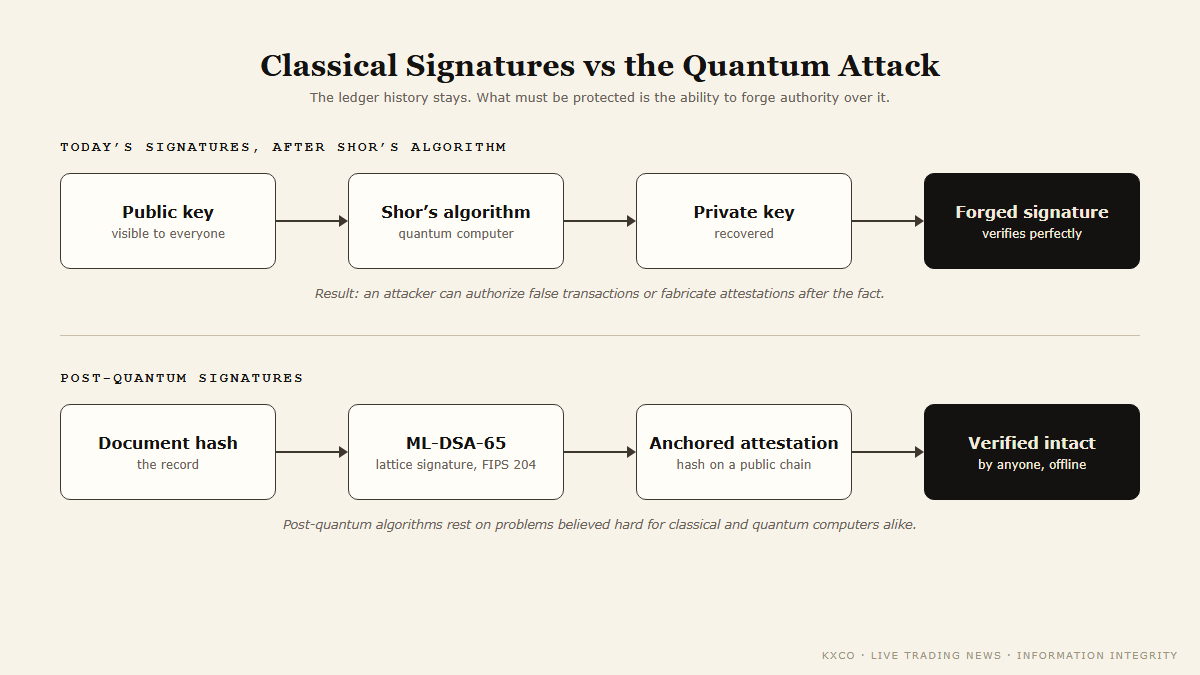
Notice what breaks and what does not. In a blockchain, the chain of hashes linking successive blocks remains mathematically intact; an attacker does not silently rewrite old blocks. What breaks is signature trust: the ability to know that a transfer, an attestation or a state update genuinely originated from the claimed party. Once signatures can be forged at scale, the practical integrity of the record collapses even though the hash chain is continuous. Ownership can be diverted. Attestations can be fabricated. The line between authentic history and manufactured history erodes, and it erodes without a single page returning "not found."
None of this is speculative fiction, and the timeline is not KXCO's. NIST finalized the post-quantum standards in August 2024: ML-KEM (FIPS 203) for key exchange, and ML-DSA (FIPS 204) and SLH-DSA (FIPS 205) for signatures. National security agencies have published migration timelines clustering around the late 2020s through the mid-2030s. Hybrid post-quantum key exchange already protects a large and growing share of internet traffic at major content networks. The migration is underway because "harvest now, decrypt later" is understood: material protected today may still need to be confidential or provable years after a cryptographically relevant quantum computer arrives. For records, the equivalent is sign now, forge later. A signature made today with RSA or ECDSA is a promise that expires on a date nobody can name.
What an unbroken chain requires
An immutable record is only as strong as the cryptography binding each link, and the assumptions under which that cryptography stays secure. Elliptic-curve and RSA signatures were designed for a classical world; relying on them for long-lived records is writing history in a medium a future technology can dissolve.
Post-quantum cryptography replaces those primitives with lattice and hash-based algorithms believed to resist both classical and quantum attack. When they are used to sign transactions, attestations and document hashes, the practical effect is precise and worth stating carefully. Deletion can still happen at the hosting layer; any operator can stop serving data, and no cryptography prevents that. What changes completely is what deletion achieves. The cryptographic commitments remain independently verifiable by anyone holding a copy of the signed material, so the record can be re-proved authentic from any surviving copy. And forgery becomes computationally infeasible under the new assumptions, so the record cannot be silently rewritten either.
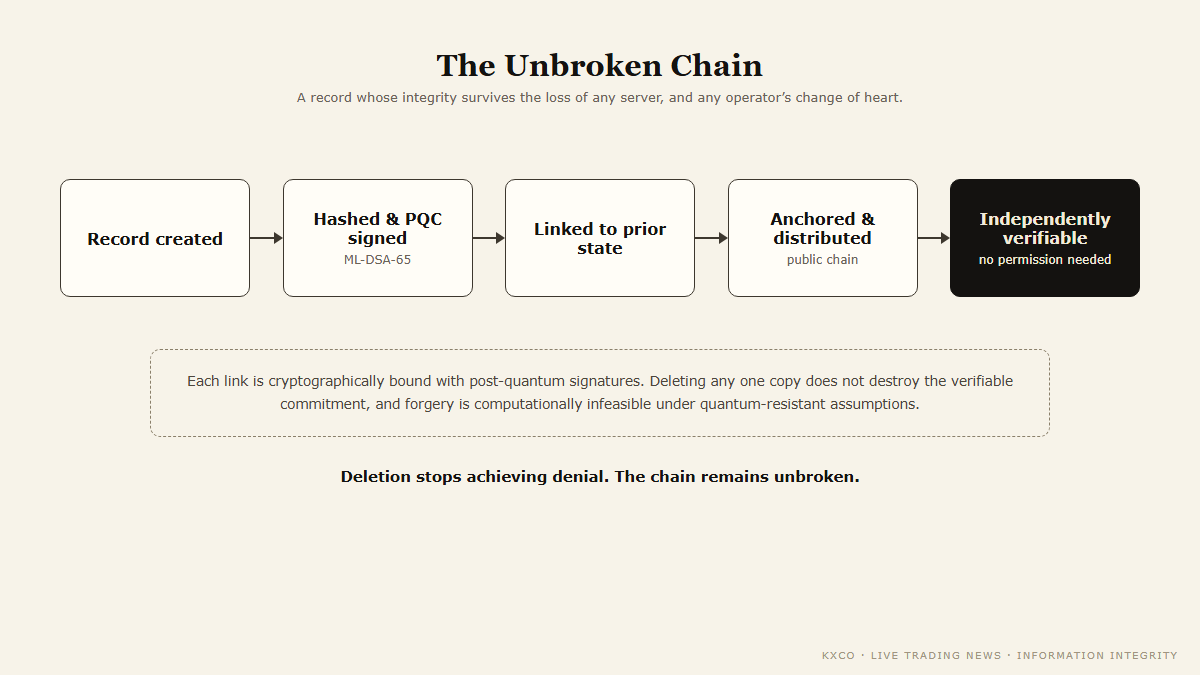
The chain does not quietly become editable. It stays unbroken under the threat model that will define the coming decades. That is a different goal from secrecy. The point is not hiding information. It is durable authenticity, the preserved ability to demonstrate what was published, by whom, and when.
What KXCO runs, including under this publication
This is the problem space KXCO operates in, and the capabilities are live rather than promised.
Armature L1, KXCO's settlement network, has used the NIST lattice signature ML-DSA-65 from its first block, so there is no quantum-vulnerable legacy layer to migrate away from, and it carries the anchors that make long-lived records independently checkable. The publishing infrastructure behind Live Trading News signs articles with ML-DSA-65 and writes anchors to Armature L1 as part of the publish flow, applied forward from adoption and never backdated. Verification is open: the kxco packages on npm let anyone check a signature offline, against the public record, with no KXCO server involved. For organizations that must migrate existing estates in place, KXCO Sentinel and Bastion inventory quantum-vulnerable cryptography and turn the migration into a tracked, evidenced program.
One honest boundary belongs in any serious version of this argument. None of this stops an operator, including KXCO, from taking a page down. What it stops is the second half of the Assange scenario: the denial that the page ever existed. Once a record is signed and anchored, any surviving copy can be re-proved authentic by anyone, and the anchor on the public chain does not go away because a server did.
Stakes for journalism, markets and public memory
Journalism depends on citing sources that remain available and whose authenticity can be checked; when original documents disappear or can be forged after the fact, accountability collapses. Financial markets depend on the integrity of ownership records, transaction histories and regulatory filings. Legal systems depend on signed contracts and evidentiary chains. Science depends on the durability of published data and methods. In each domain the same structural risk appears: centralized digital control combined with quantum-vulnerable cryptography creates the conditions for selective amnesia and selective fabrication.
Assange's observation was never only about governments or intelligence services. It was about the architecture of information itself. Any system that makes erasure cheap and authentication brittle will eventually be used by whoever holds power at the moment of decision. Paper raised the cost of revisionism through physical multiplicity. Properly designed quantum-resistant systems raise it through mathematics that stay hard even for quantum computers.
The alternative is a future in which inconvenient pages return "does not exist," inconvenient signatures can be manufactured, and the public is invited to accept the revised narrative because the evidence has been made unavailable or untrustworthy. That outcome is a design choice, not an inevitability. The work of preserving an unbroken chain of authentic information is the precondition for any serious claim to truth in a digital age. We stop the tampering. The chain remains unbroken. The software is live and adoption is growing.
A longer technical version of this argument, with the full sourcing, is on the KXCO developer blog.
Shayne Heffernan, Ph.D., is the founder of Live Trading News, the KnightsBridge Group, Knightsbridge Law and the KXCO.ai ecosystem spanning post-quantum cryptography, identity, attestation and enterprise ontology.
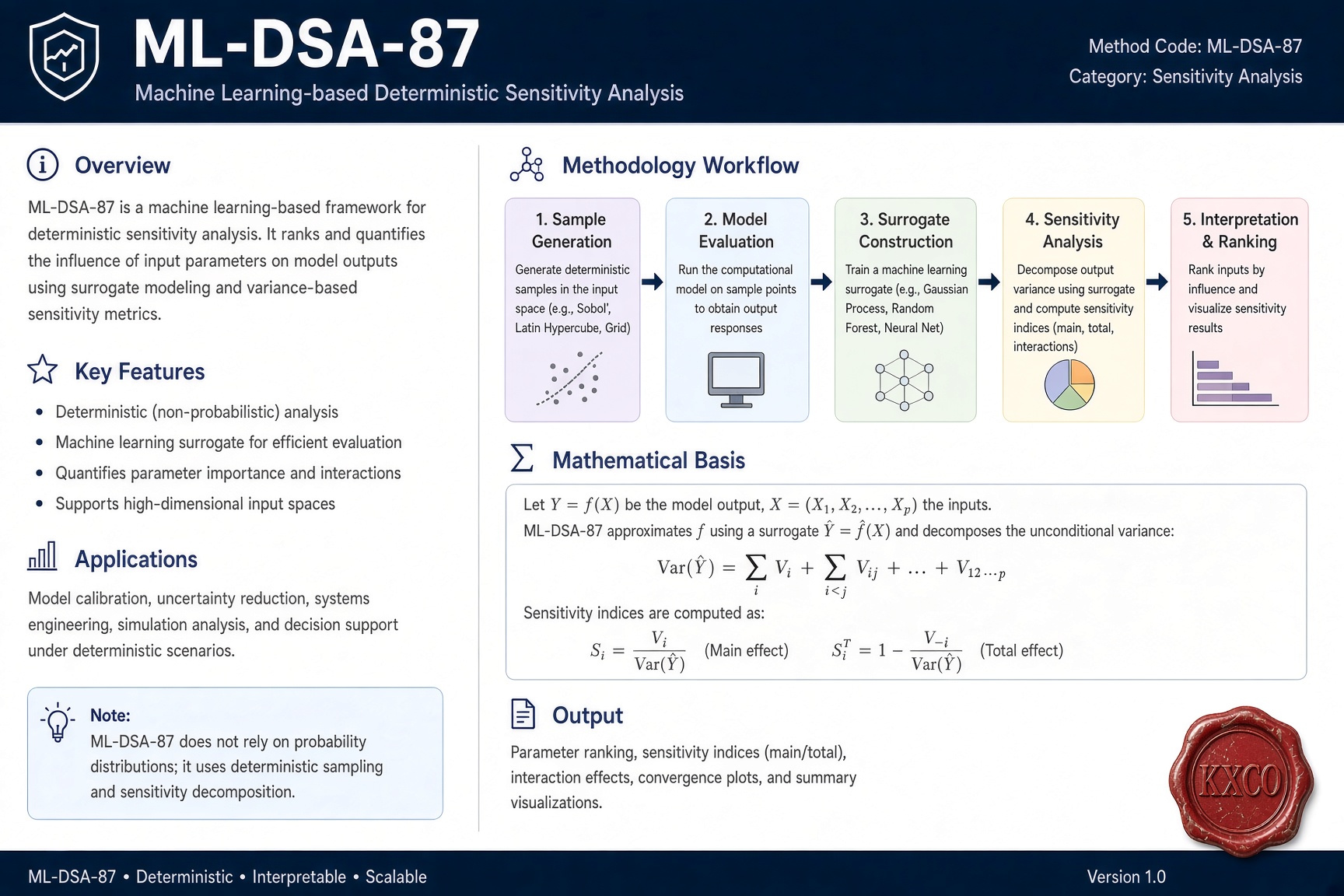
KXCO Now Verifies ML-DSA-87 in Consensus, the Signature Level Named by the NSA
On 6 October 2026 KXCO's chain began verifying ML-DSA-87 signatures as a rule of consensus, and the first ML-DSA-87 identity registered 28 seconds later. ML-DSA-87 is the category 5 level of NIST's FIPS 204, specified by the NSA for US national security systems and preferred by Australia's Information Security Manual. KXCO ships it for signing and for keys held in hardware, accepts it across its network and verifies it on chain, and anyone can check a verdict.
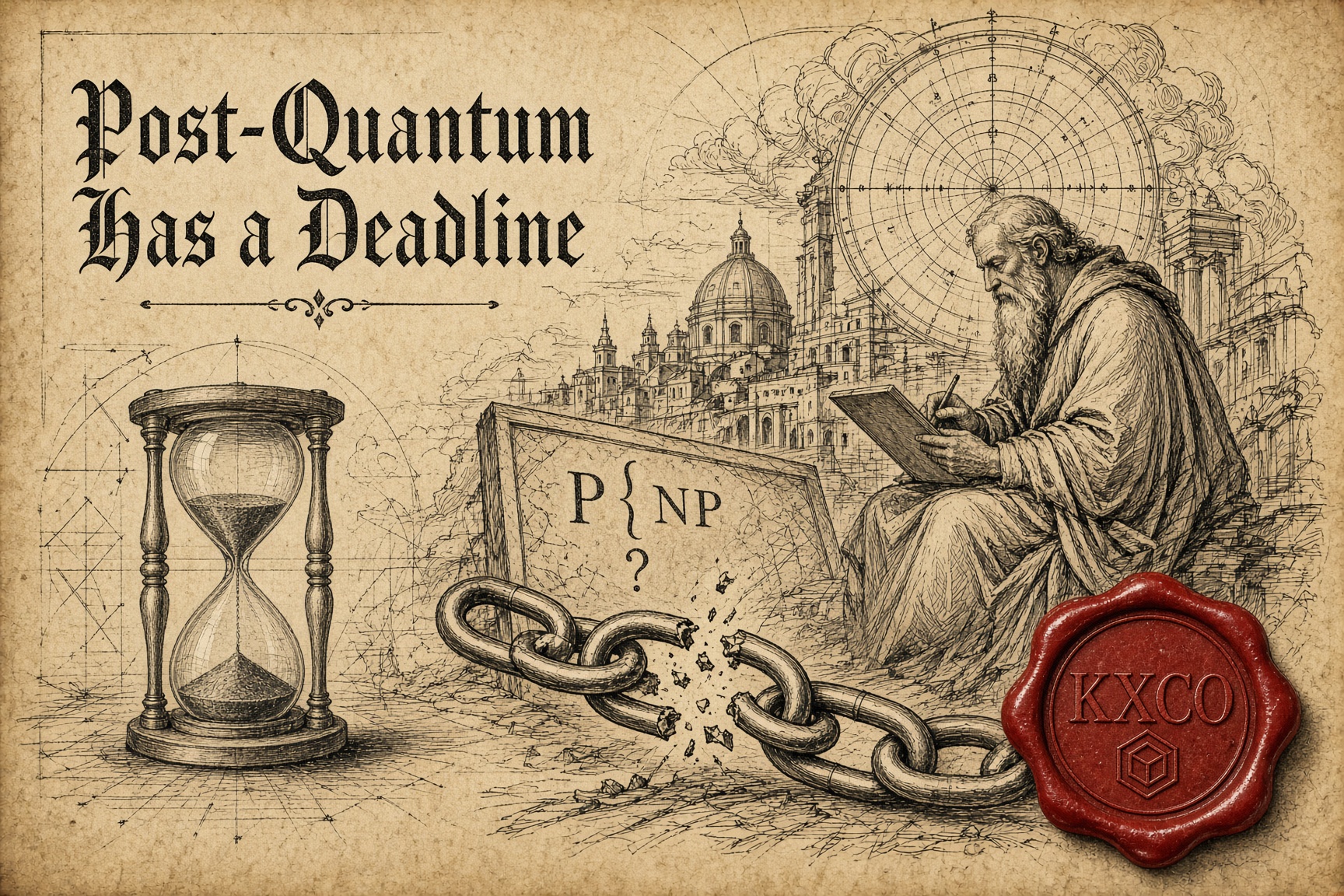
Post-Quantum Has a Deadline: 2030 for Keys, 2031 for Signatures
Executive Order 14412 gives federal high-value systems until 31 December 2030 for post-quantum key establishment and until 31 December 2031 for signatures. Six of the seven official calendars put a milestone in 2030. The Order reaches vendors through the contract, the purchase, the build, the data and the inventory. The runtimes already moved: a stock Node.js client negotiates X25519MLKEM768 by default. What is left is in the application.
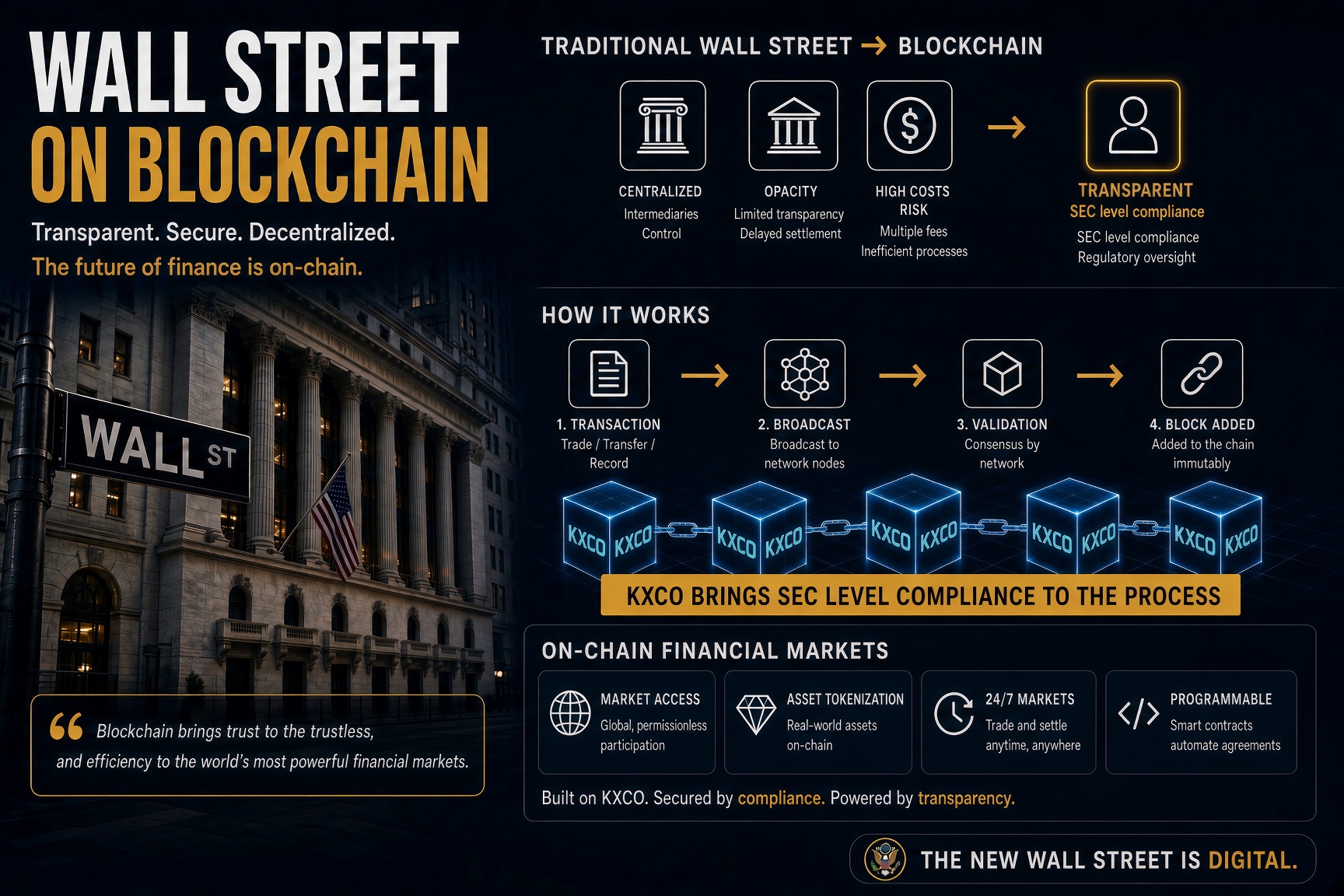
Tokenising a Share in Code: the Register Entry, the Credential and 4 Checks
The SEC has said what a tokenised share's record must hold: wallet, quantity and issue date on chain, the holder's name off chain, permissioned participants, and the same dividends as the share. This developer note builds it in JavaScript: an ML-DSA-65 signed register entry, a stranger's check, the same check at Armature's 0x0b precompile, a credential gate and an exact dividend at a record date.
The 2030 Post-Quantum Deadline in Code: 6 Changes and the Test for Each
A stock Node.js client already negotiates X25519MLKEM768, so TLS 1.3 took the first post-quantum step on its own. Nothing the application owns has moved. This developer note reads Executive Order 14412 and OMB M-26-15 as six changes: ML-KEM key establishment, ML-DSA signatures, a one-import move to Category 5, PQC-signed JWS at the gateway, re-encryption of long-lived data and a CycloneDX CBOM from the lockfile. Every block was run against the published packages.
Every story, signed and delivered.
Subscribe to the kxco channel and get the headline, the AI-written key takeaways, and the chain-anchor link the moment we publish. Audio versions and per-ticker subscriptions arrive in the next iteration.