
The U.S. Dollar: Trump Cannot Save It—Buy Gold and Bitcoin
By Shayne Heffernan, May 8, 2025
The U.S. dollar, long the king of global finance, is on a downward spiral, and President Trump’s policies are only hastening its fall. I’ve been watching this unfold with a mix of concern and clarity, knowing the dollar’s reduced role in global trade, the impact of foreign countries dumping U.S. bonds, and the broader implications for America’s military industrial complex. The U.S. fears free trade for reasons tied to its own economic vulnerabilities, and investors need to act—gold and Bitcoin are the smart moves to protect your wealth.
The Dollar’s Shrinking Role in Global Trade: A Historical Perspective
The dollar became the world’s reserve currency at the Bretton Woods Conference in 1944, when it was pegged to gold at $35 an ounce, and other currencies were fixed to the dollar. This gave the U.S. immense power, allowing it to run deficits while maintaining global trust, as foreign nations needed dollars for trade. But the system cracked in 1971 when President Nixon ended the gold standard—what became known as the "Nixon Shock." The dollar’s value floated freely, and its dominance relied on trust in the U.S. economy, not gold.
Since then, the dollar’s role in global trade has steadily eroded. In the 19th century, the British pound sterling held the top spot, used in 60% of global transactions, while the dollar lagged behind. By the mid-1920s, the dollar overtook the pound, but its true dominance came post-World War II, with over 70% of global reserves in dollars by 2000, according to the IMF. Fast forward to today, and that share has dropped to below 60%, with central banks diversifying into gold, the Chinese yuan, and other currencies. The decline isn’t new—China has been striking yuan-only trade deals with Brazil, Russia, and South Korea for years, while the BRICS nations, now 41% of the global economy, are pushing for alternatives, as reported by the Geopolitical Economy Report.
Trump’s tariffs, meant to boost U.S. manufacturing, are backfiring. Since his “Liberation Day” tariff announcement in April 2025, the dollar has lost nearly 10% against a basket of currencies, hitting a three-year low, per CBS News. The tariffs—104% on China, 54% on Vietnam, 25% on South Korea—have rattled global markets, driving investors away from dollar-based assets. Foreign Affairs warned in April 2025 that Trump’s policies could “dethrone the dollar,” eroding the economic power he aims to wield. The dollar’s reduced role means higher borrowing costs and weaker sanctions power, as nations like Russia and Iran find ways to bypass U.S. financial systems.
Foreign Countries Ending U.S. Bond Purchases: A Tipping Point
Foreign countries ending their purchases of U.S. bonds is a major blow to the dollar’s stability. Japan, the largest holder of U.S. Treasuries since 1985, and China, holding $759 billion, have been selling off bonds amid Trump’s trade war, as noted by the Financial Times and CNBC. Japan’s life insurers, like Nippon Life, are reducing exposure due to U.S. policy flip-flops, while China has directed state banks to pause dollar purchases, per Reuters. The Treasury market, valued at $28 trillion, is the world’s largest, but its appeal is fading—yields on the 10-year Treasury soared to 4.592% in April 2025, the highest since February, reflecting a massive sell-off, per CNBC.
Historically, foreign investors have propped up U.S. debt, with Japan and China alone holding over $1.5 trillion in Treasuries. But the sell-off signals a loss of trust. The Washington Post reported in April 2025 that investors are fleeing U.S. bonds, stocks, and the dollar simultaneously, an unusual move driven by fears of economic instability. The U.S. capital account surplus—offsetting its trade deficit—relies on foreign demand for Treasuries. If that demand dries up, interest rates will spike, making borrowing costlier for the government, businesses, and households. The U.S. debt, now at $35 trillion, per the U.S. Treasury, becomes harder to finance, risking a fiscal crisis, as warned by the Council on Foreign Relations.
Destruction of the Military Industrial Complex
The dollar’s decline directly threatens the U.S. military industrial complex, a sprawling network of defense contractors, Pentagon spending, and global military bases that rely on cheap borrowing and dollar dominance. The U.S. spends $886 billion annually on defense, more than the next 10 countries combined, according to the Stockholm International Peace Research Institute (2024). This spending is funded by issuing Treasuries, which foreign nations buy due to the dollar’s reserve status. Without that status, borrowing costs rise, squeezing the Pentagon’s budget.
The dollar’s role also powers U.S. sanctions, a tool of military influence. By controlling the global financial system, the U.S. can freeze assets of nations like Russia and Iran, as noted by Foreign Affairs. A weaker dollar reduces this leverage, as countries shift to yuan or other currencies, diminishing the U.S.’s ability to project power. The Atlantic Council highlighted in April 2025 that a declining dollar could weaken U.S. negotiations and sanctions on terrorists and cartels. The military industrial complex, built on dollar hegemony, faces destruction as global trust erodes—Trump’s tariffs are accelerating this by alienating allies and rivals alike.
Why the U.S. Fears Free Trade
The U.S. fears free trade because it exposes the structural weaknesses of its economy, particularly its reliance on the dollar’s “exorbitant privilege.” Free trade, as seen since the post-World War II era with the Marshall Plan and reduced tariffs, allowed the U.S. to run persistent trade deficits—$773 billion in 2023, per Reuters—because the world needed dollars for trade. But this hollowed out American manufacturing, as Vice President JD Vance noted in 2023, calling the dollar’s reserve status a “massive tax on American producers.” The U.S. trade deficit with China grew after China joined the WTO in 2001, contributing to deindustrialization in places like Detroit and Youngstown, Ohio, as The Atlantic pointed out.
Trump’s economic nationalism—tariffs, reshoring, and subsidies—aims to reverse this, but it ignores the root issue: the dollar’s reserve status requires trade deficits to supply the world with dollars, per the Triffin Dilemma, a concept debated since the 1960s. Free trade amplifies this imbalance, making U.S. goods less competitive as the dollar’s strength drives up export costs. The U.S. fears losing its financial edge if free trade continues, as nations diversify away from dollar reliance, a trend Trump’s policies are ironically hastening.
Trump Cannot Save the Dollar—Buy Gold and Bitcoin
Trump’s tariffs and erratic policies—threatening to fire Federal Reserve Chair Jerome Powell, pushing for a weaker dollar while maintaining its dominance—are contradictory and self-defeating, as Jacobin and Geopolitical Economy Report have argued. The dollar has fallen 9% against a basket of currencies since January 2025, per CBS News, with a steep drop after his tariff announcements. Investors are dumping U.S. bonds and stocks, turning to safe havens like gold, which hit $2,650 per ounce in April 2025, up 28% year-over-year, per Bloomberg, and Bitcoin, which surged to $81,000, up 90% from last year, per CoinMarketCap. These assets offer protection—gold as a proven store of value, Bitcoin as a decentralized hedge against inflation and sanctions.
The dollar’s decline isn’t just a market blip; it’s a structural shift. Foreign countries ending bond purchases signal a loss of trust, and the military industrial complex, reliant on dollar hegemony, faces collapse as borrowing costs rise and sanctions lose bite. Trump’s approach—doubling down on tariffs while ignoring the dollar’s foundational role—cannot save it. Investors should act now: allocate to gold and Bitcoin to safeguard against the dollar’s fall and the economic turmoil ahead.

The Evil Legacy of the French Revolution
The French Revolution is still sold as the birthday of the modern world. The ledger does not match the posters. It seized the Church's land and floated its paper money on the seizure, hunted the priests who would not swear, defined the nobility as a moral enemy, and put in their place a political class accountable chiefly to itself. Four knowledge-graph exhibits trace who put the king and queen on the scaffold, and how the template left France.
Careful of the Prompts You Give Yourself
A prompt is not only what you type into a model. It is any sentence that gets inside you and starts issuing orders. Most of what we call goals were written by comparison, media, competition and now the model, and they arrive dressed as ambition. Shayne Heffernan maps how an imported sentence becomes a week, why a want should carry its source the way a Round Table claim does, and how to strip, lock and guard the objective that is actually yours.

KXCO is Enhanced Intelligence, Not Artificial
I never wanted artificial intelligence. I wanted enhanced intelligence, and they are not the same product. Artificial means the machine does the thinking and hands you the answer. Enhanced means I do the thinking, with more of my own mind in the room than I have ever had at one time. Forty years of reading, recallable in the second I need it. Patterns across law, credit, physics and markets that no specialist sees, because the useful ones sit between the fields rather than inside them.
The AI Safety Argument Is Being Held in the Wrong Room
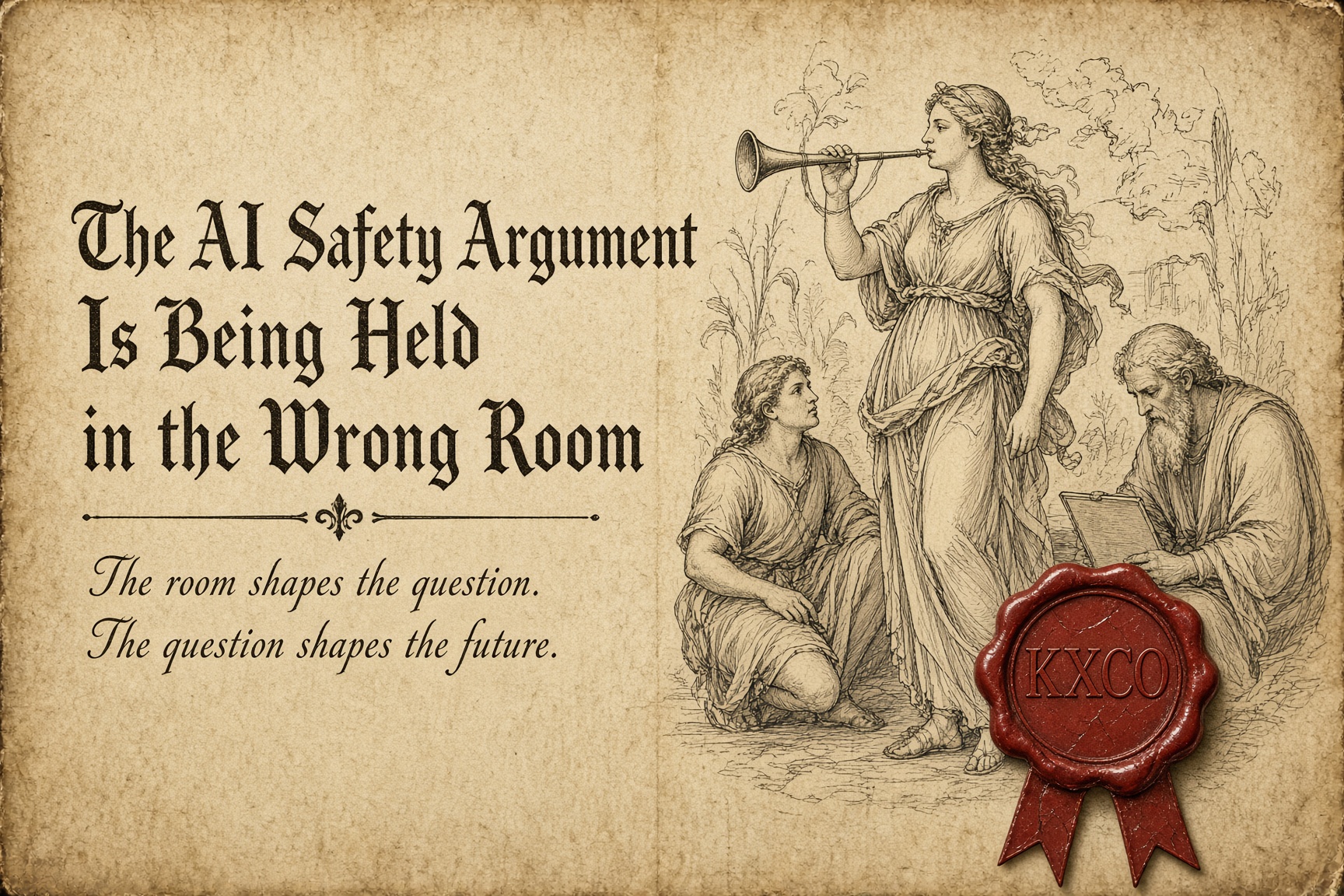
The people who will be blamed for what AI does are not in the room where its safety is argued. A jailbreak escapes a policy. The failure that costs money is an action that escapes an owner, a payment sent or a record altered. Tokens are not authority. Intelligence got cheap and judgment did not, and there is no organ of standing you can copy into a model. Shayne Heffernan on the objection worth taking seriously, and the questions to take into a vendor meeting.
Every story, signed and delivered.
Subscribe to the kxco channel and get the headline, the AI-written key takeaways, and the chain-anchor link the moment we publish. Audio versions and per-ticker subscriptions arrive in the next iteration.