
The CIA, FBI and Binance hacks, and KXCO's open-source post-quantum packages
The FBI says North Korea took more than $6 billion from Binance. CNN reports an apparent hack at the CIA, and the FBI is investigating one of its own. KXCO's 16 post-quantum packages are free on npm and score up to 9.8 on the Open Source Security Foundation's Scorecard.
Part of theQuantum Computing Center
In the past four weeks the FBI has attributed a theft of more than $6 billion from Binance to North Korea, and the CIA and the FBI have each been reported as the target of an apparent hack (FBI; CNN; SecurityWeek). In Binance's own account, the attacker had Binance's internal wallet signing service sign for it, and on 30 October Binance said that at that stage it had found no evidence that wallet private keys leaked (Binance; Binance). Between them, KXCO's 16 post-quantum packages keep signing keys in hardware, sign records anyone can verify, keep tamper-evident audit trails and encrypt files, and they are free to read, install and audit on npm today (GitHub).
The record on those packages is measured. npm's own counter shows 95,405 downloads of the 16 packages between the first publish on 20 May 2026 and 24 November (npm). The core library, kxco-post-quantum, scores 9.8 out of 10 on the Open Source Security Foundation (OpenSSF) Scorecard (OpenSSF Scorecard). The US National Institute of Standards and Technology (NIST) has graded 5,652 test cases of KXCO's code on the Demo server of its Automated Cryptographic Validation Test System, with zero failures (GitHub). The code is open source under Apache-2.0, and KXCO sells the part that someone has to operate (GitHub).
Reported breaches at the CIA and the FBI, and other incidents
On 24 November CNN reported, citing four sources, an apparent hack of an unclassified system that the CIA and the Office of the Director of National Intelligence (ODNI) use for open-source intelligence analysis (CNN). An ODNI official told CNN there were no disruptions to critical capabilities or classified systems (CNN). Two sources said early indications point to China, and no formal attribution has been made (CNN). One source told The New York Times that the intruders used ARTEX, an AI penetration-testing framework (BleepingComputer).
The FBI had already warned about that tool. In an alert on 13 November it said malicious actors had used ARTEX since at least August against government, defence and other sectors, and that some intrusions went from first targeting to privileged access in under three hours (Infosecurity Magazine).
The FBI is also investigating an apparent hack of its own National Crime Information Center (NCIC), the database that gives police records on fugitives, missing persons, criminal history and stolen property (SecurityWeek). Director Kash Patel said on 24 November that the investigation is active and the matter is ongoing, and declined to say who was behind it or what was obtained (CyberScoop). Two of CNN's sources say the CIA incident does not appear to be related (CNN).
Two months earlier, a group calling itself ShinyHunters claimed to hold data on almost all FBI agents and job applicants, taken through the FBIJobs.gov portal (Federal News Network). The FBI said in its statement that the point of breach was undetermined (Federal News Network). Current and former employees told NPR the haul could run to several terabytes, including job applications, family details and medical data (NPR).
The list goes on:
The Pentagon's personnel agency. A Defense Manpower Data Center (DMDC) letter says a small number of unauthorised users reached a server holding unencrypted personal data between October 2025 and July 2026 (SecurityWeek). A Department of War official put the count at 2.76 million living and 294,000 deceased people (SecurityWeek).
The Treasury's financial-crimes unit. The Financial Crimes Enforcement Network (FinCEN) said on 24 November that it is investigating unauthorised access to a limited subset of its systems and has taken some offline (ABC News).
A certificate authority's own keys. Private keys for eight intermediate certificates of India's eMudhra, two of them for code signing, were so weak they could be recovered from the public certificates (Help Net Security). eMudhra traced them to a faulty script at its April 2025 key ceremony (Help Net Security).
In my view, most of what these breaches reached has to stay protected for years: criminal histories, medical files and personnel records.
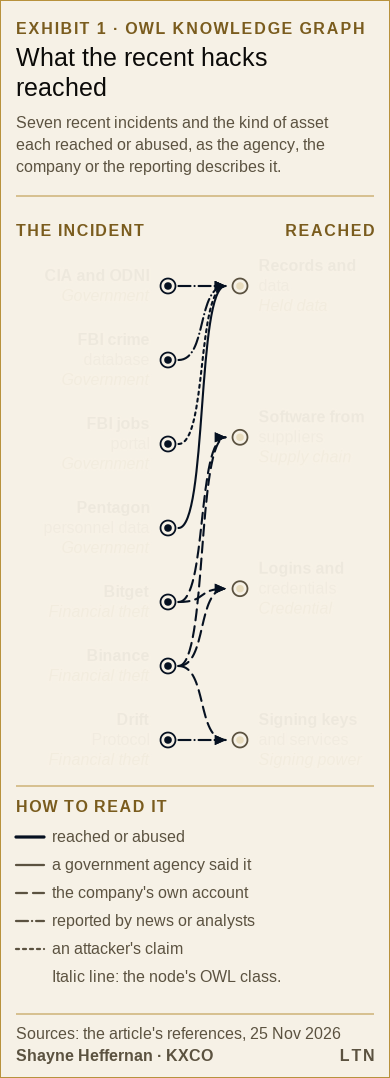
How to read Exhibit 1: each incident on the left links to the kind of asset it reached or abused, on the right. Where a source names no records, the link stands for the data on the system that was reached. The line says who stands behind the link: solid for a government agency, long dashes for the company itself, dash and dot for news outlets and analysts, short dashes for an attacker's claim. Every node carries its class in one ontology written in OWL, the Web Ontology Language, which a reasoner checked for consistency.
Binance says the attacker used its own signing service in a $6.3 billion theft
Binance's co-chief executives said its hot wallets were compromised at around 20:05 UTC on 29 October, with a loss of about $6.3 billion (Binance). The FBI said on 31 October that North Korea was responsible, in activity it calls TraderTraitor (FBI). TRM Labs counted about $6.36 billion leaving Binance wallets on ten blockchains, most of it in about 20 minutes (TRM Labs).
Binance's initial post-mortem of 3 November sets out how the attack built up over five months (Binance):
June. A wallet DevOps engineer installed a tampered copy of Homebrew while installing an AI coding tool found through a search engine.
September. A software engineer took a fake job interview and was told to download an "assignment" containing a malicious code repository.
20 October. The attacker used the compromised computer and an internal AI tool to gain control over two wallet engineers, and found a container deployment token on one engineer's computer.
29 October. The attacker used the stolen credentials to deploy a container and run the script that launched the attack.
Binance says the attacker used unauthorised access to an internal wallet signing service and had that service sign 50 transactions under Ethereum Improvement Proposal 7702 (EIP-7702), which gave an attacker-controlled contract partial execution rights over a hot wallet (Binance). On 30 October Binance said that at that stage it had found no evidence that wallet private keys were leaked (Binance). Its hot wallet used multi-party computation (MPC), so there was no single key with which to revoke the malicious authorisations at once, and halting withdrawals did not cancel them (Binance).
Binance said on 12 November that it had covered the assets impacted from its own funds (Binance). The Justice Department filed a civil forfeiture action on 23 November for more than $1.1 billion in USDC, a dollar stablecoin, and says the US has helped freeze, seize or return more than $2.9 billion since the theft (Decrypt). North Korea denies involvement (Decrypt).
The year was already a record. TRM Labs put crypto hacking losses in 2026 at about $8.7 billion by 30 October, and says North Korea took 85 per cent of that value (TRM Labs). Other recent thefts went through signers, credentials and suppliers:
Bitget, 24 September, about $388 million. Bitget says a zero-day in a third-party security product gave the attacker high-privilege credentials, and its wallet system processed forged withdrawal instructions as normal (Bitget).
Drift Protocol, 1 April, $285 million. TRM Labs says the attacker spent months persuading the protocol's multisig signers to pre-authorise transactions (TRM Labs).
FaceStealer, more than $400 million in 18 months. The Justice Department says this North Korean scheme uses deepfakes in fake video meetings and increasingly targets the people who maintain open-source software and their repository accounts (US Department of Justice).
TRM says attacks on the keys, servers and signing systems behind the money account for 88 per cent of what North Korea has stolen, Binance included (TRM Labs).
What the hacks share, and the quantum deadline
In my view the hacks above share one lesson. Whoever can make a valid signature, hold a valid login or ship code the victim trusts can act as the victim. TRM's advice after Binance was to make signing policies reject unexpected authorisations and to separate signing infrastructure by chain and wallet tier (TRM Labs).
The quantum computer adds a second problem with a deadline. Executive Order 14412 of 22 June 2026 warns that adversaries are collecting US information now to decrypt it later, once large-scale quantum computers work (Federal Register). NIST said on 27 October that today's encrypted data is already at risk from that "harvest now, decrypt later" threat (NIST). The UK's National Cyber Security Centre says the threat to signatures is forgery and impersonation, and that it should be considered before a quantum computer exists, above all for long-lived, high-value trust anchors (NCSC).
The estimated cost of that computer keeps falling:
Craig Gidney of Google Quantum AI estimated in May 2025 that a 2048-bit RSA (Rivest-Shamir-Adleman) key could be factored in under a week by a machine with less than a million noisy qubits, down from 20 million in his 2019 estimate (arXiv).
Google researchers estimated in PRX Quantum on 21 August 2026 that Shor's algorithm could break the 256-bit elliptic-curve problem on the secp256k1 curve with at most 1,200 logical qubits and 90 million Toffoli gates, or at most 1,450 and 70 million. On superconducting hardware with a physical error rate of one in a thousand, those circuits could run in minutes on fewer than half a million physical qubits (PRX Quantum).
The dates are set. NIST published the three post-quantum Federal Information Processing Standards (FIPS), FIPS 203, 204 and 205, on 13 August 2024 (NIST). Its final report Transition to Post-Quantum Cryptography Standards (IR 8547) of 27 October 2026 deprecates quantum-vulnerable public-key cryptography after 2030 and disallows it after 2035 (Help Net Security). Executive Order 14412 requires agencies to move their high-value assets and high-impact systems, National Security Systems excluded, to post-quantum key establishment by 31 December 2030 and to post-quantum signatures by 31 December 2031 (Federal Register).
Fraud and hacking are rising, and they threaten the world economy
The FBI's Internet Crime Complaint Center received 1,008,597 complaints in 2025, reporting $20.877 billion in losses, up 26 per cent from $16.6 billion in 2024 (SecurityWeek). Crypto hacking had already set a record for 2026 by 30 October, as the TRM Labs figures above show (TRM Labs).
The danger reaches the whole world economy. The International Monetary Fund (IMF) warned in May 2026 of the risks that cyberattacks powered by advanced AI pose to global financial stability (Dawn). Its report said extreme losses from cyber incidents could trigger funding strains, raise solvency concerns and disrupt broader markets, and the report's authors pointed to how closely the global financial system is interconnected (Dawn). A month earlier the IMF's head, Kristalina Georgieva, had warned that the global financial system was not ready for the cybersecurity threats that AI poses (Dawn).
In my view nobody is immune. If the CIA, the FBI and Binance can be targeted, so can any bank, ministry or company. The data such systems hold, from police records to personnel files, is dangerous in the wrong hands (SecurityWeek; SecurityWeek).
Just as serious is where the stolen money goes. On 12 November the FBI's Cyber Branch Operations Director, Brett Leatherman, said the North Korean regime, which the FBI holds responsible for the Binance theft, relies on the proceeds of large-scale cryptocurrency theft to fund its illicit weapons programme (US Department of Justice; FBI). In my view, hacks on this scale arm states such as North Korea, and criminal organisations too, and that is a further layer of threat on top of the losses themselves.
Identity checks are under attack as well. FinCEN said in November 2024 that financial institutions were filing more suspicious activity reports that describe suspected deepfakes, particularly fraudulent identity documents used to get past identity verification (FinCEN). The FaceStealer scheme above uses deepfakes too (US Department of Justice). I expect AI agents that act for companies to need the same identity checks as the people who run them.
KXCO has been dedicated to building tools that combat this hacking, and the 16 post-quantum packages described below are part of that work. KXCO Herald, KXCO's identity and signatures product, issues identity credentials for people and AI agents (kxco.ai). KXCO is working on advanced know-your-customer (KYC) checks for AI agents, computer systems, people and companies.
Together with John Heffernan, KXCO's Head of Engineering and Security, and Grant Leech, KXCO's Managing Director for the UK and EU, I have filed a patent application on the use of Legal Entity Identifiers (LEIs) and blockchain for KYC and identity (kxco.ai). KXCO's company page lists it as application S2025/0544, "Identity-Verified Records Anchored to a Blockchain Ledger", patent pending at the Intellectual Property Office of Ireland (kxco.ai). An LEI identifies a legal entity under the ISO 17442 standard. The verifiable LEI (vLEI) of the Global Legal Entity Identifier Foundation (GLEIF) lets a counterparty check by computer the identity, authority and role of the people acting for that entity (GLEIF).
KXCO Armature, KXCO's blockchain, is its post-quantum settlement network and public record (kxco.ai). KXCO Sovereign, KXCO's wallet system, offers self-custody, holding value under the holder's own keys, and anchors its settlement records on Armature (kxco.ai). KXCO has designed its blockchain and wallet system together as a full KYC, anti-money-laundering (AML) and anti-fraud network. At KXCO we think that network is the future, and that as fraud and hacking keep increasing it will become a very important part of how the global economy protects itself. The institution that deploys Sovereign and its partners own the regulated service, and KXCO supplies the software, takes custody of no customer assets and holds no financial licence (kxco.ai; kxco.ai).
What the 16 packages do
kxco-post-quantum is the primitive layer. It provides all three NIST standards: ML-DSA (Module-Lattice-Based Digital Signature Algorithm) at ML-DSA-87 and ML-DSA-65, ML-KEM (Module-Lattice-Based Key-Encapsulation Mechanism) at ML-KEM-1024 and ML-KEM-768, and SLH-DSA (Stateless Hash-Based Digital Signature Algorithm) at SLH-DSA-SHA2-192s (GitHub). It ships ML-DSA-87 and ML-KEM-1024, the Category 5 parameter sets that the US National Security Agency's Commercial National Security Algorithm Suite 2.0 (CNSA 2.0) specifies, behind the same programming interface as the Category 3 sets (GitHub). It reimplements no NIST primitive: the maths runs in OpenSSL 3.5 on Node 24 and later, and in JavaScript on Node 22 and in browsers, with identical bytes on the wire (GitHub).
The other 15 packages put that layer to work (GitHub). Exhibit 2 links each kind of asset from Exhibit 1 to the free packages that work on it, with each package's job in short:
Signing keys and services. kxco-pq-hsm generates ML-DSA keys on the hardware security module (HSM) and signs there, and the private key never enters host memory (npm). kxco-pq-sdk's AuditedHsm writes every key generation and signature to a tamper-evident audit log (npm).
Logins and credentials. kxco-pq-sdk issues credentials that carry a role and an authority list inside the institution's signature, so a user can be revoked without re-keying the institution (npm). kxco-pq-agent gives an AI agent a key and a scope signed by the institution that answers for it. The agent cannot widen the scope, and every agent identity must expire (npm).
Software from suppliers. kxco-verify checks a KXCO signature on an artefact, a site's deployment attestation included, in a browser or terminal with no KXCO server in the trust path (npm). npx kxco-pq-scan reads a project's dependency tree locally, with no account or upload, and writes its quantum-vulnerable cryptography into a CycloneDX cryptography bill of materials (GitHub).
Records kept for years. kxco-pq-vault encrypts files to one or many recipients in ML-KEM-1024 envelopes and is built for harvest now, decrypt later (npm). kxco-pq-attest signs documents that any counterparty can verify offline, years later (npm). kxco-pq-audit keeps a tamper-evident audit trail in which any edit, gap or reorder fails verification and names the entry (npm).
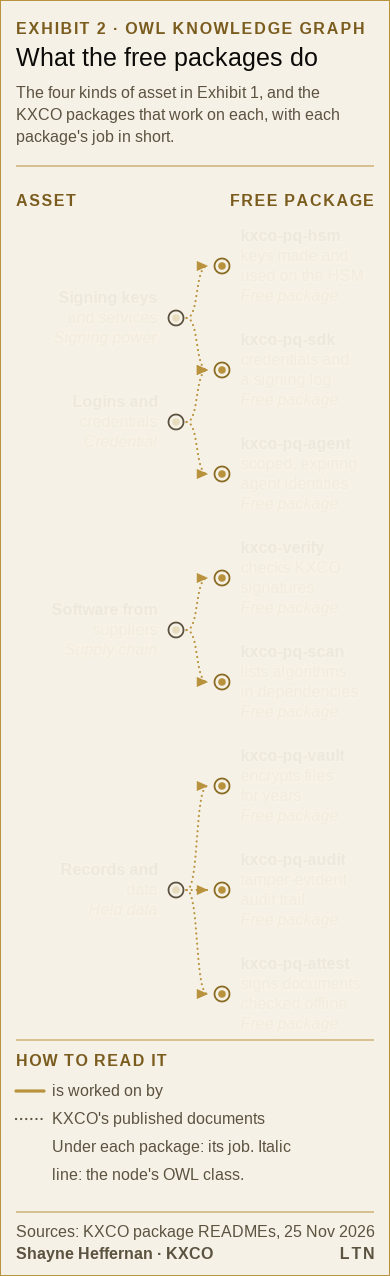
How to read Exhibit 2: each kind of asset on the left links to the free packages on the right that work on it, and the line under each package name sums up its job. It is the same OWL ontology as Exhibit 1.
On Transport Layer Security (TLS), the core library's README puts the gap plainly: "What TLS never reaches is what your application signs, issues and stores, and that is this package" (GitHub).
95,405 downloads since May
The first package, kxco-post-quantum, went on npm on 20 May 2026 (npm). By 24 November npm counted 95,405 downloads across the family, 17,075 of them of the core library (npm). October was the busiest month, with 28,990 (npm).
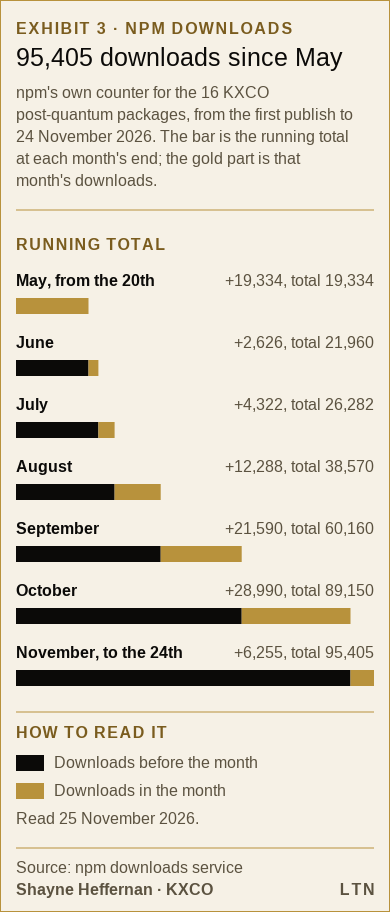
How to read Exhibit 3: each bar is the running total at the end of the month, and its gold part is that month's downloads. Every figure is npm's own daily count, read from its public downloads service on 25 November (npm).
A 9.8 on the OpenSSF Scorecard
The OpenSSF Scorecard is an automated tool that scores a project's security practices check by check from 0 to 10 (GitHub). Its checks cover code review, branch protection, pinned dependencies, signed releases, fuzzing, token permissions and known vulnerabilities, among others (GitHub).
kxco-post-quantum scored 9.8 in its scan of 23 November (OpenSSF Scorecard). All 15 scored KXCO package repositories sit between 7.3 and 9.8, above OpenSSL at 6.3, BoringSSL and Bouncy Castle (Java) at 6.4, and Node.js and Go at 6.2 (OpenSSF Scorecard). The two projects built for post-quantum work score close behind the core library: liboqs at 9.2 and mlkem-native at 9.0 (OpenSSF Scorecard). kxco-post-quantum also holds the OpenSSF Best Practices passing badge, first earned on 4 October (OpenSSF Best Practices).
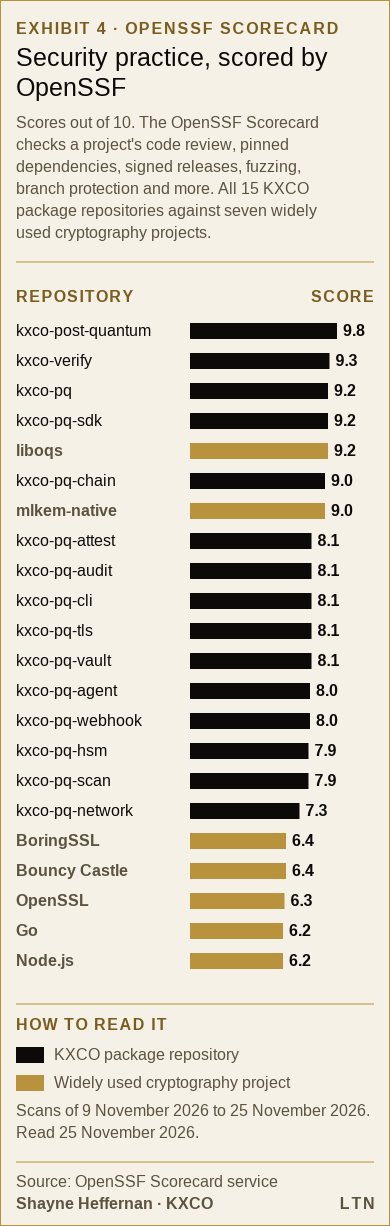
How to read Exhibit 4: black bars are KXCO's repositories and gold bars are widely used cryptography projects, each with its score on the bar. The scores come from the Scorecard's public service, read on 25 November (OpenSSF Scorecard).
The open-source supply chain is a target in its own right: the Justice Department says FaceStealer increasingly goes after the maintainers of open-source code and their repository accounts (US Department of Justice). Every one of the 15 releases KXCO published on 29 October carries a provenance attestation under SLSA (Supply-chain Levels for Software Artifacts), which records the workflow that built it (kxco.ai).
What NIST's test server graded
NIST tests implementations of its standards over its Automated Cryptographic Validation Protocol (ACVP). Its server sends test vectors nobody has seen and grades the answers itself (GitHub).
KXCO has been through it twice:
12 and 13 September 2026. NIST's server graded 2,130 test cases of kxco-post-quantum covering ML-KEM, ML-DSA and SLH-DSA in every parameter set NIST offers, with zero failures (GitHub). The three sessions were approved onto Demo certificate A11025 (GitHub).
28 October 2026. NIST's server graded the self-testing entry point, kxco-post-quantum/fips, in session 783228: 3,522 test cases across 13 vector sets, all passed (kxco.ai). They covered ML-KEM and ML-DSA, the SHA-2 and SHA-3 hash functions (SHAKE included), the keyed-hash message authentication code HMAC and the random bit generator (kxco.ai).
That is 5,652 test cases graded by NIST's server, with zero failures (GitHub). The library also passes 1,793 of NIST's published vectors with 0 failures, and refuses the other 310 on purpose, because each pairs a parameter set with a weaker hash (GitHub). It passes 225 interoperability checks against liboqs, Bouncy Castle and the Python reference implementations, in both directions (GitHub).
NIST graded these test cases on the Demo server: it is not a certificate from NIST's Cryptographic Algorithm Validation Program (CAVP) or a validation under FIPS 140-3, the United States standard for cryptographic modules (NIST).
Open source under Apache-2.0
All 16 packages are licensed Apache-2.0 (npm). KXCO's licensing terms say the maths is free, and permanently so: use it commercially, fork it, ship it inside a product, and signing and verification keep working with the network unplugged (GitHub). The core library makes no network call and needs no account or access key (kxco.ai).
KXCO publishes it this way so that a buyer can audit all of it before relying on any of it (kxco.ai). The core library's builds are reproducible and checked by automated builds, with SLSA provenance and a CycloneDX software bill of materials on every kxco-post-quantum release since version 1.4.1 (GitHub). KXCO commits that envelopes issued today keep verifying in its signature and anchored modes with no KXCO server in the path (GitHub). The copyright belongs to Knightsbridge Financial Ltd, trading as KXCO, a company registered in England and Wales (GitHub).
What KXCO sells on top of the free packages
The licence covers the code, not the service (GitHub). A signature made by a key that was revoked an hour ago is still a valid signature, and no offline mathematics can tell you it was revoked (GitHub). KXCO sells two things on top of the free code: licensed products and the services someone has to operate (kxco.ai).
The products come first. KXCO Herald issues signed, revocable attestations for domains and documents, and identity credentials for people and AI agents, each checkable at verify.kxco.ai without an account (kxco.ai). KXCO Armature is the layer-one network on which a party outside KXCO can check that a record existed in that form no later than the time it was anchored (kxco.ai). The free kxco-pq-scan is the way into KXCO Portcullis, which finds quantum-vulnerable cryptography across an estate (kxco.ai).
The services answer whether a key is still trusted now, and carry a record onto Armature (GitHub):
Hosted key registry and live revocation. The registry answers whether a key is active, revoked or rotated at the moment of verification, and kxco-verify asks it with one flag and fails closed (npm).
Anchoring on Armature. KXCO sells anchor quotas for writes of hashes, audit roots and attestations to Armature, and kxco-pq-audit, kxco-pq-attest and kxco-pq-sdk can each anchor there (GitHub).
A relay that pays the gas. With kxco-pq-chain, KXCO's relay submits the transaction and the institution is invoiced, without holding a token or running a node (npm).
Agent identities and webhook key rotation. KXCO sells registered machine identities and the hosted key-rotation endpoint behind signed webhooks (GitHub).
Support and a service-level agreement (SLA). KXCO offers availability commitments, an escalation path and a named contact, priced in US dollars per seat per year (GitHub).
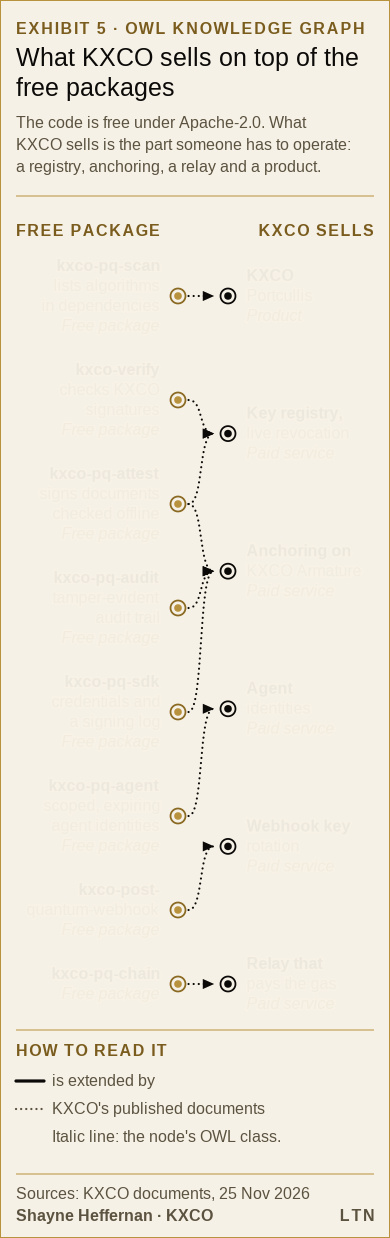
How to read Exhibit 5: each free package on the left links to the paid KXCO service or product built on it, as KXCO's published READMEs, licence and price documents and product pages state (GitHub). Exhibits 1, 2 and 5 are views of the same OWL ontology.
Talk to KXCO
In my view, every institution that holds keys, signs records or keeps data for years should start now, and the first step costs nothing. Run npx kxco-pq-scan on a project, install kxco-pq for the whole family, and read the code before you rely on it (GitHub). When you need a registry, revocation, anchoring or an SLA, write to KXCO at [email protected] or use the form at kxco.ai/contact (kxco.ai).
What to watch
The Federal Acquisition Regulatory (FAR) Council's 180 days under Executive Order 14412 run out on 19 December 2026 (Federal Register). K&L Gates wrote on 24 November that the order directs the council to publish, by mid-December, a proposed rule requiring covered contractors to comply with NIST's standards, post-quantum included (K&L Gates).
Sources
FBI, North Korea Responsible for $6 Billion+ Binance Attack: fbi.gov
CNN, CIA hit by hack impacting unclassified information: cnn.com
SecurityWeek (AP), FBI Investigating Apparent Hack of Its Key National Criminal Justice Database, AP Source Says: securityweek.com
Binance (X article), 29 October Binance Security Incident: Initial Findings and Response Update: x.com
Binance, Security Incident Update #2 (2026-10-30): binance.com
GitHub, kxco-post-quantum README: github.com
OpenSSF Scorecard: KnightsbridgeAIQ/kxco-post-quantum: securityscorecards.dev
GitHub, ACVTS: testing against NIST's live server: github.com
KXCO developer blog, The 29 October upgrade: KXCO's post-quantum stack passes 3,522 NIST test cases: kxco.ai
BleepingComputer, Hackers reportedly breached CIA intelligence analysis system: bleepingcomputer.com
Infosecurity Magazine, FBI Highlights Growing Abuse of AI-Driven Pentesting Framework ARTEX: infosecurity-magazine.com
CyberScoop, Patel mum on FBI crime info database hack, citing ongoing investigation: cyberscoop.com
Federal News Network (AP), FBI investigates hackers' claim to have stolen sensitive employee data, compromised jobs website: federalnewsnetwork.com
NPR (via OPB), FBI hunting the hackers who stole its employees' sensitive data: opb.org
SecurityWeek, Pentagon Personnel Agency Data Breach Impacts 3 Million People: securityweek.com
ABC News, Treasury's FinCEN says 'cybersecurity incident' includes 'unauthorized access' of some systems: abcnews.com
Help Net Security, eMudhra security blunder left trusted CA signing keys exposed to anyone: helpnetsecurity.com
TRM Labs, North Korea Steals USD 6.36 Billion From Binance in the Largest Hack in History: trmlabs.com
Binance, Security Incident Update (2026-10-30): binance.com
Binance Completes Coverage of Assets Impacted in Security Incident; New Proof of Reserves Published: binance.com
Decrypt, Justice Department Moves to Forfeit $1.1B in USDC From North Korea's Binance Hack: decrypt.co
TRM Labs, North Korea Has Stolen USD 12.8 Billion in Crypto, USD 7.4 Billion of It in 2026: trmlabs.com
Bitget Security Incident (September 2026): Hack Timeline, Impact, and Latest Official Updates: bitget.com
TRM Labs, North Korea Stole 76% of All Crypto Hack Value in 2026 With Just Two Attacks: trmlabs.com
US Department of Justice, Justice Department Announces Actions to Disrupt North Korea’s Massive Theft of Cryptocurrency: justice.gov
Federal Register, Securing the Nation Against Advanced Cryptographic Attacks (Executive Order 14412): federalregister.gov
NIST Report Provides Guidelines for Transition to Post-Quantum Cryptography Standards: nist.gov
UK National Cyber Security Centre, Next steps in preparing for post-quantum cryptography: ncsc.gov.uk
arXiv, How to factor 2048 bit RSA integers with less than a million noisy qubits: doi.org
PRX Quantum, Securing Elliptic Curve Cryptocurrencies against Quantum Vulnerabilities: Resource Estimates and Mitigations: doi.org
PRX Quantum Perspective on blockchain vulnerabilities (Babbush, Gidney, Boneh and others): journals.aps.org
NIST Releases First 3 Finalized Post-Quantum Encryption Standards: nist.gov
Help Net Security, NIST starts the countdown to retire quantum-vulnerable encryption: helpnetsecurity.com
SecurityWeek, FBI: Cybercrime Losses Neared $21 Billion in 2025: securityweek.com
Dawn (AFP), IMF warns of 'inevitable' AI cyber threats: dawn.com
FinCEN Issues Alert on Fraud Schemes Involving Deepfake Media Targeting Financial Institutions: fincen.gov
kxco.ai, KXCO Herald: kxco.ai
kxco.ai, About KXCO: leadership and post-quantum infrastructure company: kxco.ai
GLEIF, The verifiable LEI (vLEI): gleif.org
kxco.ai, KXCO Armature: kxco.ai
kxco.ai, KXCO Sovereign: kxco.ai
npm, kxco-pq-hsm README: npmjs.com
npm, kxco-pq-sdk README: npmjs.com
npm, kxco-pq-agent README: npmjs.com
npm, kxco-verify README: npmjs.com
GitHub, Licensing: what is free, what is paid: github.com
GitHub, kxco-pq-scan README: github.com
npm, kxco-pq-scan README: npmjs.com
npm, kxco-pq-vault README: npmjs.com
npm, kxco-pq-attest README: npmjs.com
npm, kxco-pq-audit README: npmjs.com
GitHub (OpenSSF), ossf/scorecard: OpenSSF Scorecard, Security health metrics for Open Source: github.com
OpenSSF Scorecard: openssl/openssl: securityscorecards.dev
OpenSSF Scorecard: google/boringssl: securityscorecards.dev
OpenSSF Scorecard: bcgit/bc-java: securityscorecards.dev
OpenSSF Scorecard: nodejs/node: securityscorecards.dev
OpenSSF Scorecard: golang/go: securityscorecards.dev
OpenSSF Scorecard: open-quantum-safe/liboqs: securityscorecards.dev
OpenSSF Scorecard: pq-code-package/mlkem-native: securityscorecards.dev
OpenSSF Best Practices: kxco-post-quantum: bestpractices.dev
GitHub, ACVTS Demo session 783228, session-final.json: github.com
GitHub, CONFORMANCE.md, kxco-post-quantum: github.com
NIST CSRC, How to Access ACVTS: csrc.nist.gov
NIST CSRC, Cryptographic Algorithm Validation Program (CAVP): csrc.nist.gov
npm registry: kxco-pq: npmjs.com
npm registry: kxco-pq-chain: npmjs.com
npm registry: kxco-pq-network: npmjs.com
npm registry: kxco-pq-cli: npmjs.com
npm registry: kxco-pq-tls: npmjs.com
npm registry: eslint-plugin-kxco-pq: npmjs.com
kxco.ai, KXCO architecture: kxco.ai
GitHub, NOTICE, kxco-post-quantum: github.com
kxco.ai, KXCO Herald: kxco.ai
kxco.ai, KXCO Armature: kxco.ai
kxco.ai, KXCO Portcullis: kxco.ai
GitHub, SALES-SKU.md, kxco-pq-network: github.com
kxco.ai, Contact KXCO: kxco.ai
K&L Gates, Quantum Readiness Is a Boardroom Issue: A Post-Quantum Cryptography Migration Roadmap for Industry: klgates.com
OpenSSF Scorecard: KnightsbridgeAIQ/kxco-pq: securityscorecards.dev
OpenSSF Scorecard: KnightsbridgeAIQ/kxco-pq-chain: securityscorecards.dev
OpenSSF Scorecard: KnightsbridgeAIQ/kxco-pq-network: securityscorecards.dev
OpenSSF Scorecard: KnightsbridgeAIQ/kxco-pq-sdk: securityscorecards.dev
OpenSSF Scorecard: KnightsbridgeAIQ/kxco-verify: securityscorecards.dev
OpenSSF Scorecard: KnightsbridgeAIQ/kxco-pq-attest: securityscorecards.dev
OpenSSF Scorecard: KnightsbridgeAIQ/kxco-pq-audit: securityscorecards.dev
OpenSSF Scorecard: KnightsbridgeAIQ/kxco-pq-hsm: securityscorecards.dev
OpenSSF Scorecard: KnightsbridgeAIQ/kxco-pq-vault: securityscorecards.dev
OpenSSF Scorecard: KnightsbridgeAIQ/kxco-pq-webhook: securityscorecards.dev
OpenSSF Scorecard: KnightsbridgeAIQ/kxco-pq-agent: securityscorecards.dev
OpenSSF Scorecard: KnightsbridgeAIQ/kxco-pq-cli: securityscorecards.dev
OpenSSF Scorecard: KnightsbridgeAIQ/kxco-pq-tls: securityscorecards.dev
OpenSSF Scorecard: KnightsbridgeAIQ/kxco-pq-scan: securityscorecards.dev
Not financial advice: do your own work.
Stocks mentioned: $GOOGL (NASDAQ).
Shayne Heffernan, Ph.D., is the founder of the KnightsBridge Group (shayneheffernan.com).

AI Is Taking What You Publish and What You Type
Common Crawl holds more than 300 billion web pages, and 52 per cent of crawler requests on Cloudflare's network in June 2026 were for AI training. Models can give back what they took in: one chatbot reproduced 76.8 per cent of the first Harry Potter book near word for word. A US court ordered OpenAI to give the New York Times 20 million anonymised ChatGPT logs. This KXCO warning sets out what is exposed, what to do now, and how each KXCO client runs its own AI inside its own walls.
Industrialising Intelligence: Demand, Scarcity and the Boundary of Sovereignty
AI agents generate 80% of OpenRouter's tokens, about seven times human use, and Google's monthly tokens rose about 330 times in two years to over 3.2 quadrillion. In my view the limit on AI demand has moved from people to power: the International Energy Agency expects data-centre electricity to reach around 945 terawatt-hours by 2030. Execution is becoming a utility. Selection is not. KXCO builds the boundary that keeps the decision with a named person and lets another party check the record.
Quantum Computing in November 2026: The Cost of Breaking Your Keys Keeps Falling
No quantum computer can break today's public keys yet, but three new estimates and a peer-reviewed Google paper put a break at between 19,397 and 500,000 physical qubits. Quantinuum's Helios has 98 qubits and IBM's Nighthawk r2 has 120. NIST will deprecate RSA and elliptic-curve cryptography after 2030, and only about 15% of the origin servers behind Cloudflare use post-quantum key exchange. KXCO's core library, kxco-post-quantum, scores 9.8 on the OpenSSF Scorecard.

The Week Ahead on Wall Street, 16 November 2026: Look for the Bounce
NVIDIA reports on Tuesday 17 November 2026, its first results since Jensen Huang resigned, and I expect the stock and the AI market to bounce. NVIDIA closed at $162.85 on 13 November 2026, 31.93% below its record, while the semiconductor index rose 8.05% on the week. The calendar leans to currencies, with the yen near 160 after briefly crossing it, and the US publishes retail sales, housing starts, jobless claims and the Fed's minutes. Follow them on the Live Trading News trading page.
Every story, signed and delivered.
Subscribe to the kxco channel and get the headline, the AI-written key takeaways, and the chain-anchor link the moment we publish. Audio versions and per-ticker subscriptions arrive in the next iteration.