
Saudi Arabia Bolsters Defense Manufacturing with BAE Systems Arabian Industries
Saudi Arabia Bolsters Defense Manufacturing with BAE Systems Arabian Industries
By Shayne Heffernan
Saudi Arabia is making significant strides in its defense sector with the launch of BAE Systems Arabian Industries, a new entity aimed at accelerating localization and strengthening the Kingdom’s military industrial base. This development, reported by the Saudi Press Agency, marks a key milestone in the Kingdom’s push to expand its defense capabilities, aligning with Vision 2030’s goal of achieving a self-sufficient defense sector by 2030. As someone closely following Saudi Arabia’s economic transformation, I’m impressed by the strategic vision behind this initiative and its potential to reshape the region’s military landscape.
BAE Systems Arabian Industries is the result of a merger between two major players in the defense ecosystem: BAE Systems Saudi Development and Training, which specializes in capability building, and the Saudi Maintenance and Supply Chain Management Co., a provider of supply chain and technical services. The merger, finalized nearly four months ago, consolidates over three decades of expertise in defense training, capability development, and logistics. Ahmad Abdulaziz Al-Ohali, governor of the General Authority for Military Industries (GAMI), inaugurated the company at a ceremony in Riyadh, attended by numerous officials and defense industry leaders. Al-Ohali emphasized that this initiative will enhance local content, transfer knowledge, and build national expertise, supporting the Kingdom’s target of localizing over 50% of military spending by 2030—a substantial increase from 19.35% in 2024, up from just 4% in 2018.
The Kingdom’s defense localization efforts are gaining momentum, as evidenced by recent achievements like the production of its first locally manufactured components for the Terminal High Altitude Area Defense (THAAD) system launcher in Jeddah. This milestone, following localization agreements signed at the 2024 World Defense Show, reflects growing technical collaboration with global defense firms such as Lockheed Martin. With the non-oil sector contributing 51% to GDP in 2024 and foreign direct investment (FDI) reaching $26 billion, up 12% from the previous year, Saudi Arabia is creating an attractive investment environment for defense partnerships. The integration of national and global expertise within BAE Systems Arabian Industries, as Al-Ohali noted, demonstrates the confidence of major companies in this evolving landscape.
Abdulatif Al-Shaikh, the new company’s CEO, shared a vision to position BAE Systems Arabian Industries as the leading Saudi company in the defense sector, supporting capabilities both within the Kingdom and across the region. This aligns with Vision 2030’s broader objectives of fostering a sustainable military-industrial system while boosting local content in human and technical resources. At Knightsbridge, we’re inspired by Saudi Arabia’s commitment to innovation and self-reliance, principles that mirror our own efforts in the financial sector, where we’re advancing blockchain initiatives with the Knightsbridge Chain, Digital Wallet, and KDA, alongside a range of Bitcoin products like tokenized derivatives and staking options, to drive new demand in global markets.

The Evil Legacy of the French Revolution
The French Revolution is still sold as the birthday of the modern world. The ledger does not match the posters. It seized the Church's land and floated its paper money on the seizure, hunted the priests who would not swear, defined the nobility as a moral enemy, and put in their place a political class accountable chiefly to itself. Four knowledge-graph exhibits trace who put the king and queen on the scaffold, and how the template left France.
Careful of the Prompts You Give Yourself
A prompt is not only what you type into a model. It is any sentence that gets inside you and starts issuing orders. Most of what we call goals were written by comparison, media, competition and now the model, and they arrive dressed as ambition. Shayne Heffernan maps how an imported sentence becomes a week, why a want should carry its source the way a Round Table claim does, and how to strip, lock and guard the objective that is actually yours.

KXCO is Enhanced Intelligence, Not Artificial
I never wanted artificial intelligence. I wanted enhanced intelligence, and they are not the same product. Artificial means the machine does the thinking and hands you the answer. Enhanced means I do the thinking, with more of my own mind in the room than I have ever had at one time. Forty years of reading, recallable in the second I need it. Patterns across law, credit, physics and markets that no specialist sees, because the useful ones sit between the fields rather than inside them.
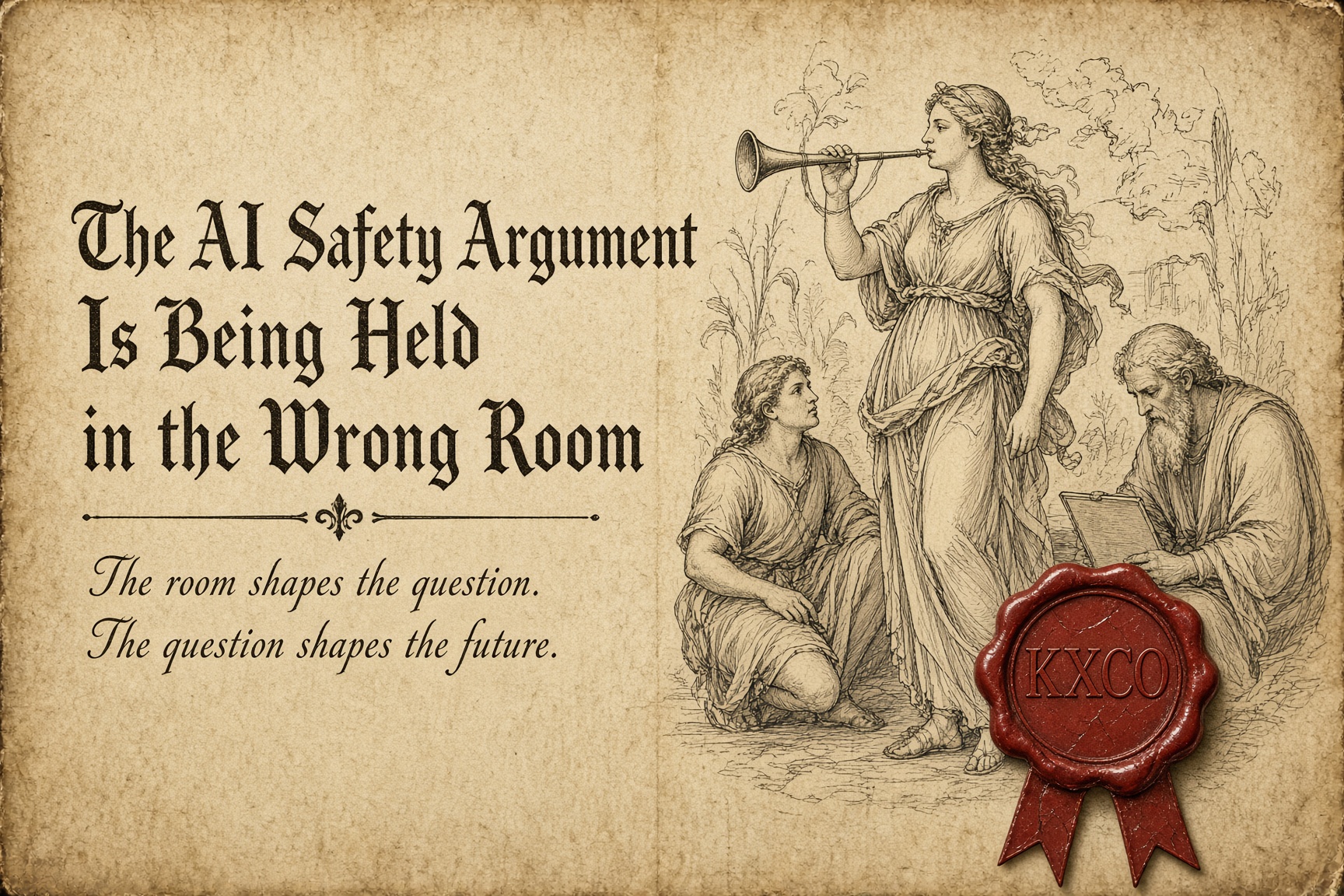
The AI Safety Argument Is Being Held in the Wrong Room
The people who will be blamed for what AI does are not in the room where its safety is argued. A jailbreak escapes a policy. The failure that costs money is an action that escapes an owner, a payment sent or a record altered. Tokens are not authority. Intelligence got cheap and judgment did not, and there is no organ of standing you can copy into a model. Shayne Heffernan on the objection worth taking seriously, and the questions to take into a vendor meeting.
Every story, signed and delivered.
Subscribe to the kxco channel and get the headline, the AI-written key takeaways, and the chain-anchor link the moment we publish. Audio versions and per-ticker subscriptions arrive in the next iteration.