
Sanctions are splitting the AI chip market in two, and power will decide who wins
China's best AI chips trail NVIDIA's by three to four years, and the export controls are splitting the market in two. China uses more than twice America's electricity. In my view this is an arms race that power will settle, and America must get to work building more power.
Part of theStocks Center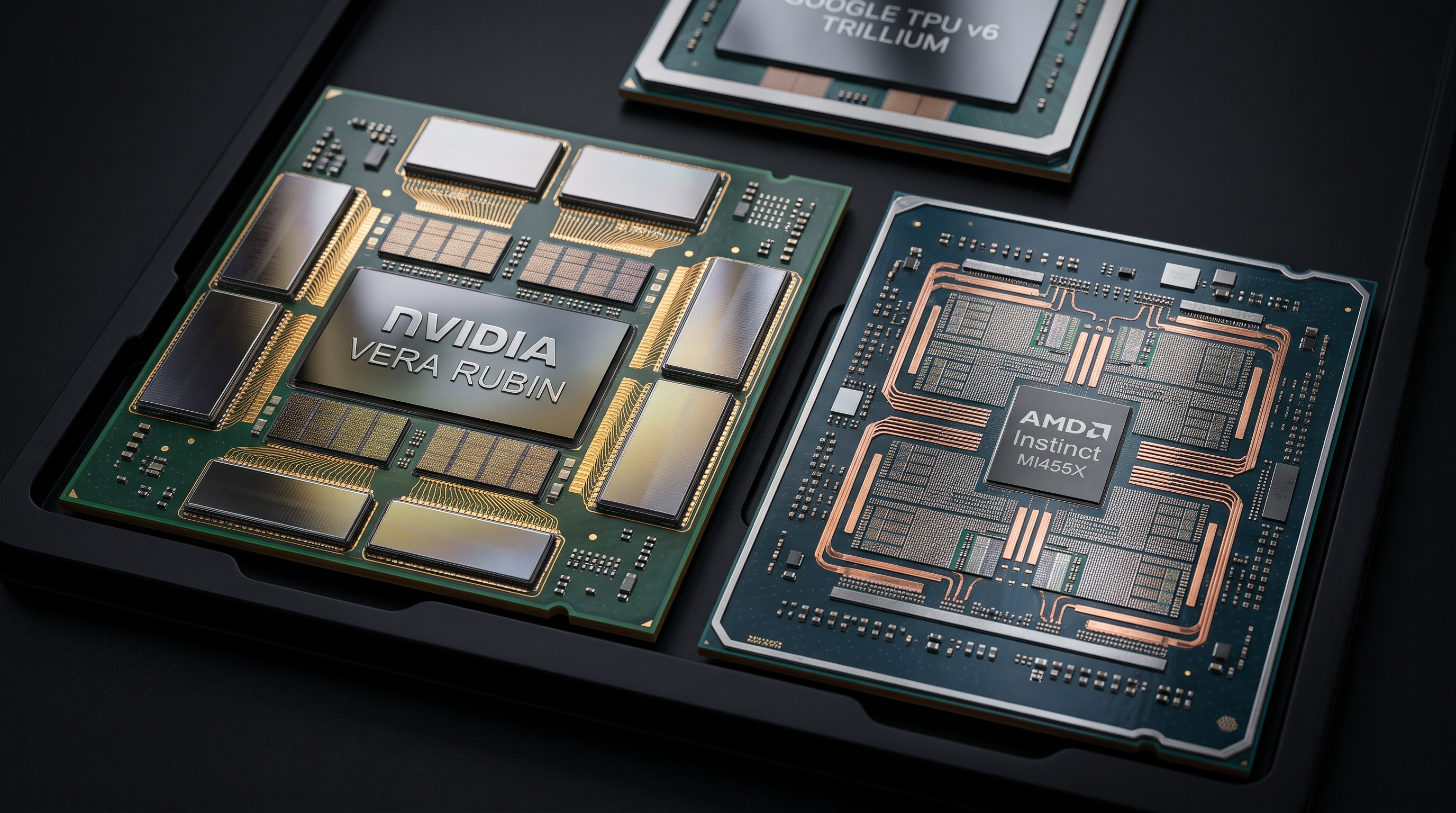
China's best AI chips are still well behind America's. Huawei's best, the Ascend 950, is roughly half as powerful as NVIDIA's H100, a chip launched four years ago (CNAS). Epoch AI expects Huawei's chips to trail NVIDIA's by three to four years until at least 2030 (Epoch AI).
The export controls are also splitting the market in two. Beijing's regulators have told new data-centre projects that received any state funds to use only domestic AI chips, two sources told Reuters (Reuters, via The Daily Star). In June 2026 NVIDIA's chief executive, Jensen Huang, said NVIDIA had largely conceded China to Huawei, Reuters reported (Reuters, in KXCO's AI record). A side led by the United States and a Chinese side are taking shape, and in my view each is building its own companies to fill it.
In my view power, more than the chip, will settle the contest between the two sides, and on power China is ahead. The subject is semiconductors and computing, but in my view what is really being contested is AI, by far the most dangerous weapon that has ever been developed. The contest to build it is, in my view, an arms race whose stakes go far beyond web traffic.
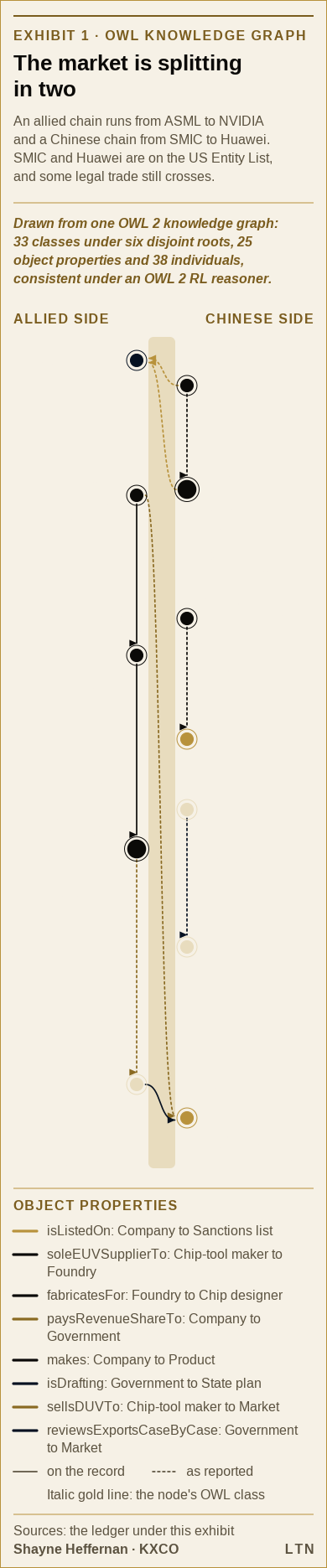
Sources for Exhibit 1: Epoch AI, CNAS, ASML and TSMC in KXCO's AI record, the Entity List in KXCO's AI record, ASML's China revenue, the BIS rule, the licence revenue share, CXMT's HBM and Beijing's compute plan.
How far behind China's chips are
The sources measure different things, and none of them puts China level with NVIDIA. Epoch AI puts NVIDIA's B300 at roughly 7 times the raw arithmetic performance of the Ascend 950 series (Epoch AI). Chris McGuire of the Council on Foreign Relations put the best US chips at about five times as powerful as Huawei's best in December 2025, and expected the gap to widen to seventeen times by 2027 (CFR). Even on very aggressive assumptions, he estimated, Huawei would produce only about 4% of NVIDIA's aggregate AI computing power in 2026.
Manufacturing is the deeper constraint. The leading process that SMIC, China's main chip foundry, runs in mass production is its 7nm N+3 node, and the compute dies of Huawei's Ascend 950 and 960 are made on it (Epoch AI). As of September 2026, CNAS put SMIC's 7nm yield at an estimated 26%, against 90% at TSMC, and cited Goldman Sachs's estimate that China can make only about 8% of the advanced AI chips it needs (CNAS). High-bandwidth memory is the bottleneck in Huawei's production (Epoch AI), and Chinese chipmakers have relied on grey-market channels for it, paying several times what buyers outside China pay, Reuters reported (Reuters).
The furthest gap is in lithography, the machines that print chips. The 28nm immersion tool that SMEE announced in 2023 has never been deployed, and a state-owned venture reportedly plans around five immersion systems this year and roughly 20 in 2027 (Tom's Hardware). A Reuters investigation in December 2025 described a Chinese extreme-ultraviolet (EUV) prototype that generated EUV light but had not yet exposed a wafer. Beijing's target for chip output from it is 2028, and Reuters' sources called 2030 more realistic (Tom's Hardware). ASML still sells China its deep-ultraviolet (DUV) machines, and China is expected to be about 20% of ASML's 2026 revenue, all of it DUV (KXCO's AI record).
In my view China has proven that it can develop technology, and develop it at scale, even if it is not yet as capable as the United States. Huawei has brought its Ascend 960DT forward to the first quarter of 2027, three quarters ahead of its original roadmap (Huawei). CXMT, China's largest maker of DRAM memory chips, raised its share of world DRAM revenue to 9.5% in the second quarter of 2026, from 7.6% in the first (TrendForce, via Herald Business). It has begun small-scale production of HBM3E, although it still trails the leading memory makers by a wide margin in its ability to mass-produce high-bandwidth memory (JoongAng Daily).
A Chinese system, LineShine, tops the November 2026 TOP500 list of the world's fastest supercomputers at 2.198 exaflops (TOP500). In two critical minerals China already leads: it produced 99% of the world's primary low-purity gallium (USGS) and, in 2024, 91% of refined magnet rare earths (IEA).
Power and the chip gap
A chip-for-chip comparison misses how China builds. In April 2025 SemiAnalysis found that Huawei's CloudMatrix 384 system delivers 300 petaflops of dense BF16 compute, almost double NVIDIA's GB200 NVL72 (SemiAnalysis). It does so with 384 weaker chips, drawing about 559 kilowatts against 145 kilowatts for NVIDIA's rack, so NVIDIA's system is 2.3 times as power-efficient (Tom's Hardware). SemiAnalysis's verdict on that trade-off is direct: "The deficiencies in power are relevant but not a limiting factor in China".
In my view that sentence is the centre of the contest. Power is essential, and chips without power are as useless as power without chips. China has the power. America has to build it. China does not need to match NVIDIA chip for chip if it has the power to link more chips together. A weaker chip, deployed in larger systems and fed by abundant electricity, still delivers frontier computing. So the question that matters is whether China can build chips good enough to deploy in large numbers, and the power to run them.
That raises the question of whether the gap is only money. On today's evidence it is not. China cannot simply deploy more chips to make up the difference, because it cannot yet make enough of them: Epoch AI estimates that Huawei will produce 1.5 million units in 2026 against 5.9 million for NVIDIA (Epoch AI). Yield, high-bandwidth memory and lithography tools hold the volume down, and in my view money takes years to turn into any of them. In my view money and time can close that gap, and Beijing is spending the money.
Building that way does cost China more. Data centres in China usually cost $5.5 million to $6.5 million per megawatt to construct, against about $8 million to $12 million in the United States (ChinaTalk). Industrial electricity costs about 6 US cents a kilowatt-hour in China, against about 9 cents in America. The extra cost is in the chips. NVIDIA's B300 delivers about 6.2 times the performance per dollar of Huawei's Ascend 950DT (Epoch AI), and a CloudMatrix 384 costs about $8 million against about $2.6 million for NVIDIA's rack (ChinaTalk).
On ChinaTalk's numbers, America's efficiency more than offsets China's cheaper building and power while China runs on CloudMatrix 384s. With NVIDIA's H200, China's savings on construction and other bills would give it similar computing per dollar to an American data centre (ChinaTalk). That puts a price on the legal trade described below.
The state pays part of the difference. Local governments in energy-rich provinces such as Gansu, Guizhou and Inner Mongolia have cut energy costs for some of the country's largest data centres by up to 50%, the Financial Times reported (The Standard). ASPI reports that the subsidies go to data centres that use domestically produced chips (ASPI). AI data-centre projects in China have drawn over $100 billion of state funding since 2021, a Reuters review of government tenders found (Reuters, via The Daily Star).
In my view that answers the cost question: where Chinese computing costs more, Beijing will pay the difference, and the difference will stop mattering to the contest. These are investments in national infrastructure, made by a central government that can manage power, chips and data centres together, with far fewer political obstacles than Washington faces. It is a different system, with different outcomes and different challenges. The price is waste. Some of China's western data centres run at utilisation as low as 20% to 30%, against a government target of at least 60% (ASPI).
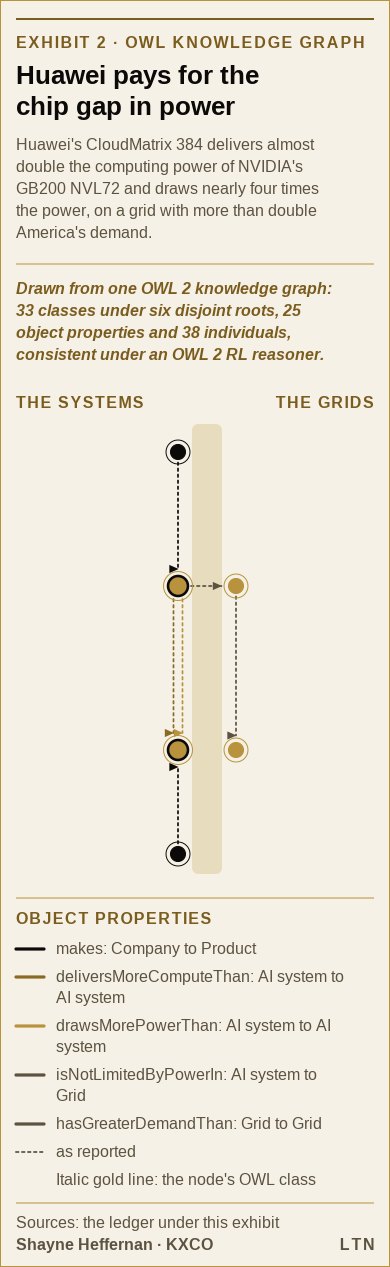
Sources for Exhibit 2: SemiAnalysis, Tom's Hardware, Ember and pv magazine.
The power gap runs the other way
China's electricity demand reached 10,573 terawatt-hours in 2025, more than double the 4,536 terawatt-hours of the United States (Ember). China added 315 gigawatts of solar and 119 gigawatts of wind capacity in 2025, its National Energy Administration reported (pv magazine). It added a further 252.93 gigawatts of generating capacity in the first nine months of 2026 (SolarQuarter). America added 53 gigawatts in 2025, its largest year since 2002, and plans 86 gigawatts in 2026 (EIA).
The American build is meeting limits that have nothing to do with chips. PJM plans for the electricity needs of more than 67 million people across 13 states and the District of Columbia. As of its July 2026 auction for 2028/2029, it cleared at its price cap and 6,831 megawatts short of its reliability requirement (PJM). Equipment is booked well ahead: GE Vernova held 122 gigawatts of gas equipment in backlog or under slot reservation across its customers at 30 September 2026 (GE Vernova). Local opposition blocked or delayed at least 45 data-centre projects worth nearly $68 billion between April and June 2026 (Data Center Watch). On 3 November voters favoured limits on data centres in 40 of the 41 local ballot measures decided (Ballotpedia).

Sources for Exhibit 3: PJM, GE Vernova, Data Center Watch, Ballotpedia, WHYY, the White House, the Senate vote, in KXCO's AI record, Carnegie and ANS.
Washington's answer is that the data centres should bring their own power. In the State of the Union on 24 February 2026 the President said: "We're telling the major tech companies that they have the obligation to provide for their own power needs" (WHYY). On 4 March Amazon, Google, Meta, Microsoft, OpenAI, Oracle and xAI signed the Ratepayer Protection Pledge, agreeing to "build, bring, or buy new generation resources" (White House). The Senate passed its permitting bill, S. 5653, by 62 votes to 33 on 19 November (AP, in KXCO's AI record).
That answer takes time. Nuclear is only one form of power among many, and in my view it is slow. The hyperscalers' announced nuclear agreements could supply up to 13 gigawatts, which Carnegie puts at less than 20% of projected US data-centre demand through 2035 (Carnegie). GE Vernova Hitachi's BWRX-300 small modular reactor received its first US construction permit, for TVA's Clinch River site, in September 2026 (ANS). Its backers have targeted the early 2030s for commercial operation. Ontario Power Generation's first BWRX-300, at Darlington, is no longer expected to reach commercial operation by October 2030 (World Nuclear News).
In my view America is capable of building every kind of power, and what it has to overcome is political. Today it does not have a fast way to catch up. China has the lead on power, and America must get to work building it.
What the split costs America
The controls are not complete, and in my view the trade that still crosses them helps both sides. Since 15 January 2026, applications to export NVIDIA's H200 and AMD's MI325X to China that meet set conditions have moved from a presumption of denial to case-by-case review (BIS). The New York Times reported on 7 November that about two dozen companies in China had been cleared to buy H200s (KXCO's AI record). In August 2025 NVIDIA and AMD agreed to pay the US government 15% of their revenue from H20 and MI308 sales in China in exchange for export licences (BBC).
That trade is narrow. H200 shipments accounted for less than 1% of NVIDIA's quarterly data-centre revenue, and IDC put Huawei at 28% of Chinese data-centre AI accelerator shipments in the first half of 2026, against NVIDIA's 34% (The Motley Fool). Beijing is preparing to spend about $295 billion over five years building data centres across the country, relying on local suppliers, including Huawei, for at least 80% of technology such as AI chips, Bloomberg reported (The Standard). Washington, for its part, now requires a licence for advanced chips used in data centres, wherever located, that will give access to a significant volume of computing power to entities headquartered in, or with an ultimate parent headquartered in, China, Macau or another Country Group D:5 country (Federal Register).
In my view whether to sell a competing nation your chips and take its money, or to block it and keep your advantage, is a political and strategic question. Keep American technology out of China and you make it essential that China builds its own, and you give up the income from selling there. The controls also push data-centre growth back into the United States, into the grid and the local politics described above. Globalised trade has made a technology advantage like this very hard to keep. America's lead is a lead for now, and China will do everything it can to close the gap. Keeping the lead takes continuous work by Washington and the chip companies together, in an economy that helps those companies grow.
The Gulf's money reaches both sides
In my view the Gulf leans heavily towards the American side. Abu Dhabi's MGX (KXCO's AI record) is one of the four initial equity funders of Stargate (OpenAI). Microsoft is investing $15.2 billion in the United Arab Emirates, including $1.5 billion of equity in G42 (Microsoft). Saudi Arabia's HUMAIN plans to deploy up to 600,000 NVIDIA GPUs in Saudi Arabia and the United States over three years (HUMAIN and NVIDIA).
Gulf money also reaches China. Prosperity7, a fund owned by Saudi Aramco, joined a financing round for the Beijing AI company Zhipu in 2024 (Bloomberg, via Gulf News). Saudi Arabia deepened its AI and space cooperation with China in June 2026 (Reuters, in KXCO's AI record). In my view the Gulf is not a power broker in this contest, although its money can drive growth in research and development on either side.

Sources for Exhibit 4: MGX in KXCO's AI record, OpenAI, Microsoft, HUMAIN and NVIDIA, Gulf News and Reuters, in KXCO's AI record.
Helium, sulphur and the Iran war
The war with Iran has cut supplies of helium, which semiconductor fabrication cannot do without, and of sulphur, the feedstock for the acid used to refine copper, nickel, lithium and rare earths. On 18 March Iranian strikes took all production at Qatar's Ras Laffan industrial complex offline, and Qatar, through Ras Laffan, accounts for well over half of China's helium imports (Trivium China). Nearly half of the world's seaborne sulphur trade normally passes through the Strait of Hormuz, which closed in late February 2026 (UTS). The cut does not fall evenly. The United States is a net exporter of helium (USGS), while China imports, by most estimates, well over 85% of its helium (Trivium China). In my view the Iran war is a live issue for the chip supply chain, and a secondary one.
The fight over data centres
Data centres were on the ballot. In NBC's exit poll 56% of voters said AI data centres were a major factor or more in their vote for Congress (Data Center Dynamics). Some common claims about data centres have not survived a fact-check. PolitiFact rated Mostly False a claim that bills near large data centres had risen by as much as 267% in five years: the figure is for wholesale costs, and the claim was about residential bills (PolitiFact). A Rutgers study asked whether data centres are raising electric bills and answered "Mostly Not. Yet." (Rutgers). Even counting the water used to generate their power, 12 times their direct use, data centres account for less than 1% of US water consumption, by the Information Technology and Innovation Foundation's calculation from Lawrence Berkeley National Laboratory volumes for 2023 and US Geological Survey data (ITIF).
Data centres do use a great deal of power. They consumed about 4.4% of US electricity in 2023, 176 terawatt-hours, and the Lawrence Berkeley National Laboratory expects that share to reach between 6.7% and 12% by 2028 (Berkeley Lab). Worldwide they used around 1.5% of the world's electricity in 2024, 415 terawatt-hours, the International Energy Agency (IEA) found, with the United States accounting for 45% of that and China for 25% (IEA). The IEA expects emissions from their electricity use to grow from 180 million tonnes today to 300 million tonnes by 2035 in its base case. That is still below 1.5% of energy-sector emissions, although data centres are among the fastest-growing sources (IEA).
Some grievances are real. In April 2026 Ben Green of the University of Michigan told the Harvard Gazette that over the past year Virginia and Georgia had given up more than $1 billion of revenue in tax breaks for data centres (Harvard Gazette). In my view data centres use power and water as cars use petrol and aircraft use fuel, and using something does not make it harmful. They are not massive polluters, although they do burn power. They are essential infrastructure, like dams, roads and airports, and we have to view them that way. They are not optional. The frenzy over their environmental impact is political rather than factual, and it is a problem America will have to solve if it wants the power and the build.
What America has to do
In my view America needs a unified, bipartisan push towards power. It needs a business-friendly economy, one where technology companies want to be and can grow, and universities that produce the people the country needs. The political climate in America today is not conducive to a strong federal push in this area, and that is a real challenge for the United States. China has the lead on power. America has to build.
What is not yet settled
Beijing's 80% target comes from a plan that Bloomberg reported is still in early discussions, with details that could change (The Standard). Huawei says, on its own data, that its Ascend has passed NVIDIA's share of China's market (Huawei, in KXCO's AI record), while IDC's count for the first half of 2026 still had NVIDIA ahead (The Motley Fool).
How this analysis was made
I developed this analysis with the Forge at KXCO. The judgements in it are mine.
What to watch
China's suspension of its ban on exports of gallium, germanium and antimony to the United States was set to run until 27 November 2026 (The Star). Whether Beijing extends it is the next test of which side holds the minerals beneath both stacks. Huawei's Ascend 960DT, due in the first quarter of 2027, is the next measure of China's chip progress (Huawei).
Stocks mentioned: $NVDA (NASDAQ), $ASML (NASDAQ), $TSM (NYSE), $AMD (NASDAQ) and $GEV (NYSE).
Shayne Heffernan, Ph.D., is the founder of the KnightsBridge Group (shayneheffernan.com).

The fake news of Nvidia's China spy scandal
For four weeks the story ran that China had aimed a spy at Nvidia's chief executive. On 24 November US intelligence officials told congressional staff they had found no evidence China directed Alice Huang to spy on Jensen Huang and, the Journal reported, no indication she passed on significant intelligence. The Times reported they did not dispute that she passed information after the affair began. The correction got the two days before Thanksgiving, and the leakers are still anonymous.

AI Is Taking What You Publish and What You Type
Common Crawl holds more than 300 billion web pages, and 52 per cent of crawler requests on Cloudflare's network in June 2026 were for AI training. Models can give back what they took in: one chatbot reproduced 76.8 per cent of the first Harry Potter book near word for word. A US court ordered OpenAI to give the New York Times 20 million anonymised ChatGPT logs. This KXCO warning sets out what is exposed, what to do now, and how each KXCO client runs its own AI inside its own walls.

AI Sell-Off Is Noise and Demand Is Rising
In my view the AI sell-off is noise. Anthropic priced its IPO at $83 on 18 November 2026 and closed its first day at $97.17. NVIDIA reported a $115.8 billion quarter and guided to $130 billion, yet closed at $125.53 on 20 November 2026, 47.5% below its record. Ramp puts paid business adoption of AI at 56.8%, up 1 point. KXCO's AI ontology ranks Oracle, Alibaba and NVIDIA as the three profitable names with the most upside to the analysts' targets.
Industrialising Intelligence: Demand, Scarcity and the Boundary of Sovereignty
AI agents generate 80% of OpenRouter's tokens, about seven times human use, and Google's monthly tokens rose about 330 times in two years to over 3.2 quadrillion. In my view the limit on AI demand has moved from people to power: the International Energy Agency expects data-centre electricity to reach around 945 terawatt-hours by 2030. Execution is becoming a utility. Selection is not. KXCO builds the boundary that keeps the decision with a named person and lets another party check the record.
Every story, signed and delivered.
Subscribe to the kxco channel and get the headline, the AI-written key takeaways, and the chain-anchor link the moment we publish. Audio versions and per-ticker subscriptions arrive in the next iteration.