
Sanctions are splitting the AI chip market in two, and energy will decide who wins
China's best AI chips trail NVIDIA's by three to four years, and the export controls are splitting the market in two. China added more than eight times America's new generating capacity in 2025. I believe this is an arms race that energy will settle.
Part of theStocks Center
In brief
The split. China's best AI chips trail NVIDIA's by years, and the export controls are splitting the market in two.
The trade-off. China pays for its chip gap with energy: Huawei links more chips into each system and feeds them far more electricity.
The lead. China has the energy: on my estimate, the Huawei chips made since 2025 can use no more than about a tenth of its data-centre capacity by the end of 2026. Morgan Stanley puts the power shortfall for America's data centres at about 49 gigawatts by 2028.
The view. Energy will decide this contest, and America has to build energy faster than China can put its own chips to work.
The plan. America needs a federal energy plan for its data centres, and Washington already holds the levers: permitting, grid connections, nuclear finance and the H200 licences.
China's best AI chips are still well behind America's. Huawei's best, the Ascend 950, is roughly half as powerful as NVIDIA's H100, a chip launched four years ago (Center for a New American Security, CNAS), and Epoch AI expects Huawei's chips to trail NVIDIA's by three to four years until at least 2030 (Epoch AI).
Washington's export controls are also splitting the market in two. Beijing's regulators have told new data-centre projects that received any state funds to use only domestic AI chips, two sources told Reuters (Reuters, via The Daily Star). In May 2026 NVIDIA's chief executive, Jensen Huang, told CNBC that NVIDIA had "really largely conceded" the Chinese market (eWeek).
My view is that energy, more than chips, will settle this contest, and on energy China is ahead. It is an arms race. What is really at stake is AI, which I regard as by far the most dangerous weapon ever developed.

Sources for Exhibit 1: Epoch AI, Epoch AI, B300, CNAS, CNAS, Ascend 950, ASML's China sales, CNBC, ASML in China, The Motley Fool, H200, the Bureau of Industry and Security rule, the licence revenue share, TrendForce, CXMT, CXMT's HBM and Beijing's compute plan. From KXCO's AI record: ASML and TSMC, TSMC and NVIDIA, Huawei and SMIC and the Entity List.
How far behind China's chips are
Epoch AI puts NVIDIA's B300 at roughly 7 times the raw arithmetic performance of the Ascend 950 series (Epoch AI).
Manufacturing is the deeper constraint. SMIC, China's main chip foundry, makes the compute dies of Huawei's Ascend 950 and 960 on its 7nm N+3 node, the leading process it runs in mass production (Epoch AI). As of September 2026, CNAS put SMIC's 7nm yield at an estimated 26%, against 90% at TSMC (CNAS). High-bandwidth memory is the bottleneck in Huawei's production (Epoch AI).
The widest gap is in lithography, the process that prints a chip's circuit pattern onto a silicon wafer, and in the machines that do it. The 28nm immersion tool that Shanghai Micro Electronics Equipment (SMEE) announced in 2023 has never been deployed (Tom's Hardware). ASML does not ship its most advanced equipment, including its extreme ultraviolet (EUV) machines, to China, but some less advanced deep-ultraviolet (DUV) machines are still bought and sold there (CNBC). ASML expects China to make up about 20% of its total net sales in 2026, services included (ASML).
China is moving fast in other parts of the chain. CXMT, China's largest maker of DRAM memory chips, raised its share of world DRAM revenue to 9.5% in the second quarter of 2026 (TrendForce, via Herald Business), and has begun small-scale production of HBM3E high-bandwidth memory (JoongAng Daily). A Chinese system, LineShine, tops the November 2026 TOP500 list of the world's fastest supercomputers (TOP500). That tells me China can develop technology, and develop it at scale.
Energy and the chip gap
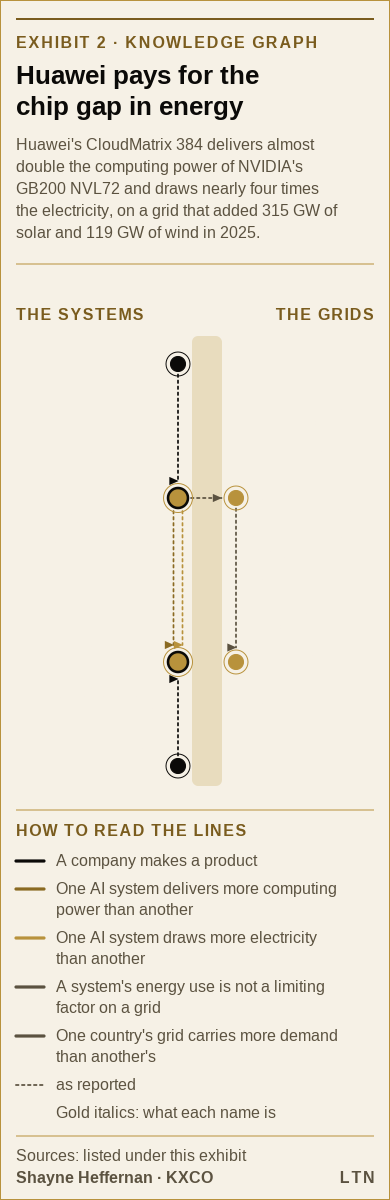
A chip-for-chip comparison misses how China builds. In April 2025 SemiAnalysis found that Huawei's CloudMatrix 384 system delivers 300 petaflops (a petaflop is a million billion calculations a second) of dense 16-bit (BF16) computing, almost double NVIDIA's GB200 NVL72 (SemiAnalysis). It does so with 384 weaker chips, drawing about 559 kilowatts against 145 kilowatts for NVIDIA's rack, so NVIDIA's system is 2.3 times as power-efficient (Tom's Hardware). SemiAnalysis's verdict is direct: "The deficiencies in power are relevant but not a limiting factor in China".
That sentence is the centre of the contest. For AI, chips need energy to run, and energy only becomes computing when there are chips to use it. One without the other is useless. China has the energy. America has to build it.
The newest systems tell the same story. On the makers' ratings and SemiAnalysis's estimate of the rack's draw, at the same 16-bit precision, NVIDIA's Vera Rubin NVL72 (288 petaflops for 180 to 220 kilowatts) gets four to five times as much computing from each kilowatt as Huawei's 64-chip Ascend 950DT cabinet (31.1 petaflops for about 100 kilowatts), though the two companies measure power and computing differently (Huawei; NVIDIA; SemiAnalysis).
Sources for Exhibit 2: SemiAnalysis, Tom's Hardware, Ember and pv magazine.
The case against my view
The strongest objection is that China's binding limit is chips. Epoch AI estimates that Huawei will produce 1.5 million units in 2026 against 5.9 million for NVIDIA (Epoch AI). Goldman Sachs estimates that China can make only about 8% of the advanced AI chips it needs (CNAS), and Chris McGuire of the Council on Foreign Relations put Huawei at about 4% of NVIDIA's aggregate AI computing power in 2026, even on very aggressive assumptions (CFR). On those numbers, electricity cannot turn chips China cannot make into computing.
My answer is that China's energy is waiting for its chips. Some of China's western data centres run at utilisation as low as 20% to 30% (Australian Strategic Policy Institute, ASPI), which ASPI puts down to transmission bottlenecks, distance from users and talent, and weak demand. ChinaTalk found that many Chinese data centres sit idle because they lack the most advanced chips and because AI demand has yet to arrive (ChinaTalk).
China used 25% of the world's data-centre electricity in 2024, against America's 45%, the International Energy Agency (IEA) found (IEA). Yet China's electricity demand reached 10,573 terawatt-hours in 2025, more than double America's 4,536 (Ember). China's data centres take a much smaller share of its electricity than America's do, and that leaves room for many more.
So the race is whether America can build energy faster than China can put its own chips to work on the energy it already has.
What China's way costs
China's way of building costs more per unit of computing. Its data centres are usually cheaper to build, at $5.5 million to $6.5 million per megawatt against about $8 million to $12 million in the United States (ChinaTalk), but its chips cost more. NVIDIA's B300 delivers about 6.2 times the performance per dollar of Huawei's Ascend 950DT (Epoch AI). On ChinaTalk's numbers, America's efficiency more than offsets China's cheaper building and energy while China runs on CloudMatrix 384s. With NVIDIA's H200, China would reach similar computing per dollar (ChinaTalk).
The state pays part of the difference. Local governments in energy-rich provinces such as Gansu, Guizhou and Inner Mongolia have cut energy costs for some of the country's largest data centres by up to 50%, the Financial Times reported (The Standard). ASPI reports that the subsidies go to data centres that use domestically produced chips (ASPI). Where Chinese computing costs more, I think Beijing will pay the difference, and the extra cost becomes a non-issue. That spending is investment in national infrastructure, directed by a central government that faces far fewer political obstacles than Washington.
The energy gap runs the other way
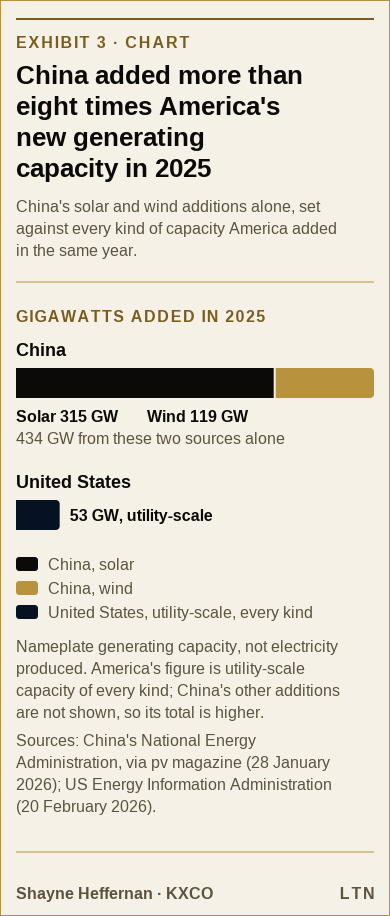
China added 315 gigawatts of solar and 119 gigawatts of wind capacity in 2025 (pv magazine). Together that is more than eight times the 53 gigawatts of new utility-scale capacity of every kind that America added, in its largest year since 2002 (EIA). China added a further 252.93 gigawatts of generating capacity in the first nine months of 2026 (SolarQuarter), while America plans 86 gigawatts for the whole of 2026.
Sources for Exhibit 3: pv magazine, on China's National Energy Administration figures and the US Energy Information Administration.
America's build is meeting limits that have nothing to do with chips. As of July 2026, the 2028/2029 capacity auction that PJM Interconnection runs for 13 states and the District of Columbia had cleared at its price cap and 6,831 megawatts short of its reliability requirement (PJM). GE Vernova held 122 gigawatts of gas equipment in backlog or under slot reservation at 30 September 2026 (GE Vernova). Local opposition blocked or delayed at least 45 data-centre projects worth nearly $68 billion between April and June 2026 (Data Center Watch).
Washington's answer is that data centres should bring their own energy. "We're telling the major tech companies that they have the obligation to provide for their own power needs," President Donald Trump said in the State of the Union on 24 February 2026 (WHYY). Nuclear is one source among many, and it is slow. The first US BWRX-300 small modular reactor is targeted for the early 2030s (ANS). The nuclear agreements announced so far by the largest technology companies could supply up to 13 gigawatts, under 20% of projected US data-centre demand through 2035 (Carnegie).
I think America is capable of building every kind of energy. It has to overcome the political obstacles first, and today it has no fast way to catch up.

Sources for Exhibit 4: PJM, GE Vernova, Data Center Watch, Ballotpedia, WHYY, the White House, the Senate vote, AP via ABC News, Carnegie and ANS.
The race in numbers
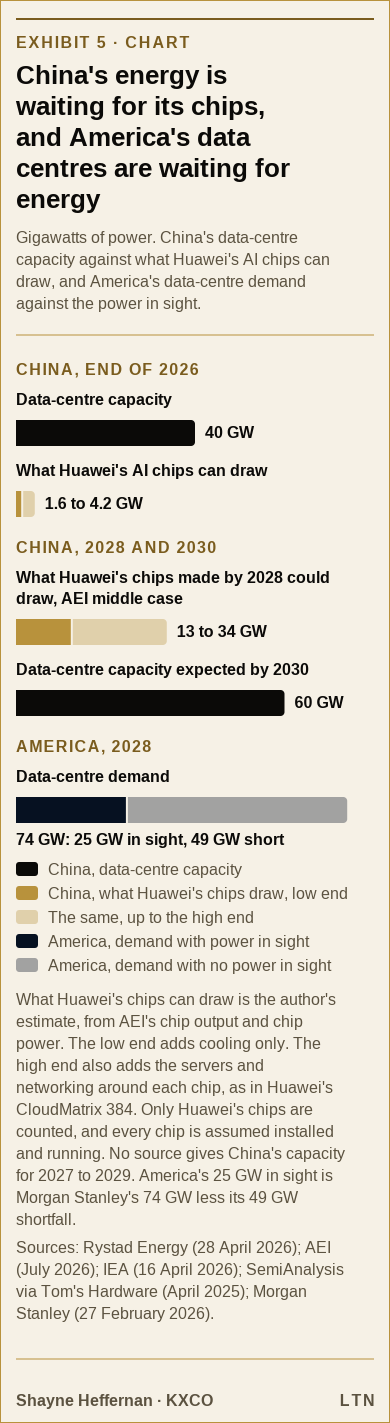
China's data centres had 32 gigawatts of capacity at the end of 2025. Rystad Energy expects 40 gigawatts by the end of 2026 and more than 60 gigawatts by 2030 (Rystad Energy). AEI, the American Enterprise Institute, estimates that Huawei could make about 700,000 Ascend chips in 2025 and, on its production targets, 1.35 million in 2026 (AEI), against Epoch AI's 1.5 million (Epoch AI). AEI puts the power that the 2026 output is rated to draw, its chip power, at 780 megawatts (AEI).
On my estimate, working from AEI's figures (AEI) and assuming every chip is installed and running, the Huawei chips made in those two years could draw from 1.6 gigawatts with cooling alone to 4.2 gigawatts with servers and networking as well, by the end of 2026. That is between 4% and a tenth of China's data-centre capacity. The estimate leaves out older Huawei chips, other Chinese makers and the NVIDIA chips already in China. China wants more chips than Huawei can make: AEI puts China's demand for AI computing in 2026 at 3,635 megawatts of chip power, of which Huawei's output meets 21%.
Huawei's output starts to catch up with China's capacity from 2028. In AEI's middle case, Huawei's output that year alone carries 6,152 megawatts of chip power (AEI), and on my estimate the Huawei chips made from 2025 to 2028 could draw 13 to 34 gigawatts at the grid. No source gives China's capacity for 2028. Against the 60 gigawatts Rystad expects by 2030, the Huawei chips made by 2028 would fill between a fifth and a little over half of it.
I think America's shortage comes first. Morgan Stanley estimated in February 2026 that US data centres could need 74 gigawatts by 2028, with a shortfall of about 49 gigawatts in available power (Morgan Stanley).
Sources for Exhibit 5: Rystad Energy, AEI, the IEA, SemiAnalysis via Tom's Hardware and Morgan Stanley.
What the split costs America
The controls are not complete. In August 2025 NVIDIA and AMD agreed to pay the US government 15% of their revenue from H20 and MI308 sales in China in exchange for export licences (BBC). Since 15 January 2026, applications to export NVIDIA's H200 and AMD's MI325X to China that meet set conditions have moved from a presumption of denial to case-by-case review (the Commerce Department's Bureau of Industry and Security). Even so, H200 shipments were less than 1% of NVIDIA's quarterly data-centre revenue (The Motley Fool).
Whether to sell a competing nation your chips and take its money, or block it and keep your advantage, is a political and strategic question, and it is not a simple one. Keep American technology out of China and you make it essential for China to build its own, and you give up the income from selling there. America's lead is a lead for now, and keeping it takes continuous work by Washington and the chip companies together.
What America has to do
My position is that America needs an energy policy that deals with the growing demand from data centres. That demand cannot be ignored, and America cannot try to limit it. Data centres are the infrastructure of the next century, and they have to be accepted as that. They have to come, and there needs to be a federal plan to power them.
The plan should treat data centres as America treats dams, roads and airports: as essential infrastructure, not an option, built with every kind of energy. The objections to them are political, not factual. Data centres use power and water, as cars use petrol and aircraft use fuel, and that is no reason to block them.
That takes a unified, bipartisan push towards energy, a business-friendly economy where technology companies want to be and can grow, and universities that produce the people the country needs. Washington already holds the levers:
Permitting. The Senate passed S. 5653 by 62 votes to 33 on 19 November, and the bill now goes to the House (AP, via ABC News). Under the bill, the Federal Energy Regulatory Commission (FERC) would make utilities charge data centres both the existing cost and a reasonable assessment of the added cost of the transmission they need, to minimise or avoid shifting it onto other customers (the bill; C2ES).
Grid connections. In October 2025 the Energy Department directed FERC to start rulemaking to speed up grid connections for large electricity users, including data centres (Energy Department). In June 2026 FERC directed the six regional grid operators under its jurisdiction to justify or reform their tariffs for data centres (Energy Department).
Nuclear finance. The Energy Department offered Vistra a conditional loan commitment of up to $4.2 billion to raise the output of its nuclear plants in Pennsylvania and Ohio, adding 433 megawatts (Energy Department).
The H200. H200 chips bound for China already carry a 25% US import tariff, which NVIDIA says it cannot pass on to customers (The Motley Fool). If NVIDIA is right, the tariff does not raise what Chinese buyers pay. I think Washington can keep licensing the chips, but only if the licence terms price in the cost advantage they give China.
I do not think the political climate in America today is conducive to a strong federal push in this area, and that is a real challenge for the United States. China has the lead on energy. America must get to work building it.
What is not yet settled
Bloomberg reported in June that Beijing's plan to take at least 80% of the technology for its data-centre build from local suppliers was still in early discussions (The Standard). Huawei's Eric Xu said in September 2026 that NVIDIA's share in China is hard to measure, but that on Huawei's own data Ascend has surpassed it (Huawei, via Malay Mail). The market research firm IDC's count for the first half of 2026 still had NVIDIA ahead, at 34% of Chinese data-centre AI accelerator shipments against Huawei's 28% (The Motley Fool).
How this analysis was made
I developed this analysis with the Forge at KXCO. The judgements in it are mine.
What to watch
China will extend its suspension of export controls on gallium, germanium, antimony and other critical minerals bound for the United States to 27 January 2027, Seoul Economic Daily reported on 24 November 2026, citing Hongxing News (Seoul Economic Daily). Whether Beijing extends it again may show how it means to use these minerals, which are used in chipmaking. Huawei's Ascend 960DT, due in the first quarter of 2027, is the next measure of China's chip progress (Huawei).
Stocks mentioned: $NVDA (NASDAQ), $ASML (NASDAQ), $TSM (NYSE), $AMD (NASDAQ) and $GEV (NYSE).
Shayne Heffernan, Ph.D., is the founder of the KnightsBridge Group (shayneheffernan.com).

The fake news of Nvidia's China spy scandal
For four weeks the story ran that China had aimed a spy at Nvidia's chief executive. On 24 November US intelligence officials told congressional staff they had found no evidence China directed Alice Huang to spy on Jensen Huang and, the Journal reported, no indication she passed on significant intelligence. The Times reported they did not dispute that she passed information after the affair began. The correction got the two days before Thanksgiving, and the leakers are still anonymous.

AI Is Taking What You Publish and What You Type
Common Crawl holds more than 300 billion web pages, and 52 per cent of crawler requests on Cloudflare's network in June 2026 were for AI training. Models can give back what they took in: one chatbot reproduced 76.8 per cent of the first Harry Potter book near word for word. A US court ordered OpenAI to give the New York Times 20 million anonymised ChatGPT logs. This KXCO warning sets out what is exposed, what to do now, and how each KXCO client runs its own AI inside its own walls.

AI Sell-Off Is Noise and Demand Is Rising
In my view the AI sell-off is noise. Anthropic priced its IPO at $83 on 18 November 2026 and closed its first day at $97.17. NVIDIA reported a $115.8 billion quarter and guided to $130 billion, yet closed at $125.53 on 20 November 2026, 47.5% below its record. Ramp puts paid business adoption of AI at 56.8%, up 1 point. KXCO's AI ontology ranks Oracle, Alibaba and NVIDIA as the three profitable names with the most upside to the analysts' targets.
Industrialising Intelligence: Demand, Scarcity and the Boundary of Sovereignty
AI agents generate 80% of OpenRouter's tokens, about seven times human use, and Google's monthly tokens rose about 330 times in two years to over 3.2 quadrillion. In my view the limit on AI demand has moved from people to power: the International Energy Agency expects data-centre electricity to reach around 945 terawatt-hours by 2030. Execution is becoming a utility. Selection is not. KXCO builds the boundary that keeps the decision with a named person and lets another party check the record.
Every story, signed and delivered.
Subscribe to the kxco channel and get the headline, the AI-written key takeaways, and the chain-anchor link the moment we publish. Audio versions and per-ticker subscriptions arrive in the next iteration.