
KXCO's Model Books Are Five for Five on FDA Decisions
KXCO's model books held INO-3107, BBP-418 and bezuclastinib, and the FDA approved all three. They held neither ivonescimab nor deramiocel, and the FDA refused both. KXCO is expanding its FDA ontology to more filings and companies.
Part of theStocks Center
KXCO's model books are five for five on decisions by the US Food and Drug Administration (FDA). The model books are research portfolios of FDA filings, sealed and signed on 15 October 2026, with no money invested in them. Since they were sealed, the FDA has ruled on five filings on KXCO's FDA board that the books' scorecard counts. The books held three of them, Inovio's INO-3107, a DNA medicine for recurrent respiratory papillomatosis, BridgeBio's BBP-418 and Cogent's bezuclastinib, and the FDA approved all three. They held neither Summit Therapeutics' ivonescimab nor Capricor's deramiocel, and the FDA refused both.
The board's first screen ranked all three approvals before the FDA acted. On 21 October 2026 it ranked eight of the filings due in the next 90 days, and it put INO-3107 first. The FDA approved INO-3107 nine days later. The same screen ranked bezuclastinib third and BBP-418 seventh of the eight, and the FDA has now approved both, BBP-418 four days and bezuclastinib six days before their target dates. Deramiocel was left off the ranked list, and the FDA refused it.
The market has paid for it. From the close of 14 October to the close of 25 November 2026, the board values Book 1 up 14.7% and Book 2 up 16.1%. Over the same weeks the S&P 500 fell 6.9%, the Nasdaq Composite fell 11.6% and the Dow Jones Industrial Average fell 2.8%, on Yahoo Finance closing prices. Both books are ahead of the biotech index funds and of every actively managed biotech and health care fund we compared them with.
Because of that record, we are expanding the FDA ontology to more filings and more companies, and expanding the testing with it. The record behind every decision is public on the board at kxco.ai/fda. Fund managers who want the same record on the names they hold can contact KXCO at kxco.ai.
Five decisions, five right
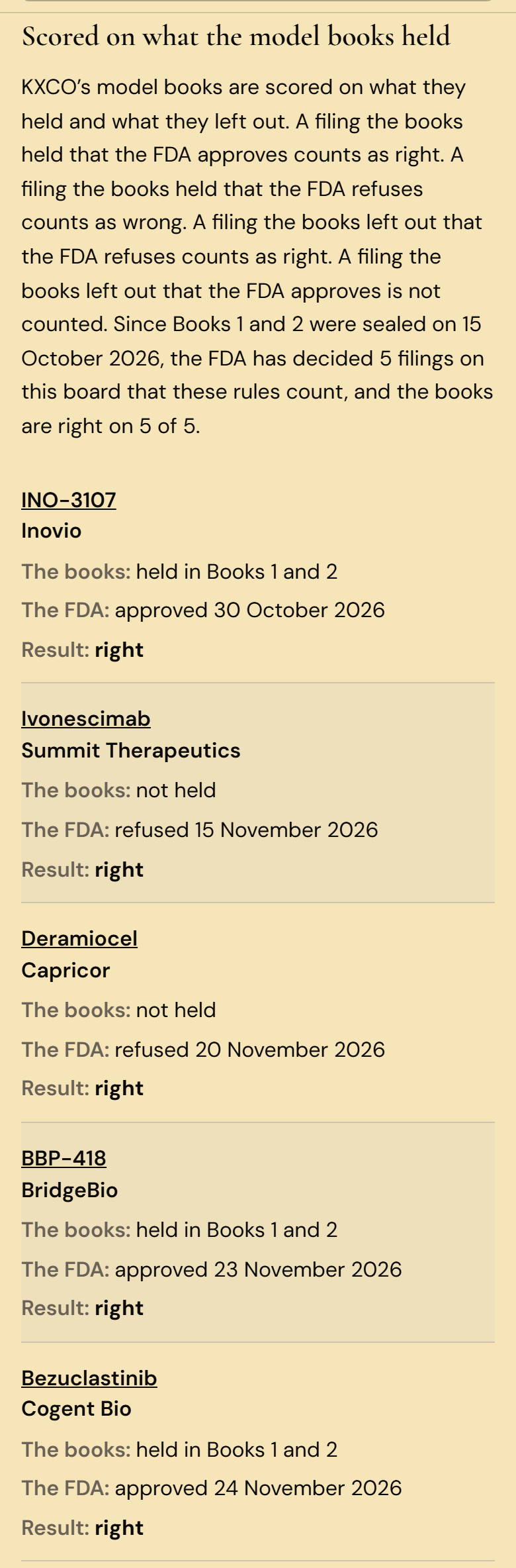
The model books are our list, and I score them the way a fund scores a manager: on what they held and what they left out. A filing the books held that the FDA approves is right. A filing the books held that the FDA refuses is wrong. A filing the books left out that the FDA refuses is right. A filing the books left out that the FDA approves is not counted.
On that scorecard the five decisions read:
INO-3107, Inovio. Held in Books 1 and 2. Approved on 30 October 2026. Right.
Ivonescimab, Summit Therapeutics. Not held. Refused on 15 November 2026. Right.
Deramiocel, Capricor. Not held. Refused on 20 November 2026. Right.
BBP-418, BridgeBio. Held in Books 1 and 2. Approved on 23 November 2026. Right.
Bezuclastinib, Cogent. Held in Books 1 and 2. Approved on 24 November 2026. Right.
The FDA also approved PolyPid's D-PLEX100 on 24 November 2026, as BACFENSSI, an extended-release antibiotic paste to reduce surgical site infections after colorectal surgery. The books did not hold it, and under the rules above an approval the books left out is not counted. A refusal of anything the books held would count against them, and the board would publish it the same way.
The books were sealed on 15 October 2026, Book 1 at 09:15 and Book 2 at 11:44 Coordinated Universal Time (UTC). Each holds 17 positions across 13 companies, and every position was fixed before the FDA acted on it. The books are published on the board as they were signed, with their signatures, so anyone can check them against the portfolio's public key, offline and with nothing asked of KXCO. Nothing in them can be changed after the event without breaking the signatures.
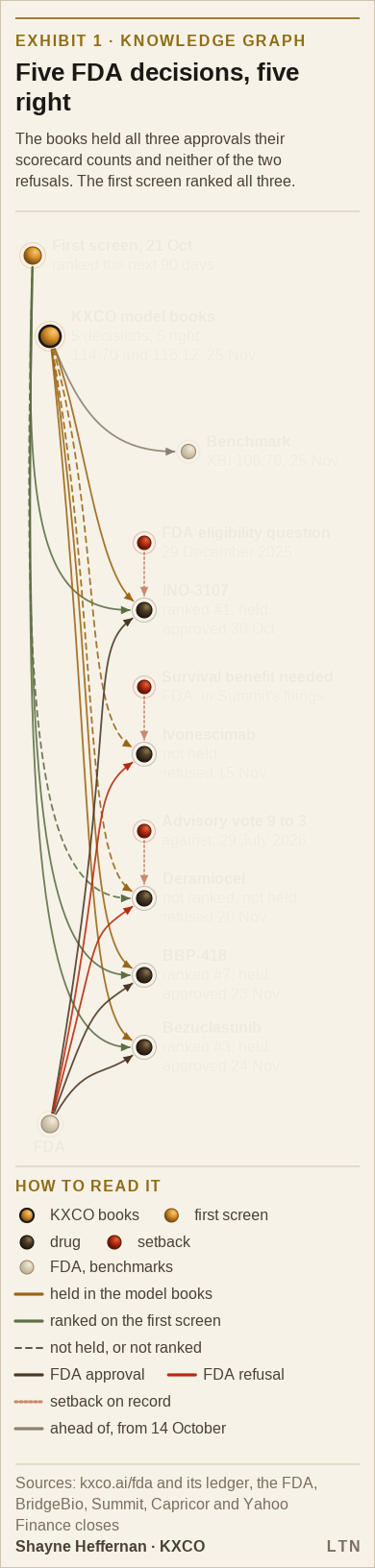
How to read Exhibit 1: the board's first screen of 21 October 2026 sits at the top, with the model books below it. The books' links run into each decision: solid where they held the drug, dashed where they did not. The first screen's links run to the three drugs it ranked that the FDA has since decided, and a dashed one to deramiocel, which it left off. The FDA's links come from below: approval in dark brown, refusal in red.
The first screen put INO-3107 first
The board's first screen asks one question: where is the biggest opportunity? It answers with the filings due in the next 90 days, ranked. The ranked screen went live on 21 October 2026, and INO-3107 stood first. It stayed first in every one of the 29 versions of the board published between 21 and 30 October 2026.
It was not an easy name to put first. The FDA had already approved a rival treatment for adults with recurrent respiratory papillomatosis, PAPZIMEOS, in August 2025, and Inovio's own filings said it expected accelerated approval only if INO-3107 showed a clinically meaningful benefit over that rival. The record also held an FDA question, dated 29 December 2025, on whether the filing qualified for accelerated approval.
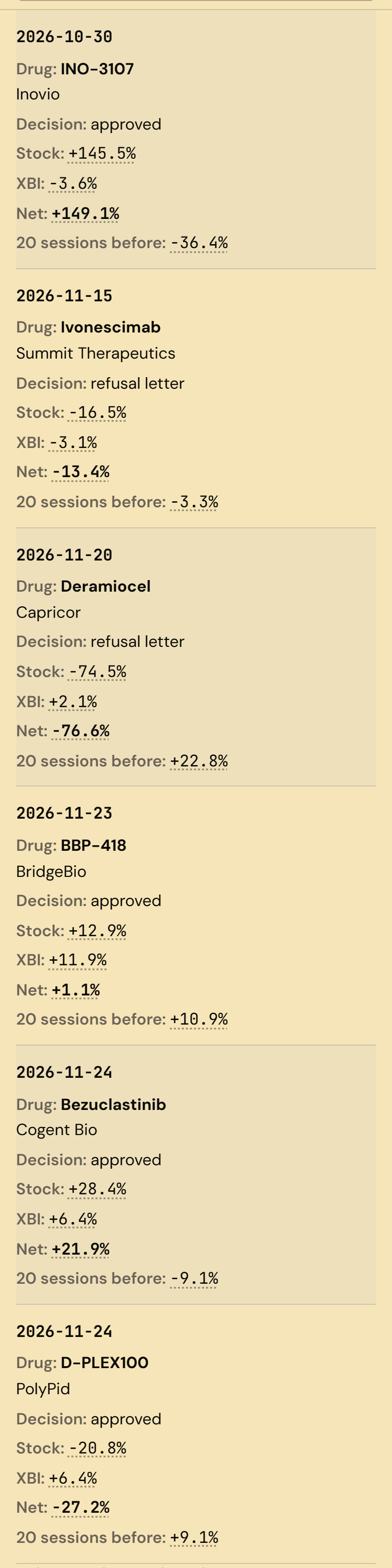
The FDA granted INO-3107 accelerated approval on 30 October 2026, its target date. On the board's decision-day table, which runs from the last close before the day of an announcement to the first close after that day, Inovio's shares rose 145.5% while the SPDR S&P Biotech ETF (XBI) fell 3.6%: net of the sector, +149.1%. In the books, the INO-3107 position closed at $1.89 on 2 November 2026, 90.9% above its entry at the close of 14 October 2026.
The two refusals the books did not hold
Neither book held Summit Therapeutics' ivonescimab, filed with platinum-containing chemotherapy for advanced non-small cell lung cancer in patients already treated with therapy targeting the epidermal growth factor receptor (EGFR). The ground for the refusal had been public since May 2025. Summit's quarterly report for the period to 30 September 2026 repeats a statement the FDA had made to it: "The FDA noted that a statistically significant OS benefit is necessary to support marketing authorization in this setting, and the PFS results from this study may not be sufficient to support marketing authorization." OS is overall survival, how long patients live. PFS is progression-free survival, how long before the cancer grows.
On 15 November 2026 Summit announced the FDA's complete response letter, the agency's refusal to approve an application in its present form. In Summit's words, "the FDA determined that substantial evidence of effectiveness is not established in the absence of a statistically significant overall survival (OS) improvement."
Neither book held Capricor's deramiocel, a cell therapy for Duchenne muscular dystrophy, and the board's first screen had left it off the ranked list on 21 October 2026. On 20 November 2026 Capricor announced a complete response letter on its resubmitted application. In Capricor's words, the letter "states that the FDA does not consider the data sufficient to establish substantial evidence of effectiveness and cites certain other clinical deficiencies". Capricor disputes the finding. It says deramiocel "has been studied in two randomized, double-blind, placebo-controlled trials, HOPE-2 and HOPE-3, both of which met their primary endpoints", and that it believes "the data support approval".
Both refusals turned on the evidence of effectiveness, and neither book held either drug.
Decision four: BBP-418, held and approved
BBP-418 is BridgeBio's oral small molecule for limb-girdle muscular dystrophy type 2I/R9, a genetic muscle-wasting disease. The FDA accepted the application for priority review with a target date of 27 November 2026, and told BridgeBio that it was not planning an advisory committee meeting on it.
The books held it from the start, and the first screen ranked it seventh on 21 October 2026.
On 23 November 2026, four days before its target date, BridgeBio announced that the FDA had granted BBP-418 traditional (full) approval, as Welgemda, for adult and paediatric patients weighing at least 30 kg. In BridgeBio's words, Welgemda is the "first and only FDA-approved therapy for individuals living with LGMD2I/R9 (FKRP-related), and represents the first approved treatment for any form of limb-girdle muscular dystrophy".
The approval landed in a strong week for the whole sector. On the board's decision-day table, BridgeBio's shares rose 12.9% from the close of 20 November to the close of 24 November 2026, and XBI rose 11.9% over the same two sessions: net of the sector, +1.1%. In the books, the BBP-418 position closed at $85.87 on 24 November 2026, 32.2% above its entry at $64.94 on 14 October 2026.
Decision five: bezuclastinib, held and approved
Bezuclastinib is Cogent's small-molecule drug for gastrointestinal stromal tumours (GIST), a cancer of the digestive tract, and for systemic mastocytosis. The FDA accepted the GIST application with priority review and a target date of 30 November 2026, and identified no potential review issues.
The books held it, and the first screen ranked it third on 21 October 2026.
On 24 November 2026, six days before its target date, the FDA approved bezuclastinib as Ekitna, "To treat advanced gastrointestinal stromal tumors, in combination with sunitinib, in adults who have received prior treatment with imatinib", in the words of the FDA's list of novel drug approvals. Cogent has two more applications for the drug before the FDA, in systemic mastocytosis, and the board carries both.
On the board's decision-day table, Cogent's shares rose 28.4% from the close of 23 November to the close of 25 November 2026, while XBI rose 6.4%: net of the sector, +21.9%. In the books, the bezuclastinib position closed at $36.08 on 25 November 2026, 28.2% above its entry at $28.15 on 14 October 2026.
Ahead of the market, the industry and the funds
Single decisions are one test. The books are the other: they show what the selections did, held as sealed, over the same weeks as the market.
From the close of 14 October to the close of 25 November 2026, per the books' public ledger and Yahoo Finance closing prices:
KXCO's model books: Book 1 +14.7%, Book 2 +16.1%, on the board's valuation.
The market: S&P 500 -6.9%, Nasdaq Composite -11.6%, Dow Jones Industrial Average -2.8%.
The biotech index funds: SPDR S&P Biotech ETF (XBI) +6.7%, iShares Biotechnology ETF (IBB) +7.4%, VanEck Biotech ETF (BBH) +7.2%, ALPS Medical Breakthroughs ETF (SBIO) +12.1%.
Actively managed biotech and health care funds: Franklin Biotechnology Discovery (FBDIX) +12.8%, Fidelity Select Biotechnology (FBIOX) +10.3%, T. Rowe Price Health Sciences (PRHSX) +5.9%, Vanguard Health Care (VGHCX) +7.3%, ARK Genomic Revolution ETF (ARKG) -15.1%.
Four of the nine are index funds, which hold the sector by rule. Five are run by managers who choose, as the books do. The closest of the nine funds is Franklin Biotechnology Discovery (FBDIX), at +12.8%. Book 1 leads it by 1.93 percentage points and Book 2 by 3.35.
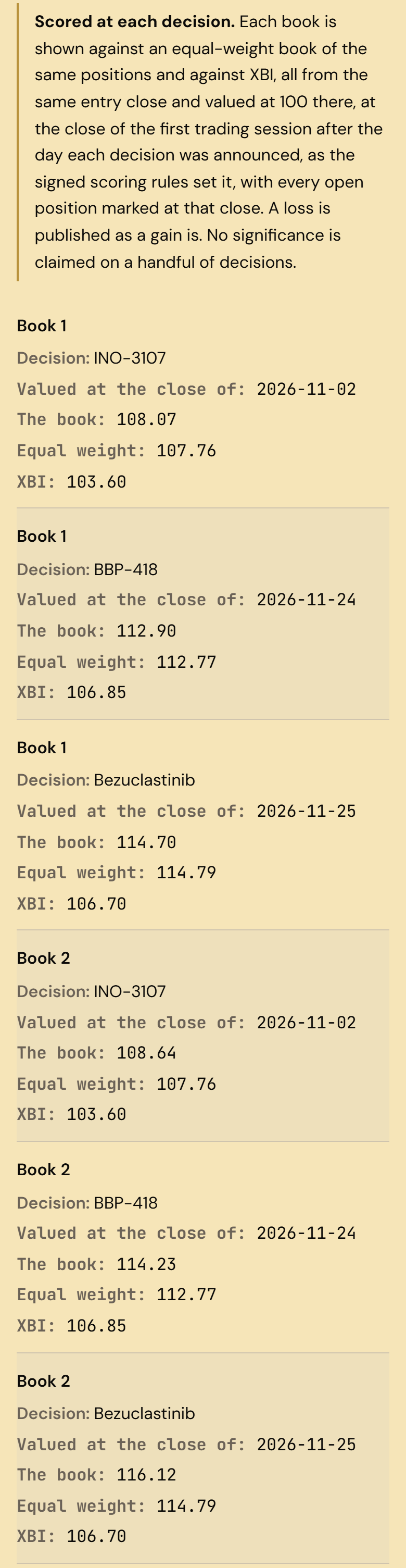
The board values the books at the close of the first trading session after the day each decision is announced, as its signed scoring rules set it, against XBI from the same start. At the close of 2 November 2026, after INO-3107's approval, it valued Book 1 at 108.07 and Book 2 at 108.64, against 103.60 for XBI. At the close of 24 November 2026, after BBP-418's approval, it valued Book 1 at 112.90 and Book 2 at 114.23, against 106.85 for XBI. At the close of 25 November 2026, after bezuclastinib's approval, it valued Book 1 at 114.70 and Book 2 at 116.12, against 106.70 for XBI.
The board also keeps an equal-weight book of the same positions, so a reader can separate what the selection did from what the weighting did. At the close of 25 November 2026 the equal-weight book stood at 114.79, 8.1 points above XBI: that lead comes from which filings the books held. The weighting added 1.3 points to Book 2, at 116.12, and took 0.1 from Book 1, at 114.70.
Holding the approvals, not holding the refusals
The gains came from what the books held. They held all three approvals into their decisions. On the board's decision-day table, Inovio rose 145.5%, BridgeBio 12.9% and Cogent 28.4% across their approvals. A list that only warns is no use to a fund. It has to find the decisions worth owning, and hold them. The rest of each book is positions still before the FDA, marked at the same close.
Not holding the refusals kept both books clear of the falls. On the same table, Summit's shares fell 16.5% across ivonescimab's refusal and Capricor's fell 74.5% across deramiocel's. No position in either book was exposed to either fall. The board has now measured six refusal days, net of XBI: -9.7%, -35.1%, -5.7%, +3.4%, -13.4% and -76.6%. The deepest of them, Capricor's on 20 November 2026, came on a filing neither book held.
A list judged only on the drugs it backs can hide its misses by backing nothing. This one counts every refusal, held or not, so a drug the books held that the FDA refuses counts against them, and the board publishes it. That is the scorecard we keep, and the public ledger lets anyone check it.
Inside the ontology
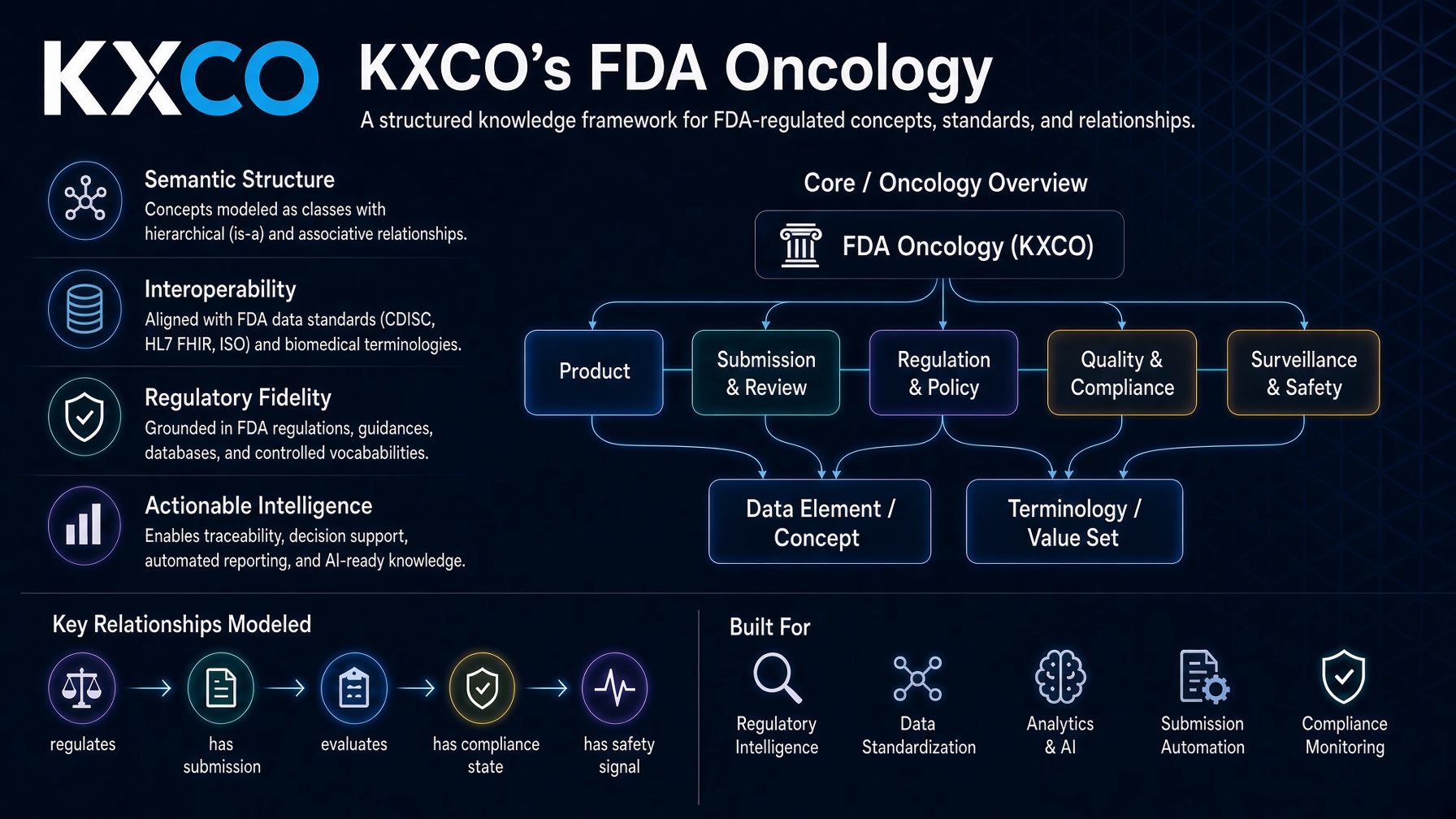
A calendar of FDA dates tells you when a decision is due. It does not tell you what the FDA has already said about the application, what the company has disclosed, or which of those statements bears on the outcome. KXCO's FDA ontology is a record of those things.
As at 25 November 2026 it holds 554 entities and 573 claims drawn from 714 sources, across 40 drugs. Every claim carries the web address it came from and the sentence it was read from: 573 of 573, without exception. It quotes the FDA's own letters where the FDA has published them, four so far, with the PDFs. It holds 76 dated regulatory events, each linked to its source, and it names 277 people connected to these filings. The entities are of 8 kinds: drugs, companies, regulators, manufacturing sites, trials, conditions, regulatory events and people.
Look at what it held before the approvals. On BBP-418, it held the priority review and the FDA's word that no advisory committee was planned. On bezuclastinib, it held the priority review and the FDA's finding of no potential review issues. On INO-3107, it held the rival approval, the bar Inovio itself had set and the FDA's question on accelerated approval. None of it is a forecast. Each entry is read from the regulator's or the company's own documents and filed against the drug, with the source one click away.
That is what a portfolio manager needs from research on an FDA decision: what the regulator has already said, joined to the price, with the source attached.
What a fund sees on the board
The board is built for someone who has to take a position. For each company it shows the cash held against the next FDA decision, the net cash and the quarters of runway it buys, the upside to the major banks' median price target, insider trades over the last 90 days and the move the options market prices for the decision alone. It records a regulatory concern on 9 of its 23 pending filings, each one dated and sourced. It measures every decision day, approval or refusal, net of XBI, and it publishes the result either way: in the board's words, a loss is published as a gain is.
Expanding the footprint and the testing
The public board is a sample. It covers 23 pending FDA filings, chosen to show what the research can do. Five decisions in, the books are right on all five decisions their scorecard counts, and the first screen's three decided names have all been approved. That is the reason for the next step.
We are expanding the FDA ontology to more filings and more companies, so that it carries more of the FDA's calendar, and we are expanding the testing with it, so that more decisions are scored in public as the FDA rules. Every new filing joins the record the way the first did: each fact with its source, each decision scored when it lands, a loss published the same way as a gain.
For a fund, the larger footprint means the same record on more of the names it holds or follows, and more decisions on which the record is tested in public before the result is known. Each approval and each refusal adds to a scorecard that anyone can check against the signed ledger. A KXCO room built for a fund covers any number of stocks, with live quotes, alerts, export and a data feed.
Proprietary, and for licensed funds and institutions
The selection mechanism is proprietary to KXCO.ai. The processes behind the selection are proprietary to KXCO.ai. Round Table, the engine behind the board, runs privately, and the public board is a demonstration on public data only. We license the instrument. We do not hand over the edge.
This is not available on a retail basis, and there is no subscription. We run it only in partnership with licensed funds and institutions. KXCO is a software company. It holds no financial licences and never takes custody of client assets; the licensed institutions that deploy the software hold those relationships.
The books are model books kept for research: no money is invested in them, and they are not an offer, a solicitation or a recommendation to buy or sell any security.
For biotech fund managers
If you run money in biotech, or allocate to people who do, start with the record. Every decision, every source and every result is on the board at kxco.ai/fda, and its next results will be published there as the FDA rules.
Then talk to us about the names you hold. Contact KXCO at kxco.ai.
What to watch
Savara's molgramostim passed its 22 November 2026 target date with no FDA action recorded; the board records that the FDA would not meet the date and has given no revised one. The next target date on the board is Vanda's Quimilza, on 12 December 2026, followed by Mineralys's lorundrostat on 22 December 2026. Cogent's two systemic mastocytosis applications for bezuclastinib come after them, with target dates of 30 December 2026 for the non-advanced form and 29 June 2027 for the advanced form.
Not financial advice: do your own work.
Stocks mentioned: $INO (NASDAQ), $SMMT (NASDAQ), $CAPR (NASDAQ), $BBIO (NASDAQ), $PYPD (NASDAQ), $COGT (NASDAQ), $SVRA (NASDAQ), $VNDA (NASDAQ) and $MLYS (NASDAQ).
Shayne Heffernan, Ph.D., is the founder of the KnightsBridge Group (shayneheffernan.com).
KXCO Three for Three on FDA Decisions
The FDA has ruled on three drugs on KXCO's FDA board since we set our model books in October 2026, and all three are wins for the books. They held INO-3107, and the FDA approved it on 30 October. They held neither ivonescimab nor deramiocel, and the FDA refused both. Per the books' public ledger and Yahoo Finance closes, from 14 October to 20 November 2026, Book 1 rose 0.9% and Book 2 rose 2.1%, while the S&P 500 fell 10.5%, the Nasdaq 15.3%, the Dow 6.7% and XBI 4.5%.
KXCO's FDA Ontology Is Two for Two on FDA Decisions
The FDA has decided two filings on KXCO's FDA board since the board began ranking them, and on my scorecard the board got both right. It ranked Inovio's INO-3107 first and the FDA approved it on 30 October; Inovio moved +149.1% net of the sector. It gave Summit's ivonescimab no call, and Summit announced the FDA's refusal on 15 November; Summit fell 16.5%. KXCO's record held the FDA's survival warning before the refusal was announced.
The Week Ahead on Wall Street, 16 November 2026: Look for the Bounce
NVIDIA reports on Tuesday 17 November 2026, its first results since Jensen Huang resigned, and I expect the stock and the AI market to bounce. NVIDIA closed at $162.85 on 13 November 2026, 31.93% below its record, while the semiconductor index rose 8.05% on the week. The calendar leans to currencies, with the yen near 160 after briefly crossing it, and the US publishes retail sales, housing starts, jobless claims and the Fed's minutes. Follow them on the Live Trading News trading page.

KXCO's FDA Ontology Ranked INO-3107 First. Its Two Published Books Beat XBI.
KXCO's FDA ontology ranked INO-3107 first before the FDA approved it on 30 October 2026; Inovio (INO) then hit $2.71 after hours from a $0.60 close. KXCO's two published research books on the ontology stood at 109.31 and 110.28 at the close of 13 November, from 100 at the close of 14 October, against 102.58 for XBI. Nine more decisions on the board fall due before 31 December, starting with molgramostim (SVRA) and deramiocel (CAPR) on 22 November.
Every story, signed and delivered.
Subscribe to the kxco channel and get the headline, the AI-written key takeaways, and the chain-anchor link the moment we publish. Audio versions and per-ticker subscriptions arrive in the next iteration.