
How to Tokenize a Real-World Asset on KXCO Armature
Bring real estate, commodities, receivables and instruments on-chain — custodian-held, legally wrapped, oracle-verified.
Part of theKXCO Center
Tokenizing a real-world asset means proving, continuously, that the on-chain token represents a real, redeemable claim. KXCO has published a step-by-step guide to doing exactly that on KXCO Armature.
What it takes
Real estate, commodities, receivables, fund interests or instruments — the requirements are the same:
Contact KXCO first. There is no self-serve deployment — every build begins with onboarding and ends with KXCO approval.
A regulated custodian. Reserves and underlying assets are held by a regulated custodian — never by KXCO.
KYC / KYB. The issuer and every holding address are identity-verified and carry a post-quantum KxcoIdentity credential.
Live oracles. Reserves, assets and NAV are verified on-chain continuously — not self-reported.
An enforceable legal wrapper. Legal ownership of the underlying is mapped to the on-chain token, so the token is a redeemable claim — not a symbolic pointer.
Why Armature is the gold standard
Most tokenization happens on anonymous, self-attested public chains. Armature is the opposite: a permissioned, post-quantum-secured settlement layer where the backing is held by a regulated custodian, verified live by oracle, gated to KYC-verified holders, and approved by KXCO before launch. Identity and authorization use ML-DSA-65 (NIST FIPS-204), which Armature verifies natively on-chain — so what you build is protected against the quantum threat, with instant finality and a complete on-chain audit trail.
Read the full guide
How to tokenize a real-world asset on KXCO Armature →
Every build starts with a conversation. Contact KXCO to begin.
Tokenized Assets for Wall Street
Regulators now ask whether the ledger is the register, who holds each unit, and whether a transfer is checked before it clears. KXCO answers all three in software: a register that settles on a chain whose validators attest every block with ML-DSA-87, holders admitted by the licensed institution under its own KYC with the Travel Rule in the wallet, and the offering's rule applied before a unit moves. The close is a market to sell into.
Tokenisation and RWA With KXCO: ML-DSA-87 on Chain, Verifiable by Anyone
Armature, KXCO's chain, has verified ML-DSA-87, the highest security category in NIST FIPS 204, natively on chain since 6 October 2026, and KXCO's platform signing keys moved to it on 6 and 7 October. Regulators now name tokenisation a supervisory priority, and DORA already requires cryptography that can change with cryptanalysis. Six tests an institution should run before it trusts a tokenisation platform, and where to check KXCO's answer to each.
Your AI Agent Can Now Own a Wallet — and Keep It
The wallet has always assumed a person is holding the phone. Autonomous AI agents break that assumption. Shayne Heffernan on the self-custodial, quantum-secure wallet built so a machine can own value — and the one line where regulation begins.
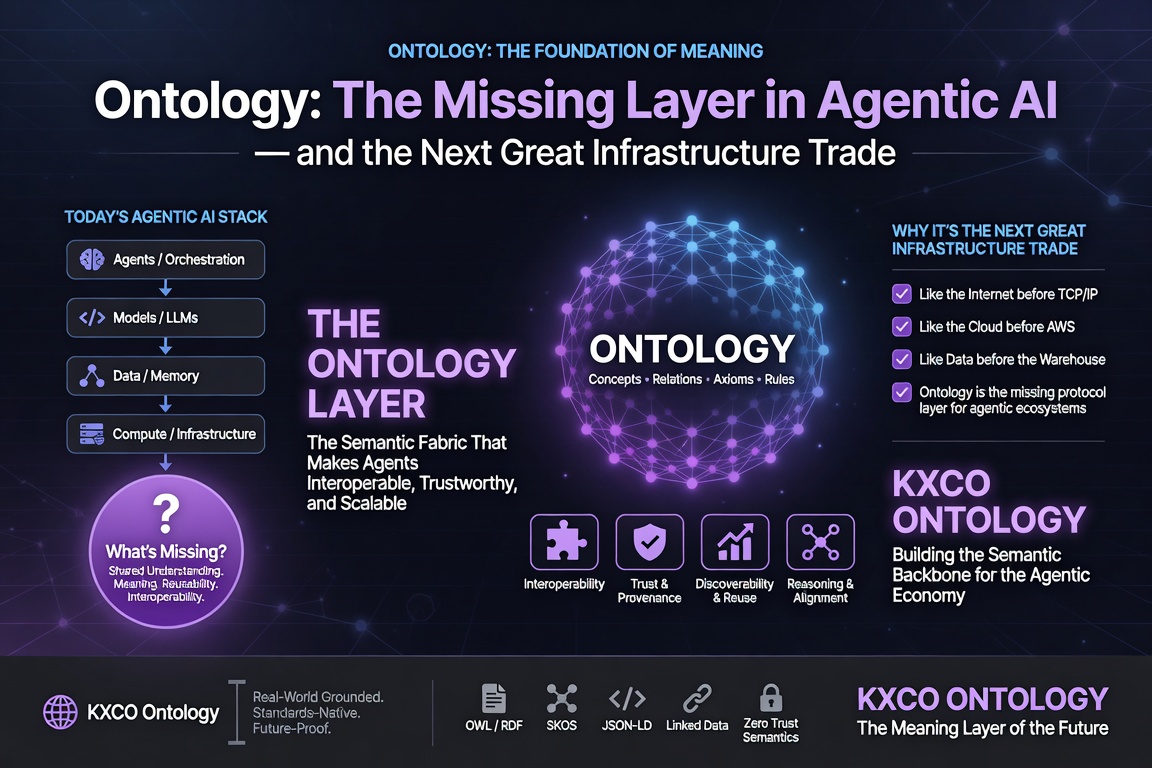
Ontology: Agentic AI and Infrastructure
The AI trade so far has been a compute trade. The next leg is a meaning trade — and ontology, secured and settled, is the layer almost everyone is skipping. Shayne Heffernan on why ontology is the missing layer in agentic AI, and the infrastructure it needs.
Every story, signed and delivered.
Subscribe to the kxco channel and get the headline, the AI-written key takeaways, and the chain-anchor link the moment we publish. Audio versions and per-ticker subscriptions arrive in the next iteration.