
How to Retire and Grow Your Own Food
A practical global guide to self-sufficiency, financial independence and living off the land
Part of theLife Center
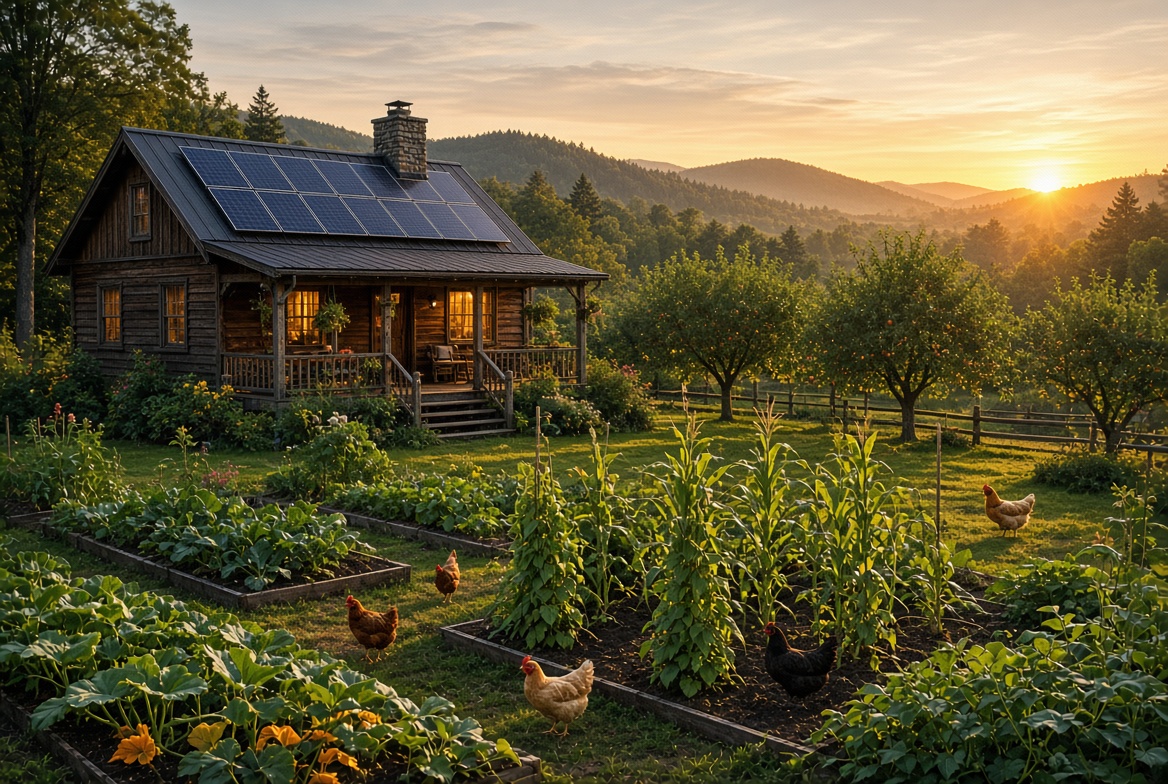
A retirement homestead is a small business with a kitchen attached. Solar, water, garden, orchard and flock have to work as one system.
The traditional picture of retirement is a golf course, a cruise ship and a drawdown plan that quietly depends on the stock market behaving for thirty years. For a growing number of people, that picture has stopped being reassuring. Retirement is starting to mean something more physical: a return to the land, and to food you can point at.
Homesteading in retirement is an act of self-reliance with a balance sheet behind it. It hedges food and energy inflation with real assets, it keeps the body working, and it replaces portfolio anxiety with problems that can actually be solved with a spade. What it is not is a pastoral fantasy free of arithmetic.
To work, a retirement homestead has to be run with the discipline of a small business. That means land valuation, yields per square foot, the cost of a well, the price of a lease you cannot convert to title, and the physics of killing bacteria in a jar. Most of the failures in this field are not failures of effort. They are failures of sequencing and arithmetic, committed by people who were entirely willing to do the work.
This guide covers the whole decision. Where to go, what land actually costs, what the infrastructure costs behind it, what to grow for calories and what to grow for cash, how to keep a flock, how to preserve a harvest without killing anyone, and how to sequence the first three years so the money lands in the right order. It covers the United States, the United Kingdom, Europe and Asia, with current figures from official sources and a note on where those sources disagree.
Two warnings before the detail. First, tenure law in Asia and farmland ownership law in parts of the European Union will stop some readers dead, regardless of budget, and those rules are covered in full below because they are the sort of thing people discover after wiring a deposit. Second, every figure here has a date attached. Land values, planning rules and visa thresholds all move, and a guide that hides its vintage is worse than no guide at all.
Where are the best places to homestead in retirement?
Location decides everything downstream. It sets your growing season, your heating or cooling bill, your water security and what livestock can survive your winter or your monsoon. Four vectors are worth ranking before anything else: climate, the property tax or land fee burden, water rights and access, and distance to a market where surplus can be sold.
United States: proven ground, low carrying cost
The Ozarks, covering northwest Arkansas and southern Missouri, remain the benchmark. Land is cheap, the four seasons support both fruit trees and staple crops, the forest carries game, and the limestone aquifers are reliable. USDA put Arkansas pasture at $3,500 per acre and Missouri pasture at $2,850 per acre in its Land Values 2026 Summary, against a national pasture average of $2,000.
Carrying cost is the quiet advantage, and for a household living on fixed income it matters more than the purchase price. Tax Foundation county data puts effective property tax rates on owner-occupied homes in Arkansas counties between 0.14 and 0.76 per cent, and Missouri counties between 0.34 and 1.14 per cent. Rural counties cluster at the bottom of those ranges. On a $250,000 property, the gap between a 0.3 per cent county and a 1.1 per cent county is $2,000 a year, every year, forever, which over a twenty five year retirement is a second vehicle and a new roof.
The Appalachian foothills of eastern Tennessee, western North Carolina and southern Virginia offer steep wooded ground, 40 to 60 inches of rainfall and unusually strong local food networks. They are no longer the bargain they were. Tennessee pasture now runs $5,910 per acre, nearly three times the national average, because the region has been thoroughly discovered. The regional Appalachian average sits at $4,880.
The Upper Midwest and Great Lakes give you deep loamy soil and abundant water in exchange for winters that demand serious heating. Budget for a wood stove and the woodlot to feed it, or for propane at a price you do not control. East of the Cascades, in eastern Washington and northern Idaho, hot dry summers suit roots, squash and grain, and hydroelectric power keeps utility rates among the lowest in the country. The trade there is water, which is a legal question before it is a plumbing question.
The water question most buyers skip
In the eastern United States, water rights are broadly riparian, meaning the right attaches to land touching a watercourse and reasonable use is generally permitted. West of roughly the hundredth meridian, most states run prior appropriation, where water rights are separate property, senior claims are satisfied first, and owning the land above an aquifer does not automatically entitle you to pump it. Buyers move from Ohio to Idaho and assume the rules travelled with them. They did not.
Rainwater harvesting is regulated in some western states for the same reason, on the argument that captured rain would otherwise reach a senior downstream right. The rules have loosened over the past decade, but the correct move is to confirm the position in the specific state and county before designing a catchment system, not after building it.
Ask three questions before any offer. Is there a recorded, transferable water right or a legal permit to drill. What do neighbouring wells yield in gallons per minute, and at what depth. Has the aquifer level moved over the last twenty years. A county extension office or state geological survey will answer all three at no cost.
United Kingdom: Wales and the One Planet route
Wales is the one part of Britain with a planning policy written for exactly this. One Planet Development, which sits under Technical Advice Note 6, permits low impact dwellings in open countryside that would otherwise be refused outright.
The conditions are demanding and worth reading before falling in love with a field. The household has to reach an ecological footprint well below the Welsh average, meet at least 65 per cent of its basic needs from the land within five years, run on renewable energy, and accept annual monitoring against a management plan. Most approved sites run between two and ten hectares.
Understand the scale of the gate before building a plan around it. A review carried out for the Welsh Government counted roughly 38 approved One Planet Developments in just over a decade of the policy, concentrated heavily in Pembrokeshire and Carmarthenshire. That is a real route, and it is a narrow one. It rewards applicants who arrive with a genuine land based business plan and a management plan they can actually deliver, and it refuses people who treat it as a planning loophole with a vegetable patch attached.
British land is not cheap either. Savills put prime arable in England at around £9,900 per acre and poorer pasture at about £6,100 per acre in the first half of 2025 in its Farmland Market research. Rough grazing in the Welsh uplands sits below that, which is precisely why the One Planet route is attractive. Scotland offers cheaper remote plots and a stronger right to roam tradition. Planning permission is required almost everywhere in Britain, and going off grid exempts a dwelling from nothing at all.
Continental Europe: where the value is, and who is allowed to buy it
Rural Portugal and Andalusia combine mild winters, excellent solar and established expat communities, at living costs well below northern Europe once you are away from the coastal tourist belt. Portugal also runs the most usable retirement pathway in the region. The D7 residence route is built for people living on pensions and other passive income, and its income threshold tracks the national minimum wage, which sits at €920 a month in 2026, with higher figures required for a spouse and dependants and a matching bank balance.
The raw land value, though, is in central and eastern Europe. Eurostat put 2024 arable land at €8,700 per hectare in Romania and €8,679 in Bulgaria, with Hungary at €6,041, France at €6,400, Lithuania at €5,590 and Latvia lowest at €4,825. The EU average was €15,224 per hectare, up 6.1 per cent on the year. The Netherlands ran to €96,608 and Malta to €201,263, which tells you how wide the spread inside a single market can be.
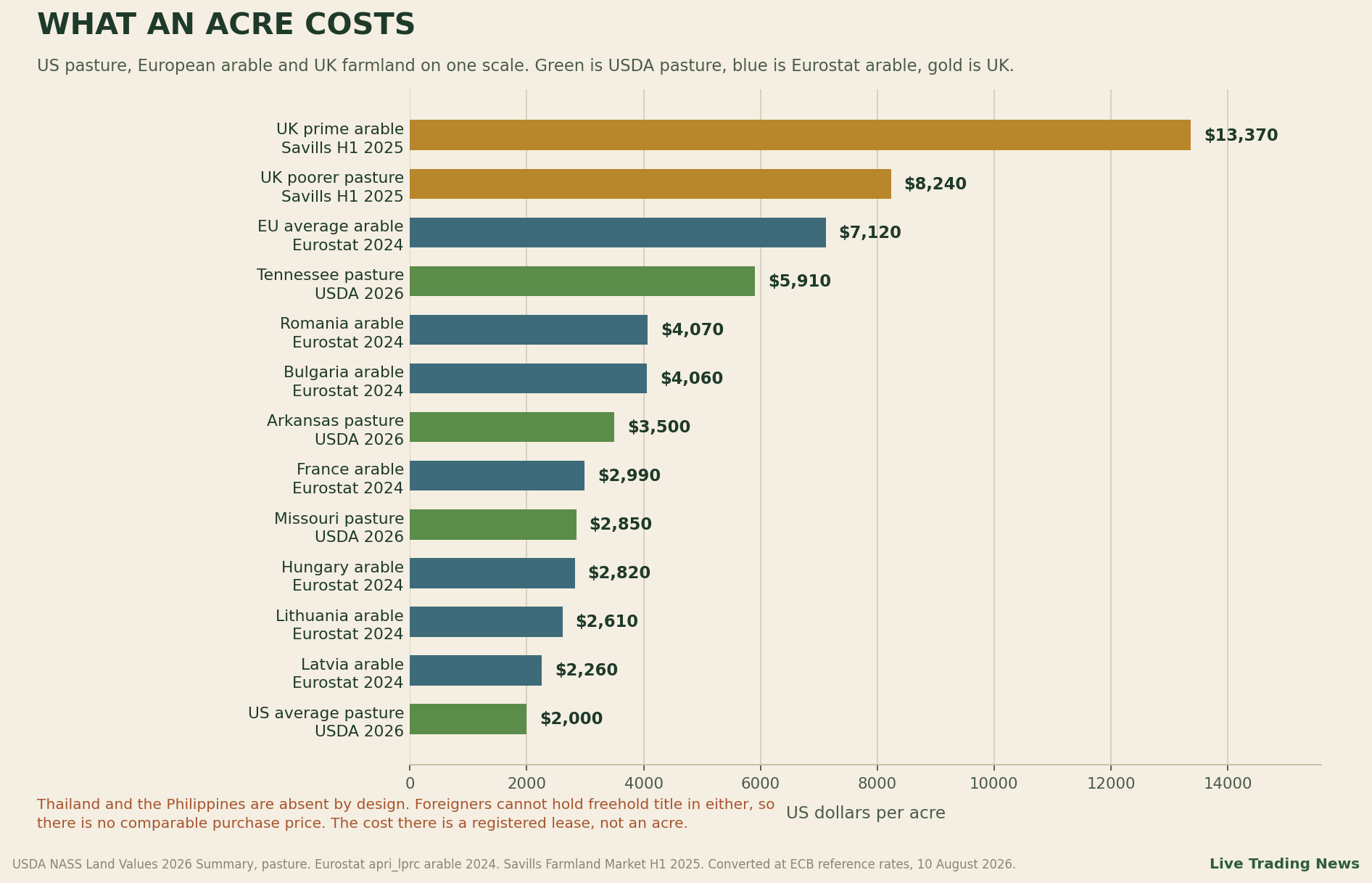
Everything converted to dollars per acre at ECB reference rates. Ozark pasture and Baltic arable land occupy the same price band. British farmland costs two to four times as much.
Now the part that stops people. Cheap farmland in the European Union is not open to everyone. Bulgaria prohibits the acquisition of agricultural land by non-EU nationals. Romania permits non-EU citizens to acquire agricultural land only on the basis of reciprocity under an international treaty, and it has not concluded such treaties with the main non-EU countries retirees come from. In practice, an American or a post-Brexit British buyer cannot simply purchase Romanian or Bulgarian farmland the way an EU citizen can.
There are structures that get used around this, mostly involving locally registered companies, and they carry real legal and tax consequences that vary by country and change with enforcement appetite. Nobody should build a retirement on one without independent local counsel who is not also selling the land. The honest summary is that eastern European farmland is exceptional value for EU passport holders, and a complicated proposition for everyone else. If you hold an EU passport through ancestry, this is the single most valuable thing that passport will ever do for you.
Asia: cheap production, complicated tenure
Northern Thailand around Chiang Mai, Chiang Rai and the highlands near Pai offers cooler elevation, near year round growing in the right microclimate, and workable retirement visas. The Philippines and the Vietnamese highlands around Da Lat follow the same pattern of low living costs and abundant tropical production.
The tenure problem has to be understood before any money moves. Thailand's Land Code prohibits foreign freehold ownership of land. The practical routes are a registered lease capped at thirty years, a usufruct, superficies over buildings, or a properly structured local company. The old workaround of stacking pre-agreed thirty year renewals into an effective ninety year term no longer holds. The Supreme Court has ruled those pre-agreed renewal clauses void and unenforceable, as Formichella and Sritawat set out in their analysis of the judgment. A widely discussed proposal to permit ninety nine year leases has not become law.
The visa side is more straightforward and more expensive than most people expect. The standard Thai retirement route requires either 800,000 baht held in a Thai bank account, or monthly income of 65,000 baht, or a combination reaching 800,000 baht a year, with the funds seasoned in the account before application and maintained through each annual renewal. The O-A category adds a health insurance requirement. Longer term categories exist with substantially higher thresholds. Those figures are capital that sits idle as a compliance buffer, and they belong in the budget as such rather than being counted twice as working capital.
Anyone modelling a Thai or Philippine homestead should therefore price a thirty year right of use, not an acre, and should size the depreciation accordingly. A structure with twenty two years left on its lease is worth materially less than the same structure with twenty eight. Add typhoons, monsoon drainage, heat, humidity and pest pressure to the risk column, and treat healthcare access and continuous visa compliance as structural requirements rather than paperwork.
The climate zone has moved
One technical note that changes plant selection everywhere in the United States. USDA updated its Plant Hardiness Zone Map in 2023, built from 1991 to 2020 climate normals across 13,412 weather stations, against 7,983 stations in the 2012 edition. About half the country shifted into a warmer half zone. Anyone working from a map printed before 2023, or from a seed catalogue that has not been updated, is planning against a climate that no longer exists. Check the current zone for the specific parcel, not the region, because elevation and cold air drainage can move a valley floor a full half zone away from the hill above it.
How much does a retirement homestead cost?
You are buying three things at once: a small farm, a food manufacturing facility and a house. Budget for all three or the homestead becomes the most expensive way anyone has ever grown a tomato.
Land. Target five to ten acres where climate and rules allow. Intensive tropical systems can work on less. At the USDA pasture values above, ten Ozark acres is roughly $28,500 to $35,000 of land, which is the single most striking number in this entire guide, and the reason the rest of the budget catches people out.
Infrastructure. This is where budgets fail. A drilled well or a serious rainwater and spring system runs from a few thousand dollars to $15,000 or more depending on depth and geology, and the variance is geological rather than negotiable. A solar array with battery backup sized for a working household typically runs into the mid five figures before incentives. High tensile fencing, a barn or workshop, a septic system and an all weather access track add substantially. In the UK and much of Europe, planning and building regulation will dominate both the budget and the timeline, often by more than the construction itself.
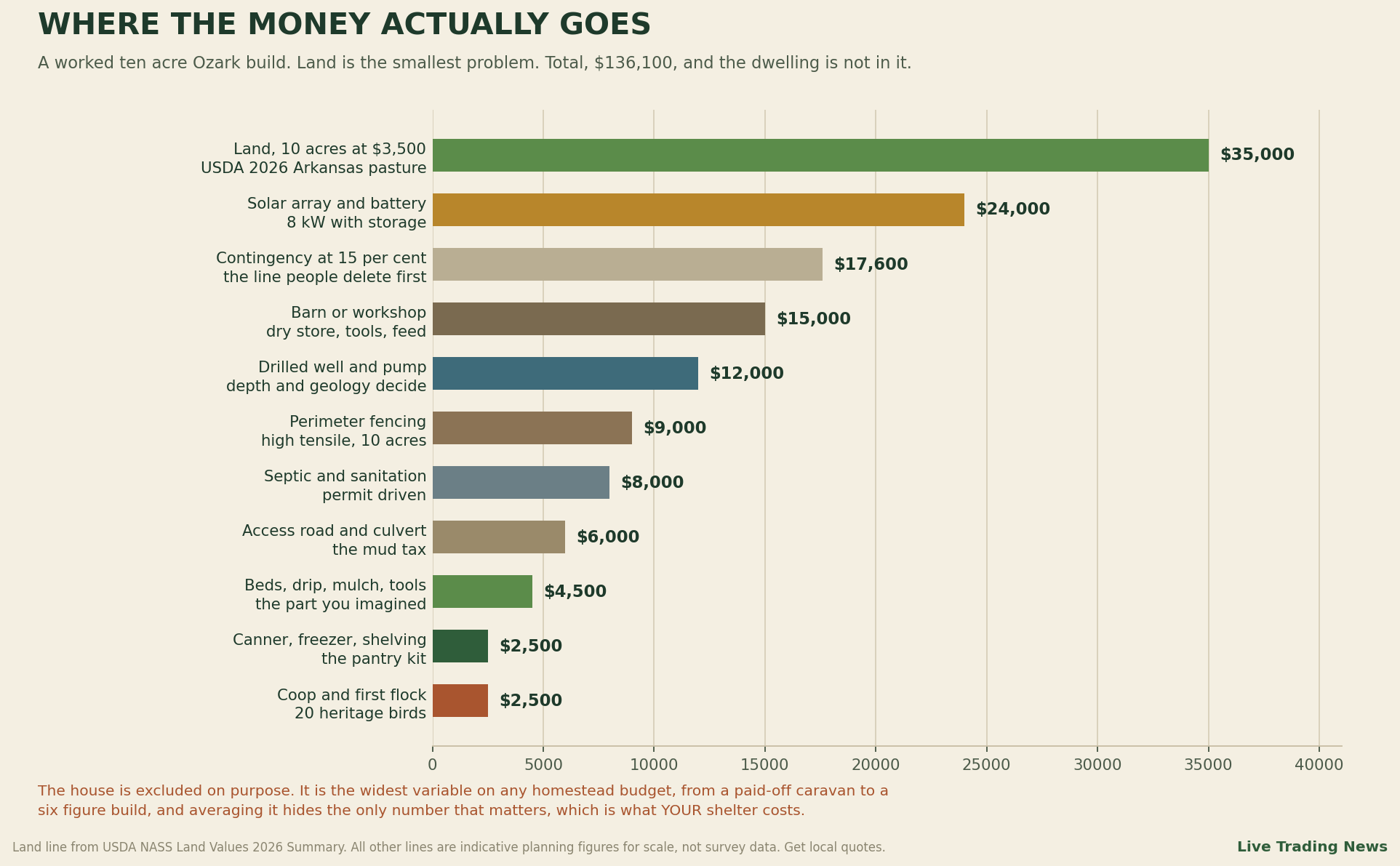
A worked example, dwelling excluded. Land is the smallest problem on the list, and the contingency line is the one people delete first and regret most.
The chart above is an illustrative build, not a survey. The land line comes from USDA. Every other line is a planning figure meant to convey proportion, and the only quotes that matter are the ones you obtain locally. What the shape shows is durable regardless of your numbers: land is a minority of the total, energy and water are the heavyweight items, and the contingency is not optional. Something always comes in wrong, and on a rural site it is usually the thing under the ground.
The dwelling is deliberately excluded, because it is the widest variable in the entire exercise. A paid-off caravan on a hardstanding and a six figure timber frame are both legitimate answers, and averaging them produces a number that describes nobody.
Ongoing costs. Off grid does not mean free, and this is the line that decides whether the homestead is sustainable at twenty years rather than at two. You still face property taxes or their local equivalent, and on a modest Ozark holding that is often under $1,500 a year. Then add feed supplements for the flock, which run to a few hundred dollars annually once free ranging is doing its share. Add fuel for a tractor or truck, satellite or fixed wireless internet, and a tool and equipment replacement fund, because on a working holding something mechanical fails every year without exception.
Then add the items people leave off entirely. Property and liability insurance, which matters more once you sell anything to the public. Health cover, which for early retirees in the United States is frequently the largest single line in the entire budget and dwarfs the property tax it took months to optimise. Seed, soil amendments and orchard replacement stock. Vehicle costs that are higher than suburban equivalents because everything is a longer drive on worse roads.
A working homestead should throw off $5,000 to $15,000 a year in liquid cash purely as a buffer against the well pump, the tractor and the fencing, all of which will fail on a weekend and none of which accept vegetables. For an international move, add visa compliance costs, currency risk on a pension paid in a currency you do not spend, and any dual tax exposure. A pension that fell fifteen per cent against the local currency has effectively cut the household budget by fifteen per cent, and no amount of gardening offsets that.
Systems, not purchases. The reason to think in systems rather than shopping lists is that the outputs have to connect. Every item below is cheaper if the one beside it was designed at the same time.
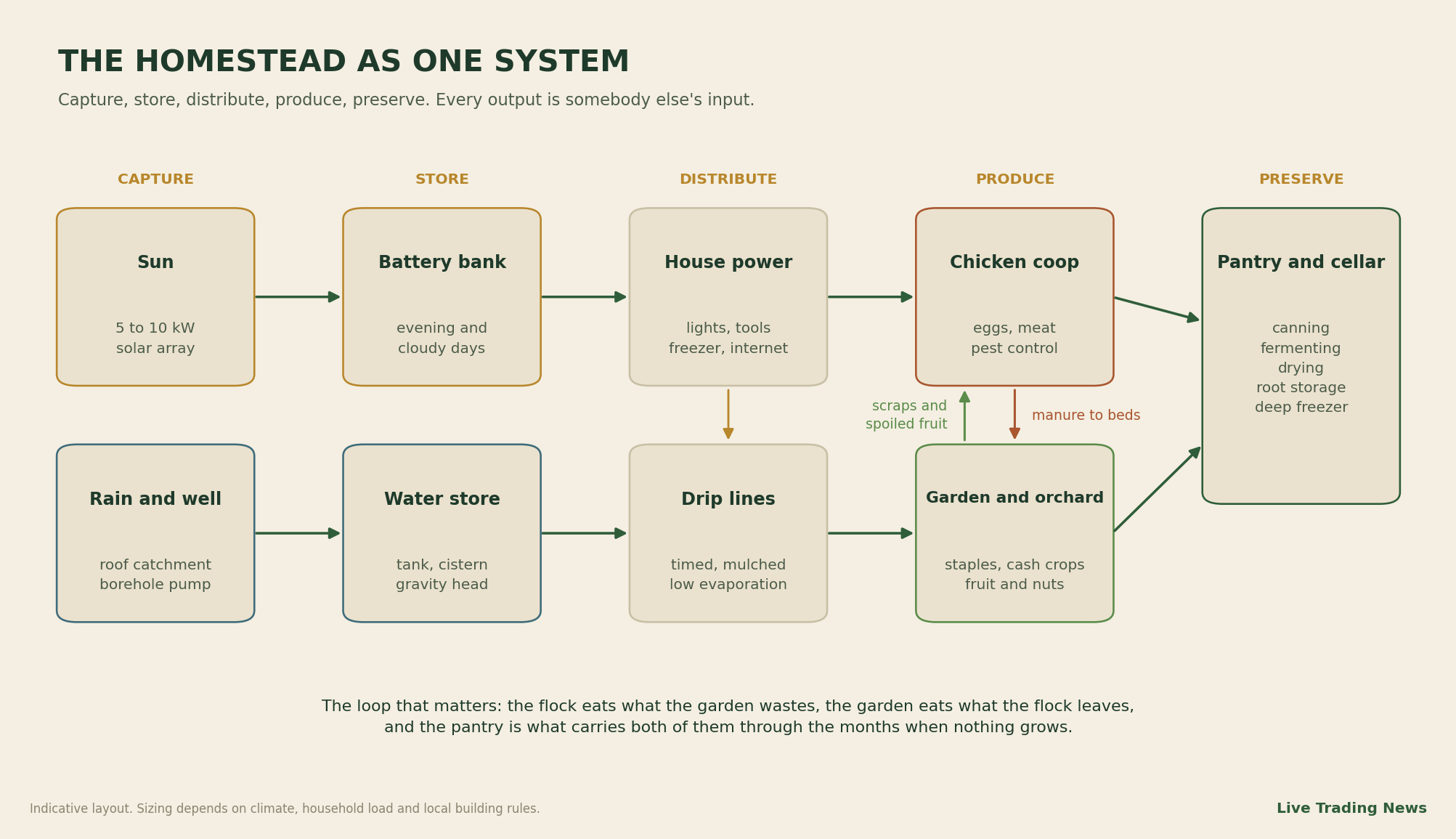
Capture, store, distribute, produce, preserve. The loops matter more than the boxes: the flock eats what the garden wastes and the garden eats what the flock leaves.
Which cash crops actually pay the bills?
Treat the homestead as a micro enterprise. Property taxes, internet, fuel and health insurance need cash, and cash comes from high margin crops that do not require acreage or industrial equipment. The buyers are local restaurants, organic markets, farm shops and specialty wholesalers, and the winning characteristics are always the same: a short production cycle, a high price per kilo, and a buyer close enough to deliver to in a car.
Microgreens are the clearest worked example, because an agricultural extension service has already done the arithmetic. The University of Missouri Extension's microgreens planning budget models production on shelving under lights and puts yield at roughly 8 to 15 ounces per standard 1020 tray, with anywhere from 27 to 46 crop cycles a year depending on the species. Income per harvested tray in its 2024 examples ranged from around $32 for pea and radish to $46 for a mix or broccoli and $60 for cabbage. Those are gross figures against which seed, growing medium, power, water and labour have to be set, which is exactly why the published budget is more useful than any confident number in a blog post. Run the extension spreadsheet with your own power price and your own market before buying a single shelf.
Gourmet mushrooms follow similar economics with a different bottleneck, which is sterile technique rather than light. Hardneck garlic is the low labour option: it goes in during autumn, it is largely ignored, it stores for months, and it sells at a premium because supermarket garlic is a different product. Medicinal and culinary herbs are the lowest input choice once established, with lavender, echinacea and chamomile in temperate zones and ginger, turmeric, lemongrass, Thai basil and moringa in the tropics.
Two seasonal earners are worth adding. Heirloom tomato and pepper starts sell hard for roughly six weeks each spring, at high margin, using space that is otherwise idle before the main season. And in tropical Asia, chili, okra, yard long beans and premium salad greens find immediate local demand without any need to educate a market.
It is worth building the target income from the bottom up rather than hoping. Suppose the goal is $8,000 of gross cash. A modest microgreens bench producing a handful of trays a week at the extension budget's gross figures gets a meaningful way toward it on a few square metres of shelving, provided the buyers are secured before the seed is sown. A few hundred pounds of hardneck garlic sold at farm gate prices adds a further block for perhaps twenty days of actual work spread across nine months. Six weeks of spring plant sales adds another. Eggs surplus to household use fill the gaps in cash flow rather than driving it.
That is four small enterprises, none of them impressive alone, combining into a number that covers the tax bill, the internet, the fuel and the insurance. It is deliberately unglamorous. The alternative, which is to plant five acres of something and hope for a wholesale buyer at harvest, is how small growers lose money at scale.
The discipline that separates income from hobby is narrow focus and reliability. One crop, one buyer, one delivery day, held consistently for a season, will out-earn five crops sold erratically at a market stall. Restaurants buy reliability before they buy quality, and a chef who can plan a menu around your Tuesday delivery becomes a permanent customer. The corollary is that you should never sell capacity you do not have, because the fastest way to lose a wholesale account is to miss one week in August.
What should you grow for real self-sufficiency?
A homestead cannot live on arugula. If the goal is to drive the grocery bill toward zero, you need calories, and calories mean staples.
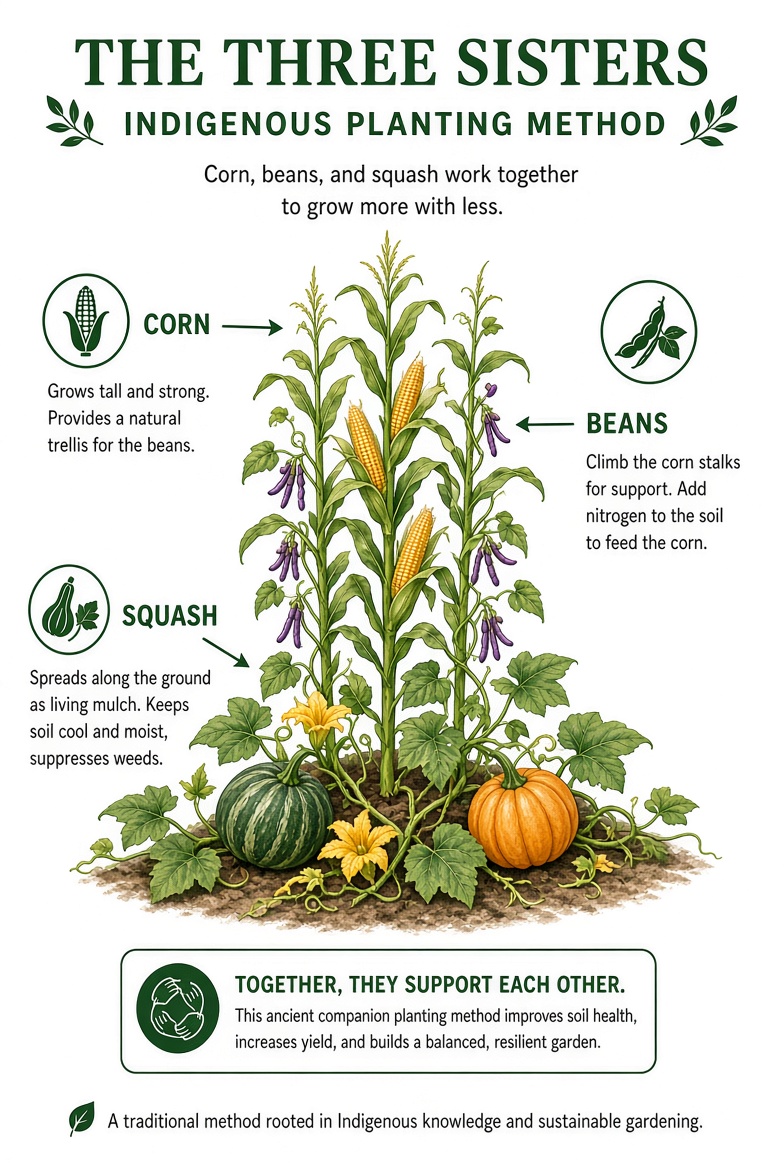
The Three Sisters. Corn carries the beans, the beans feed the corn, the squash shades the soil and suppresses weeds.
In temperate climates the Three Sisters remain the foundation, and they are a genuine agronomic system rather than a folk story. Flint or dent corn provides the carbohydrate and the trellis. Climbing beans provide protein and fix nitrogen at the root. Winter squash sprawls beneath as living mulch, holding soil moisture and suppressing weeds, and stores for months without processing. Grown together they produce more from a given area than the same three crops grown apart, and they store as dry grain, dry beans and hard skinned fruit, which is to say they need no electricity to survive the winter.
Potatoes are the highest yielding staple most people can plant. Extension guidance generally puts a well managed 100 foot row at somewhere between 150 and 300 pounds, which is a remarkable return on a strip of ground four hundred square feet in size, and the crop tolerates poor soil and cool summers that would defeat corn. The catch is disease pressure and storage: potatoes need a genuinely cool, dark, humid store and a rotation that does not put them back on the same ground.
Heirloom tomatoes such as Brandywine, Cherokee Purple, San Marzano types and Golden Jubilee are not primary calories, but they are the backbone of the preserved pantry and the single biggest contributor to whether the food you stored is food you actually want to eat in February. That is not a trivial consideration. A pantry full of things nobody enjoys gets abandoned in year two.
In the humid tropics the staple list changes completely, and the mistake is to arrive with a temperate seed box. Cassava, sweet potato, taro, plantain and breadfruit carry the calories, supported by perennial nutrient dense greens including moringa, chaya, katuk and kangkong. These systems produce heavily on a smaller footprint once established, they are perennial or near perennial rather than annual, and they suit continuous or wet and dry harvesting rather than a single autumn crescendo. The corresponding cost is that almost nothing stores in a tropical pantry the way it does in a temperate one.
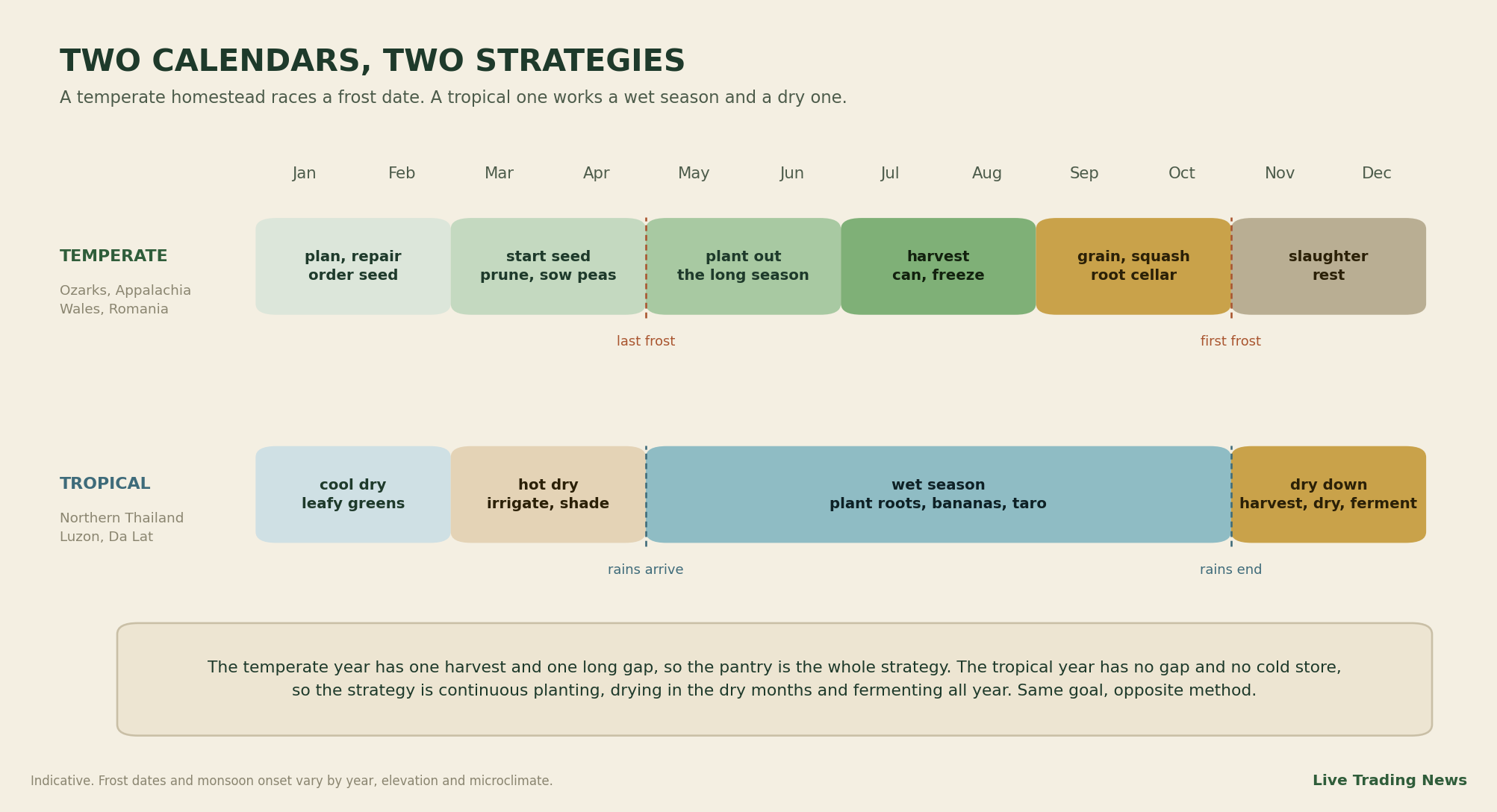
The temperate year has one harvest and one long gap, so the pantry is the strategy. The tropical year has no gap and no cold store, so the strategy is continuous planting, drying and fermentation.
Which chickens should you keep?
Chickens are the gateway livestock. They convert insects, weeds and kitchen scraps into protein, they produce fertiliser as a by-product, and they are the cheapest livestock mistake to recover from.
The economics are worth knowing before the romance sets in. University of New Hampshire Extension guidance on producing your own eggs puts a hen's output at 20 dozen eggs or more over a thirteen month laying period, against 90 to 100 pounds of feed consumed in the same window. That ratio is the whole business case. If bought feed costs more per pound than the eggs displace, the flock is a hobby that produces excellent fertiliser, and there is nothing wrong with that as long as it is a decision rather than a surprise. Free ranging, kitchen scraps and garden waste are what move the ratio in your favour, which is why the flock belongs beside the garden rather than at the far fence.
Choose dual purpose heritage breeds that lay for years and still dress out to a respectable carcass. Rhode Island Red, Plymouth Barred Rock, Australorp and Buckeye are proven temperate choices, laying broadly in the 200 to 280 egg range in a good year. Avoid pure commercial laying hybrids, which are bred to burn bright for eighteen months and then stop, and which are the wrong tool entirely for a household that wants a self-replacing flock.
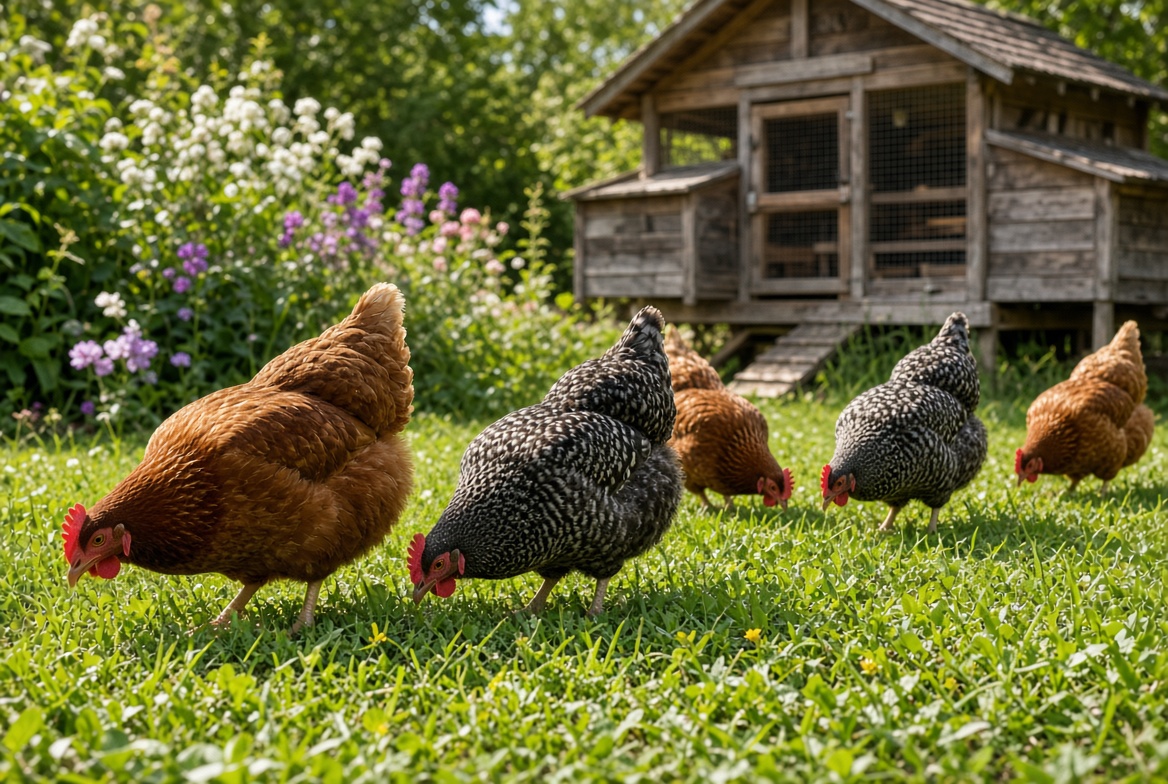
Heritage dual purpose birds are the backbone of a closed loop protein system, and they are the cheapest livestock mistake to recover from.
In hot humid Southeast Asia, prioritise heat tolerance over production figures. Naked Neck types, Fayoumi and well adapted local indigenous breeds handle the climate when given shade, ventilation and constant clean water. Short cycle meat birds still work for filling a freezer where high protein feed is available. In the tropics, local adaptation and disease resistance matter more than the numbers on a breed chart, and the best flock advice in any tropical district comes from whoever has been keeping birds there for thirty years.
Two practical points that get skipped. Predator proofing is a construction standard, not a preference, and it is far cheaper to build once than to rebuild after losing a flock in a night. And a laying flock needs a plan for birds past productive age, because a homestead that cannot process its own poultry ends up feeding twenty pensioners.
What about hunting, fishing and wild protein?
A homestead's boundaries often extend past its fence lines. Wild game carries no feed cost, and in the United States and parts of Europe where landowners hold or strongly influence hunting rights, deer and small game can supply a meaningful share of annual protein.
The yield is more predictable than most people assume. The Ohio Department of Natural Resources examined 115 field-dressed white-tailed deer and found an average field-dressed weight of 107.56 pounds producing 52.19 pounds of venison, a yield of about 48.5 per cent. Bucks averaged 129.69 pounds field dressed for 62.51 pounds of meat, and antlerless deer 92.27 pounds for 45.05 pounds. In round terms, a deer is roughly fifty pounds of boneless meat. Two or three deer a season, legally taken, is a meaningful part of a household's annual protein, and it arrives without a feed bill, a fence or a vet.
The constraints are legal rather than practical. Hunting rights vary sharply between European jurisdictions and are worth checking before purchase rather than after, because in some systems the right is attached to a hunting association rather than to the land you just bought. Across much of Asia, recreational hunting is heavily restricted or impractical for foreigners, and the realistic substitutes are fishing where permitted, small livestock and foraging of permitted species. Licences, seasons, bag limits and private land rules apply everywhere. A retirement plan is a poor thing to risk on a wildlife offence.
The wider point is that wild protein is a supplement to a system, never the system itself. Any plan whose calorie budget depends on a successful hunt is a plan with a hole in it.
How do you preserve a harvest safely?
Growing food produces seasonal abundance. Without preservation, abundance rots. This is the chapter where the homestead either works or does not, and it is the only chapter where getting it wrong can kill somebody.
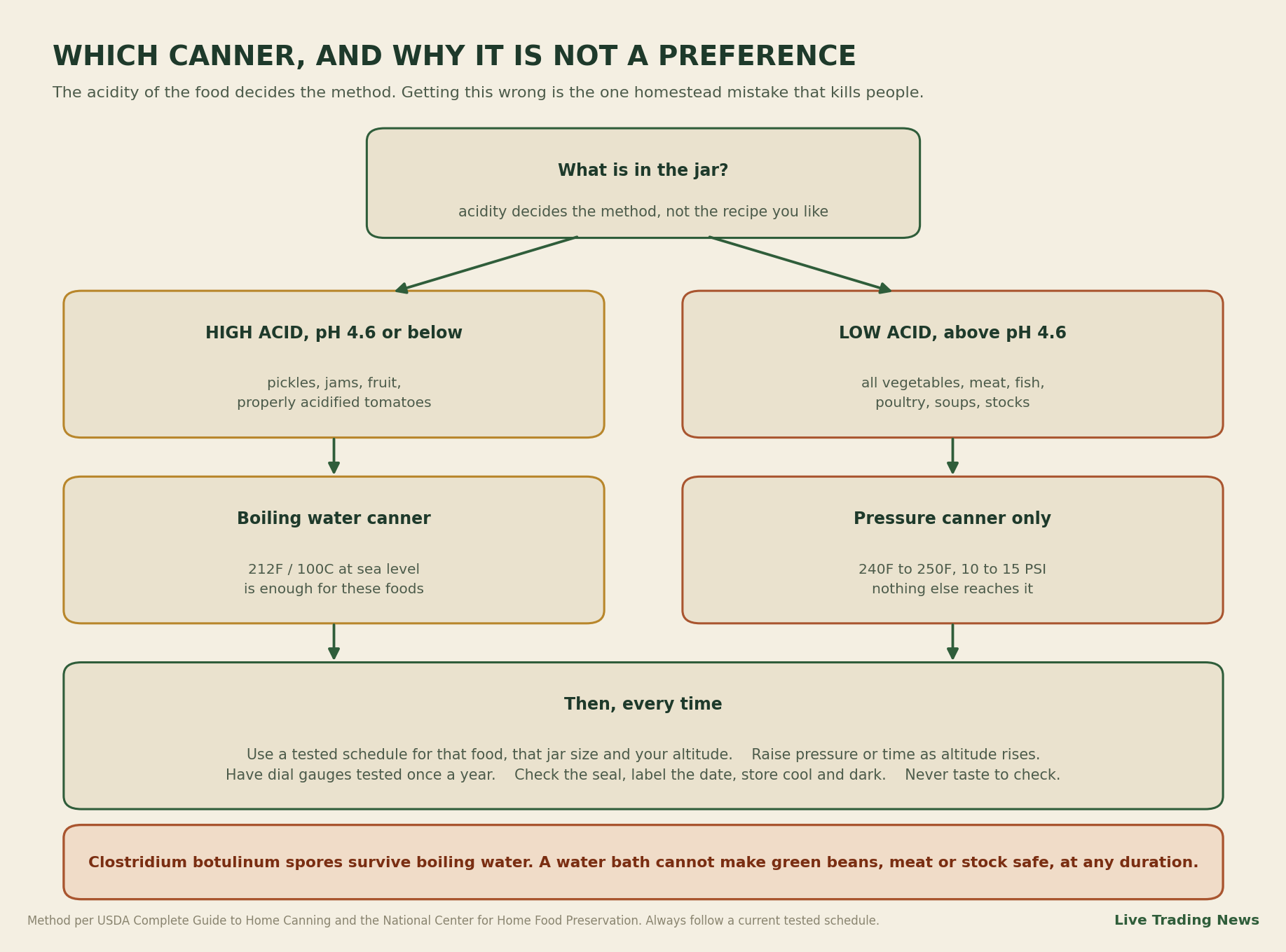
The acidity of the food chooses the method. This is the one homestead decision with no room for improvisation.
Water bath canning handles high acid foods, meaning pickles, jams, fruit and properly acidified tomatoes. Pressure canning is mandatory for all low acid foods: vegetables, meat, fish, poultry, soups and stocks. The reason is temperature. According to the National Center for Home Food Preservation, low acid foods must reach 240 to 250 degrees Fahrenheit, achieved at 10 to 15 PSI in a pressure canner. Boiling water tops out at 212 degrees at sea level, and Clostridium botulinum spores survive it indefinitely. No amount of extra time in a water bath fixes that, and no family recipe overrides it.
Four rules carry the whole practice. Use a current tested schedule for the specific food, jar size and altitude. Raise pressure or processing time as altitude rises, because water boils cooler as you climb. Have dial gauges tested annually, which most extension offices do for nothing. And never taste a jar to check it, because botulinum toxin is odourless and tasteless and the test is worthless as well as dangerous. The USDA Complete Guide to Home Canning remains the reference standard, and it is free.
Tomatoes deserve a specific warning because they sit on the boundary. Modern tomato varieties are frequently not acidic enough to water bath safely on their own, which is why tested recipes call for added bottled lemon juice or citric acid in measured amounts. This is not a flavour adjustment and it is not optional.
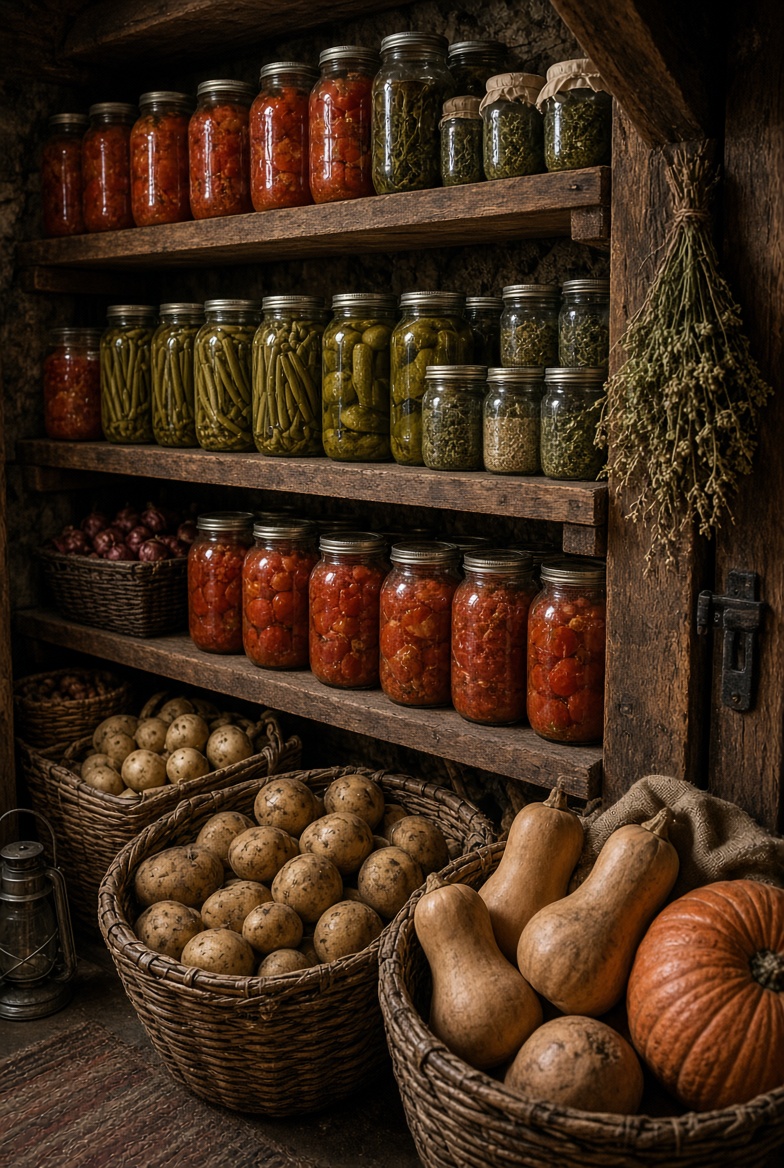
The pantry is the real balance sheet of a homestead. Jar count and freezer inventory are the metrics that replace a portfolio statement.
Beyond canning there are three other methods, and a serious pantry uses all of them. Fermentation needs only salt and an anaerobic environment, produces probiotic rich food from sauerkraut and kimchi to their tropical equivalents, and costs almost nothing in energy. Root cellaring works well in temperate zones for potatoes, carrots, beets, onions and winter squash, and it is the cheapest storage there is because the store does the work. Drying suits herbs, chilies, beans, fruit and mushrooms, and it is the dominant method in the tropics where a root cellar is close to useless.
For meat, vacuum seal and freeze at 0 degrees Fahrenheit, and note that a deep chest freezer is meaningfully more efficient than an upright because cold air does not fall out when the lid opens. The counterargument to freezing is that it is the only preservation method with a single point of failure attached to the grid, which is a strong reason to keep canned and dried stores alongside it rather than relying on the freezer alone.
What does the daily workload actually look like?
The common assumption is dawn to dusk labour. In retirement the objective is sustainability rather than exhaustion, and the design decisions made in year one determine which one you get.
Keep intensive production close to the house. Distance is the hidden tax on a homestead, and a bed fifty yards from the kitchen door gets ten times the attention of a bed at the bottom of the field. Use heavy mulching, biointensive or square foot beds, and drip irrigation fed from rainwater catchment, all of which trade one-off setup effort for permanently reduced daily work.
Hold staple crops to half an acre or less, a scale that a walk behind tractor or focused hand labour can carry. Automate the things that are pure repetition, meaning waterers, timers and irrigation, so that physical energy goes into harvesting, preserving and animal husbandry, which cannot be automated at this scale and are the parts that actually reward attention.
Then work with the season rather than against it. Winter in a temperate zone, or the quiet dry period in the tropics, is for rest, planning, repairs and seed orders. The homesteads that fail tend to be the ones run at a constant intensity all year, because the operator never built a trough into the calendar and eventually stopped being able to face the peak.
A realistic steady state for a retired couple on ten acres, with systems built and running, is a few hours a day in the growing season, long days during harvest and preservation weeks, and genuinely light work through the off season. Anyone telling you it is less than that in year one is selling something.
A practical guide to getting started
This is the part most guides omit. The failures in this field are rarely about knowledge and almost always about order of operations. Below is the sequence that works, the free help most people never claim, and the checks to run before money moves.
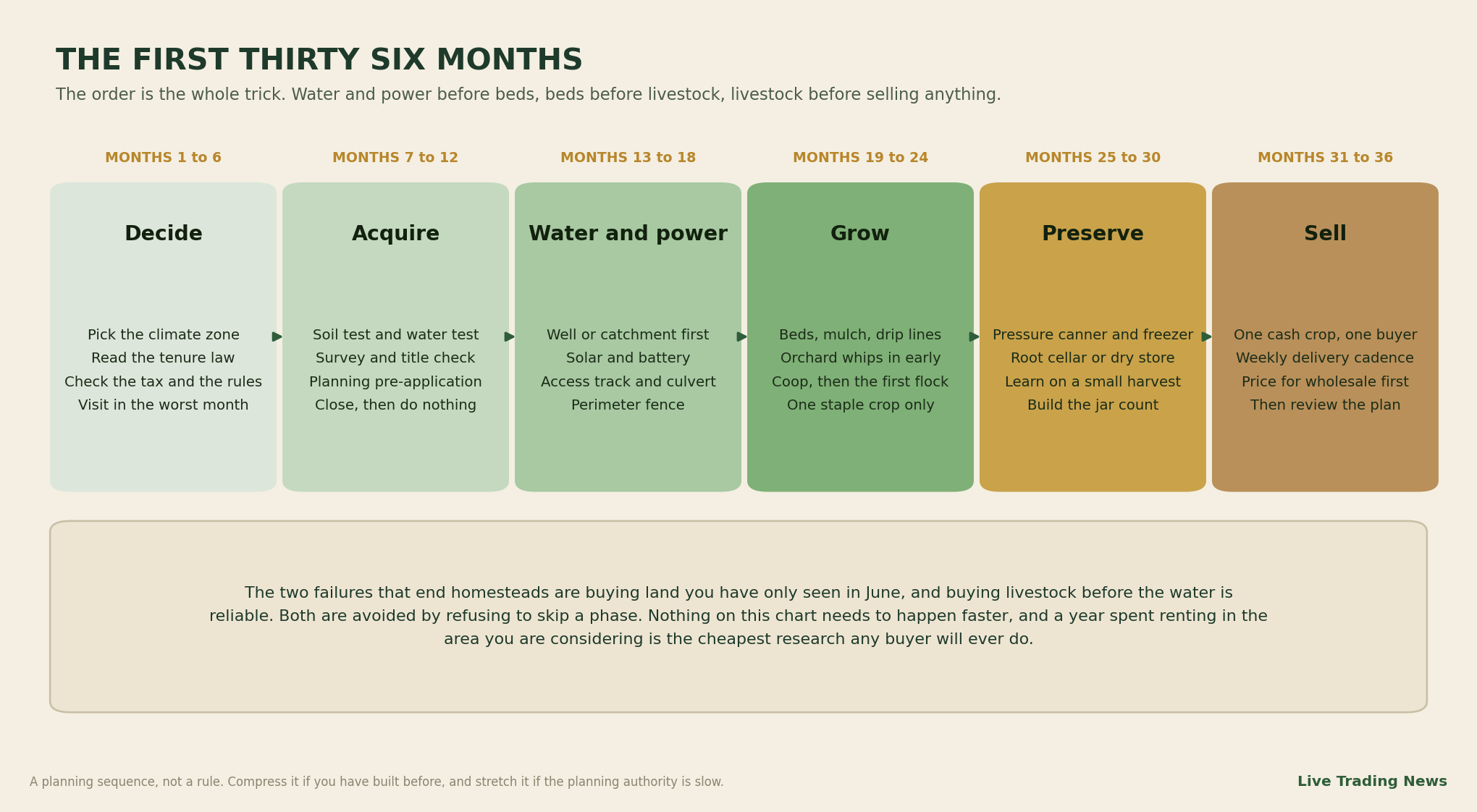
Water and power before beds, beds before livestock, livestock before selling anything. Nothing on this chart needs to happen faster.
Months one to six: decide, and visit in the worst month
Pick the climate zone before the country and the country before the parcel. Read the tenure law that applies to you personally, and confirm your own eligibility to own agricultural land in the jurisdiction rather than reading a generic guide. Check the effective property tax rate for the specific county or commune, and the planning rules for a dwelling on agricultural land, which is where British and European plans most often collapse.
Then visit in the worst month of the year. February in the Ozarks and August in Chiang Mai tell you far more than a beautiful week in May. Anyone who buys land they have only seen in good weather is buying an assumption.
Months seven to twelve: acquire slowly
Before an offer, commission a soil test and a water test, confirm legal access, get a boundary survey, and where relevant hold a planning pre-application discussion with the local authority. In Wales that conversation is close to mandatory in practice, because the OPD route is evidence driven and a management plan drafted after refusal is worth far less than one drafted before submission.
After you close, do nothing structural for a season. Watch where water sits after rain, where frost lingers in the morning, where the wind comes from, and where the sun actually lands in December rather than June. That single season of observation saves more money than any other decision in this guide, because it prevents a barn in the wrong place and beds in the wet corner.
Months thirteen to eighteen: water and power first
Well or catchment, then solar and storage, then the access track, then the perimeter fence. This order is not arbitrary. Every later system depends on water, every tool depends on power, and every delivery depends on a track that survives rain. Livestock and beds installed before reliable water become a daily hauling job that eventually ends the project.
Months nineteen to twenty four: grow one thing well
Beds, mulch and drip lines go in, orchard whips go in as early as possible because trees are the longest lead item on the whole holding, and the coop is built before the birds arrive rather than around them. Plant one staple crop properly rather than six badly. The purpose of year two is to learn your own soil, your own frost dates and your own pest pressure, none of which are in any book.
Months twenty five to thirty: learn preservation on a small harvest
Buy the pressure canner, the chest freezer and the shelving, and learn the process on a modest harvest where mistakes are cheap. Get the dial gauge tested. Build the jar count deliberately, tracking what the household actually eats rather than what looks impressive on a shelf. A pantry is inventory management, and inventory that nobody consumes is waste with a lid on it.
Months thirty one to thirty six: sell one crop to one buyer
Start the cash layer only once production is reliable, because a missed delivery costs a customer permanently. One crop, one buyer, one weekly delivery, priced for wholesale rather than for a fantasy retail margin. Then review the whole plan against what actually happened, and adjust before scaling.
The free expertise almost nobody claims
In the United States, the Cooperative Extension Service exists precisely for this and costs nothing. County offices provide soil testing, pest identification, pressure canner gauge testing, small flock guidance and enterprise budgets built by agricultural economists. The USDA Natural Resources Conservation Service provides free one-to-one technical assistance and conservation planning, and its Environmental Quality Incentives Program offers cost-share funding for practices including water infrastructure, fencing and soil work, with no minimum acreage requirement to apply. Both run through your local USDA service center, and the USDA conservation portal lists what is available. A retiree with ten acres is an eligible applicant, not an intruder.
Equivalents exist elsewhere. The UK has agricultural colleges, the Farming Community Network and local authority pre-application planning services. Most EU states run agricultural advisory services attached to their rural development programmes. In Thailand and the Philippines, provincial agricultural offices and local growers' groups hold the district specific knowledge that no imported textbook contains.
A short pre-purchase checklist
Confirm, in writing, that you personally may own or lease the land in question. Confirm a legal, recorded right of access. Confirm a water right or a permit to drill, plus neighbouring well yields. Confirm what may be built and what may not, in the specific planning jurisdiction. Confirm the effective annual property tax or land fee. Confirm flood, wildfire and, in the tropics, typhoon exposure. Confirm distance to a hospital, in winter driving time rather than in miles. Confirm broadband or satellite service, because remote medical appointments and selling produce both now depend on it.
Any one of those coming back wrong is a reason to walk away from a parcel. All of them coming back right is the definition of a good site, and a good site with mediocre soil beats poor site with excellent soil every time, because soil can be built and access cannot.
Frequently asked questions
How much land do you need to be self-sufficient in retirement?
Five to ten acres is the working answer for a temperate climate, and considerably less for an intensive tropical system. Most of the calories come from well under an acre. The rest is pasture, woodlot, orchard and buffer.
What does a retirement homestead cost to set up?
Land is often the cheapest component. At USDA 2026 pasture values, ten acres in the Ozarks runs $28,500 to $35,000. Water, power, access, fencing and outbuildings typically total several times the land cost, and the dwelling sits on top of that. A worked example totalling around $136,000 excluding the house is illustrated above, and it is a shape rather than a quote.
Where is the cheapest place to buy homestead land?
On official 2024 Eurostat figures, Latvia is the cheapest arable land in the European Union at €4,825 per hectare, with Lithuania, Slovakia, Hungary, France, Bulgaria and Romania all below the €15,224 EU average. In the United States, USDA pasture values put Missouri and Arkansas among the lowest cost regions with a genuinely workable climate.
Can an American or British buyer purchase farmland in Romania or Bulgaria?
Generally not, at least not directly. Bulgaria prohibits agricultural land ownership by non-EU nationals, and Romania allows it only on a treaty based reciprocity that does not exist with the main non-EU countries. EU citizens face no such barrier. Anyone considering a corporate structure to work around this needs independent local counsel before, not after, committing funds.
Can a foreigner buy land in Thailand for a homestead?
No. Thailand's Land Code prohibits foreign freehold ownership of land. The legal alternatives are a registered lease of up to thirty years, a usufruct, superficies over buildings, or a properly structured Thai company. Pre-agreed renewal clauses that attempt to extend a lease beyond thirty years have been ruled void and unenforceable by the Supreme Court, so a homestead there should be modelled as a thirty year right of use.
What income do you need for a retirement visa?
It varies widely and it is a real budget line. Portugal's D7 route tracks the national minimum wage at €920 a month in 2026, with uplifts for a spouse and children plus a matching bank balance. Thailand's standard retirement route requires 800,000 baht in a Thai bank, or 65,000 baht monthly income, or a combination, maintained and reverified annually. Treat those balances as locked compliance capital rather than working capital.
How much income does a homestead need to generate?
Plan for $5,000 to $15,000 a year in liquid cash. That covers property taxes or their equivalent, internet, fuel, feed supplements, insurance, medical cover and the maintenance failures that arrive without warning. Microgreens, mushrooms, garlic and herbs are the highest margin routes to it.
Are microgreens actually profitable?
They can be, and the numbers are published rather than anecdotal. The University of Missouri Extension budget models 8 to 15 ounces per 1020 tray across 27 to 46 crop cycles a year, with gross income per harvested tray in its examples running from about $32 to $60 depending on the crop. Costs for seed, medium, power and labour come off that, so run the extension spreadsheet against your own power price before investing in shelving.
How many chickens do you need for a household?
Extension guidance puts a hen at 20 dozen eggs or more over a thirteen month laying period, consuming 90 to 100 pounds of feed. Six to eight hens comfortably covers a two person household with a surplus to give away, and a dozen or more makes sense only if you intend to sell eggs or keep a self-replacing flock with a rooster.
Is home canned food safe?
It is, when the method matches the food. High acid foods can be water bath canned. Low acid foods, which includes every vegetable, all meat and all stock, must be pressure canned at 240 to 250 degrees Fahrenheit, because botulinum spores survive boiling water. Follow a current tested schedule for your altitude, add acid to tomatoes where the recipe calls for it, and have dial gauges tested each year.
How much venison does a deer actually yield?
About 48 per cent of field-dressed weight as boneless meat, on a study of 115 white-tailed deer by the Ohio Department of Natural Resources. That averaged 52 pounds of venison per deer, roughly 62 pounds from a buck and 45 from an antlerless deer.
Does homesteading actually hedge inflation?
Partially, and it is worth being precise about which part. It hedges the food and energy components of a household budget with real assets and stored production. It does not hedge healthcare, insurance or tax, which is exactly why the cash crop layer exists. Investors approaching the same theme through markets tend to look at gold and agricultural exposure such as $DBA or $CORN. A homestead is the physical version of the same trade, with better food and worse liquidity.
What is the most common reason homesteads fail?
Sequencing, followed by isolation. People buy in the wrong season, build before observing the land, and take on livestock before water is reliable. The second failure is social rather than technical, and it is why proximity to a functioning rural community, a market and a hospital belongs in the site criteria alongside soil and rainfall.
The bottom line
Retiring to a homestead is not an escape from reality. It is a move into a more fundamental one, where the metrics are soil health, jar counts and freezer inventory rather than a quarterly statement.
The financial case holds up under scrutiny, provided the arithmetic is done honestly. Choose a location with a low carrying cost and a tenure structure you are actually permitted to hold, whether that is the Ozarks at $3,500 an acre, a Welsh One Planet site, EU farmland at a third of the bloc average if you hold the passport for it, or a clear eyed thirty year position in northern Thailand. Keep infrastructure spending disciplined and sequenced. Cover the cash costs with high margin crops rather than by drawing down capital, because capital drawn down on a homestead does not come back.
Then plant the calories, keep a resilient flock, and learn to preserve properly. What you build is a food security net that no currency can be printed to replace, and an asset that produces a yield you can eat.
It also demands resilience. A late frost will take the tomatoes, a predator will take a hen, the well pump will fail on a Sunday and the monsoon will find every flaw in your drainage. In exchange, the homesteading retirement offers something the modern economy has stopped supplying: agency. You are the producer, the provider and the steward, and the food on the table was grown in dirt you touched.
How to check every number in this article
Sourcing is the difference between a guide and a brochure, and readers making six figure decisions are entitled to see the working. Every figure above comes from a source you can open, and the notes below explain what each source is, what it does and does not cover, and how often it changes. Where the data has a known weakness, it is stated rather than hidden.
Land values, United States. USDA National Agricultural Statistics Service, Land Values 2026 Summary, published July 2026. This is a survey of farm real estate, cropland and pasture values by state and region, and it is the authoritative US series. The figures used here are pasture rather than cropland, because pasture is the closer analogue for homestead land. Two cautions. State averages hide enormous county level variation, and small unimproved parcels frequently transact above agricultural value because they compete with residential and recreational buyers. Updated annually, usually in July or August.
Land values, European Union. Eurostat dataset apri_lprc, agricultural land prices by region, with the summary release EU agricultural land price increased by 6.1 per cent in 2024. Figures here are arable land in euro per hectare for 2024, the most recent complete year. National definitions differ slightly, France in particular is flagged in the dataset, and not every member state reports every year. Updated annually.
Land values, United Kingdom. Savills, Spotlight: The Farmland Market. Commercial agency research rather than official statistics, which means it reflects transacted and marketed values with a professional methodology but no statutory basis. Other agencies publish comparable indices that differ by a few per cent. Updated through the year.
Property taxes, United States. Tax Foundation, property taxes by state and county. Derived from American Community Survey housing and tax data, expressed as effective rates on owner-occupied housing. This is a ratio of aggregates and a good comparative snapshot, not a millage rate you can apply to a specific parcel. Always confirm the actual assessment with the county assessor.
Planning policy, Wales. Technical Advice Note 6 and the One Planet Development practice guidance, both from the Welsh Government. These are the primary policy documents, not summaries of them, and anyone pursuing this route should read the practice guidance in full rather than any secondary description of it, including this one.
Land tenure, Thailand. Formichella and Sritawat, analysis of the Supreme Court ruling on long term leases. Attributed legal analysis from a practising firm rather than a primary court record, used because Thai judgments are not readily available in English. The underlying statute is the Thai Land Code. Anyone acting on this should take their own Thai legal advice, because this area is actively litigated and a reform proposal remains outstanding.
Food preservation. National Center for Home Food Preservation, ensuring safe canned foods, which maintains the USDA Complete Guide to Home Canning. This is the reference standard for the English speaking world and it is free. Use the current edition rather than an older printed copy, because tested schedules have been revised over time and older family recipes frequently predate the current safety guidance.
Crop economics. University of Missouri Extension, Microgreens Planning Budget, publication G693, which comes with a downloadable enterprise budget spreadsheet. Extension enterprise budgets are the single most underused resource in small scale agriculture. They are built by agricultural economists, they show every assumption, and they are designed to be edited with your own costs rather than read as a verdict. Ask your own county extension office whether an equivalent budget exists for the crop you have in mind, because many do and almost none of them are advertised.
Flock economics. University of New Hampshire Extension, producing your own eggs. Small flock guidance including production and feed consumption over a laying period.
Game yield. Ohio Department of Natural Resources, venison meat yield. A state wildlife agency study of 115 field-dressed deer, which is why it is quoted here in preference to the widely circulated rules of thumb.
Climate zones. USDA Plant Hardiness Zone Map, 2023 edition, built on 1991 to 2020 climate normals. Check the specific parcel rather than the region.
Technical and financial assistance. USDA service center locator and the USDA conservation portal, which are the front doors to the Natural Resources Conservation Service and the Environmental Quality Incentives Program. Walking into the county office in person remains more productive than any website, and the appointment is free.
Currency conversions. European Central Bank reference rates of 10 August 2026, at 1.1555 dollars to the euro and 1.3504 dollars to the pound, used for the land cost chart so that US, European and British figures sit on one scale.
Land values, planning rules, tax rates, visa thresholds and land tenure law all change, and several of the figures above will be superseded within a year of publication. Verify the current position with qualified professionals in the target jurisdiction before committing capital. This article is general information and not legal, tax or investment advice.
About the author
Shayne Heffernan, Ph.D. is the founder of Live Trading News, the KnightsBridge Group and KXCO.ai. He writes on markets, macro and the practical systems that sit underneath them, from payment infrastructure to food production. The through line is the same in both: understand the mechanism, price the risk honestly, and build something that keeps working when the assumptions break.
If you are running the numbers on a homestead of your own, start with the two that decide everything. What does an acre cost where you are going, and what will it cost you to hold every year after that. Answer those two honestly, confirm you are legally permitted to hold the land, and everything else on this page becomes a design problem rather than a gamble.

KXCO is Enhanced Intelligence, Not Artificial
I never wanted artificial intelligence. I wanted enhanced intelligence, and they are not the same product. Artificial means the machine does the thinking and hands you the answer. Enhanced means I do the thinking, with more of my own mind in the room than I have ever had at one time. Forty years of reading, recallable in the second I need it. Patterns across law, credit, physics and markets that no specialist sees, because the useful ones sit between the fields rather than inside them.

The AI Safety Argument Is Being Held in the Wrong Room
The people who will be blamed for what AI does are not in the room where its safety is argued. A jailbreak escapes a policy. The failure that costs money is an action that escapes an owner, a payment sent or a record altered. Tokens are not authority. Intelligence got cheap and judgment did not, and there is no organ of standing you can copy into a model. Shayne Heffernan on the objection worth taking seriously, and the questions to take into a vendor meeting.

NIST Graded Our Post-Quantum Cryptography. Zero Failures.
NIST's Algorithm Validation Test System generated test vectors nobody had seen, we answered them over the ACVP protocol, and NIST graded the result: 2,130 cases across ML-KEM, ML-DSA and SLH-DSA in every parameter set offered, zero failures, demo certificate A11025. This is what that proves, where we deliberately drew the claim narrower than NIST's own matrix, and why the FIPS 140-2 sunset on 21 September makes the distinction between being graded and grading yourself worth understanding.

The Problem Is Not the Problem
People treat the Jack Sparrow line as a joke. The attribution is a joke. The sentence is not. Forty years in markets says the same thing Epictetus said in 125 CE and Robert Merton named in 1948: the event is finite, and the story you appoint to govern it is not. This essay walks the quote back to its actual sources, draws the loop that turns a feeling into an order, and sets out the four places a rule written in advance cuts the loop. Faith is not a hedge. It is a stance.
Every story, signed and delivered.
Subscribe to the kxco channel and get the headline, the AI-written key takeaways, and the chain-anchor link the moment we publish. Audio versions and per-ticker subscriptions arrive in the next iteration.