
How to Protect Your Portfolio Against Global De-Dollarization
By Shayne Heffernan, May 6, 2025
Global de-dollarization is accelerating, and it’s a trend investors can’t ignore. The U.S. dollar’s status as the world’s reserve currency is under pressure, with Asian currencies surging and Middle Eastern economies diversifying, as Reuters reported today. China’s yuan hit a midpoint rate of 7.3043, its weakest since February, yet Beijing holds it above 7.2 despite U.S. tariffs of 104% on Chinese goods, per Bloomberg. The U.S. trade deficit reached $1.3 trillion in March, and Trump’s tariffs are driving trade partners away, fueling recession fears, according to Investing.com. As the owner of Knightsbridge, I’ve seen this shift coming, and we’ve positioned ourselves to help investors navigate this new financial landscape. Here’s how you can protect your portfolio against de-dollarization, with a focus on gold, Bitcoin, rural real estate, and investments in Asia and the Middle East.
The De-Dollarization Threat
De-dollarization is the global move to reduce reliance on the U.S. dollar for trade and reserves. Asia’s economic indicators show resilience—regional growth is projected at 4.9% in 2025 by the Asian Development Bank, with China targeting 5% growth despite tariffs, per Reuters. In the Middle East, the IMF forecasts MENA growth at 2.6% in 2025, with the GCC’s non-energy sector expanding by 4.4%, per ICAEW. Meanwhile, Iran’s currency has crashed to 920,000 rials per dollar, prompting a push for non-dollar trade, as noted by the Wilson Center. Russia and China are leading the charge, using yuan and gold, while the Middle East explores alternatives to the petrodollar, per the Atlantic Council. The dollar’s decline—evidenced by investors shifting to gold, the yen, and the Swiss franc—threatens portfolios tied to dollar-based assets.
Diversify with Gold
Gold is a proven hedge against currency devaluation. As the dollar weakens, gold prices have spiked, with spot gold hitting $3,250 per ounce in April 2025, up 28% year-over-year, per Bloomberg. Gold’s value rises when fiat currencies falter, making it a safe haven during de-dollarization. Central banks in China and India increased gold reserves by 405 metric tons in 2024, signaling a global trend, according to the World Gold Council. Allocating 10-15% of your portfolio to physical gold or gold ETFs, such as the SPDR Gold Shares (GLD), can provide stability.
Invest in Bitcoin
Bitcoin offers a decentralized alternative to the dollar, immune to government control or sanctions. Its price has surged to $81,000 in May 2025, up 90% from last year, driven by institutional adoption and de-dollarization fears, per CoinMarketCap. Bitcoin’s capped supply of 21 million coins makes it a hedge against inflation, unlike the dollar, which faces pressure from U.S. debt levels—now at $35 trillion, per the U.S. Treasury. Adding 5-10% of your portfolio in Bitcoin, through platforms like Coinbase or Binance, can diversify risk, though its volatility requires careful position sizing.
Buy Rural Real Estate
Rural real estate in stable economies offers tangible value that isn’t tied to the dollar. Land in regions like the U.S. Midwest or rural Australia has appreciated steadily, with U.S. farmland values up 7% in 2024 to $4,170 per acre, per USDA data. These assets provide income through leasing to farmers and act as an inflation hedge. Rural properties are less exposed to urban economic downturns, making them a solid choice during de-dollarization. Aim for 15-20% of your portfolio in rural real estate, focusing on areas with strong agricultural demand.
Look to Asia and the Middle East
Investments in Asia and the Middle East are attractive as these regions lead de-dollarization efforts. Asia’s growth is robust—South Asia is projected at 6.0% in 2025, led by India at 6.2%, per the IMF. The Middle East’s MENA region is expected to grow at 2.6% in 2025, with Saudi Arabia at 3.0%, despite a 3% GDP budget deficit, per ICAEW. Equity markets in these regions offer value: the Shanghai Composite Index yields a 3.2% dividend, while Saudi Arabia’s Tadawul Index has risen 12% in 2025, per Bloomberg. Real estate in Dubai and Singapore is also strong, with Dubai residential prices up 20% in 2024, per Knight Frank. Allocate 20-30% of your portfolio to stocks, ETFs (like the iShares MSCI Emerging Markets ETF), or real estate in these markets.
Knightsbridge’s Strategic Position
Knightsbridge, my company, is well positioned for de-dollarization in terms of markets and products. We’ve focused on Asia and the Middle East, regions driving economic growth and currency diversification. Our platform, KXCO.io, enables non-dollar transactions, allowing businesses to trade in local currencies or digital assets, bypassing U.S. sanctions risks. This aligns with moves by Russia, China, and Middle Eastern countries to use yuan and gold, as the Atlantic Council reports. Knightsbridge’s products, including tokenized assets and cross-border payment solutions, help investors diversify away from dollar-based holdings, offering stability in a shifting financial landscape.
Conclusion
De-dollarization is a real threat to dollar-heavy portfolios, but gold, Bitcoin, rural real estate, and investments in Asia and the Middle East provide solid protection. Knightsbridge’s focus on these regions and our non-dollar transaction tools make us a key partner for investors navigating this change. Start reallocating your portfolio today to safeguard your wealth in a post-dollar world.
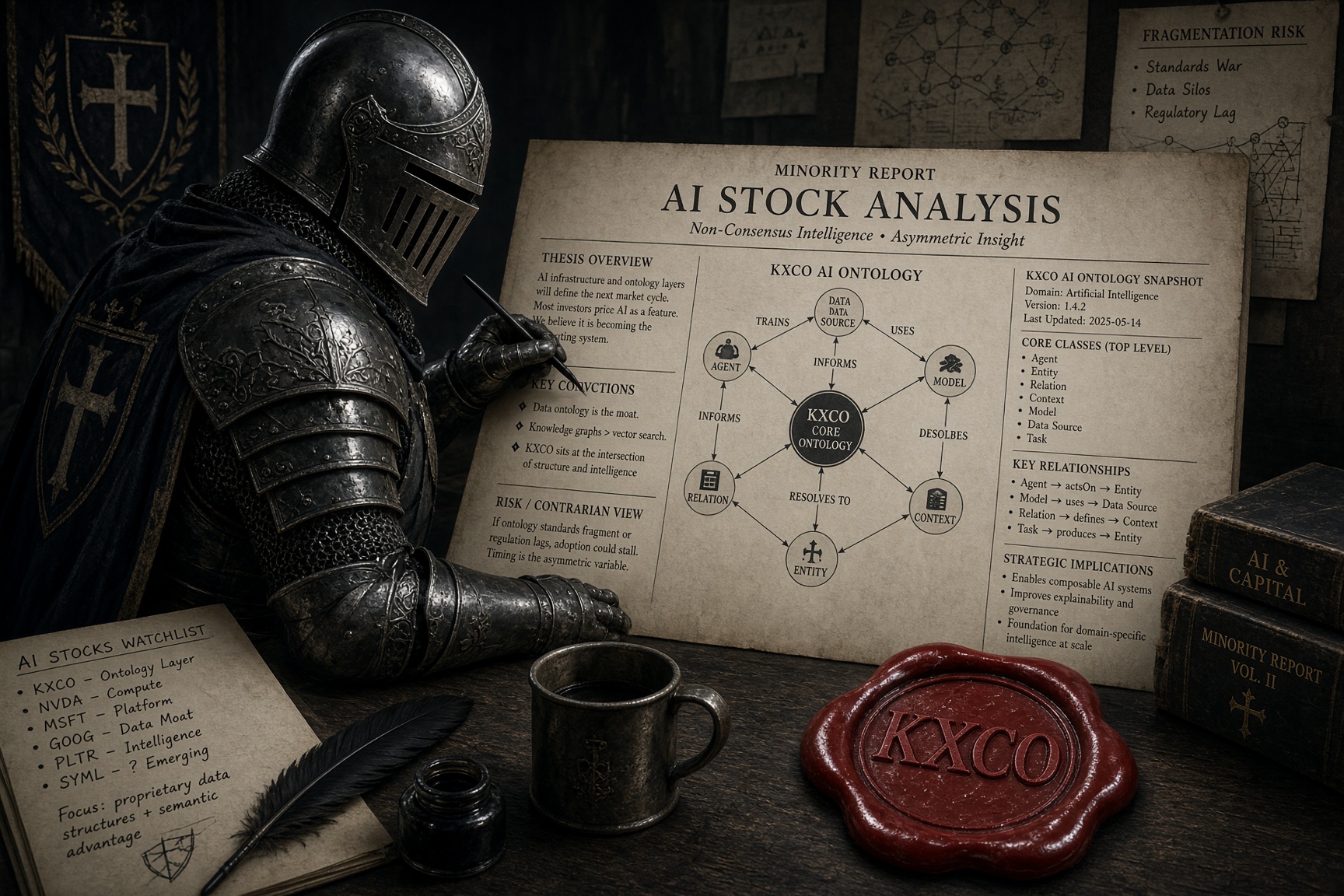
KXCO AI Ontology at 3 Months: What It Called and What Comes Next
On 19 July 2026 the Round Table's AI room published its first Analyst Outlook. To the 16 October 2026 close its 13 names rose 2.6% on an equal weight against 2.1% for QQQ, per StockAnalysis closes, and the six it opened with 35% or more of upside rose 8.6%. This piece lists the six names up more than 5%, the ten names I rate as opportunities now, the month's results in AI and quantum computing, and the official data showing that four in five firms have not yet started using AI.
SpaceX: The Road to 10 Gigawatts
SpaceX did not add an AI business. A company whose processes run on compute built its own computing plant, then built the power to run it. The 10-Q reports 1.4 gigawatts of nameplate compute at 30 June 2026, four leases worth about $41 billion a year and $100 billion of cash. The target is closer to 10 gigawatts than 5 by the end of 2027. This piece sets out the build sequence, the four layers of power in Memphis, and why Terafab is the act after 2027, not the road to it.

Thoughts on Thinking: Take an Art Break
The best way I know to keep complex work in perspective is to stop at intervals and look at something that took the same order of sustained attention under real constraints. The studies now show what that does: a museum visit restored attention where an urban walk did not, judging the beauty of an object raised abstract thinking almost 14 per cent, and artistic film raised originality even in people who felt worse for it. Five works, Leonardo to Holbein, and the non-default decision in each.

The Evil Legacy of the French Revolution
The French Revolution is still sold as the birthday of the modern world. The ledger does not match the posters. It seized the Church's land and floated its paper money on the seizure, hunted the priests who would not swear, defined the nobility as a moral enemy, and put in their place a political class accountable chiefly to itself. Four knowledge-graph exhibits trace who put the king and queen on the scaffold, and how the template left France.
Every story, signed and delivered.
Subscribe to the kxco channel and get the headline, the AI-written key takeaways, and the chain-anchor link the moment we publish. Audio versions and per-ticker subscriptions arrive in the next iteration.