
Ethical Considerations in AI: Navigating Bias and Fairness
Artificial Intelligence (AI) has become an integral part of modern life, influencing decisions from finance and healthcare to entertainment and education. However, as AI technologies continue to advance, the issue of bias and fairness in AI systems has come to the forefront. Ensuring that AI systems are unbiased and fair is not only a technical challenge but also an ethical one.
Let's explore the ethical considerations surrounding biases and fairness in AI and discuss strategies for navigating these complex issues.
The Challenge of Bias in AI: AI systems are designed to learn from vast amounts of data, and if this data contains biases, the AI systems can inadvertently perpetuate those biases. For example, biased training data can lead to AI systems that discriminate against certain demographic groups or perpetuate societal inequalities. It is crucial to recognize that AI itself is not inherently biased; rather, it learns from the biases present in the data it's trained on.
Identifying and Mitigating Bias: To address bias in AI, it's important to identify potential sources of bias in the data and the algorithms. This involves scrutinizing the training data for underrepresented groups, understanding the context of the data, and examining the algorithmic decision-making process. Developers and data scientists can employ techniques such as data augmentation, re-sampling, and algorithmic adjustments to reduce bias and promote fairness.
Fairness in AI Algorithms: Ensuring fairness in AI algorithms involves designing systems that do not discriminate against any particular group. Different notions of fairness (e.g., demographic parity, equal opportunity) can be used as guidelines for developing algorithms that treat all individuals fairly. However, achieving perfect fairness can be challenging, as there are trade-offs between different fairness criteria.
Transparent and Explainable AI: Transparency is a fundamental aspect of ethical AI. Users and stakeholders should be able to understand how AI systems arrive at their decisions. Implementing explainable AI techniques can shed light on the reasoning behind AI decisions, making it easier to identify bias and assess fairness.
Diverse and Inclusive Development Teams: To tackle bias effectively, AI development teams should be diverse and inclusive, representing various backgrounds, perspectives, and experiences. Diverse teams are more likely to identify potential sources of bias and develop solutions that cater to a wider range of users.
Continuous Monitoring and Evaluation: AI systems should be continually monitored and evaluated for bias and fairness, both during development and after deployment. Regular audits and assessments can help identify emerging bias trends and rectify them promptly.
Accountability and Regulation: Ethical considerations in AI go beyond technical aspects. Governments, organizations, and researchers must work together to establish regulations and guidelines that govern AI development, deployment, and usage. These regulations should prioritize transparency, fairness, and accountability.
Mainly the ethical considerations in AI are very essential to ensure that technology benefits all of the society without perpetuating discrimination or bias. As AI continues to transform industries, it is our responsibility to address bias and fairness issues head-on.
By implementing strategies to identify, mitigate, and monitor bias, we can create AI systems that uphold the principles of fairness, transparency, and social responsibility.
The future of AI rests not only on technological advancements but on our commitment to ethical considerations that uphold the values of equality and inclusivity.

Don't Be the Best, Be the Only: Winning in an AI World
AI is repricing competence downward. What it cannot reproduce is a life. The case for remaining non-fungible, why friction still produces the best ideas, and what it means to build AI systems that keep the human intellect in them.
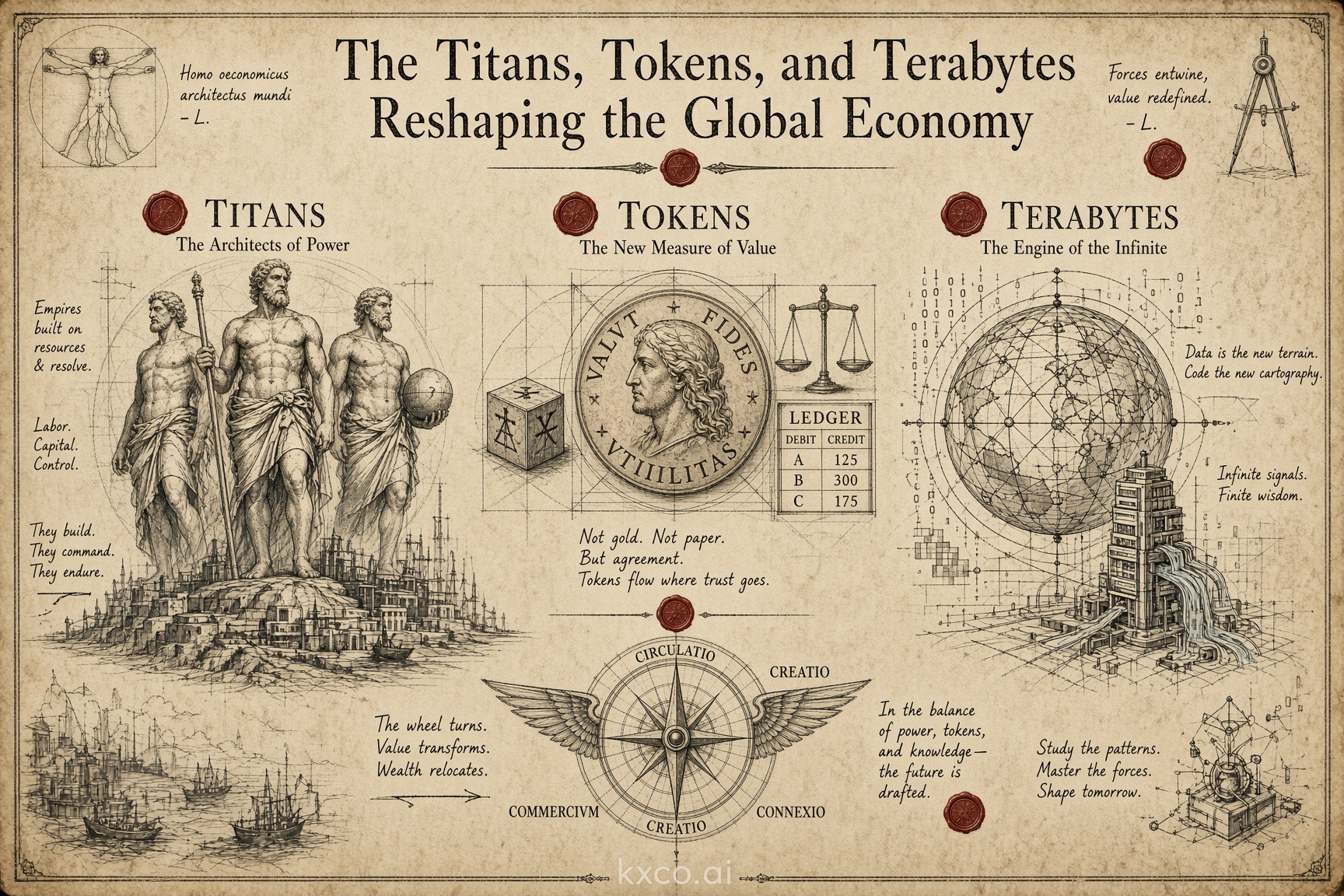
The Titans, Tokens, and Terabytes Reshaping the Global Economy
The AI arms race has moved from what the technology can do to who controls the compute, the data and the distribution. Anthropic now has five direct competitors on one cap table at a $965bn post-money. Meta is commoditising the model layer it does not sell. Nvidia carries 52 dependencies in the KXCO ontology and the sector resolves to nine critical nodes. Here is the state of the AI economy, checked line by line against our live map, and the five value gaps that map is pointing at.

Will $SPCX Buy $TSLA at $420?
The $420 tweet was treated as a joke. But Musk keeps coming back to the number — and with SpaceX now trading as $SPCX, the strategic case for it acquiring Tesla at $420 has never been stronger. Shayne Heffernan on manufacturing, AI, robotics, and the convergence the KXCO Ontology already maps.

Understanding the US China AI and Quantum Landscape
AI and quantum are usually reported as a US–China race. The more useful story is two different systems — frontier capital versus open-source scale — entangled through shared chokepoints. Shayne Heffernan maps the landscape with the KXCO AI Sector Ontology, with comparison graphics and the investable names.
Every story, signed and delivered.
Subscribe to the kxco channel and get the headline, the AI-written key takeaways, and the chain-anchor link the moment we publish. Audio versions and per-ticker subscriptions arrive in the next iteration.