
Ernest Hemingway: Catholicism and Western Cultural Decline
Though frequently tinged with existential sorrow and disillusionment, Ernest Hemingway's writings can certainly be understood as a mirror of the social collapse that has grown more obvious in contemporary times. His observations of the post-World War I era, when Western conventional norms looked to be disintegrating, provide a prophetic look at the cultural degradation we are now witnessing.
Hemingway presents in "The Sun Also Rises" (1926) a generation lost and aimless who turns to hedonistic activities to cover the gap left by a society bereft of moral compass much like todays society. This sense of aimlessness and the collapse of conventional norms reflect the social deterioration now clearly visible in many spheres of modern Western life. Hemingway's investigation of moral uncertainty, disillusionment, and the futility of war can be taken as a warning against the long-term effects of forsaking fundamental cultural and moral values.
It is my view that a return to Catholicism is the only thing that can offset Hemingway's so eloquent description of this degeneration.
I further contend that Catholic Church provides a moral and ethical framework that can help people and civilizations return to a road of justice and stability, therefore offering a solution to the problems of the world. Adopting Catholic values will help to restore the moral clarity and sense of purpose that Hemingway's characters and so, modern society seem to lack.
Hemingway's writing thus serves as a warning for the present as much as a mirror of the past. It forces us to examine the moral and cultural direction of our society and implies that, as is offered via Catholicism, a return to enduring principles could be the solution to prevent the devastation Hemingway's characters appear destined for.
Shayne Heffernan
AI is the Neat Handwriting of the Illiterate
A model in the hands of someone who has read the filing and walked the plant is a clerk. The same model, speaking for someone who has done neither, is a disguise. On AI slop, phantom citations and factslop, why finish stopped being evidence of work, and the containment layer KXCO built so a machine cannot speak as the institution until a source is attached.
Worthship: Do Not Conform to the Age
Worthship is the older English word for worship, and it means to ascribe worth. Bishop Robert Barron preached Romans 12 on 30 August. This essay follows the text into the prison letters, and puts two questions to a graph: do the four readings of that Sunday agree, and was Paul free or in chains when he wrote about despair?
The Truth in All Its Ugliness Must Survive
A majority vote does not determine the truth. Consensus is a mood, gossip is a sport, and a model will write the pretty version for free. Why the ugly number has to survive, why a record beats a dashboard, and what KXCO was built to keep standing when the room changes its mind.
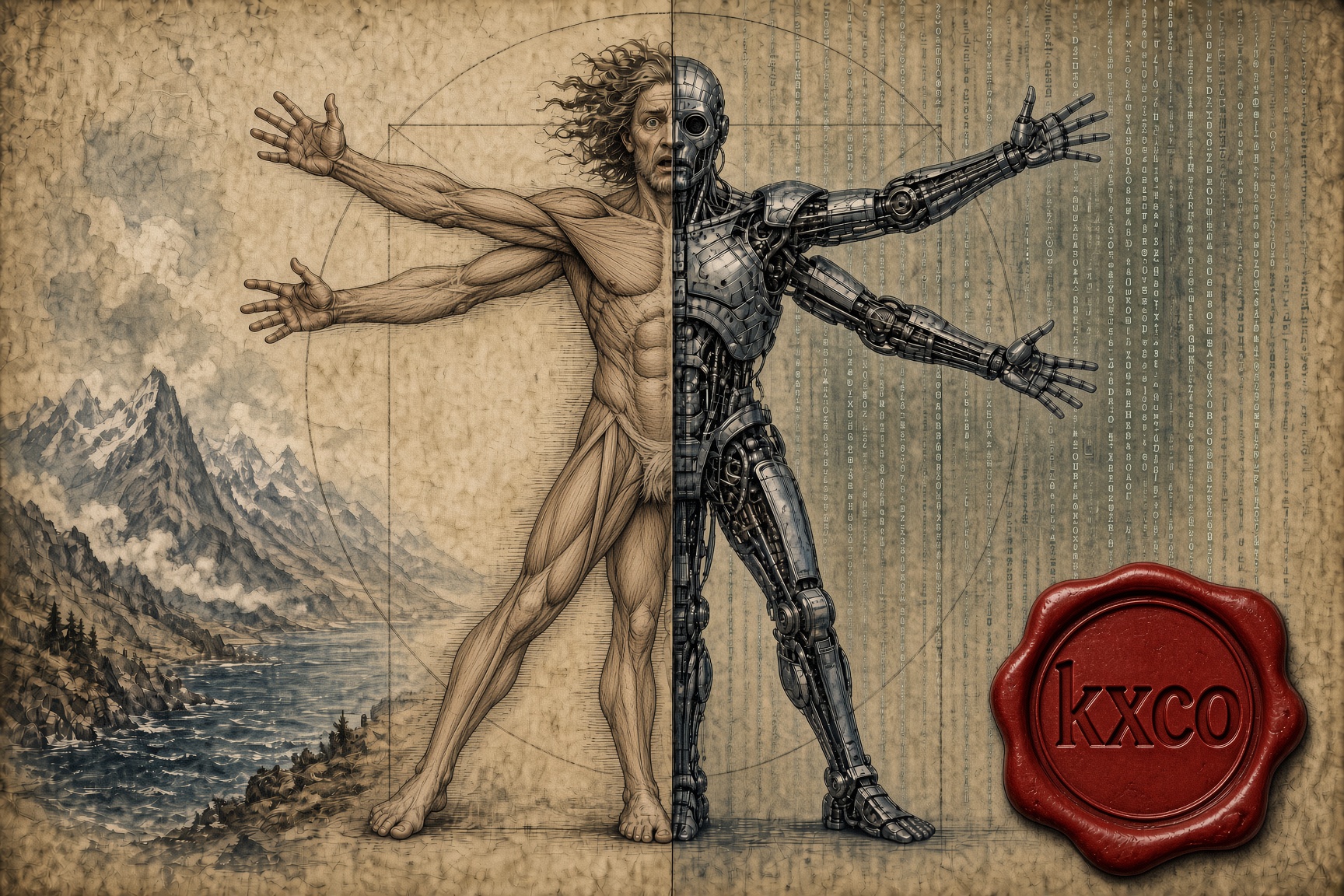
Don't Be the Best, Be the Only: Winning in an AI World
AI is repricing competence downward. What it cannot reproduce is a life. The case for remaining non-fungible, why friction still produces the best ideas, and what it means to build AI systems that keep the human intellect in them.
Every story, signed and delivered.
Subscribe to the kxco channel and get the headline, the AI-written key takeaways, and the chain-anchor link the moment we publish. Audio versions and per-ticker subscriptions arrive in the next iteration.