
Developed Countries Vs Developing Countries
#crypto #cryptocurrencies #blockchain #DeFi #digital #assets #banks #security #privacy #industrialization #developed #developing #economy #countries
"Countries which are independent and prosperous are known as Developed Countries. Countries which are facing the beginning of industrialization are called Developing Countries. Developed Countries have a high per capita income and GDP as compared to Developing Countries"--Paul Ebeling
Human Development Index (HDI) statistics rank the countries on the basis of their development. The country which is having a high standard of living, high GDP, high child welfare, healthcare, excellent medical, transportation, communication and educational facilities, better housing and living conditions, industrial, infrastructural and technological advancement, higher per capita income, increase in life expectancy etc. are known as Developed Country. These countries generate more revenue from the industrial sector as compared to service sector as they are having a post-industrial economy.
The following are the names of some developed countries: Australia, Canada, France, Germany, Italy, Japan, Norway, Sweden, Switzerland, and United States.
The following are the names of some developing countries: Colombia, India, Kenya, Pakistan, Sri Lanka, Thailand, Turkey.
There is a big difference between Developed Countries and Developing Countries as the developed countries are self-contained flourished while the developing countries are emerging as a developed country. Developing Countries are the one which experience the phase of development for the 1st time. If we talk about developed countries, they are post-industrial economies and due to this reason, the maximum part of their revenue comes from the service sector.
Developed Countries have a high Human Development Index as compared to Developing Countries. The former has established itself in all fronts and made itself sovereign by its efforts while the latter is still struggling to achieve the same.
The benefit of crypto currencies in developing countries
With a track record going back over a decade, cryptocurrencies are clearly more than just a fad, but they remain widely misunderstood by many people, with doubts persisting about their genuine value, practical use and long-term application.
In the truest sense, cryptocurrencies are a digital means of exchange which use cryptography as a form of security. However, in recent times, the term ‘cryptocurrency’ has evolved as a stand-in description for, more broadly, a decentralized financial system (DeFi), a highly volatile asset class that can nose-dive or surge on the back of a Tweet, a space for bad actors to steal vulnerable investors’ identities and money, and a form of digital payment.
Mainstream investors, as well as financial institutions, are also taking more than a passing interest in cryptocurrencies.
Regulated digital currencies have benefits, say central bank chiefs
As long as the companies can be properly regulated, consumer-focused digital tokens issued by private companies could be better than central bank-issued tokens.
If these tokens are going to be used widely by the community they are going to need to be backed by the state, or regulated just as we regulate bank deposits.
Private solution is going to be better because the private sector is better than the central bank at innovating and designing features for these tokens, and there are also likely to be very significant costs for the central bank setting up a digital token system.
Around the world, many central banks are developing digital currencies, either retail tokens for use directly by consumers or wholesale tokens for use by banks.
This is a response to the development of stablecoins such as Tether and USDC, which are commonly used for payment and as a store of value.
Decentralized finance projects, part of the cryptocurrency ecosystem, could also be mitigated by greater scrutiny of such tokens.
More scrutiny of stablecoins could also help reduce risks from DeFi, which aims to replace financial intermediaries with computer code.
The adoption of cryptocurrencies in recent years has been particularly fast in the global south. From Ys 2019 to 2021, there was a 2,300% growth in cryptocurrency, with the Top 15 countries for adoption last year being low and middle-income developing countries.
The true benefit of blockchain technology comes through moving crypto assets without the middle man: bank. Hence for the public good.
Have a prosperous day, Keep the Faith!

Digital Erasure, and Why KXCO Matters
Pew found 38 percent of 2013's web pages gone a decade later, and quantum computing will eventually let attackers forge the signatures that prove records authentic. Why durable history now depends on post-quantum cryptography, on-chain anchoring and verification that needs nobody's permission.

Economic Calendar and Trading Strategies for the Week Ahead: July 20–24, 2026
A pivotal week for markets: Iran's closure of the Strait of Hormuz sends crude above $86 and gasoline over $5, while Alphabet, Tesla and Intel earnings test the AI trade. Full economic calendar plus trading strategies across oil, gold, Bitcoin, FX and AI chip stocks.
Economic Calendar and Trading Strategies for the Week Ahead: July 14–18, 2026
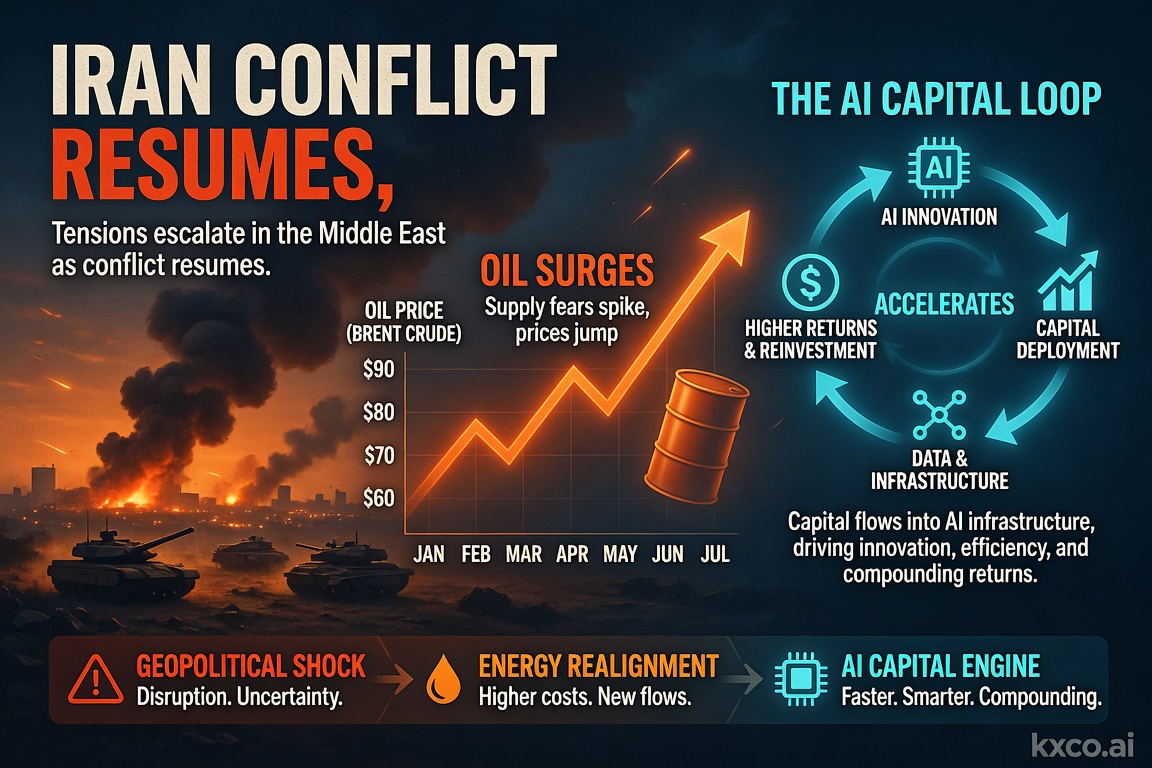
A pivotal week for markets: US strikes on Iran reignite the oil risk premium, June CPI and retail sales test the Fed's rate-cut path, and the $1 trillion AI capital loop keeps driving the tech trade. Full economic calendar plus trading strategies across oil, gold, Bitcoin, FX and AI stocks.

Quantum Computing Just Became an Institutional Risk
Shayne Heffernan on BlackRock's quantum-computing warning for Bitcoin and Ethereum, Google's cryptanalysis research, the two on-chain risk vectors, and how KXCO's Armature L1 — post-quantum from genesis, coordinated by its ontology — answers a threat that just went institutional.
Every story, signed and delivered.
Subscribe to the kxco channel and get the headline, the AI-written key takeaways, and the chain-anchor link the moment we publish. Audio versions and per-ticker subscriptions arrive in the next iteration.