
Crypto: Central Bank Digital Currency and stablecoins are proof that cryptocurrency is here to stay
#cryptocurrency #CBDC #stablecoins #government #private #knightsbridge #centralized #decentralized #blockchain
"Governments have made the process of crypto adoption for traditional banks a miserable experience, that is ending" --Paul Ebeling
The inception of Central Bank Digital Currency (CBDC) and stablecoins are proof that cryptocurrency is here to stay. While CBDCs are issued by the government, stablecoins are issued privately to facilitate a blockchain initiative.
While both CBDC and stablecoins are fundamentally used for the same purposes, the major difference between them is the issuing authority which is either centralized or decentralized.
For instance, CBDCs are government-issued and as such are regulated by a centralised authority. And stablecoins do not operate in the same manner; instead, they exist across a distributed, and decentralized blockchain network.
Unlike other crypto-assets such as Bitcoin (BTC), Ethereum (Ether) that are volatile, CBDCs and stablecoins are a much better alternative to fiat currencies. Specifically, CBDCs are as good as a nation’s fiat currency, only that they operate on-chain.
Stablecoins are wrapped currencies, meaning their value is tied to another cryptocurrency, fiat currency, or an exchange-traded commodity.
In this context, we are referring to stablecoins that are pegged to the value of fiat currencies. For instance, a unit of Tether (USDT), USD Coin (USDC), or Binance USD (BUSD), is worth approximately $1, implying that they would function typically as a digital USD would.
The Big Q: How does the digitalization of financial services especially in the area of currency distribution affect traditional banks and their existing policies?
The Big A: Some major banks have woken up to the reality that cryptocurrency is here to stay.. For instance, banks like JPMorgan, Goldman Sachs, and some others have either adopted cryptocurrency as a mode of payment or have gone ahead to create their own digital coin for payment.
But, most banks have yet to register their attendance in the crypto space and, in other situations, governments have made the process of crypto adoption for traditional banks a miserable experience.
The world is getting to the point where banks must open up to the emerging crypto industry otherwise they stand to face a lot of uncertainty in the ever-changing world of finance.
In its latest global regulatory outlook report, Ernst & Young recommended for banks to adjust their regulatory perimeter to accommodate the incoming launches of state-backed central bank digital currencies (CBDC) and private stablecoins.
According to the report, digitisation is transforming the global financial environment in significant ways, with one of the most vital areas being the provision and facilitation of digital currency.
However, not discarding concerns relating to consumer protection and money laundering, the report revealed that customers’ appetites in gaining exposure to digital assets might outperform the firm’s internal control environment. Consequently, the need for traditional banking firms to re-evaluate their regulatory parameters is now more essential than ever.
A Key concern raised is the fact that retail banks may forfeit a lot of customers should they decide to adopt CBDC which appears to be a safer option for those who have little or no risk appetite but are willing to go the digital route.
“If customers can keep their money with a central bank, they have no need for a retail bank, and firms will see their interest rate margins contract precipitously,” the report states.
The report also revealed to what extent the incoming evolution may impact traditional retail banking, stating: “The macroprudential or international implications of a major currency having a retail coin could be very significant for retail banks and the dollarization of smaller economies.”
The implication is that most central banks are likely to pursue a wholesale version, thereby leaving retail banks to cater for themselves.
“Even then, however, banks will need to think about the implications for their balance sheets and the possible interaction between central bank digital assets and private ones, such as stablecoins,” the report further noted.
So, the best bet for traditional banks, as recommended by EY, would then be to take proactive steps, especially in understanding the broad direction of the regulation.
And traditional banks must strive to take a seat with the central banking authority and look for how best to approach the emerging tokenomics.
Have a prosperous day, Keep the Faith!

Digital Erasure, and Why KXCO Matters
Pew found 38 percent of 2013's web pages gone a decade later, and quantum computing will eventually let attackers forge the signatures that prove records authentic. Why durable history now depends on post-quantum cryptography, on-chain anchoring and verification that needs nobody's permission.

What is Cathie Wood Buying?
ARK fully exited Twilio in 2024, so the old $44.7 million story is history. The capital is now flowing into SpaceX, wafer-scale AI silicon, GPU cloud and stablecoin rails. Here is what Cathie Wood is actually buying as of mid-August 2026, what she is trimming, and whether the math still holds.

Economic Calendar and Trading Strategies for the Week Ahead: July 20–24, 2026
A pivotal week for markets: Iran's closure of the Strait of Hormuz sends crude above $86 and gasoline over $5, while Alphabet, Tesla and Intel earnings test the AI trade. Full economic calendar plus trading strategies across oil, gold, Bitcoin, FX and AI chip stocks.
Economic Calendar and Trading Strategies for the Week Ahead: July 14–18, 2026
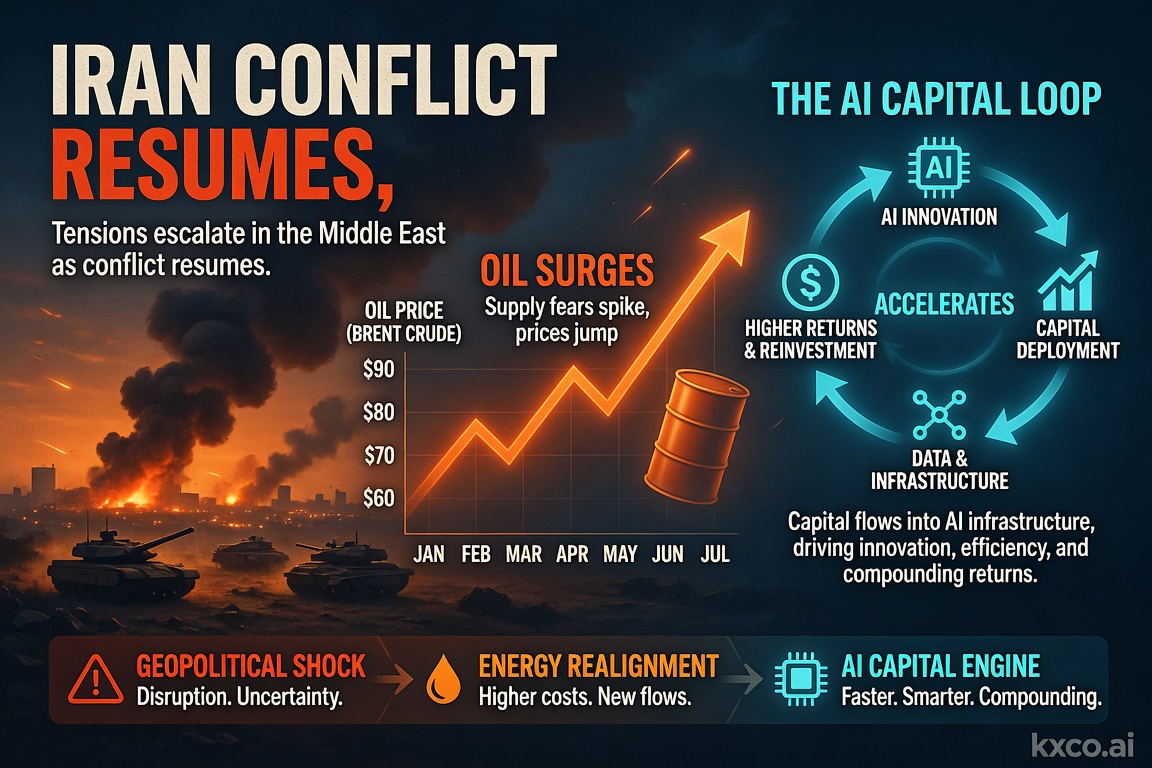
A pivotal week for markets: US strikes on Iran reignite the oil risk premium, June CPI and retail sales test the Fed's rate-cut path, and the $1 trillion AI capital loop keeps driving the tech trade. Full economic calendar plus trading strategies across oil, gold, Bitcoin, FX and AI stocks.
Every story, signed and delivered.
Subscribe to the kxco channel and get the headline, the AI-written key takeaways, and the chain-anchor link the moment we publish. Audio versions and per-ticker subscriptions arrive in the next iteration.