
Chinese Yuan Continues Growth Trajectory in Global Payments
The Chinese currency renminbi (RMB), commonly known as the yuan, has maintained its position as the fourth most active currency for global payments by value, according to a recent report. Released by the Society for Worldwide Interbank Financial (SWIFT), a leading provider of financial messaging services, the report highlights the continued expansion of RMB usage on the international stage.
In February, the RMB accounted for 4 percent of global payments by value, demonstrating its significance in the international financial landscape. Despite a 20.47 percent decrease in RMB payments value compared to January, the currency's resilience is evident, particularly when considering that all payment currencies experienced a 10.37 percent decrease during the same period, as reported by SWIFT.
When examining international payments outside the Eurozone, the RMB maintains its prominence, ranking fifth with a share of 2.78 percent in February. This underscores the currency's growing influence beyond regional boundaries and its increasing adoption in global transactions.
A significant portion of offshore RMB transactions occurs in China's Hong Kong Special Administrative Region, which accounts for 79.9 percent of the market share. Following Hong Kong, other key players in the offshore RMB market include Britain, with a 5.37 percent share, and Singapore, with a 3.39 percent share. These figures indicate the widespread use of RMB in international trade and investment activities, further solidifying its status as a global currency.
The growth in RMB usage reflects China's continued economic expansion and its efforts to promote internationalization of its currency. As China plays an increasingly significant role in global trade and investment, the RMB's importance in facilitating cross-border transactions is expected to further increase in the coming years.
With ongoing advancements in China's financial infrastructure and continued liberalization of its capital markets, the RMB is poised to become an even more integral component of the international monetary system. As such, businesses and financial institutions worldwide are likely to continue embracing the RMB for their cross-border transactions, contributing to its sustained growth and prominence in the global payments landscape.

Understanding the US China AI and Quantum Landscape
AI and quantum are usually reported as a US–China race. The more useful story is two different systems — frontier capital versus open-source scale — entangled through shared chokepoints. Shayne Heffernan maps the landscape with the KXCO AI Sector Ontology, with comparison graphics and the investable names.
Economic Calendar and Trading Strategies for the Week Ahead: July 20–24, 2026
A pivotal week for markets: Iran's closure of the Strait of Hormuz sends crude above $86 and gasoline over $5, while Alphabet, Tesla and Intel earnings test the AI trade. Full economic calendar plus trading strategies across oil, gold, Bitcoin, FX and AI chip stocks.
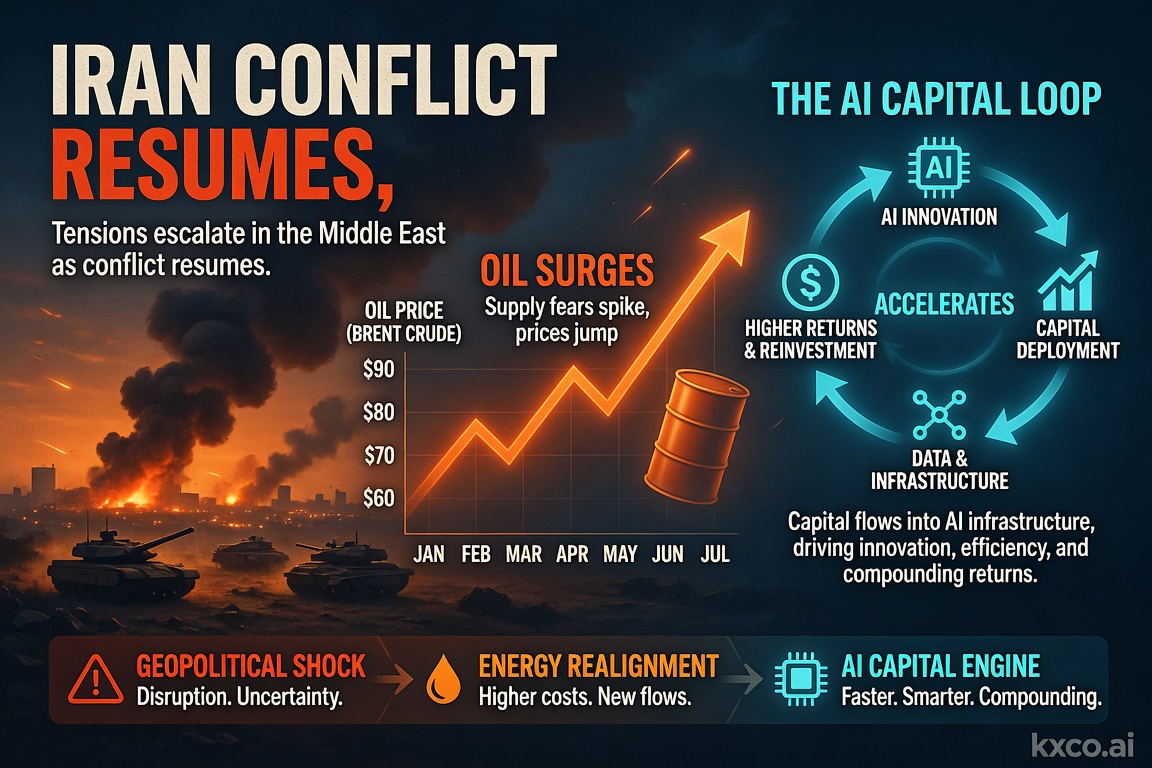
Economic Calendar and Trading Strategies for the Week Ahead: July 14–18, 2026
A pivotal week for markets: US strikes on Iran reignite the oil risk premium, June CPI and retail sales test the Fed's rate-cut path, and the $1 trillion AI capital loop keeps driving the tech trade. Full economic calendar plus trading strategies across oil, gold, Bitcoin, FX and AI stocks.
Economic Calendar and Trading Strategies for July 7–11, 2026
A trader's guide to the week of July 7–11, 2026: the US and China economic calendar, the Fed-pivot test after a soft jobs report, and how to trade Nvidia, SpaceX, Bitcoin, the dollar, gold, silver, AI and quantum. Track every release on Live Trading News.
Every story, signed and delivered.
Subscribe to the kxco channel and get the headline, the AI-written key takeaways, and the chain-anchor link the moment we publish. Audio versions and per-ticker subscriptions arrive in the next iteration.