
China Economic Update
Among hundreds of reform objectives set out by China's ruling Communist Party following a pivotal, long-awaited strategy conference was better protection for private sector rights.
As part of initiatives to boost trust in the private sector, a senior economic official also said the party promised additional steps to open to foreign companies, provide a "transparent and stable" environment for them and safeguard intellectual property.
Deputy director of the general office of the Central Financial and Economic Affairs Commission, Han Wenxiu, said that it was "necessary to create a favorable environment and provide more opportunities for the development of the private sector," in China.
Although some voiced questions regarding their local execution, observers and business owners have welcomed the projected initiatives.
Han said China would better control administrative inspections involving the private sector, support qualified businesses to lead significant technological breakthroughs, and enhance the mechanism for private companies to participate in major national projects in a briefing in Beijing on Friday on the result of the third plenum.
The four-day, closed-door plenary session concluded on Thursday with a statement on a broad spectrum of reform goals to be accomplished over the following five years.
Adopted by Central Committee members headed by President Xi Jinping, the resolution text addresses a broad spectrum of policy issues pertaining to "reforms" and "modernization," with a comprehensive declaration coming next week.
According to Han, confronting head-on a long-standing source of wage disparities, the plenum also witnessed the first clear guarantee from Beijing allowing migrant workers to register their domicile in the cities where they work.
Whether state-owned or private, acts violating the rules of business would draw the "same responsibility, same charges and same punishment," he warned.
According to Tang Fangyu, deputy chairman of the Policy Research Office of the Central Committee, the commitments included among "more than 300 reform goals" embraced at the plenum.
They arise amid low trust in the private sector, where investment fell by 0.4% last year, while in the public sector climbed by about 5%.
Although the development of a law to support the private economy is said to be already under progress, the plenum also helped to shape it.
Director and founding member of Beijing Mugong Law Firm Liu Changsong praised the party's backing of the upcoming law as "an excellent move" and also applauded the promise to stop too much governmental intervention in commercial conflicts.
However, a Beijing-based attorney who has defended more than a dozen lawsuits involving private businesses over the past five years expressed reservations about the law's impact since China's court system is not autonomous.
She remarked, asking anonymity because of the sensitivity of the issue, "even if we manage to draft and pass a very comprehensive law, we will face problems on the enforcement side."
She further pointed out that passing legislation would not alter the inclination toward government agencies or state-owned businesses in terms of corporate conflicts with private businesses.
While labeling a recent drop as "temporary," Han also said that China would keep its "opening-up" policy and defend the rights of international businesses and individuals in the nation and increase the utilization of foreign investment.
The Communist Party of China finishes its strategy conference in front of mounting uncertainty.
Though it said this was "mostly attributable to a high base last year," data from the Ministry of Commerce shows foreign direct investment in China dropped by almost 28% year on year in the January-April period, the steepest drop this century.
China would keep opening sensitive industries including communications, internet, health, and culture to abroad players, Han said, and aim to create a "transparent, stable, and predictable" environment for international companies.
It would also welcome more foreign service, capital, and labor and further defend the "commercial secrets and intellectual property" of foreign corporations so as to "vigorously safeguard the rights and interests of foreign-funded enterprises."
The plenum also decided to make e-payment systems and medical treatment more easily available, therefore facilitating life in China for foreign nationals.
Official figures revealed that more than 14.6 million foreigners visited China in the first half of the year, a rise of more than 152% from a year before. Of them, more than half came using China's enlarged visa-free policy to cover more nations.
Founder of Singapore-based water treatment company Suntar Environmental Co Ltd Lan Weiguang expressed concerns regarding their execution at local government levels notwithstanding the goodwill displayed in the pledges.
"It's great to see the party document offer particular suggestions on how to safeguard private company rights. However, Lan expressed concern that some local cadres will simply use it selectively depending on their local needs when it gets to the local level.
"I hope that the decision of the plenum can be fully implemented everywhere in China so that foreign companies investing in China like us may have peace of mind."
Beijing has also specifically promised to let migrants register their official residence, known as hukou, in the urban areas where they work and to provide them equal social benefits as local residents, so possibly resolving a long-standing problem feeding China's great urban-rural wealth gap.The strict registration system limits migrant workers with hukou registered in their home villages access to the typically better urban public services, while spending most of their time working in cities.
"The plenum decided to develop a system under which people register their hukou in their usual places of residence and enjoy basic public services there," Han remarked.
Over the last years, the government has promised to simplify the integration of China's 297 million migrant workers into metropolitan areas.
But earlier agreements' official language was sometimes imprecise, such "guaranteeing equal rights," and cautious, such "experimenting with a hukou registration system based on people's usual place of residence."
Zheng Linyi, a researcher from the China Academy for Rural Development at Zhejiang University, said the pledge was a “big breakthrough”, signifying that the authorities were “bringing the issue to the agenda”.
"The language suggests that, in terms of easing hukou restrictions, small towns and large cities are getting equal treatment," he remarked.
"But I think there will be some differences in implementation at the local level – major population centres will mainly be open for high-end skilled workers only, or public services would be under too much strain," he remarked.
Government statistics show that although over 66% of China's population lived in cities at the end of last year, only roughly 48% possessed an urban hukou.
The 2030 Compute Landscape: GPUs, Power and the Architecture of Intelligence
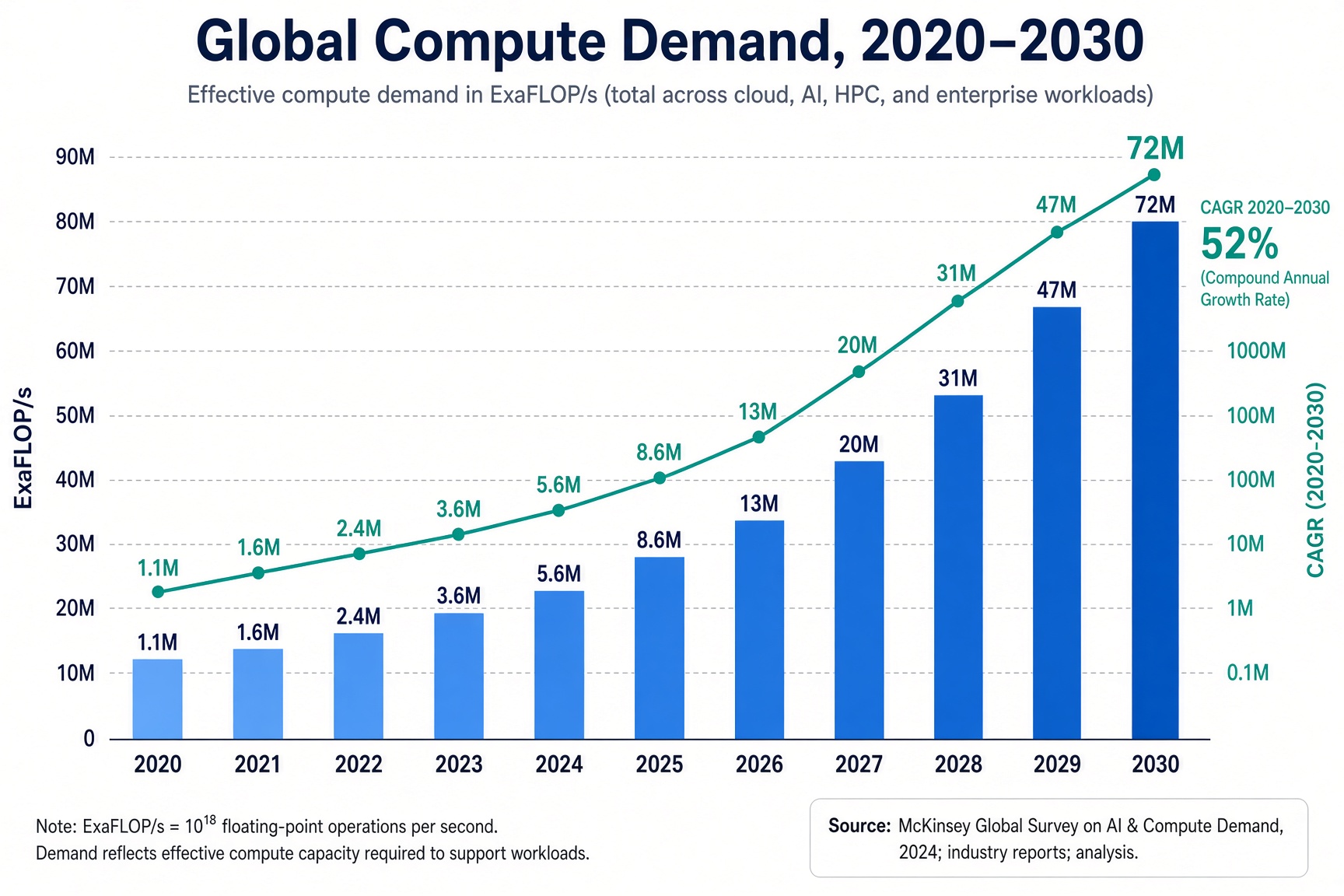
The constraint on AI is no longer ideas or data but compute and the power to run it. Frontier training compute has grown about five times a year since 2020, and the leading AI supercomputer of June 2030 is on course for about 2 million chips and 9 gigawatts. Shayne Heffernan sets out the 2030 arithmetic, the power problem, who has already contracted the gigawatts, and how GPUs, custom ASICs, wafer-scale engines and quantum machines divide the work.

KXCO AI Ontology at 3 Months: What It Called and What Comes Next
On 19 July 2026 the Round Table's AI room published its first Analyst Outlook. To the 16 October 2026 close its 13 names rose 2.6% on an equal weight against 2.1% for QQQ, per StockAnalysis closes, and the six it opened with 35% or more of upside rose 8.6%. This piece lists the six names up more than 5%, the ten names I rate as opportunities now, the month's results in AI and quantum computing, and the official data showing that four in five firms have not yet started using AI.

SpaceX: The Road to 10 Gigawatts
SpaceX did not add an AI business. A company whose processes run on compute built its own computing plant, then built the power to run it. The 10-Q reports 1.4 gigawatts of nameplate compute at 30 June 2026, four leases worth about $41 billion a year and $100 billion of cash. The target is closer to 10 gigawatts than 5 by the end of 2027. This piece sets out the build sequence, the four layers of power in Memphis, and why Terafab is the act after 2027, not the road to it.

Thoughts on Thinking: Take an Art Break
The best way I know to keep complex work in perspective is to stop at intervals and look at something that took the same order of sustained attention under real constraints. The studies now show what that does: a museum visit restored attention where an urban walk did not, judging the beauty of an object raised abstract thinking almost 14 per cent, and artistic film raised originality even in people who felt worse for it. Five works, Leonardo to Holbein, and the non-default decision in each.
Every story, signed and delivered.
Subscribe to the kxco channel and get the headline, the AI-written key takeaways, and the chain-anchor link the moment we publish. Audio versions and per-ticker subscriptions arrive in the next iteration.